
Most “top shoe manufacturers in USA” lists rank factories that will never make a single pair of shoes for your label. New Balance owns five U.S. factories — and uses every one of them for its own sneakers. Red Wing, Allen Edmonds, and Alden run American production lines with waiting lists of their own-brand customers, not empty capacity looking for OEM work. If you’re a buyer searching for US shoe manufacturers that actually take contract and OEM orders, those lists are useless. This one is built differently: we verified five factories that take outside production work, cross-checked every entry against its official website or public contract records, and documented the industry structure that explains why this list is so short.
Here’s the short version: genuine contract manufacturing capacity in the US is thin and skewed toward niches — military dress oxfords in Virginia, private-label sneakers and handbags in New York and Los Angeles. Expect unpublished MOQs, per-pair costs that start where Chinese FOB quotes end, and a domestic industry that now supplies roughly 1% of what Americans wear: roughly 99% of shoes sold in the US are imported, and China alone accounts for about 62% of those imports.
Which US Factories Actually Take Contract and OEM Orders?
Five entries survived verification. Each was confirmed by reading its official website directly or through public contract records — the evidence level for each row tells you what stands behind it.
| # | Factory | Location | Model | Product Focus | MOQ | Evidence |
|---|---|---|---|---|---|---|
| 1 | Capps Shoe Company | Gretna, Virginia | Contract manufacturing for US military (DoD contracts only) | Men’s & women’s dress oxfords, AGSU service shoes | DoD IDIQ contracts; not open to commercial OEM | Official website ✓ + DoD contract records ✓ |
| 2 | Modern Vice | New York City (Garment District) | Private label & footwear development division | Women’s focus; dress, boots, custom work | Not published | Official website ✓ |
| 3 | Shoe Factory Los Angeles | Los Angeles, CA (est. 2008) | Full-package contract manufacturer | Tech packs → lasts → samples → production; footwear + handbags | Not published | Official website ✓ |
| 4 | COMUNITYmade | Los Angeles, CA | Private label manufacturing services (appointment-based) | Premium handmade custom shoes | Not published | Official website ✓ |
| 5 | The/Studio | US-based platform | Private label on pre-developed sneaker platforms | Sneakers, patches & apparel adjacency | Quoted after feasibility review | Official website ✓ |
A few entries deserve a closer look:
Capps Shoe Company is the structural exception that proves the rule. Since 1997 the Virginia company has built its business on US Department of Defense contracts, and it is one of the largest suppliers of military dress oxford shoes — including for the Army Green Service Uniform. The scale is real: a 2019 Navy contract for men’s and women’s dress oxfords drew local news coverage of a $60 million award, and public procurement records list an Air Force IDIQ contract (SPE1C120D1246) with a ceiling above $15 million. But read the model column carefully: DoD contracts only. Capps demonstrates both that US dress-shoe contract manufacturing exists and that it is institutionally tethered to military procurement rather than open to a commercial buyer with a 60-pair trial order.
Modern Vice runs the most explicit private label operation among US footwear brands. The Adoni family behind it has been making shoes in New York since the 1970s — first in Brooklyn, now from a Garment District facility (family-factory history documented by MakersRow) — and its dedicated private label division offers footwear development and production services, staffed by craftsmen the company says have “a minimum of 30 years” making shoes. Women’s footwear is the center of gravity; if your program is men’s classic dress shoes, this is a development partner worth a conversation, not a volume factory.
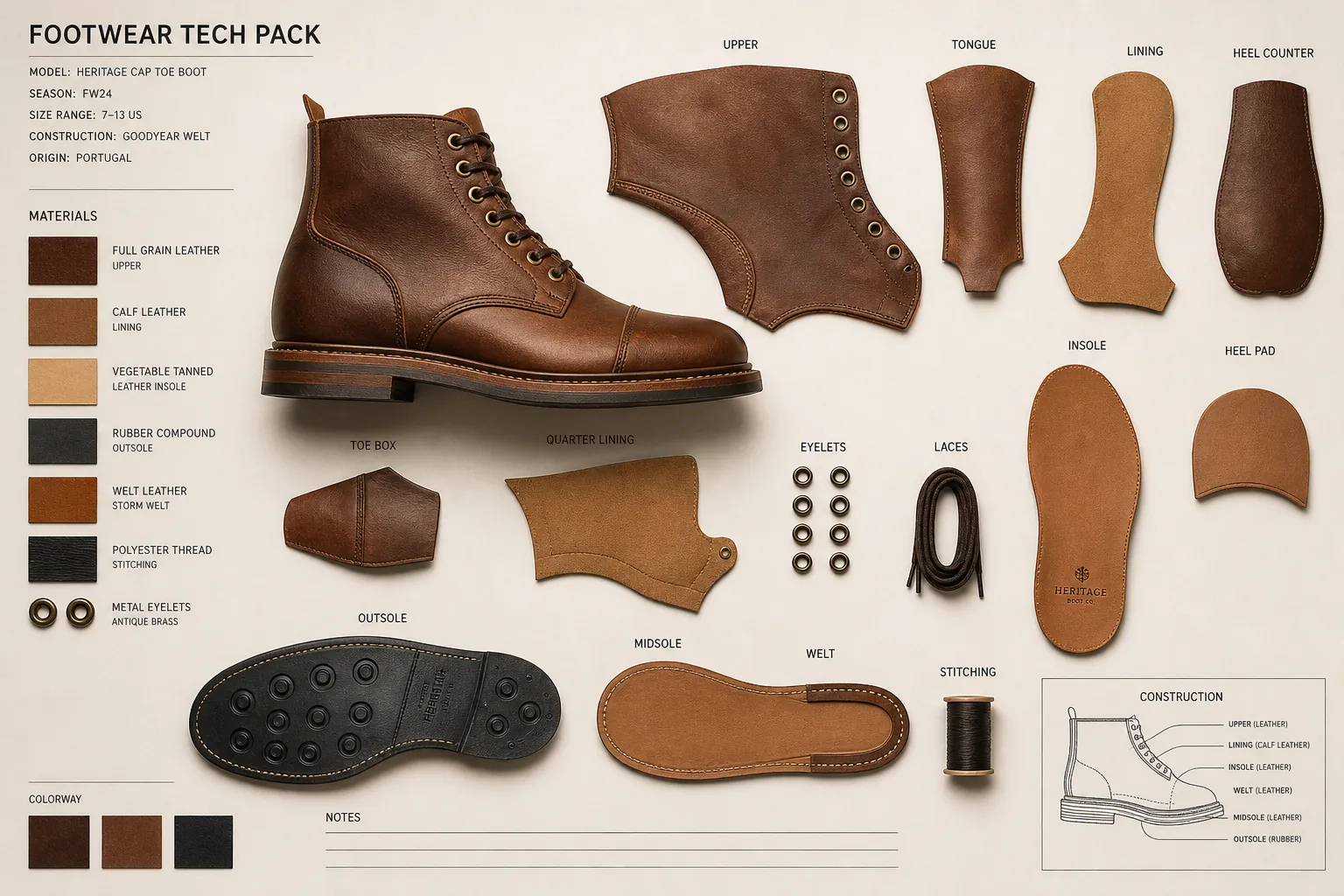
Shoe Factory Los Angeles is the most complete full-package shop we verified: since 2008 it has offered the full chain — tech packs, custom lasts, material sourcing, 3D modeling and printing, heel and sole injection molding, and samples — as individual services or a full package from first sketch to finished product. If you show up with a design and no tech pack, this is the kind of US shop that can build one for you. For the template of what a complete spec package contains, see our footwear tech pack template guide.
COMUNITYmade rounds out the LA cluster with appointment-based private label manufacturing — handmade, premium positioning, and a consultation-gated intake process. Like everything on this list, MOQs are unpublished and negotiated per program.
第一手证据(Source: verification notes, November 2026 — every candidate’s official website read directly; Capps cross-checked against public DoD contract records): 这份名单的核实过程本身就是数据。我们初筛了 9 家候选,逐家打开官网核对「是否承接第三方代工」。4 家被剔除——Italian Shoe Factory(名字带 Italy 但官网自述运营地是 Dubai,不占美国席位,且是「shoe manufacturers USA」搜索结果的常见污染源)、Parkhurst Boots(加拿大安省工厂,常被混进美国名单)、Shoe Factory LA 之外两家 LA 传闻级名字(Lotas、Soleboy——Reddit 社区提及但无可验证官网,不满足官网直核标准)。另一家候选官网关键词扫描零命中(无可验证的第三方代工证据),一并剔除。另需说明:New Balance、Red Wing、Allen Edmonds、Alden 等自有品牌工厂官网确认纯自有品牌经营、无任何代工服务页——它们的存在恰恰说明:在美国,名牌工厂 ≠ 可用产能。
The Famous US Shoe Factories — and Why They Won’t Take Your Order
The factories buyers actually know by name are brands, not contract manufacturers. Here’s the list everyone else passes off as “US shoe manufacturers,” with the honest model column filled in:
| Brand | Location | What they make | Contract manufacturing? |
|---|---|---|---|
| New Balance | Five US factories (MA & ME) | Athletic sneakers (Made in USA line) | No — own-brand only |
| Allen Edmonds | Port Washington, Wisconsin | Goodyear-welted dress shoes since 1922 | No — own-brand only |
| Alden | Middleboro, Massachusetts | Dress shoes, shell cordovan specialist | No — own-brand only |
| Red Wing Shoes | Red Wing, Minnesota | Work boots since 1905 | No — own-brand only |
| Rancourt & Co. | Lewiston, Maine | Handsewn casual & dress casual | No — own-brand only |
| SAS | San Antonio, Texas | Comfort shoes | No — own-brand only |
| Danner | Portland, Oregon | Hiking & work boots | No — own-brand only |
| Whites Boots | Spokane, Washington | Pac boots, work boots | No — own-brand only |
| Wesco | Portland, Oregon | Work boots | No — own-brand only |
| Thorogood (Weinbrenner) | Merrill, Wisconsin | Work boots | No — own-brand only |
Two of them deserve context rather than a dismissive one-liner. New Balance is the structural anomaly: five US factories (per industry coverage of the surviving American shoe factories), a “Made in USA” product line, and a domestic supply chain it keeps for its own volume. Allen Edmonds has been Goodyear-welting dress shoes in Wisconsin since 1922 — its own site states the heritage openly — and its capacity serves its own waiting lists. If you want an Allen Edmonds-style shoe with your logo, the realistic path is a factory that offers the same construction at OEM terms — like our own Goodyear-welted private label programs — not the Wisconsin factory itself.
第一手证据(Source: Google SERP scan, November 2026): 为了验证「美国男装正装皮鞋商业代工真空」,我们把「mens leather dress shoes manufacturer USA private label」类查询的 Google 前若干结果逐条过了一遍:命中结果由三类构成——海外工厂页(Dubai 借名的 Italian Shoe Factory、中国工厂页)、自有品牌名单文(Alden/Allen Edmonds 当作 manufacturers 列出)、以及我们自己的 private label 榜单页。没有一个美国本土正装皮鞋合同制造商出现在结果里。这个真空是结构性的:正装皮鞋的模具、楦型库和沿条工艺产线投入巨大,而美国仅存的小规模产能集中在军品(Capps)和运动/休闲小批(LA/NYC 定制坊)。买家拿着「美国正装鞋代工厂」的预期进市场,会撞上的不是工厂,是目录站和海外厂。
How Many Shoe Factories Are Left in the USA?
The industry structure explains everything above. According to NPR’s industry retrospective, only around 200 footwear factories remained in the United States as of 2019 — many of them serving military or safety-footwear niches (NPR). The American Apparel & Footwear Association’s 2026 ShoeStats report shows roughly 96.9%–99% of shoes sold in the US are imported (the range spans AAFA’s combined apparel-and-footwear figure and earlier footwear-only counts such as USITC’s), with China accounting for about 61.9% of US shoe imports (AAFA ShoeStats). IBISWorld counts around a thousand businesses in the broader “shoe & footwear manufacturing” category, but that figure includes small specialty and repair-adjacent operations, not all of them factories.
What’s left onshore clusters into four groups:
- Military and safety footwear (Capps, Belleville, and peers) — DoD contracts keep some dress-oxford and boot lines alive, often under Berry Amendment domestic-source rules.
- Own-brand heritage factories (the ten-brand table above) — capacity locked to their own labels.
- Urban custom workshops (LA and NYC) — small-batch, high-touch, appointment-based; genuine but tiny.
- Directory/platform entries (The/Studio-style operations) — marketing platforms with factory networks, not factories themselves.
第一手证据(Source: Wincheer sales team RFQ records, 2025–2026): 作为年产能 500,000+ 双的中国男鞋皮鞋制造商(est. 2007,工厂位于广东江门),我们的销售团队在处理美国买家 RFQ 时反复看到三类高频问题:一是关税结构(HTS 6403 皮面鞋类的税率叠加与 Chapter 99 附加税适用);二是交期与打样轮次(2-3 轮打样、30-45 天量产交期的真实性确认);三是合规与认证(REACH 对欧盟订单的适用性、美国订单的 CPSIA/加州 Prop 65 相关咨询)。这三类问题在美国本土采购语境下几乎不存在——因为美国工厂对商业买家的报价里根本没有「FOB $25-40」这个数量级的存在。美国买家真正要决定的不是「美国工厂贵不贵」,而是「Made in USA 标签的零售溢价能否覆盖 5-10 倍的产地成本差」。
What Does It Cost to Have Shoes Made in the USA?
Published contract pricing is rare. What’s knowable: small-batch urban workshops quote per-pair costs that start where Chinese FOB quotes end — custom programs in LA and NYC routinely land well above $100 per pair (in our RFQ experience, roughly 5–10x the Chinese FOB baseline), with sneaker platforms quoting after feasibility review. Against $25–40 FOB for equivalent-volume Chinese OEM production, the multiple is structural, not negotiable: US labor costs, domestic leather sourcing, and the absence of clustered supply chains (no Montegranaro-style district where lasts, soles, welts, and eyelets are all one town away) mean per-pair costs cannot converge with Chinese program pricing at any realistic volume.
The honest framing mirrors our Italy guide: you are not paying 5–10x for objectively better shoes — you are paying for a “Made in USA” country-of-origin label with specific retail channels where it matters, plus labor that genuinely costs more. The FTC’s Made in USA Labeling Rule (16 CFR Part 323) makes unqualified “Made in USA” claims on labels enforceable with civil penalties, and the underlying standard requires that the product be “all or virtually all” US-made — a US-assembled shoe with imported uppers cannot carry the unqualified label. If your brand math needs that label, budget for it consciously; if it doesn’t, the calculation usually favors a China OEM program with a US warehouse strategy.
What MOQs Do US Factories Require?
Here’s what almost no list will tell you plainly: none of the five verified factories publishes an MOQ. The pattern across all five: feasibility review first, program-specific quotes second. The/Studio evaluates tooling investment, unit economics, and MOQs before prototyping begins; COMUNITYmade gates intake behind a paid consultation; Modern Vice and Shoe Factory LA quote after design review. Expect per-program MOQs in the hundreds of pairs minimum for full development programs, and higher unit costs that make sub-100-pair trials economically painful on the US side.
If your program needs a genuine low-MOQ entry point, that’s exactly the gap the Chinese OEM market fills: our low-MOQ leather shoe manufacturer guide documents how 60-pair mixed-style programs work — MOQs that US shops, in our verification, would not quote at all.
How Do You Vet a US Contract Manufacturer?
Verification standards don’t change with geography — the six-step checklist applies whether the factory is in Virginia or Jiangmen:
- Confirm the legal entity. Our own screening caught a Dubai-registered company using an Italian name and a Canadian factory routinely mixed into US lists. Ask for the legal entity name and state of registration.
- Confirm third-party production explicitly. “Manufacturer” in the US often means “makes its own brand.” You want a dedicated private label or contract manufacturing page with a named division — like Modern Vice’s private label division — not a brand site with a “custom” button.
- Sample before you scale. Prototyping capability is the real test. Shoe Factory LA’s willingness to sell tech packs, lasts, and 3D-printed prototypes as standalone services is what full-package capability looks like.
- Agree the inspection regime in writing. Pre-shipment inspection under an agreed AQL level applies at any origin; our AQL guide covers the sampling math.
- Pin down compliance for your destination market. US-made goods sold in the US skip import duties — that’s the point — but US-bound imports need HTS classification and duty planning (our US tariff guide breaks down the stack).
- Verify construction claims. “Goodyear welted” should mean a stitched welt you can see and press; our construction comparison guide gives you the inspector’s checklist.
USA or China: Which Sourcing Route Fits Your Brand?
You’ve seen the trade-off throughout this guide. Here it is as a decision table — the same framework we walk through with US buyers choosing between onshore development partners and our Jiangmen production lines:
| Dimension | US contract manufacturing | Chinese OEM (Wincheer profile) |
|---|---|---|
| FOB-equivalent cost per pair | Well above $100 (5–10x Chinese FOB per RFQ records) | $25–40 |
| MOQ posture | Unpublished; quoted per program after feasibility | 60 pairs, mixed styles |
| Capacity profile | Niches: military (Capps), urban custom (LA/NYC) | Production lines, 500,000+ pairs/year |
| Country-of-origin label | “Made in USA” — FTC-gated, retail premium in domestic channels | “Made in China” — neutral in wholesale/volume channels |
| Import duty | None (domestic) | Per HTS 6403 stack + Chapter 99 measures |
| Best for | Domestic premium brands, government/EDA programs, origin-driven retail | Scaling brands, wholesale programs, price-led retail |
One structural signal worth factoring in: the surviving US factories are consolidation targets, not growth stories — Caleres-owned Allen Edmonds, brand-owned capacity locked to house labels, and DoD-tethered lines like Capps. Onshore capacity for a commercial buyer is not expanding; if you need it, plan lead times accordingly. And if you’re mapping the full origin landscape beyond this US-vs-China comparison, our private label manufacturer regional guide covers the by-region picture including Vietnam, India, and Turkey.
FAQ: Sourcing From US Shoe Manufacturers
Q: Who are the top shoe manufacturers in the USA that accept OEM orders?
A: The verified shortlist is short by design: Capps Shoe Company (Virginia, military dress oxfords, DoD contracts only), Modern Vice (NYC private label division), Shoe Factory Los Angeles (full-package contract manufacturing since 2008), COMUNITYmade (LA private label, appointment-based), and The/Studio (sneaker private label platform). Famous factory-owning brands — New Balance, Red Wing, Allen Edmonds, Alden — do not take outside OEM orders.
Q: Do New Balance’s US factories make shoes for other brands?
A: No. New Balance operates five US factories, and their capacity is dedicated to the company’s own “Made in USA” sneaker lines. The same applies to Red Wing, Allen Edmonds, Alden, and other heritage brands — their sites describe own-brand production only.
Q: How much does it cost to have shoes made in the USA?
A: For small-batch custom work in the LA/NYC workshops, expect well above $100 per pair — our RFQ records put custom US programs at roughly 5–10x the $25–40 Chinese FOB baseline, depending on construction and materials. The gap is structural (US labor and no clustered supply chain), not a negotiation gap.
Q: How many shoe factories are left in the USA?
A: Around 200 footwear factories remained as of NPR’s 2019 industry retrospective, many serving military or safety niches; roughly 97–99% of shoes sold in the US are imported per AAFA statistics. Broader directory counts that include specialty workshops run to about a thousand businesses, but they are not all factories.
Q: Is “Made in USA” labeling regulated?
A: Yes. The FTC’s Made in USA standard requires that an unqualified claim mean the product is “all or virtually all” made in the US — imported uppers assembled domestically cannot carry the unqualified claim, and qualified claims need explicit disclosure.
The Bottom Line
The US offers something real: an FTC-gated “Made in USA” label with genuine retail power in domestic channels, plus military-grade dress-shoe capability that survives on DoD contracts. The five factories above are real, verified, and — within their niches — take outside work, which already puts this list ahead of most of what ranks for this search.
But run the math with open eyes. A small-batch US quote at several multiples of the $25–40 Chinese FOB is not a rounding error — at 60-pair MOQs it’s the difference between a funded brand and a stalled one. At Wincheer Shoes Co., Ltd., we’ve run men’s leather shoe production lines in Jiangmen, Guangdong since 2007 — 500,000+ pairs a year, Goodyear and blake construction, 60-pair MOQs, and CE/REACH-certified compliance for EU and US buyers. Many of our US clients use exactly the dual-origin strategy described above: onshore custom capsules for the domestic story, offshore volume for the core business. Request a quote and put our numbers next to any US offer you’re holding.
Sources
- NPR — Why the American Shoe Disappeared (retrieved 2026-11-06)
- AAFA — ShoeStats & ApparelStats 2026 report (retrieved 2026-11-06)
- WWD/Footwear News — How a Small Group of U.S. Shoe Factories Survive (retrieved 2026-11-06)
- Federal Register — Made in USA Labeling Rule, 16 CFR Part 323 (retrieved 2026-11-06)
- WSET — Capps Shoe Company $60M Navy contract (retrieved 2026-11-06)
- HigherGov — Contract SPE1C120D1246 (Capps Shoe Company) (retrieved 2026-11-06)
- MakersRow — American Made Shoes In The Garment District: Meet Modern Vice (retrieved 2026-11-06)
- Official websites verified directly: Modern Vice, Shoe Factory Los Angeles, COMUNITYmade, The/Studio (retrieved 2026-11-06)