
TL;DR
T/T (wire transfer) is most common: 30-50% deposit, balance before shipment. L/C (letter of credit) offers highest security but costs 2-5% + bank fees. Alibaba Trade Assurance is free but limits control. For first orders, use 30-50% deposit + balance against inspection. Wincheer Shoes accommodates T/T and L/C arrangements.
Introduction
Payment term selection represents one of the most consequential decisions in international B2B leather shoe sourcing. The method chosen affects cash flow, risk exposure, operational complexity, and ultimately the sustainability of buyer-manufacturer relationships. Too much risk protection strains relationships and limits competitive advantage; too little exposes buyers to potentially catastrophic losses.
The global footwear trade involves billions of dollars annually, with payment disputes representing a significant portion of international trade conflicts. Industry data indicates that payment-related issues account for approximately 18% of B2B footwear disputes, with average disputed amounts exceeding $45,000 per case. Understanding payment mechanics enables buyers to structure arrangements that protect all parties while facilitating efficient trade.
This guide provides comprehensive analysis of payment methods available for B2B leather shoe orders, with practical guidance on selection criteria, implementation procedures, and risk management strategies.
Table of Contents
- Payment Method Overview
- Telegraphic Transfer (T/T)
- Letter of Credit (L/C)
- Alibaba Trade Assurance
- PayPal and Digital Payment Platforms
- Mixed and Progressive Payment Structures
- Selection Criteria Framework
- Implementation Best Practices
- FAQ
- Conclusion
Payment Method Overview
Available Payment Methods for B2B Footwear
| Payment Method | Protection Level | Cost | Complexity | Relationship Impact | Best For |
|---|---|---|---|---|---|
| T/T (30/70) | Moderate | Low | Low | Positive | Established relationships |
| T/T (100% Advance) | Low | Low | Low | Neutral | First orders, small values |
| L/C (Sight) | High | Moderate | High | Neutral | High-value orders, new suppliers |
| L/C (Usance) | High | Moderate-High | High | Neutral | Large orders, financing needs |
| Alibaba Trade Assurance | Moderate-High | Low-Moderate | Low | Positive | Alibaba platform transactions |
| PayPal Business | Moderate | Moderate | Low | Positive | Small orders, testing |
| D/P (Documents Against Payment) | Moderate | Low | Moderate | Neutral | Mid-value orders |
Cost Comparison by Order Value
Total payment costs vary significantly by method and order value:
| Order Value | T/T Total Cost | L/C Total Cost | Trade Assurance | PayPal |
|---|---|---|---|---|
| $5,000 | 0.1% ($5) | 1.5% ($75) + $300 flat | 5% ($250) | 3.5% ($175) |
| $25,000 | 0.05% ($12.50) | 1.0% ($250) + $300 flat | 3% ($750) | 2.9% ($725) |
| $100,000 | 0.02% ($20) | 0.8% ($800) + $300 flat | 2% ($2,000) | N/A (limit) |
| $500,000 | Flat fee negotiation | 0.5% ($2,500) + flat | Negotiated | N/A |
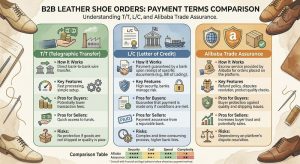 |
Telegraphic Transfer (T/T)
How T/T Works in Practice
Telegraphic Transfer, also called wire transfer, involves buyer instructing their bank to transfer funds directly to manufacturer’s bank account. The process:
- Buyer and manufacturer agree on payment terms (typically 30% deposit, 70% balance before shipment)
- Buyer sends deposit upon order confirmation
- Manufacturer begins production
- Manufacturer provides shipping documentation
- Buyer verifies documentation and instructs bank to transfer balance
- Manufacturer receives funds and releases shipping documents
T/T Advantages for B2B Footwear
Low transaction costs: Bank wire fees typically range from $15-50 per transaction regardless of amount, representing minimal percentage cost for orders above $10,000.
Speed: Funds typically transfer within 2-5 business days domestically, 5-7 days internationally. Faster than documentary collections and most L/C structures.
Simplicity: Straightforward process requiring only bank account information from both parties. No specialized documentation or procedures beyond standard international wire protocols.
Relationship building: Progressive payment structure (deposit-production-balance) builds trust as manufacturer demonstrates delivery capability before receiving full payment.
T/T Risks and Mitigations
Buyer exposure to non-delivery: Manufacturer receiving full payment before shipment bears delivery risk. Mitigation: never pay 100% advance unless order value warrants minimal risk, maintain 30% hold until shipping documentation verification.
Manufacturer exposure to non-payment: Balance payments not received after shipment create collection difficulty. Mitigation: manufacturer controls document release until balance payment confirmed.
Documentation gaps: Wire transfers provide no inherent documentation verification. Mitigation: require comprehensive shipping documentation review before initiating balance payment.
Bank errors and delays: International wires occasionally experience delays or errors outside either party’s control. Mitigation: build timeline flexibility into production schedules.
Recommended T/T Structures for Leather Shoes
First Order Structure:
- 30% deposit upon order confirmation
- 70% balance payment against shipping documents via email copies
- Full release of documents upon payment confirmation
Established Relationship Structure:
- 30% deposit upon order confirmation
- 20% payment upon production completion notification with photo evidence
- 50% balance before original documents release
Volume Order Structure:
- 20% deposit per order within annual framework agreement
- Monthly settlement for delivered orders against accepted quantities
- Trueing up within 15 days of month-end
Letter of Credit (L/C)
L/C Fundamentals
A Letter of Credit is a bank’s conditional payment guarantee substituting bank credit for buyer credit. The issuing bank commits to pay the beneficiary (manufacturer) upon presentation of compliant documents meeting specified terms.
L/C Types for Footwear Orders
Sight L/C: Payment made immediately upon document presentation, regardless of shipment timing. Manufacturer receives funds faster; buyer has inspection opportunity before payment.
Usance L/C: Payment deferred for specified period (typically 30, 60, or 90 days) after document presentation. Extends buyer cash flow; manufacturer receives payment commitment but must wait for actual funds.
Transferable L/C: Enables middlemen to transfer L/C benefits to actual manufacturers. Useful for trading companies; adds complexity for direct manufacturers.
Revolving L/C: Recurring L/C structure for regular shipment programs. Reduces per-transaction costs for established supply relationships.
L/C Document Requirements
Standard documentary requirements for leather shoe L/Cs:
- Signed commercial invoice (3 originals, 3 copies)
- Packing list
- Full set of clean on-board ocean bills of lading (or air waybill)
- Certificate of origin
- Insurance certificate (if CIF terms)
- Quality inspection certificate (when specified)
- Leather content declaration (for EU/UK market compliance)
L/C Costs Breakdown
Letter of Credit costs vary by bank and transaction:
| Cost Component | Typical Range | Who Pays |
|---|---|---|
| Issuance fee | 0.15-0.5% of L/C value | Buyer |
| Amendment fee | $50-150 per amendment | Varies |
| Confirmation fee | 0.2-0.5% (if confirmed) | Buyer |
| Negotiation fee | 0.1-0.25% | Beneficiary (manufacturer) |
| Courier/handling | $30-80 per document set | Buyer |
| Typical Total | 0.5-1.5% of L/C value |
L/C Advantages
High protection level: Bank payment commitment replaces buyer credit risk. Manufacturer receives guaranteed payment; buyer receives guaranteed documentation before payment obligation triggers.
Document control: Specified documents must be presented and verified before payment, ensuring proper documentation accompanies shipments.
Financing capability: Usance L/C structures enable buyer financing through extended payment terms while maintaining manufacturer payment security.
Dispute resolution framework: L/C terms provide objective criteria for acceptance or rejection, reducing subjective disputes.
L/C Disadvantages
Complexity: L/C procedures require specialized knowledge. Document discrepancies—however minor—can prevent payment.
Cost: Transaction costs exceed simple wire transfers, particularly for smaller orders where percentage fees accumulate.
Timeline inflexibility: L/C amendments require time and fees. Production or shipping schedule changes create expensive amendment requirements.
Relationship impact: Formal L/C procedures can feel adversarial compared to simpler payment arrangements.
Alibaba Trade Assurance
Platform Overview
Alibaba Trade Assurance provides payment protection for transactions conducted through Alibaba’s platform. The service offers buyer protection for orders where manufacturers fail to deliver products matching agreed specifications or shipping timelines.
How Trade Assurance Works
- Buyer places order through Alibaba platform with Trade Assurance selected
- Buyer makes payment to Alibaba’s escrow account
- Manufacturer receives notification and begins production
- Buyer verifies shipment and documentation
- Alibaba releases funds to manufacturer upon buyer confirmation or automatic release timeline
Trade Assurance Coverage
Protected elements:
- Product quality matching order specifications
- On-time shipment within agreed timeline
- Correct quantity delivery
- Accurate documentation provision
Claim submission timeline:
- Quality claims: within 15 days of delivery
- Non-delivery: automatic protection after extended timeline
- Dispute resolution: Alibaba mediation process
Trade Assurance Limitations
Platform limitation: Trade Assurance only available for Alibaba platform transactions. Manufacturers outside Alibaba platform cannot utilize this protection.
Percentage coverage: Coverage limited to order value placed through platform. Additional costs (shipping, duties, testing) not covered.
Definition disputes: “Substantial matching” determinations can favor manufacturers in spec interpretation disputes. Careful specification documentation required.
Limited for large orders: Percentage fees accumulate significantly for large orders, making alternative arrangements more economical.
PayPal and Digital Payment Platforms
PayPal Business for B2B Footwear
PayPal offers buyer and seller protection for eligible transactions:
Advantages:
- Strong buyer protection (buyer can dispute charges)
- Widely accepted and recognized
- Relatively quick settlement
- Accessible for smaller orders
Disadvantages:
- Percentage fees (2.9% + $0.30 per transaction) make it economical only for smaller orders
- Not designed for large B2B transactions
- Chargeback risk for manufacturers
- Currency conversion fees for international transactions
Practical application: PayPal most appropriate for sample orders, development orders under $5,000, or testing initial manufacturer relationships before establishing T/T arrangements.
Other Digital Platforms
Pingpong, Payoneer, WorldFirst: These platforms offer B2B payment services optimized for China trade, often with better exchange rates and lower fees than traditional banks for USD/CNY transactions.
Wirex, Revolut Business: Emerging platforms offering competitive international transfer rates, useful for regular smaller payments to Chinese manufacturers.
Mixed and Progressive Payment Structures
Structure Design Principles
Optimal payment structures balance risk management, cash flow efficiency, and relationship development:
Risk allocation: Each payment milestone should correspond to risk assumption. Party bearing risk should receive payment at that milestone.
Trust building: Progressive payment tied to demonstrated performance builds manufacturer credibility and buyer confidence over time.
Cash flow optimization: Buyers should minimize free credit to manufacturers while avoiding payment terms that strain manufacturer cash flow.
Recommended Progressive Structures
Structure A: Standard Production Progression
| Milestone | Percentage | Trigger | Risk Allocation |
|---|---|---|---|
| Order Confirmation | 30% | Contract signed | Buyer funds production startup |
| Sample Approval | 20% | Approved samples received | Buyer invests in production preparation |
| Production Complete | 30% | Notification + photos | Manufacturer completed production |
| Final Delivery | 20% | Documents verified | Buyer inspects before final payment |
Structure B: Documentation-Based Progression
| Milestone | Percentage | Trigger | Risk Allocation |
|---|---|---|---|
| Order Confirmation | 30% | Contract signed | Buyer funds material procurement |
| Shipping Documentation | 40% | Copies of B/L presented | Buyer pays before shipment |
| Delivery Confirmation | 30% | Goods received, quantity verified | Buyer pays upon delivery |
Structure C: Performance-Based Progression
| Milestone | Percentage | Trigger | Risk Allocation |
|---|---|---|---|
| Order Confirmation | 25% | Contract signed | Initial investment |
| Quality Inspection Passed | 35% | Third-party inspection report | Production quality confirmed |
| Delivery Documentation | 40% | Original documents received | Buyer accepts delivery |
Selection Criteria Framework
Method Selection by Order Characteristics
Choose T/T when:
- Order value $10,000-$100,000
- Manufacturer verified through previous orders or audit
- Standard product specifications reducing delivery dispute risk
- Established or developing relationship
- Production timeline allows progressive payment
Choose L/C when:
- Order value exceeds $100,000
- New manufacturer relationship without established trust
- Complex specifications requiring document verification
- Buyer has established credit facilities supporting L/C issuance
- Strict compliance documentation required for final market
Choose Trade Assurance when:
- Transacting through Alibaba platform
- Order value under $50,000
- Standard product specifications
- First transaction with new manufacturer
- Buyer values claim resolution platform over direct negotiation
Choose PayPal when:
- Order value under $5,000
- Sample or development orders
- Testing new products or manufacturers
- Buyer values chargeback protection
Manufacturer Profile Considerations
| Manufacturer Profile | Recommended Payment | Rationale |
|---|---|---|
| New, unverified | L/C or Trade Assurance | Risk reduction essential |
| Verified, <3 orders | T/T (50/50) or Trade Assurance | Building trust with measured risk |
| Established, 3-10 orders | T/T (30/70) | Demonstrated reliability warrants reduced protection |
| Strategic partner, 10+ orders | T/T (30/70) or open terms | Relationship warrants minimal payment administration |
Implementation Best Practices
Documentation Requirements
Regardless of payment method, maintain comprehensive documentation:
Pre-Production:
- Signed purchase contract with detailed specifications
- Payment receipts documenting deposit
- Sample approval sign-off
- Production schedule with milestones
Pre-Shipment:
- Quality inspection report
- Packing list confirmation
- Shipping schedule notification
- Document copies for review
Post-Shipment:
- Original document receipt
- Delivery confirmation
- Dispute notification (if applicable)
- Final payment confirmation
Bank Relationship Management
Establish international banking relationships before needed: Pre-qualify banks capable of L/C issuance and international wire processing. Chinese-correspondent bank relationships reduce transfer fees and processing time.
Negotiate fee structures: For regular buyers, banks offer fee negotiations on both L/C issuance and wire transfer costs. Volume commitments unlock better pricing.
Understand settlement times: Different payment methods and banks involve different settlement timelines. Build appropriate timeline buffers into cash flow projections.
Dispute Prevention and Resolution
Clear specification documentation: Payment disputes typically stem from specification ambiguity. Comprehensive product specifications, approved samples, and clear quality criteria prevent most disputes.
Prompt communication: Problems identified immediately allow resolution before escalation. Establish communication protocols for quality or timeline concerns.
Document everything: All significant communications should be documented in writing. Email provides sufficient documentation record for most B2B transactions.
Escalation procedures: Establish manufacturer contact hierarchy for dispute escalation before disputes occur.
FAQ
What percentage should buyers pay as deposit for first orders?
First orders typically warrant 30-50% deposits to demonstrate buyer commitment and fund manufacturer production startup costs. Deposits below 30% may indicate lack of buyer commitment; deposits above 50% transfer excessive risk to buyers. The appropriate level depends on manufacturer verification, order specifications complexity, and relationship history.
Is L/C worth the cost for mid-sized orders ($50,000-$100,000)?
For orders in this range, cost-benefit analysis typically favors T/T with documented progressive payments. L/C costs of $500-1,500 plus administrative complexity often exceed the protection value for orders where manufacturers have been verified. However, if manufacturer verification is limited or specifications are complex, L/C protection may justify the additional cost.
How does Alibaba Trade Assurance compare to traditional payment methods?
Trade Assurance offers convenience and platform-based dispute resolution but with limitations compared to traditional methods. It works well for platform transactions with new manufacturers where buyer values convenience over cost optimization. For established relationships and larger orders, traditional T/T or L/C provide better cost efficiency and equal or superior protection.
What happens if a manufacturer claims payment but buyer has not received goods?
Dispute resolution procedures depend on payment method. T/T disputes require direct negotiation; bank involvement limited. L/C disputes involve documentary presentation; discrepancies resolved by specified terms. Trade Assurance disputes go through Alibaba mediation. Appropriate documentation (shipping tracking, inspection reports) determines resolution outcomes. Prevention through careful manufacturer verification is more effective than dispute resolution.
How can buyers protect against currency fluctuation in large orders?
Large orders spanning months between order placement and payment create currency exposure. Forward contracts lock exchange rates for future payments. Some banks offer currency options for protection with upside potential. Building currency contingency into pricing (with adjustment clauses) shares fluctuation risk with manufacturers.
What payment terms do established B2B footwear buyers typically request?
Established buyers with verified manufacturers typically negotiate T/T arrangements with 30% deposits and 70% balance payments before shipment, or against shipping documents. Terms improve as relationships develop: 30/70 becomes 20/80, then potentially net-30 or open terms for the highest-volume buyers. Improvement tracks demonstrated delivery reliability over multiple successful orders.
Conclusion
Payment term selection balances multiple factors: protection level, transaction cost, administrative complexity, and relationship impact. No single payment method suits all situations. The sophisticated B2B buyer maintains flexibility to structure arrangements appropriate to specific order characteristics and relationship stages.
The key principle: match payment protection to actual risk exposure. Over-protection wastes cost; under-protection invites disaster. Systematic evaluation of manufacturer reliability, order complexity, and transaction value enables optimal payment structure selection.
Investment in payment structure optimization pays returns through reduced dispute rates, improved manufacturer relationships, and optimized cash flow management. As relationships develop and trust builds, payment terms can evolve to benefit both parties through reduced administrative cost and improved cash positioning.
Red Flags When Sourcing Leather Shoes from China: A Buyer’s Checklist
Negotiating with Chinese Leather Shoe Manufacturers: Wincheer Shoes’ Strategic Guide
About Wincheer Shoes
Wincheer is a professional leather shoe manufacturer based in Shanghai, China. Established in 2007, we specialize in OEM/ODM manufacturing of men’s leather shoes including Oxford, Derby, Loafer, Monk, and Chelsea styles. With experience dating back to 2007 and CE/REACH/RoHS certifications, we export quality footwear to global markets at competitive prices ($25-$40/pair).