
TL;DR
China’s major footwear trade shows include Canton Fair (Guangzhou, bi-annual), Shanghai Shoe Expo (annual), and CIFF (Guangzhou/Dongguan). Success requires 3-6 months preparation, focused manufacturer targeting, and systematic follow-up within 72 hours. Budget $5,000-15,000 per show for international buyers. Wincheer Shoes’ long-standing trade show experience informs this comprehensive guide.
Introduction
Trade shows remain one of the most effective channels for B2B footwear sourcing, offering opportunities to evaluate manufacturers, compare capabilities, negotiate terms, and build relationships that online communication cannot replicate. China hosts several major footwear trade shows throughout the year, each with distinct characteristics that serve different buyer needs.
Yet many buyers squander trade show opportunities through inadequate preparation, unfocused showroom wandering, and failure to convert show conversations into lasting supplier relationships. The difference between productive and disappointing trade show experiences often lies not in the buyers’ budgets or industry connections, but in their strategic preparation and execution.
Wincheer Shoes has participated in China’s footwear trade shows for years, both as exhibitor and as attendee during market research visits. This guide shares our accumulated expertise on maximizing trade show value—from pre-show planning through post-show relationship development.
Whether you are attending your first China footwear trade show or seeking to improve your established show strategy, this guide provides actionable frameworks for better outcomes.
Table of Contents
- Major China Footwear Trade Shows
- Pre-Show Preparation Framework
- On-Site Show Strategy
- Manufacturer Evaluation at Shows
- Negotiation Tactics for Trade Shows
- Post-Show Follow-Up Excellence
- Trade Show Cost Analysis
- FAQ: Trade Show Questions
Major China Footwear Trade Shows
Annual Calendar Overview
China’s footwear trade show calendar spans the full year, with major shows distributed to serve different buying seasons:
| Trade Show | Location | Typical Dates | Focus | Buyer Profile |
|---|---|---|---|---|
| Canton Fair (Phase 3 – Footwear) | Guangzhou | April/May, October/November | All categories | International buyers, large buyers |
| Shanghai International Shoe Expo | Shanghai | June | Premium leather | Regional, specialty buyers |
| China International Footwear Fair (CIFF) | Guangzhou | March, September | Mass market | Volume buyers, retailers |
| Shanghai International Leather Fair | Shanghai | September | Materials + products | Full supply chain |
| Dongguan Shoe Fair | Dongguan | November | Manufacturing hub | Factory-direct seekers |
| Wenzhou International Shoe Fair | Wenzhou | October | Professional footwear | Safety, work footwear |
Canton Fair: The Giant
The China Import and Export Fair (Canton Fair) in Guangzhou is the world’s largest trade fair, with over 25,000 exhibitors across three weeks. Phase 3 focuses on consumer goods including footwear.
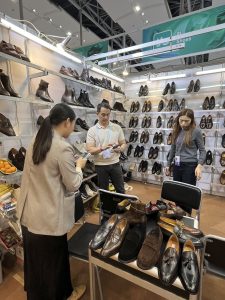
Canton Fair Footwear Section Characteristics:
| Factor | Details |
|---|---|
| Exhibition scale | 300+ footwear exhibitors |
| Geographic spread | Factories from all major manufacturing regions |
| Quality range | From budget to premium |
| Buyer traffic | Highest of any China footwear show |
| Appointment necessity | Essential for serious buyers |
| Language support | Moderate—English varies significantly |
Strategic Approach to Canton Fair:
The scale that makes Canton Fair valuable also makes it challenging. Strategies for success include:
- Prioritize by importance: Decide whether footwear is primary focus or one of multiple categories
- Limit geographic scope: Focus on specific manufacturing regions rather than attempting national coverage
- Build show appointments: Contact manufacturers before the show to schedule dedicated time
- Plan logistics carefully: Guangzhou is large; hotel and transportation require advance booking
Shanghai International Shoe Expo
The Shanghai show offers a more concentrated, premium-focused alternative to Canton Fair’s mass-market orientation.
Shanghai Shoe Expo Characteristics:
| Factor | Details |
|---|---|
| Exhibition scale | 200+ exhibitors (footwear focus) |
| Quality positioning | Premium to luxury |
| Geographic concentration | Yangtze River Delta manufacturers |
| Buyer density | Lower overall but higher serious buyer concentration |
| Factory access | More direct—fewer trading companies |
Why Shanghai Show Appeals to Premium Buyers:
- Manufacturing cluster proximity: Many exhibitors have Shanghai-area factories
- Quality orientation: Premium facilities use the show to attract premium clients
- Reduced trading company presence: More direct factory access
- English proficiency: Generally higher than national average
CIFF: China International Footwear Fair
CIFF serves as the primary trade platform for mass-market and volume-focused footwear sourcing.
CIFF Characteristics:
| Factor | Details |
|---|---|
| Exhibition scale | 500+ exhibitors across two phases |
| Quality range | Value to mid-market |
| Geographic spread | Primarily Guangdong manufacturers |
| Price positioning | Volume/price focus |
| International buyer services | Extensive interpreter services, buyer lounges |
CIFF Strategic Value:
CIFF serves specific buyer needs effectively:
- Volume buyers seeking price-competitive manufacturers
- Buyers focused on fast fashion/frequent replenishment cycles
- Retailers with high SKU counts requiring many supplier relationships
- Buyers seeking factory-direct relationships in Guangdong manufacturing belt
Why Shanghai Has Become a Hub for Premium Leather Shoe Manufacturing
Pre-Show Preparation Framework
Research and Target Identification
Successful trade show attendance begins weeks before the event. Preparation transforms random showroom wandering into targeted manufacturer engagement.
8-Week Pre-Show Preparation Timeline:
| Week | Activity | Output |
|---|---|---|
| 8 weeks out | Define show objectives | Written goals document |
| 7 weeks out | Research exhibitor list | Target manufacturer list (30-50) |
| 6 weeks out | Research target backgrounds | Company profiles, capabilities |
| 5 weeks out | Identify interpretation needs | Interpreter arrangements if needed |
| 4 weeks out | Request showroom appointments | Schedule meetings |
| 3 weeks out | Prepare company materials | Samples, catalogs, business cards |
| 2 weeks out | Confirm all appointments | Verify schedule |
| 1 week out | Final logistics preparation | Hotels, transportation, credentials |
Defining Your Show Objectives
SMART Objective Framework for Trade Shows:
| Objective Type | Example | Measurement |
|---|---|---|
| Specific | Meet 10 new manufacturers in Goodyear welted | Count of meetings |
| Measurable | Collect 15 product samples | Sample collection count |
| Achievable | Qualify 3 potential manufacturing partners | Qualification assessment |
| Relevant | Find 2 suppliers meeting EU compliance needs | Compliance verification |
| Time-bound | Complete all follow-up within 30 days | Follow-up timeline |
Research Protocol for Target Manufacturers
Pre-Show Manufacturer Research Checklist:
| Information Category | What to Find | Sources |
|---|---|---|
| Company registration | Legal name, export history | Company websites, directories |
| Production capabilities | Construction types, capacity | Show directories, prior attendance records |
| Quality certifications | ISO, SA8000, compliance | Company profiles, third-party databases |
| Export markets | Geographic experience | Catalog, website |
| Minimum order quantities | MOQ ranges | Direct inquiry, show directories |
| Pricing positioning | Premium/mid/value | Website, prior show intelligence |
Materials Preparation
Essential Show Materials:
| Material | Purpose | Notes |
|---|---|---|
| Company introduction | Establish credibility | One-page summary in English and Chinese |
| Product requirements | Communicate specifications | Tech packs, reference samples |
| Quality standards | Set expectations clearly | Written quality requirements |
| Business cards | Contact exchange | Include email, not just phone |
| Sample requests | Interest demonstration | Pre-approved sample allowance if budget allows |
| Order timeline | Scheduling discussion | Realistic production calendars |
Digital Materials (Tablet/Phone):
- Product portfolio images (organized by category)
- Previous production examples
- Quality certification copies
- Laboratory test reports
- Factory audit reports (if available)
How to Select a Reliable B2B Leather Shoe Manufacturer: A Complete Guide for Global Buyers
On-Site Show Strategy
Day Structure and Time Management
Trade shows reward structured approaches over opportunistic wandering. Plan your days with clear priorities:
Recommended Daily Structure:
| Time Block | Activity | Focus |
|---|---|---|
| Early morning (8:00-9:30) | Show floor reconnaissance | New exhibitors, floor plan familiarity |
| Morning (9:30-12:00) | Scheduled appointments | Target manufacturers |
| Lunch (12:00-1:30) | Network strategically | Industry contacts, informal meetings |
| Afternoon (1:30-5:00) | Continued appointments | Secondary targets |
| Late afternoon (5:00-6:30) | Walk-through | Discovery of unplanned opportunities |
| Evening (7:00+) | Relationship building | Dinner with promising contacts |
The Trade Show Conversation Framework
Manufacturer Meeting Structure:
| Phase | Duration | Purpose | Key Actions |
|---|---|---|---|
| Introduction | 2-3 minutes | Establish credibility | Company overview, market position |
| Capabilities assessment | 10-15 minutes | Evaluate fit | Production questions, capacity verification |
| Product discussion | 15-20 minutes | Explore opportunities | Sample review, customization potential |
| Commercial terms | 10-15 minutes | Preliminery discussions | MOQ, pricing indicators, lead times |
| Next steps | 5 minutes | Commit to action | Follow-up schedule, sample exchange |
Questions to Ask Manufacturers
Essential Qualification Questions:
| Category | Question | What You Learn |
|---|---|---|
| Production | What construction types can you produce? | Technical capability range |
| Production | What is your monthly production capacity? | Scalability |
| Quality | What certifications do you hold? | Compliance capability |
| Quality | Do you conduct in-house testing? | Quality control depth |
| Experience | Which markets have you exported to? | International experience |
| Experience | What brands have you produced for? | Capability validation |
| MOQ | What are your minimum order quantities? | Viability for your scale |
| Lead time | What lead times do you typically achieve? | Timeline fit |
| Sample | What is your sample development process? | Development capability |
Red Flags at Trade Shows
Warning Signs During Manufacturer Meetings:
| Red Flag | Implication | Response |
|---|---|---|
| Cannot describe factory location | Possible trading company posing as factory | Request factory photos, verify directly |
| Vague capacity claims | May be overstating capability | Request specific numbers, documentation |
| Unwilling to discuss minimums | MOQ likely very high | Probe for realistic ranges |
| No quality certifications | Compliance may be weak | Inquire about testing processes |
| Sample development unclear | Limited development capability | Press for details on sample process |
| Pressure to commit at show | May be prioritizing volume over quality | Request time for consideration |
Leather Footwear Quality Standards and Inspection: Wincheer Shoes’ Professional B2B Framework
Manufacturer Evaluation at Shows
On-Site Assessment Framework
Evaluate manufacturers against your specific criteria:
Evaluation Matrix Template:
| Criterion | Weight | Manufacturer A | Manufacturer B | Manufacturer C |
|---|---|---|---|---|
| Quality capability | 25% | |||
| Price competitiveness | 20% | |||
| MOQ fit | 15% | |||
| Lead time capability | 15% | |||
| Communication responsiveness | 10% | |||
| Compliance/ certifications | 10% | |||
| Production capacity | 5% | |||
| Weighted Total | 100% |
Evaluating Manufacturing Facilities Remotely
When evaluating at trade shows, you cannot see factories directly. Proxy indicators help:
Remote Factory Assessment Indicators:
| Indicator | What It Tells You | Questions to Ask |
|---|---|---|
| Staff presence at show | Export experience level | Ask about their specific role |
| Booth setup quality | Marketing and investment level | Observe professionalism |
| Sample quality | Production capability | Examine finish details |
| English proficiency | Communication capability | Direct conversation assessment |
| Materials displayed | Material sourcing relationships | Ask about supplier partnerships |
| Catalog/presentation quality | Professional maturity | Review complete materials |
Product Sample Evaluation
Sample Assessment Checklist:
| Aspect | What to Examine | Quality Indicators |
|---|---|---|
| Stitching | Seam consistency, thread tension | Even stitches, no looseness |
| Upper leather | Surface quality, smell, feel | Consistent grain, supple texture |
| Sole attachment | Edge quality, bond consistency | Clean joints, no gaps |
| Hardware | Function, finish quality | Smooth operation, no flaking |
| Overall construction | Alignment, symmetry | Left-right consistency |
| Lining | Material quality, stitching | Smooth internal seams |
| Last shape | Proportion, fit impression | Professional appearance |
Negotiation Tactics for Trade Shows
The Unique Trade Show Negotiation Context
Trade shows create unusual negotiation dynamics:
Trade Show Negotiation Characteristics:
| Factor | Implication | Strategy Adjustment |
|---|---|---|
| Compressed timeline | Decisions must be made quickly | Pre-prepare walk-away points |
| Competition present | Manufacturers know you see alternatives | Use competition for leverage |
| Information asymmetry | You may know less than manufacturer | Invest in pre-show research |
| First impression importance | Manufacturers invest in show presence | Credibility matters |
| Relationship starting point | Everything is preliminary | Avoid over-commitment |
Effective Trade Show Negotiation Approaches
Approach 1: The “Serious Buyer” Positioning
Demonstrate genuine purchase intent while maintaining flexibility:
| Tactic | Purpose | Implementation |
|---|---|---|
| Specify realistic order quantities | Establish credibility | Share actual purchase plans |
| Discuss timeline for first order | Create commitment | Share development calendar |
| Request specific samples | Advance relationship | Ask for particular styles |
| Provide clear specifications | Show professionalism | Bring tech packs |
| Indicate potential for volume | Signal future opportunity | Discuss growth projections |
Approach 2: The “Information Gathering” Positioning
When still in exploration phase:
| Tactic | Purpose | Implementation |
|---|---|---|
| Ask broad questions | Learn manufacturer range | Explore capabilities before committing |
| Collect materials extensively | Build database | Gather catalogs, samples |
| Meet many suppliers | Comparative analysis | Don’t over-invest in single relationship |
| Avoid price anchoring | Keep negotiating room | Don’t quote target prices early |
| Be honest about timeline | Manage expectations | Acknowledge you are exploring |
Trade Show Pricing Dynamics
Price Discussion Strategies:
| Strategy | When to Use | Risk Level |
|---|---|---|
| Request complete pricing sheet | At show | Moderate—may anchor expectations |
| Indicate target price | When testing fit | High—limits flexibility |
| Ask for “show pricing” | When interested | Moderate—”special” pricing often illusion |
| Compare quotes across suppliers | When evaluating options | Lower—uses competition |
| Defer pricing discussion | When not ready | Low—preserves flexibility |
What “Show Special Pricing” Actually Means:
Be cautious of dramatic show-only discounts:
- True show specials exist but are uncommon
- Some manufacturers raise prices then “discount” for show
- Real value in show pricing is relationship-building, not price reduction
- Better approach: Request volume pricing applicable to realistic order sizes
Negotiating with Chinese Leather Shoe Manufacturers: Wincheer Shoes’ Strategic Guide
Post-Show Follow-Up Excellence
Post-Show Follow-Up Timeline
The value of trade show relationships depends heavily on follow-up execution:
Critical Follow-Up Timeline:
| Timeframe | Action | Priority |
|---|---|---|
| Within 48 hours of show | Thank you messages to key contacts | Critical |
| Week 1 post-show | Sample requests to promising suppliers | High |
| Week 2 post-show | Detailed specification submissions | High |
| Week 3-4 post-show | Pricing requests, order discussions | Medium |
| Week 6 post-show | Relationship status assessment | Medium |
| Month 3 post-show | Review progress, adjust strategy | Medium |
Converting Show Conversations to Orders
The Journey from Show Contact to Production:
| Stage | Typical Timeline | Key Activities |
|---|---|---|
| Initial contact | During show | Meeting, catalog exchange |
| Follow-up interest | Week 1-2 | Sample requests, questions |
| Capability confirmation | Week 2-4 | Specification discussion |
| Sample development | Week 4-8 | Prototype creation |
| Sample review | Week 8-10 | Evaluation, feedback |
| Commercial negotiation | Week 10-12 | Price, terms, MOQ |
| First order | Week 12-16 | Production commitment |
| Production | Week 16-24 | Manufacturing |
| Delivery | Week 24-28 | Shipping, customs |
Why Most Show Contacts Don’t Convert:
Common failure points:
- No follow-up within 48 hours (manufacturer loses interest)
- Vague interest without commitment
- Unresponsive to manufacturer questions
- Sample evaluation delays
- Price negotiation breakdown
- No clear decision timeline
Building Long-Term Show Relationships
Strategic Approach to Show Repeat Presence:
If attending multiple shows or attending same show annually:
| Year | Relationship Stage | Actions |
|---|---|---|
| Year 1 | Initial contact | Exchange information, assess fit |
| Year 2 | Developing relationship | Meet same contacts, show progress |
| Year 3 | Established relationship | Deepen partnership, discuss exclusivity |
| Year 4+ | Strategic partnership | Joint development, preferred pricing |
The Value of Show Relationship Investment:
Long-term show presence yields compounding returns:
- Familiarity with your company reduces sales friction
- Sales representatives invest more in serious buyers
- Manufacturers offer better terms to proven relationships
- Access to new products and capabilities before public release
- Crisis resolution support from established relationships
Trade Show Cost Analysis
Budget Planning Framework
Typical Trade Show Attendance Costs:
| Cost Category | Budget Range | Notes |
|---|---|---|
| Airfare | $800-2500 | Depends on origin, booking timing |
| Hotel | $100-300/night | Guangzhou/Shanghai premium during shows |
| Transportation | $200-500 | Airport transfers, local transport |
| Interpretation | $200-500/day | Professional interpreter if needed |
| Meals | $50-150/day | Business meals add significantly |
| Sample shipping | $500-2000 | Express shipping for collected samples |
| Booth fees (if exhibiting) | $5000-30000 | If exhibiting as supplier |
| Miscellaneous | $300-800 | Communication, tips, unexpected |
Total Typical Cost for International Buyers:
| Buyer Origin | Single Show (3-4 days) | Extended Visit (7-10 days) |
|---|---|---|
| North America | $4000-7000 | $6000-12000 |
| Europe | $4500-8000 | $7000-14000 |
| Asia (non-China) | $2000-4000 | $3500-7000 |
| Australia | $3500-6000 | $5500-10000 |
ROI Considerations
Evaluating Trade Show Investment Returns:
| Return Type | Measurement | Typical Timeframe |
|---|---|---|
| New supplier relationships | Suppliers met vs. qualified | 3-12 months |
| Order placement | Orders from new suppliers | 6-18 months |
| Cost savings | Price improvements vs. prior suppliers | 12-24 months |
| Product improvements | New capabilities accessed | 12-36 months |
| Market intelligence | Industry trends, pricing data | Immediate to 6 months |
Cost Per Qualified Supplier:
| Metric | Calculation | Benchmark |
|---|---|---|
| Total attendance cost | Sum of all expenses | $5000-15000 |
| Qualified suppliers met | Serious prospects (not trading companies) | 5-20 |
| Cost per qualified supplier | Total cost / qualified suppliers | $500-2000 |
This cost-per-qualified-supplier often compares favorably to the $2000-5000 cost of traditional supplier qualification through travel and research without shows.
Supply Chain Resilience: How B2B Shoe Manufacturers Are Adapting to Global Challenges
FAQ: Trade Show Questions
Q1: Do I need an interpreter at China trade shows if my Chinese is limited?
Yes, unless you have exceptional language skills. Even basic conversations benefit from professional interpretation. Budget $200-500 per day for qualified interpretation. Some show organizers provide interpreter services. Negotiate in advance for better rates. Avoid relying on manufacturer-supplied interpreters as they may filter information.
Q2: Should I attend multiple shows in one China trip?
Combining shows can be efficient, but consider: logistics complexity increases, each show gets less focused attention, and physical fatigue affects judgment. If combining, space shows at least one week apart. Consider pairing a major show (Canton Fair) with a factory visit trip to specific manufacturers.
Q3: How do I distinguish factories from trading companies at trade shows?
Ask specific questions about production details: “What machines do you use for lasting?” “What is your defect rate?” “Show me how you do quality control.” Trading companies typically cannot answer detailed production questions. Ask for factory photos and verify addresses. Request visits to verify.
Q4: Is it better to schedule appointments or walk the floor?
For serious sourcing, pre-scheduled appointments with target manufacturers are essential. Walking the floor for discovery is valuable for finding unexpected opportunities, but should complement a structured appointment schedule rather than replace it. Plan 60-70% scheduled, 30-40% exploratory.
Q5: How many manufacturers should I target at a single show?
Realistically evaluate your capacity. For focused engagement (meaningful conversation, catalog exchange, sample request), 10-15 manufacturer meetings per show provides quality interaction. Beyond 15, preparation and follow-up quality typically suffers. Consider multiple shows to cover more ground rather than overwhelming a single show.
Q6: What should I do with collected samples and catalogs?
Samples and catalogs serve as physical reminders of conversations and references. Organize immediately with manufacturer contact information attached. Create a tracking system to follow up on promised samples from manufacturers. Consider shipping materials home via consolidated freight rather than carrying everything.
Conclusion
Trade shows remain powerful channels for B2B footwear sourcing, offering manufacturer access, comparative evaluation, and relationship building that no other single activity provides. Yet trade show success requires systematic preparation, focused execution, and disciplined follow-up.
The investment in trade show attendance—typically $5000-15000 for international buyers—generates returns through new supplier relationships, improved pricing, and market intelligence. But these returns materialize only with strategic approach to show selection, manufacturer engagement, and relationship conversion.
Wincheer Shoes welcomes serious buyers exploring manufacturing partnerships. Whether you encounter us at a trade show or discover us through other channels, we offer transparent discussion of our capabilities and the relationship terms that work for both parties.
Invitation to Connect:
We welcome trade show meetings and offer:
- Capability presentations tailored to your requirements
- Sample development discussions
- Manufacturing partnership exploration
- Compliance and certification guidance
About Wincheer Shoes
Wincheer is a professional leather shoe manufacturer based in Shanghai, China. Established in 2007, we specialize in OEM/ODM manufacturing of men’s leather shoes including Oxford, Derby, Loafer, Monk, and Chelsea styles. With experience dating back to 2007 and CE/REACH/RoHS certifications, we export quality footwear to global markets at competitive prices ($25-$40/pair).