
China remains the world’s largest footwear exporter, and for B2B buyers in 2026, finding the right shoe manufacturer China partner is still one of the highest-leverage decisions you’ll make. Get it right and you control margin, quality, and speed. Get it wrong and you’re managing chargebacks, delays, and brand damage.
This guide walks you through a proven 5-step factory selection process, regional hub comparisons, red flags to avoid, and a sample evaluation checklist — everything you need to source confidently.
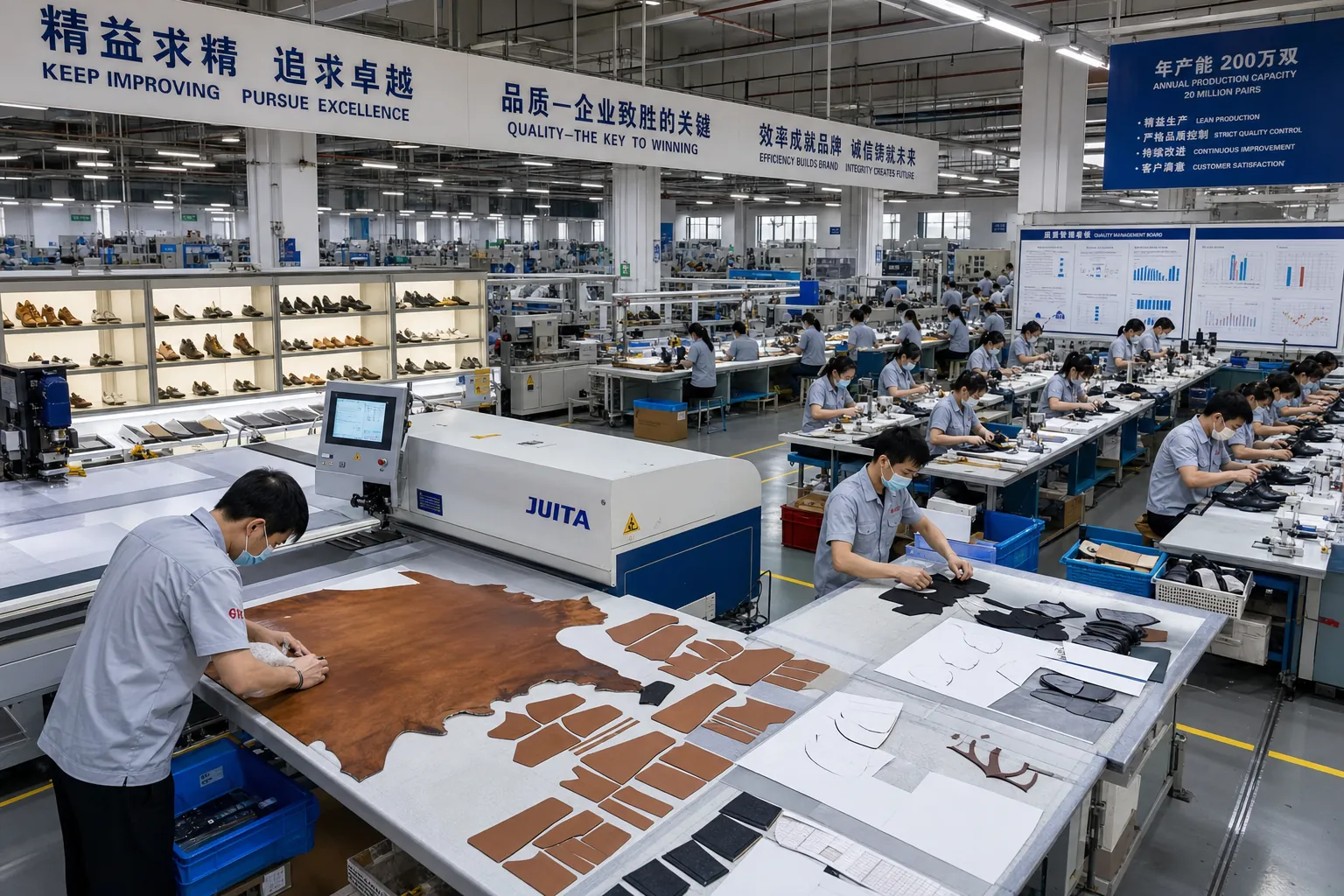
As a manufacturer founded in 2007, producing 500,000+ pairs annually from our Jiangmen factory, Guangdong, with a defect rate of 0.8–1.2% against an industry average of 2–4%, Wincheer Shoes reflects what a mature, export-ready China shoe factory looks like. Use those benchmarks as your baseline when evaluating any supplier.
How To Find Reliable Shoe Manufacturer China 2026: Table of Contents
- Why China Remains #1 for Shoe Manufacturing in 2026
- The 5-Step Factory Selection Process
- Key Verifications: Certifications and Audits
- Red Flags: Warning Signs of Unreliable Factories
- Major Shoe Manufacturing Hubs in China
- Guangzhou vs Wenzhou vs Jinjiang: Comparison Table
- Communication and Negotiation Tips for Western Buyers
- Sample Evaluation Checklist
- FAQ
- Ready to Start Your Shoe Line?
Why China Remains #1 for Shoe Manufacturing in 2026
Despite nearshoring trends and tariff pressures, China still produces roughly 57% of the world’s footwear. The reasons are structural, not just cost-based.
The supply chain depth is unmatched. Leather tanneries, sole factories, hardware suppliers, and packaging manufacturers are often within 50 km of each other — particularly in Guangdong and Fujian provinces. That proximity compresses lead times and reduces logistics complexity.
Labor skill is another factor. Decades of production experience mean Chinese factories have craftspeople who understand Goodyear welt construction, Blake stitching, and cemented sole bonding at a level that newer manufacturing countries are still developing.
Finally, MOQ flexibility has improved dramatically. Many established factories now offer 0 MOQ on existing designs and 60-pair minimums on custom styles — making China accessible to emerging brands, not just large-volume buyers.
The 5-Step Factory Selection Process
Step 1: Research
Start with platform-based discovery: Alibaba, Global Sources, and Made-in-China are the three primary directories. Filter by “verified supplier,” “trade assurance,” and years in operation.
Cross-reference any factory you find on these platforms with their own website, LinkedIn presence, and Google search. A factory with no independent web presence beyond a marketplace listing is a yellow flag.
Target factories that specialize in your product category. A factory that primarily makes athletic footwear is not the right partner for dress shoes, even if they claim capability.
Step 2: Verify
Request the following documents before any further conversation:
- Business license (营业执照) — check registration date and scope
- Export license
- Relevant certifications (CE EN ISO20347, REACH, RoHS for EU markets)
- Factory audit reports (BSCI, SMETA, or equivalent)
Cross-check the business license registration number against China’s National Enterprise Credit Information Publicity System gsxt.gov.cn. This is a free government database and takes 2 minutes.
Step 3: Audit
A desk audit (document review) is the minimum. For orders above $50,000, a physical factory audit is worth the cost — typically $300–$600 through a third-party inspection firm like SGS, Bureau Veritas, or QIMA.
Key audit checkpoints:
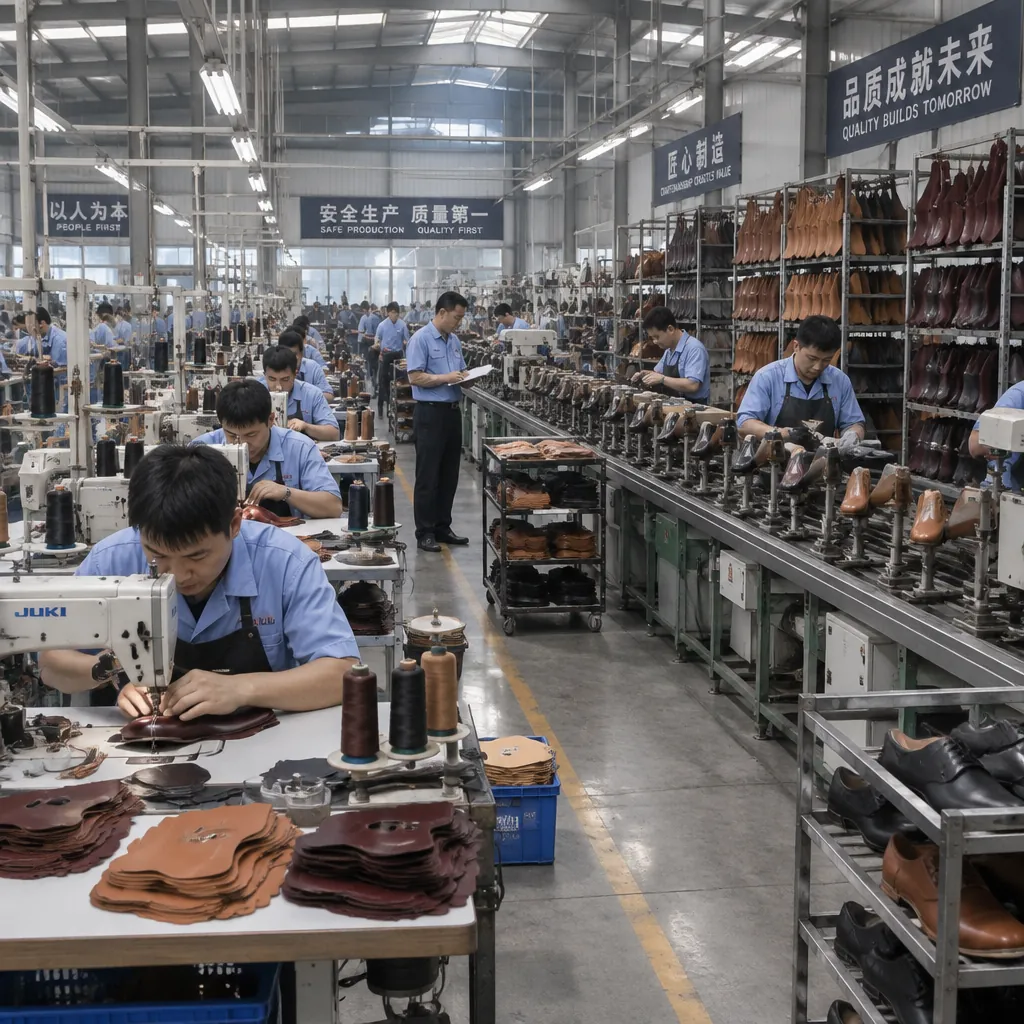
- Production floor size vs claimed capacity
- Worker headcount and skill level
- Raw material storage conditions
- In-line QC stations
- Finished goods inspection area
Step 4: Sample
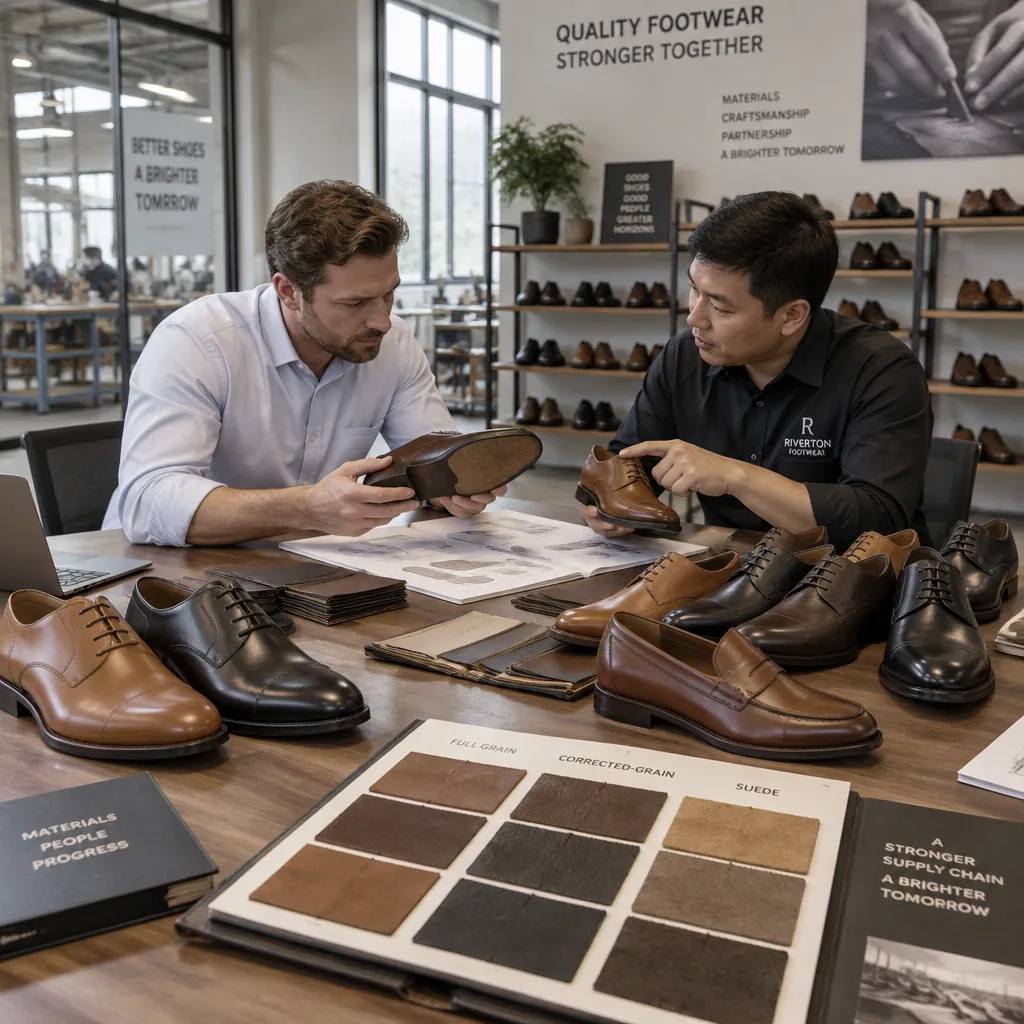
Never place a bulk order without evaluating production samples — not pre-production prototypes, but actual production-run samples pulled from the line.
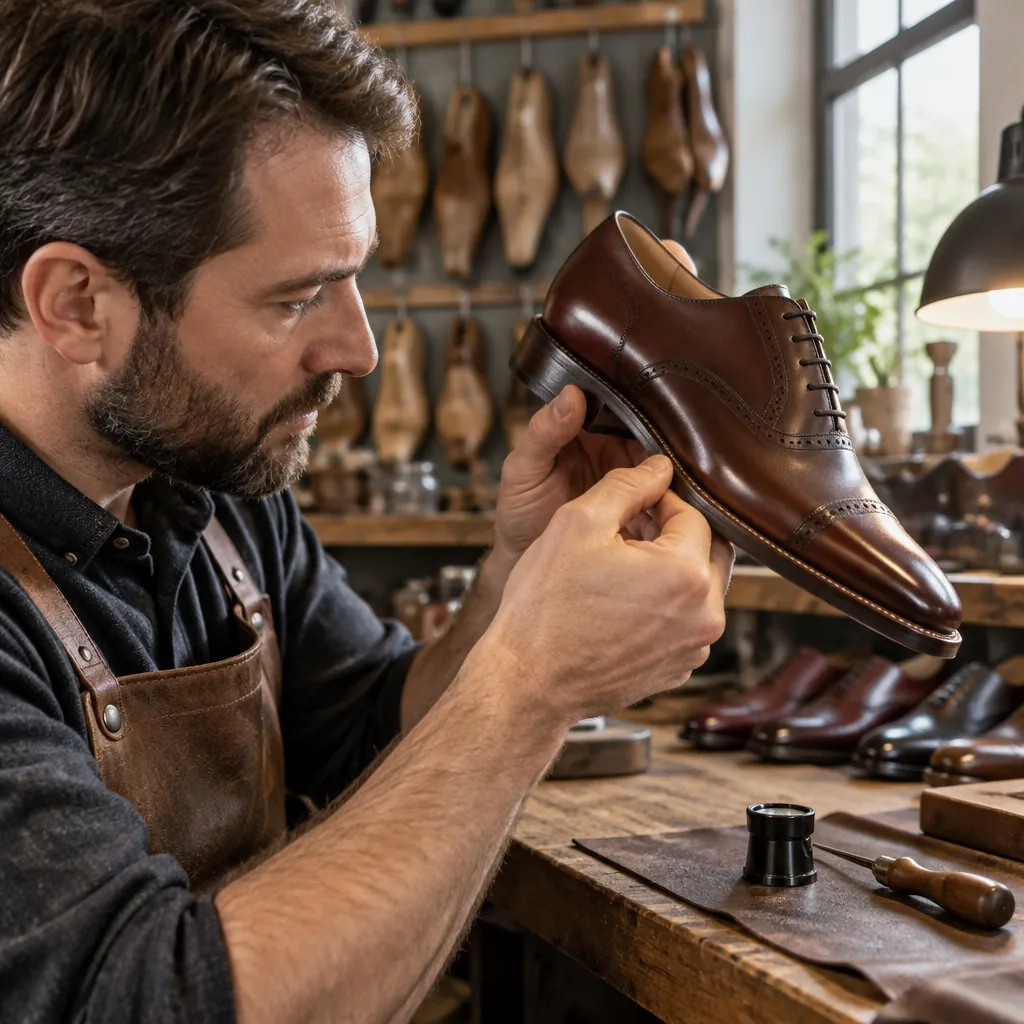
Evaluate samples against your tech pack specifications. Check stitching density, lasting quality, sole adhesion, and colorfast consistency. We cover this in detail in the Sample Evaluation Checklist section below.
Step 5: Contract
A pro-forma invoice is not a contract. Before bulk production begins, have a written agreement covering:
- Exact product specifications and approved sample reference
- Defect rate tolerance (specify AQL level — typically AQL 2.5 for footwear)
- Lead time with penalty clauses
- Payment terms (standard is 30% deposit, 70% before shipment)
- IP ownership for custom designs and molds
- Dispute resolution jurisdiction
Key Verifications: Certifications and Audits
CE Marking (EN ISO 20347)
For any buyer selling into the EU or UK, CE marking under EN ISO 20347 is mandatory for occupational footwear and strongly recommended for dress shoes sold through European retail channels. Verify the certificate is current and issued by an accredited notified body — not self-declared.
For a detailed breakdown of what CE marking requires for footwear, see our CE marking footwear guide Shoe Manufacturer Guide.
REACH and RoHS
REACH compliance confirms restricted chemical substances (chromium VI, azo dyes, phthalates) are within EU limits. RoHS is relevant if your shoes include electronic components (light-up soles, smart insoles).
Ask for the test report, not just a declaration. Reports should be from an accredited lab (SGS, Intertek, TÜV).
BSCI and SMETA Audits
These social compliance audits verify labor conditions, working hours, and factory safety. Major European retailers and Amazon’s supply chain programs increasingly require them. A factory with a current BSCI or SMETA audit on file is demonstrably more organized than one without.
Red Flags: Warning Signs of Unreliable Factories
Knowing what to avoid is as important as knowing what to look for. Here are the patterns that consistently signal problems:
Price too low to be real. If a factory quotes $12–15/pair for genuine leather dress shoes when the market rate is $25–40/pair, they are either using PU leather labeled as genuine, cutting corners on construction, or planning to substitute materials after your deposit clears.
Reluctance to share documentation. Any legitimate factory will provide their business license and basic certifications within 24–48 hours. Delays or excuses are a signal.
No third-party audit history. Factories that have never been audited by BSCI, SMETA, or a major brand are operating without external accountability.
Vague answers on production capacity. If a factory claims 100,000 pairs/month but can’t tell you their worker count or floor space, the number is fabricated.
Pressure to skip samples. “We have many clients who order without samples” is a line designed to move you to deposit faster. Never skip samples.
Communication disappears after deposit. This is the most damaging scenario. Establish communication cadence expectations in writing before any money moves.
For a full checklist of sourcing warning signs, see our red flags when sourcing leather shoes from China What Does OEM Mean in Shoes guide.
Major Shoe Manufacturing Hubs in China
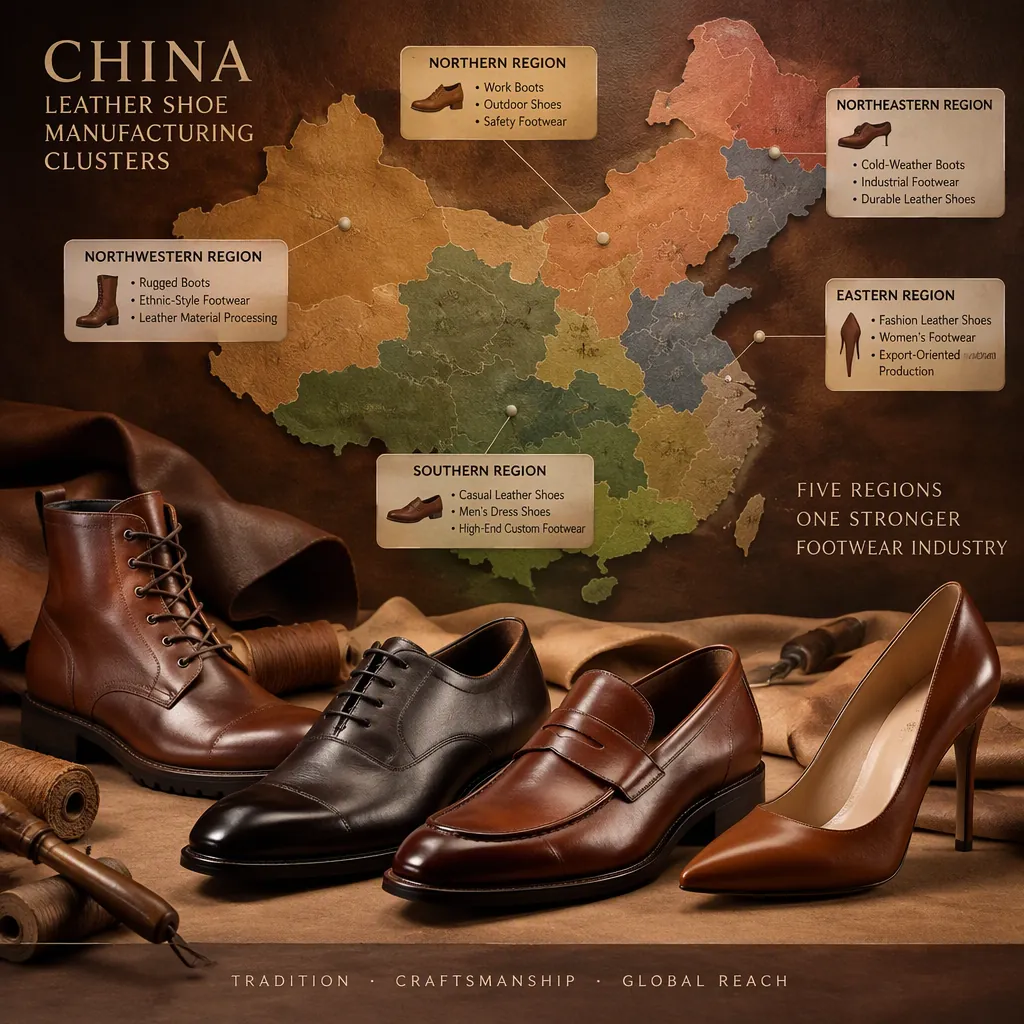
Guangzhou (Guangdong Province)
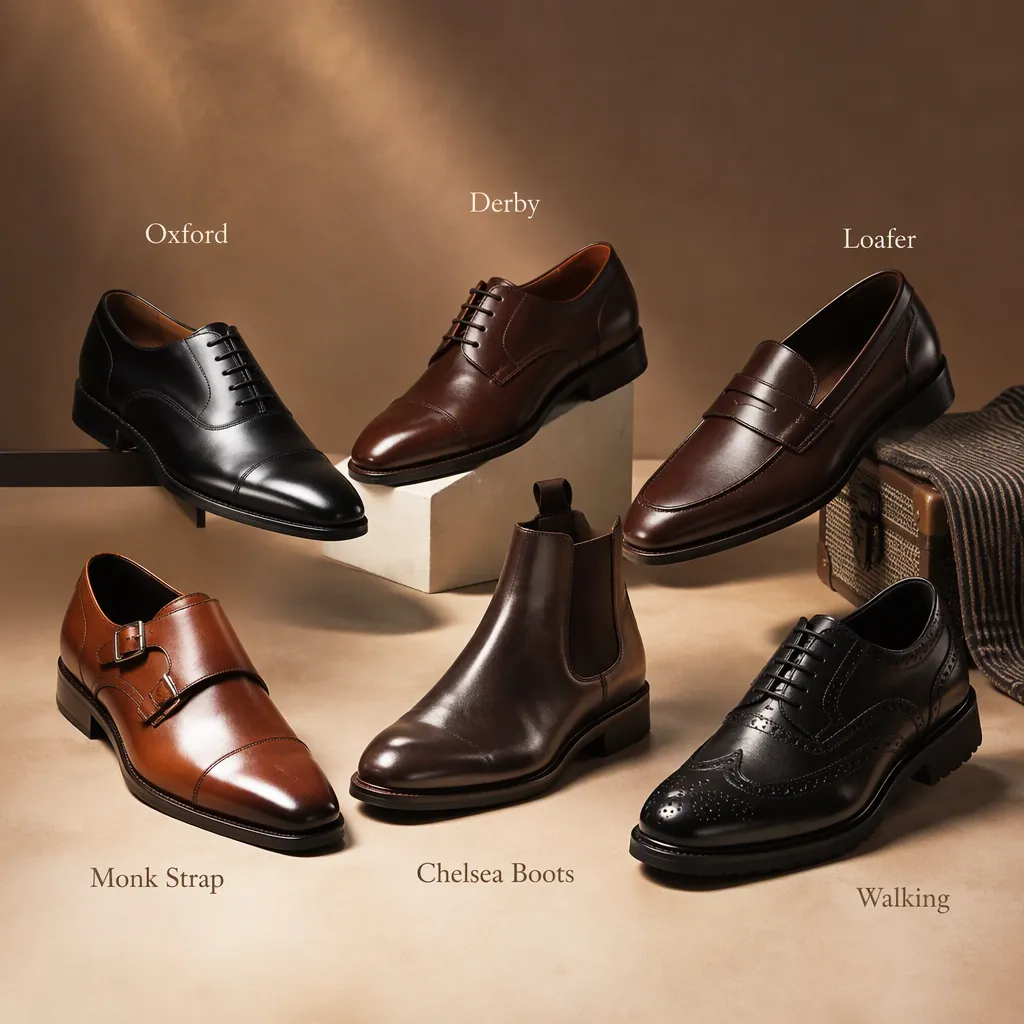
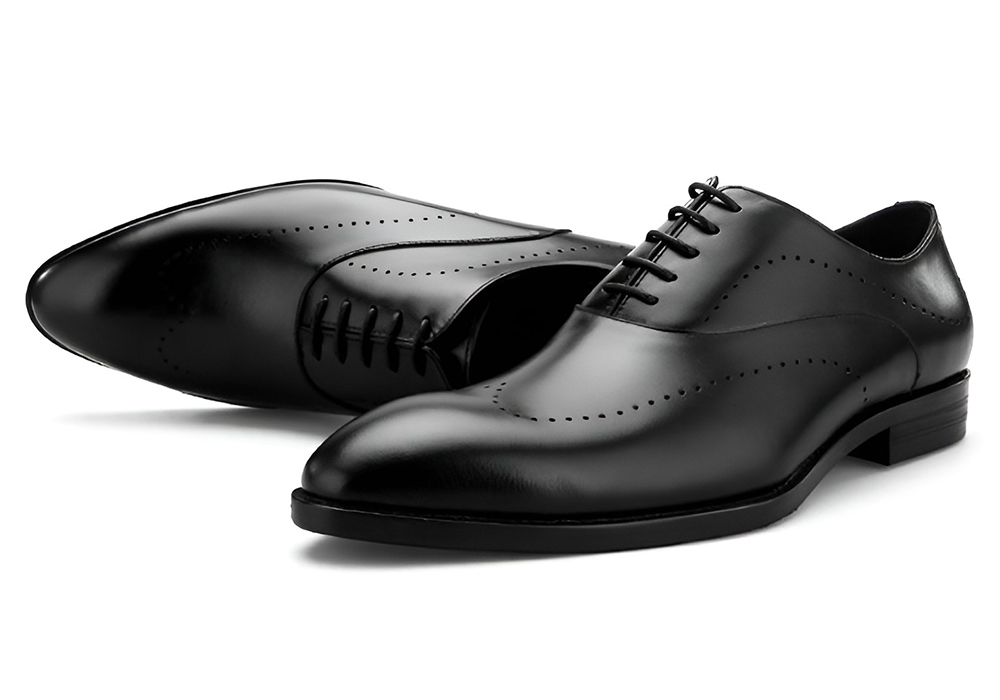
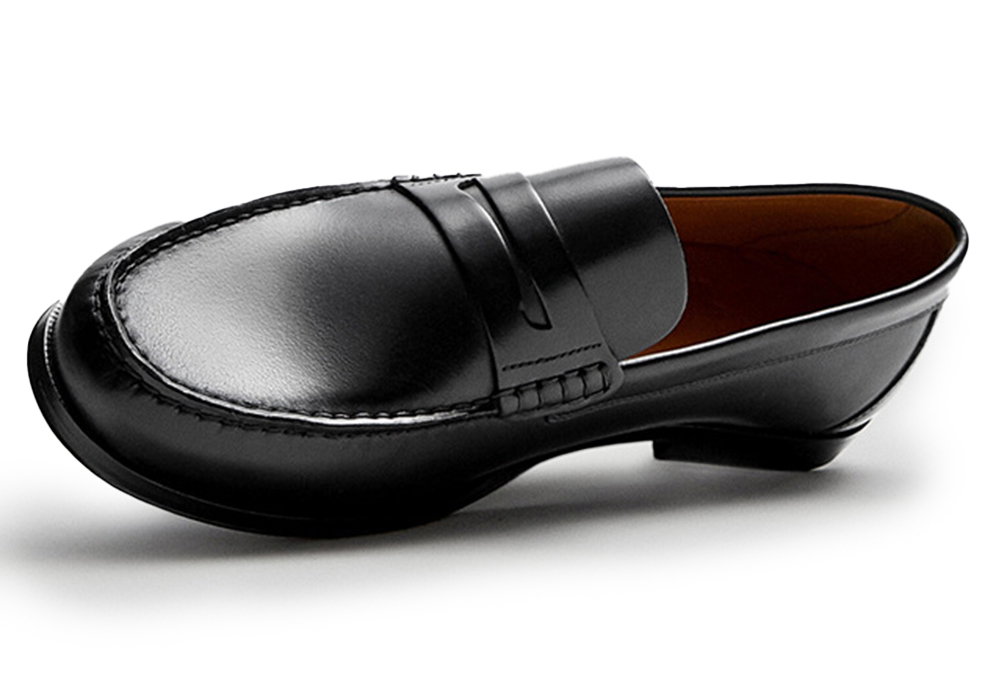
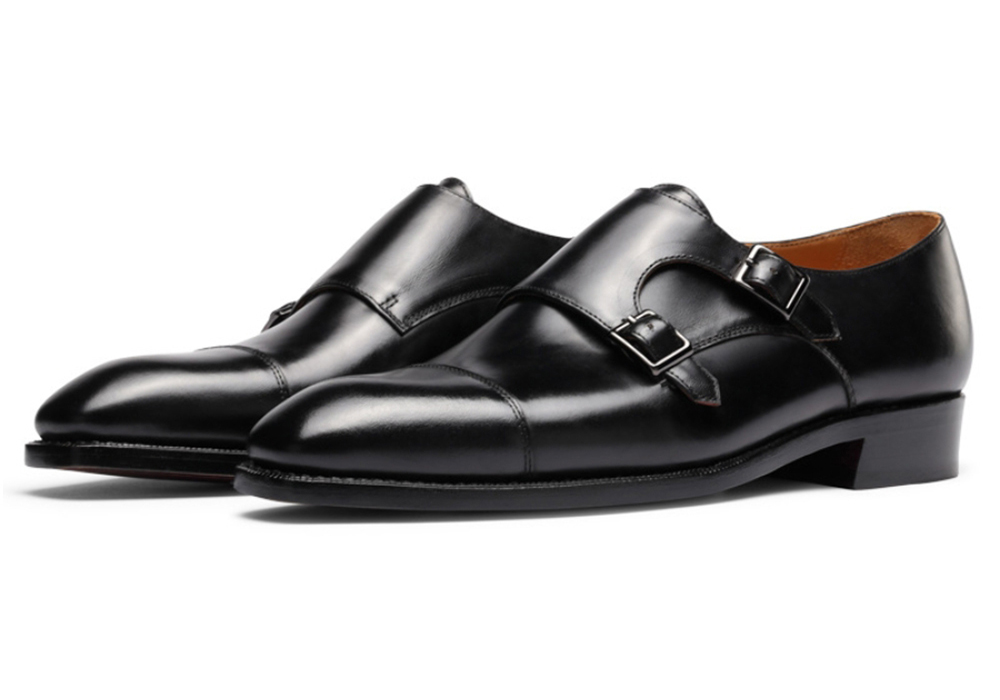
Guangzhou and the surrounding Pearl River Delta region is China’s premium leather footwear center. Factories here tend to specialize in men’s dress shoes — Oxfords, Derbies, Monk Straps, Chelsea Boots — with higher craftsmanship standards and better access to quality full-grain leather.
The region has deep integration with Hong Kong trading infrastructure, making it the most accessible hub for Western buyers in terms of logistics, English-speaking staff, and export documentation.
Wenzhou (Zhejiang Province)
Wenzhou is China’s largest footwear cluster by volume, with an estimated 4,000+ shoe factories. The city’s strength is mid-market leather and synthetic footwear at competitive price points.
Wenzhou factories are strong on speed and volume but can be inconsistent on quality control at the individual factory level. Buyer due diligence is especially important here.
Jinjiang (Fujian Province)
Jinjiang dominates athletic, casual, and sport-lifestyle footwear. If you’re sourcing sneakers, running shoes, or casual canvas styles, Jinjiang is the right hub. For formal leather dress shoes, it’s not the primary destination.
Guangzhou vs Wenzhou vs Jinjiang: Comparison Table
| Factor | Guangzhou | Wenzhou | Jinjiang |
|---|---|---|---|
| Primary Category | Men’s dress & leather | Mid-market leather & synthetic | Athletic & casual |
| Craftsmanship Level | High | Medium | Medium |
| Price Range (FOB) | $25–45/pair | $15–35/pair | $12–30/pair |
| MOQ Flexibility | High (many offer low MOQ) | Medium | Medium |
| English Communication | Good | Fair | Fair |
| Certification Readiness | CE/REACH common | Variable | Variable |
| Best For | B2B dress shoe buyers, private label brands | Volume buyers, mid-market retail | Sportswear, casual brands |
| Lead Time (typical) | 30–45 days | 25–40 days | 20–35 days |
Communication and Negotiation Tips for Western Buyers
Set the tone early
Your first message to a factory signals whether you’re a serious buyer or a price-shopper. Lead with your annual volume requirement, target markets, and product category — not price. Factories allocate their best production slots to buyers who demonstrate scale and seriousness.
Use written specs, not verbal descriptions
Every product discussion should be anchored to a written tech pack or at minimum a detailed specification sheet. Verbal agreements in cross-cultural sourcing create expensive misunderstandings.
Understand Chinese business culture around “face”
Chinese manufacturers will rarely say “no” directly. “We will try our best” often means “this is difficult or impossible.” Learn to read indirect signals and ask clarifying questions: “What would need to be true for this to be possible?”
Negotiate on total value, not just unit price
The best negotiating leverage is volume commitment, payment terms, and repeat order frequency — not squeezing the per-pair price. A factory that earns $28/pair on a reliable 10,000-pair/month order will prioritize your production over a buyer paying $32/pair on a one-time 500-pair order.
Confirm payment terms in writing
Standard B2B terms for China shoe orders are 30% T/T deposit, 70% T/T before shipment. For new relationships, some buyers use Letter of Credit (LC) for added security. For a detailed breakdown, see our payment terms for B2B leather shoe orders Shoe Manufacturer Guide guide.
Sample Evaluation Checklist
Use this checklist when evaluating production samples from any shoe manufacturer China candidate. Score each item 1–5 and set a minimum threshold before approving bulk production.
Upper Construction
- Leather grain consistency across both shoes in the pair
- Stitching density: minimum 8–10 stitches per inch on critical seams
- No skipped stitches, thread pulls, or uneven tension
- Edge finishing: burnished, painted, or heat-sealed (no raw edges)
- Lining material is smooth, fully bonded, no bubbling
Lasting and Shape
- Last shape matches approved design spec
- No toe box distortion or heel cup collapse
- Symmetry between left and right shoe (measure heel-to-toe length)
Sole and Construction
- Sole adhesion: attempt manual delamination — no separation at edges
- Heel attachment: no movement or creaking under pressure
- Outsole material matches spec (rubber, leather, TPR — verify, don’t assume)
Hardware and Details
- Eyelets are set flush, no sharp edges
- Buckles (on monk straps) move smoothly and lock securely
- Laces are correct length and material
Finishing
- Color matches approved Pantone or physical swatch
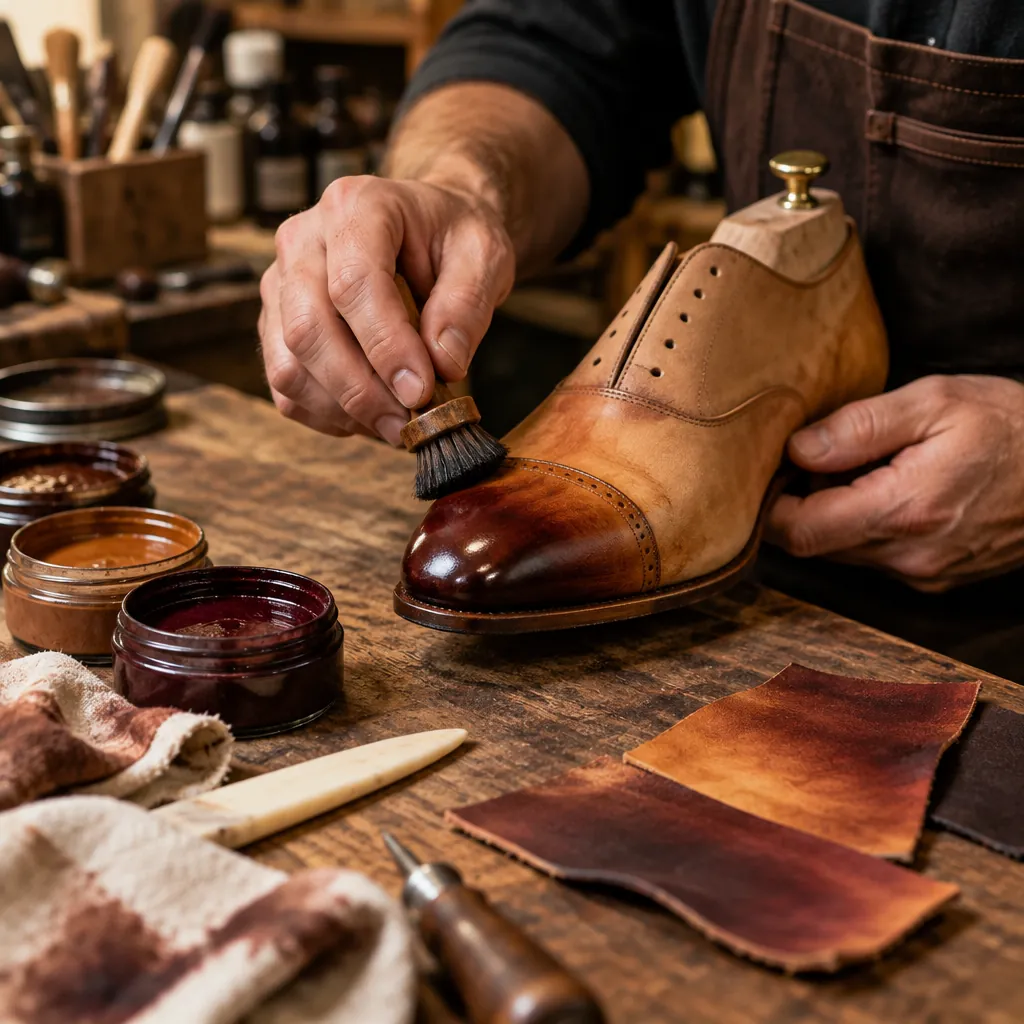
- Polish or finish is even — no streaking, pooling, or missed areas
- No adhesive residue visible on upper or outsole
Packaging
- Shoe trees or toe stuffing present to maintain shape
- Individual shoe bags if specified
- Box print matches approved artwork
For buyers building a private label line, our private label shoes 10-step brand launch guide Shoe Manufacturer Guide covers how to integrate sample evaluation into your full product development timeline.
If you want to explore the full range of styles available from established China factories, browse our men’s dress shoe styles guide Shoe Manufacturer Guide for category-specific sourcing context.
FAQ
Q: What is a realistic MOQ when sourcing from a shoe manufacturer China?
A: It varies by factory type. Trading companies often require 300–500 pairs per style. Established direct manufacturers increasingly offer 0 MOQ on existing catalog designs and 60 pairs for custom styles. Always clarify whether MOQ applies per style, per color, or per size run.
Q: How do I verify a Chinese shoe factory is legitimate before visiting?
A: Request their business license and cross-check the registration number on China’s National Enterprise Credit Information Publicity System (gsxt.gov.cn). Also request their most recent third-party audit report (BSCI or SMETA) and verify certifications directly with the issuing body.
Q: What certifications should a shoe manufacturer China have for EU market entry?
A: CE marking under EN ISO 20347 is mandatory for occupational footwear. REACH compliance is required for chemical substance limits. RoHS applies if the product includes electronic components. Always request the actual test report from an accredited lab, not a self-declaration.
Q: How long does it take from sample approval to bulk delivery?
A: For standard leather dress shoes, expect 30–45 days production time after sample approval, plus 15–25 days sea freight to Europe or North America. Rush production is possible but typically carries a 10–15% surcharge and increases quality risk.
Q: What payment terms are standard for first-time orders with a China shoe factory?
A: 30% T/T deposit before production, 70% T/T balance before shipment is the most common structure. Some buyers use Letter of Credit (LC) for larger first orders to reduce payment risk. Avoid factories that demand 50% or more upfront with no audit history or references.
Ready to Start Your Shoe Line?
Finding the right shoe manufacturer China partner takes research, verification, and patience — but the margin and