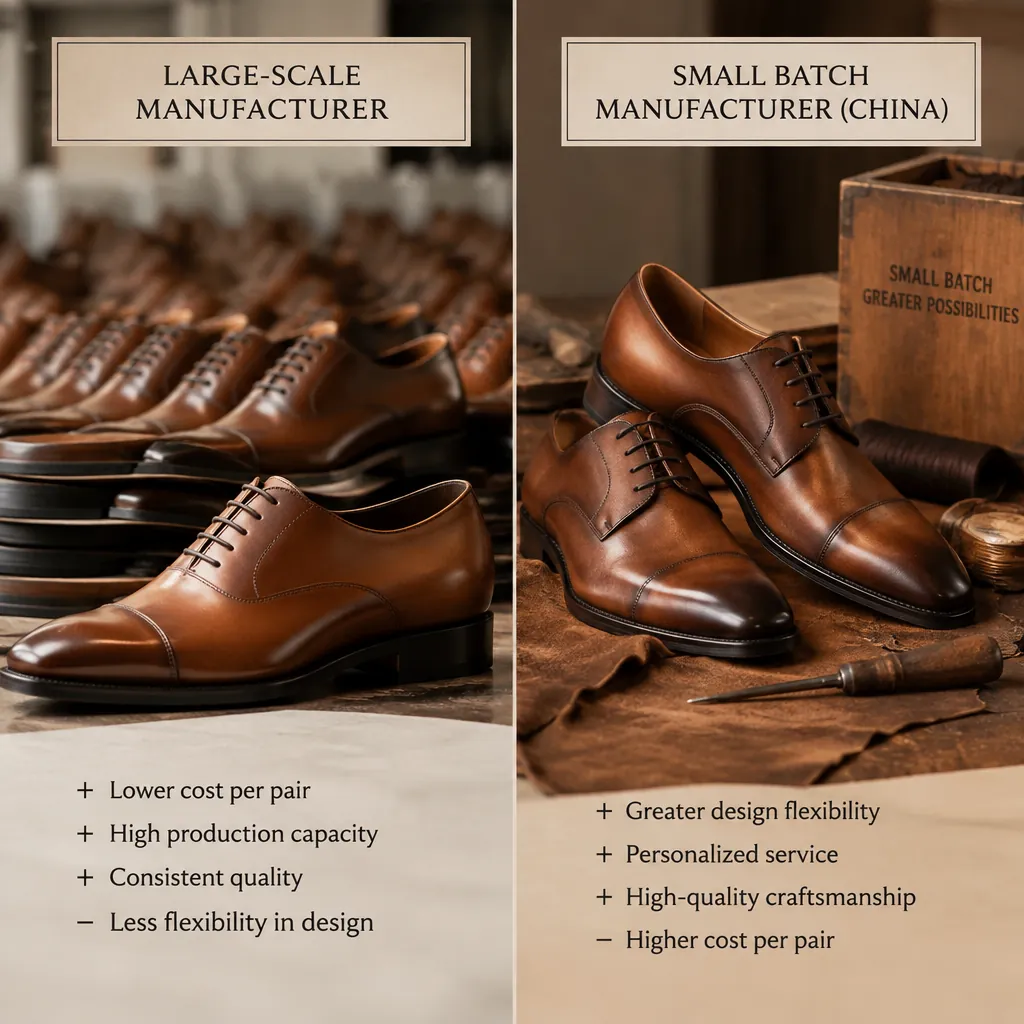

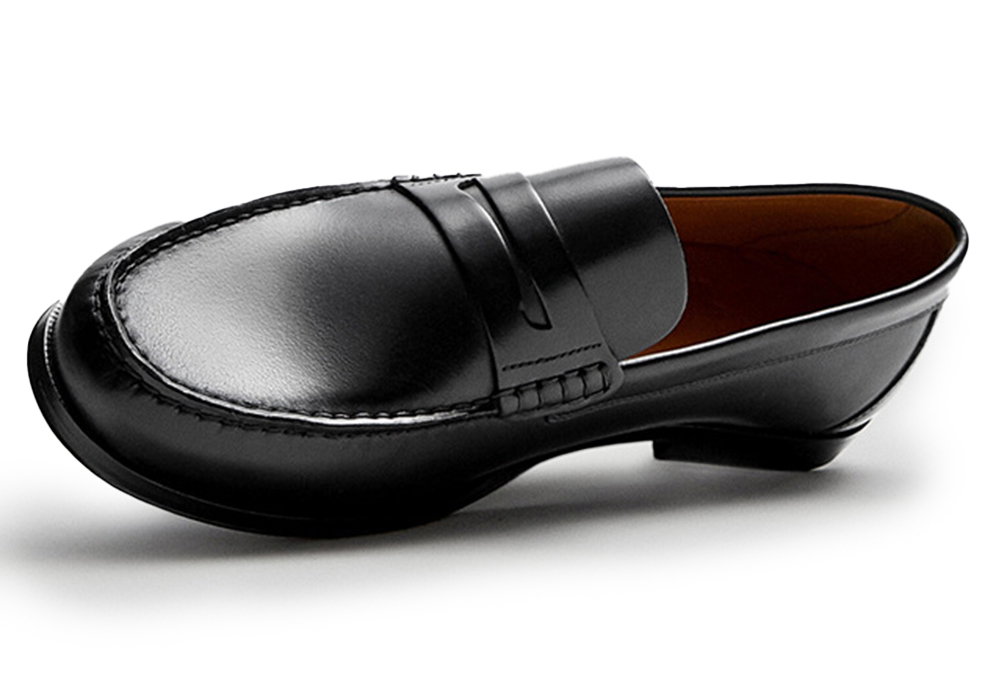
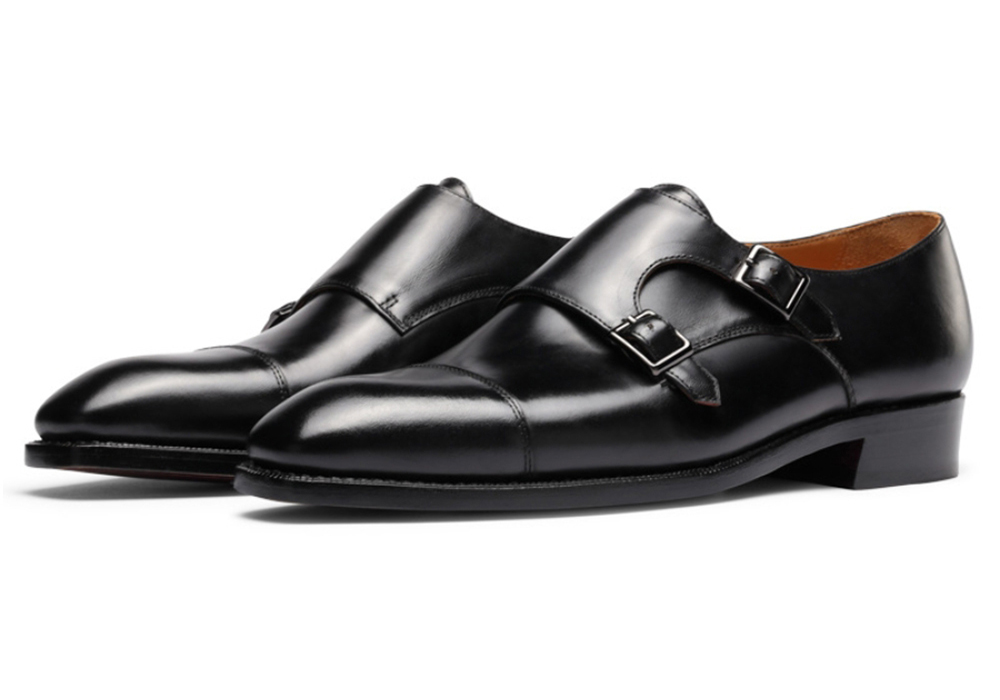
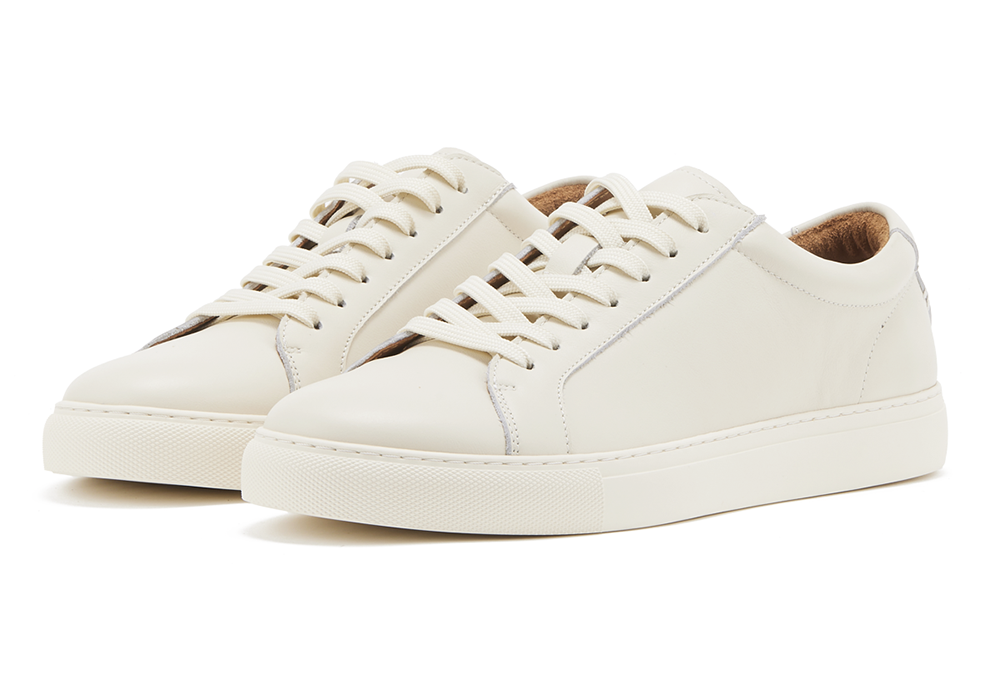
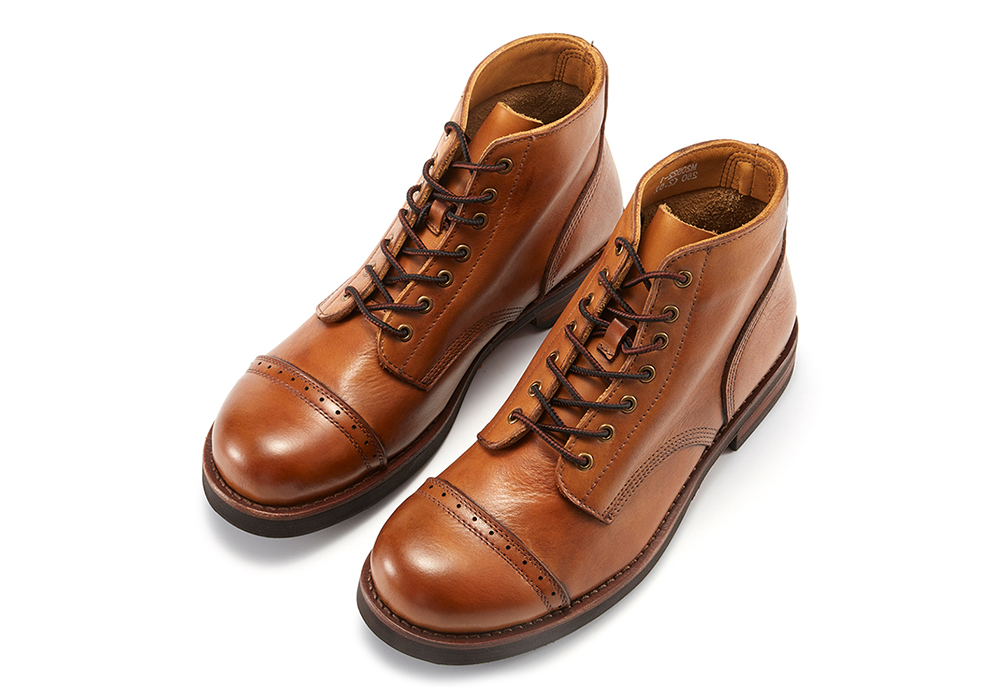
China manufactures roughly 57% of the world’s footwear — a share that has held remarkably steady despite years of tariff pressure, nearshoring trends, and post-pandemic supply chain reshuffling. For B2B buyers sourcing men’s leather dress shoes, finding the right shoe manufacturer China partner in 2026 still offers the best combination of price, scale, and technical capability available anywhere.
This guide walks you through a proven 5-step selection process, the verification steps that protect your brand, the regional hubs worth knowing, and the red flags that cost buyers money every year.
At Wincheer Shoes — a manufacturer located in Jiangmen, Guangdong (1.5 hours from Guangzhou), founded in 2007, producing 500,000+ pairs annually at $25–40/pair with a defect rate of just 0.8–1.2% (versus the industry average of 2–4%) — we’ve worked with 200+ brand partners across 50+ countries. The patterns that separate successful sourcing relationships from costly mistakes are consistent and learnable.
Table of Contents
- Why China Remains #1 for Shoe Manufacturing in 2026
- 5-Step Factory Selection Process
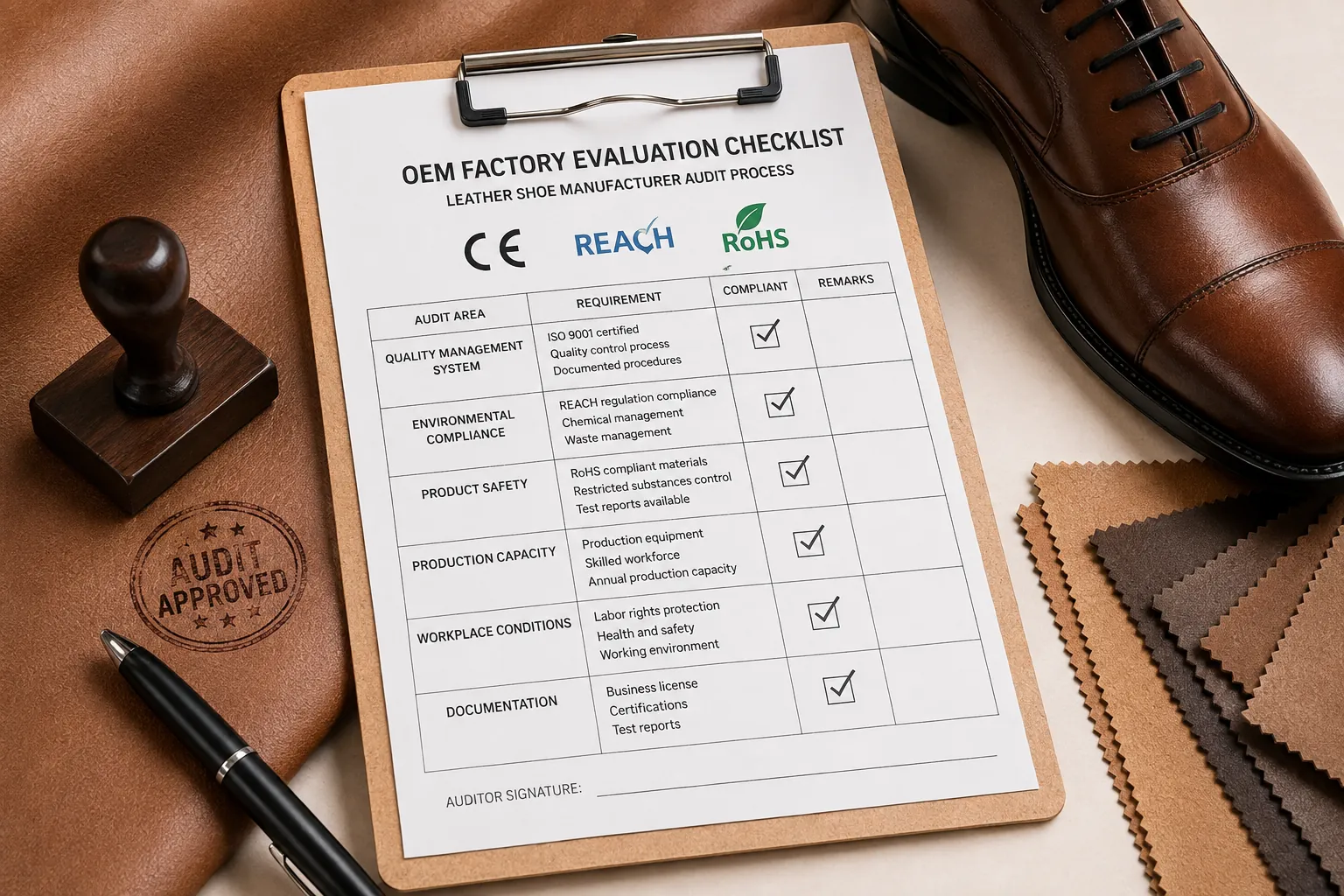
- Key Verification: Certifications and Audits
- Red Flags: Warning Signs of Unreliable Factories
- Major Shoe Manufacturing Hubs
- Guangzhou vs Wenzhou vs Jinjiang: Comparison
- Communication and Negotiation Tips for Western Buyers
- Sample Evaluation Checklist
- FAQ
- Ready to Start Your Shoe Line?
Why China Remains #1 for Shoe Manufacturing in 2026
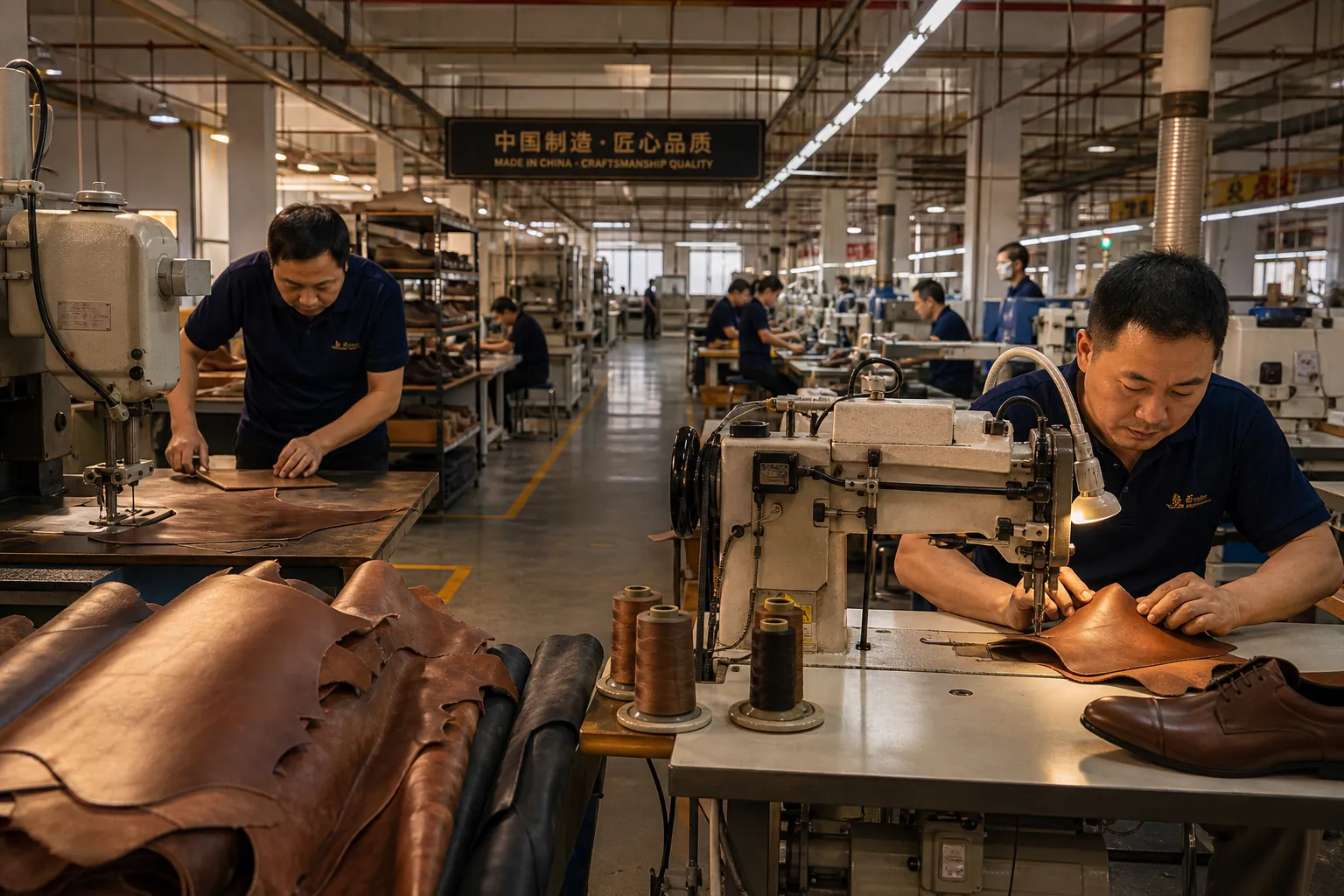
The structural advantages that built China’s footwear industry don’t disappear because of tariffs. The full supply chain — tanneries, lasts, hardware, thread, packaging — sits within a few hundred kilometers in clusters like Guangzhou and Wenzhou. No other country replicates that density.
Vietnam and Indonesia have grown, but they depend heavily on Chinese raw materials and component suppliers. When you source from a China shoe factory, you’re accessing that entire ecosystem, not just a sewing floor.
For men’s leather dress shoes specifically, China’s Goodyear welt craftsmen, leather-sourcing networks, and OEM/ODM infrastructure remain unmatched at the $25–40/pair FOB price point. Buyers targeting the EU, US, or Middle East premium market can hit quality benchmarks that competing regions struggle to meet at comparable cost.
The World Footwear Yearbook consistently ranks China first in both volume and export value. That’s not inertia — it’s infrastructure.
5-Step Factory Selection Process
Step 1: Research
Start with a defined product brief before you contact anyone. Know your construction type (Goodyear welt, Blake, cemented), target leather grade, size run, annual volume estimate, and price ceiling.
Source factory candidates from:
- Alibaba / Global Sources — useful for initial discovery, but verify independently
- Canton Fair (Guangzhou, April and October) — the most efficient in-person screening event
- Industry referrals — other brand owners in non-competing categories are the best source
- Trade databases like Panjiva or ImportGenius — shows actual export history
Build a shortlist of 8–12 factories before you start outreach. Narrowing too early means you miss better options.
Step 2: Verify
Request the following documents from every factory on your shortlist:
- Business license (营业执照) — confirms legal registration
- Export license or trading company status
- CE, REACH, or RoHS certificates (for EU-bound product)
- BSCI or SMETA audit report (within the last 24 months)
- Product liability insurance certificate
Cross-check business registration numbers on China’s National Enterprise Credit Information Publicity System (gsxt.gov.cn). It’s free, publicly accessible, and takes five minutes. Factories that resist sharing these documents are telling you something important.
Step 3: Audit
A document audit is not a factory audit. If your order volume justifies it — and anything above 500 pairs/year does — arrange a physical factory visit or commission a third-party audit through SGS, Bureau Veritas, or Intertek.
Key areas to assess during an audit:
- Production capacity vs. claimed output
- QC station placement (inline vs. end-of-line only)
- Leather and component storage conditions
- Worker skill level for your specific construction type
- Subcontracting practices (many factories outsource without disclosure)
Step 4: Sample
Never commit to a production order without a confirmed sample. Request a pre-production sample (PPS) made from your actual specified materials, not a showroom sample pulled from existing stock.
Evaluate the PPS against your tech pack. Document every deviation in writing before approving.
Step 5: Contract
A purchase order alone is not a contract. A proper supply agreement for shoe manufacturing should cover:
- Product specifications and approved sample as binding reference
- Quality acceptance standard (AQL level — typically AQL 2.5 for footwear)
- Lead time with penalty clauses
- IP ownership for custom designs and molds
- Payment terms (typically 30% deposit, 70% before shipment)
- Dispute resolution jurisdiction
Key Verification: Certifications and Audits
CE Marking (EN ISO 20347)
CE marking under EN ISO 20347 is mandatory for occupational footwear sold in the EU. For men’s dress shoes sold into European retail, CE certification signals that the factory has been tested against standardized safety and material requirements.
Verify that the certificate is current and covers your specific product category — not just a generic company-level certificate. Our CE marking footwear guide covers the full 2026 requirements in detail.
REACH and RoHS
REACH compliance ensures restricted chemicals (chromium VI, azo dyes, phthalates) stay below EU threshold levels. RoHS matters if your shoes include any electronic components (light-up soles, smart insoles).
Ask for the test report, not just a self-declaration. Reports should come from an accredited third-party lab.
BSCI / SMETA Audits
These social compliance audits verify labor practices, working hours, wages, and factory safety. Major EU and UK retailers require them. A BSCI audit report less than 24 months old is the minimum acceptable standard.
Red Flags: Warning Signs of Unreliable Factories
Experienced sourcing teams recognize these patterns immediately. New buyers learn them the hard way.
Documentation red flags:
- Certificates with no verifiable audit body or report number
- Business license registered in a different city than the claimed factory location
- Reluctance to share any document before you place an order
Pricing red flags:
- Quotes significantly below market rate ($18–22/pair for genuine leather dress shoes) — this signals material substitution
- No itemized cost breakdown available
- Price changes after sample approval without explanation
Communication red flags:
- Responses only from a sales rep who can’t answer technical questions
- No dedicated QC contact or production manager available for calls
- Promises of unrealistic lead times (e.g., 1,000 pairs in 7 days)
Operational red flags:
- Factory claims to produce everything: dress shoes, sneakers, boots, sandals, safety shoes — all in one facility
- No minimum order quantity at all (often means a trading company, not a factory)
- Showroom samples look excellent but factory visit reveals poor equipment
For a full sourcing checklist, see red flags when sourcing leather shoes from China.
Major Shoe Manufacturing Hubs
Guangzhou
Guangzhou is China’s premium leather footwear capital. The Huadu and Panyu districts host hundreds of factories specializing in men’s dress shoes, with direct access to the Pearl River Delta’s leather tanneries and hardware suppliers.
Guangzhou factories generally offer higher craftsmanship for Goodyear welt and Blake construction, stronger OEM/ODM capability, and better English-language communication. Price points are slightly higher than Wenzhou or Jinjiang, but the quality ceiling is also higher.
Wenzhou
Wenzhou (Zhejiang Province) is China’s largest footwear cluster by volume. The city has a long history in leather shoe manufacturing and strong domestic brand development. Wenzhou factories are competitive on price and efficient at scale.
The trade-off: quality consistency can vary more than in Guangzhou, and factories here often serve domestic Chinese brands first. Western buyers need to vet more carefully.
Jinjiang
Jinjiang (Fujian Province) dominates athletic and casual footwear. If your product line includes leather walking shoes or casual dress-casual hybrids, Jinjiang has relevant capacity. For formal dress shoes, it’s a secondary option.
Jinjiang factories are highly automated and efficient for high-volume, standardized product. Custom or complex constructions are less their strength.
Guangzhou vs Wenzhou vs Jinjiang: Comparison
| Factor | Guangzhou | Wenzhou | Jinjiang |
|---|---|---|---|
| Primary Specialty | Men’s dress & leather shoes | Leather shoes (all categories) | Athletic & casual footwear |
| Craftsmanship Level | High | Medium–High | Medium |
| Price Point (FOB) | $25–40/pair | $20–35/pair | $15–30/pair |
| OEM/ODM Capability | Excellent | Good | Good |
| English Communication | Good | Fair | Fair |
| Min. Order Flexibility | Moderate | Low–Moderate | Low |
| Best For | Private label dress shoes, EU/US brands | Volume orders, mid-market | Casual, athletic, high volume |
| Certifications Available | CE, REACH, RoHS, BSCI | CE, REACH, BSCI | CE, REACH |
Communication and Negotiation Tips for Western Buyers
Set Technical Expectations in Writing
Chinese factories work from tech packs. If you send a mood board and a verbal description, you will receive a sample that reflects someone’s interpretation of your idea. A proper tech pack includes: last shape, construction method, leather grade and finish, hardware specifications, stitching density, sole material and thickness, and colorway with Pantone references.
Understand the Pricing Structure
FOB pricing from a China shoe factory typically breaks down as: materials (45–55%), labor (20–25%), overhead (10–15%), and factory margin (10–15%). When you negotiate, you’re negotiating against material specs and volume — not squeezing labor. Buyers who push too hard on price get material substitutions, not efficiency savings.
The FOB shoe pricing guide breaks down all four Incoterms with real cost examples.
Communicate Through the Right Channel
WeChat is the standard business communication tool in China. Email is slower and often deprioritized. For complex technical discussions, schedule a video call with the factory’s production manager — not just the sales rep.
Build Relationship Before Leverage
Chinese business culture values long-term relationship (关系, guānxi) over transactional efficiency. Factories allocate their best production slots, QC attention, and flexibility to buyers they trust. Treating your first order as a test of leverage rather than a relationship investment is a common Western mistake.
Sample Evaluation Checklist
Use this checklist when evaluating a pre-production sample from any shoe manufacturer China partner:
Upper Construction
- [ ] Leather grade matches specification (pull-up, full-grain, corrected grain — confirm with scratch test)
- [ ] Stitching density matches tech pack (typically 8–10 stitches per inch for dress shoes)
- [ ] No exposed glue at seams or welt
- [ ] Toe box shape matches approved last
- [ ] Lining material and color correct
Sole and Construction
- [ ] Sole material confirmed (leather, rubber, TPR — check density and flexibility)
- [ ] Welt construction type verified (Goodyear, Blake, or cemented as specified)
- [ ] Heel height and stack height within ±2mm of spec
- [ ] Sole attachment integrity — no delamination at edges
Hardware and Finishing
- [ ] Eyelets, buckles, or zippers match specified finish (brushed nickel, antique brass, etc.)
- [ ] Laces correct length, material, and tip finish
- [ ] Edge finishing consistent (painted, burnished, or natural as specified)
- [ ] No color bleeding or uneven dye application
Fit and Comfort
- [ ] Last shape matches approved reference
- [ ] Insole padding and arch support as specified
- [ ] Size marking correct and legible
Packaging
- [ ] Shoe box dimensions correct for your SKU
- [ ] Tissue paper, dust bags, or other packaging components included as specified
- [ ] Labeling (country of origin, size, material content) compliant with destination market
For more on AQL inspection standards, see the AQL inspection footwear guide.
FAQ
Q: What is the typical MOQ when working with a shoe manufacturer China?
A: MOQ varies significantly. Trading companies often claim low MOQs but can’t hold them in production. Genuine factories typically require 60–200 pairs per style for custom orders. Some factories offer 0 MOQ on existing catalog designs, which is useful for testing new markets before committing to custom tooling.
Q: How long does it take from order confirmation to shipment?
A: Standard lead time for a new custom style is 45–60 days after sample approval and deposit receipt. Reorders of existing styles run 30–45 days. Factories quoting 15–20 days for custom orders are either overstating capacity or planning to cut corners.
Q: How do I verify a factory’s certifications are genuine?
A: Request the full certificate including the audit body’s name, report number, and expiry date. Cross-reference directly with the issuing body — SGS, Bureau Veritas, TÜV, and Intertek all have online verification portals. Self-issued or unverifiable certificates are a disqualifying red flag.
Q: What payment terms are standard for B2B shoe orders from China?
A: The most common structure is 30% T/T deposit upon order confirmation, 70% T/T balance before shipment against copy of bill of lading. For established relationships, 30/70 with the balance paid against documents through a bank is also common. Avoid factories demanding 100% upfront. See the payment terms guide for full details.
Q: Can I start a private label shoe brand with a small initial order?
A: Yes. Factories with