AQL inspection footwear: Understanding AQL Levels: The Foundation of Footwear Quality Control
AQL represents the maximum percentage of defective items considered acceptable in a random sample. For footwear, common AQL levels include:
AQL 1.0 (1% defect tolerance): Premium brands, luxury footwear
AQL 1.5 (1.5% defect tolerance): High-quality dress shoes, branded footwear
AQL 2.5 (2.5% defect tolerance): Standard commercial footwear
AQL 4.0 (4% defect tolerance): Budget footwear, promotional items
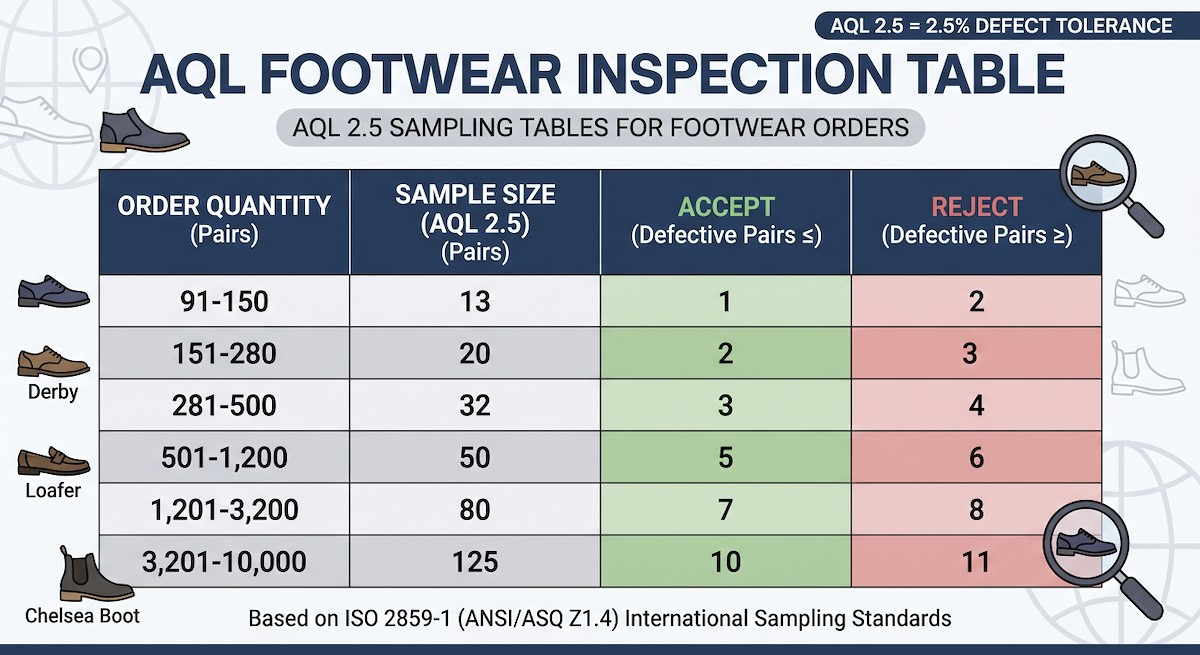
AQL Sampling Tables for Footwear Orders
| Order Quantity | Sample Size (AQL 2.5) | Accept | Reject |
|---|---|---|---|
| 91-150 pairs | 13 pairs | 1 | 2 |
| 151-280 pairs | 20 pairs | 2 | 3 |
| 281-500 pairs | 32 pairs | 3 | 4 |
| 501-1,200 pairs | 50 pairs | 5 | 6 |
| 1,201-3,200 pairs | 80 pairs | 7 | 8 |
| 3,201-10,000 pairs | 125 pairs | 10 | 11 |
The sampling methodology follows en.wikipedia.org international standards, ensuring statistical validity across different order sizes.
The 50-Point Shoe Inspection Checklist
Professional footwear inspection covers five critical areas, each containing 10 specific checkpoints:
Stitching Quality (10 Points)
- Seam straightness: Deviation tolerance ±2mm
- Stitch density: 8-12 stitches per inch for dress shoes
- Thread tension: No loose or overly tight stitches
- Color matching: Thread matches leather within acceptable variance
- Reinforcement: Double stitching at stress points
- Finishing: Clean thread cuts, no loose ends
- Consistency: Uniform stitch patterns throughout
- Strength: No skipped stitches or weak points
- Alignment: Proper seam placement and symmetry
- Durability: Stress testing at critical junctions
Leather Quality (10 Points)
- Surface finish: Consistent grain pattern and texture
- Color uniformity: No significant shade variations
- Defect inspection: No scars, holes, or blemishes
- Flexibility: Appropriate bend without cracking
- Thickness consistency: Uniform material gauge
- Edge finishing: Clean, sealed leather edges
- Marking clarity: Sharp, legible brand impressions
- Moisture resistance: Proper treatment application
- Aging resistance: No premature wear signs
- Chemical compliance: REACH regulation adherence
Sole Construction (10 Points)
- Attachment security: Proper bonding or stitching
- Material quality: Appropriate hardness and flexibility
- Tread pattern: Sharp, consistent molding
- Heel attachment: Secure mounting and alignment
- Wear resistance: Abrasion testing compliance
- Flexibility: Appropriate bend points
- Thickness uniformity: Consistent sole gauge
- Edge finishing: Clean, sealed perimeters
- Anti-slip properties: Adequate traction patterns
- Durability markers: No premature wear indicators
Alignment and Fit (10 Points)
- Left-right symmetry: Matching pair dimensions
- Heel counter alignment: Proper positioning and shape
- Toe box shape: Consistent last conformity
- Arch support: Appropriate curve and support
- Size accuracy: Compliance with sizing standards
- Width consistency: Uniform last application
- Interior smoothness: No rough seams or protrusions
- Insole positioning: Proper placement and adhesion
- Tongue alignment: Centered and functional
- Eyelet positioning: Symmetrical and functional
Finish and Presentation (10 Points)
- Polish quality: Even application and shine
- Hardware finish: Consistent metal treatments
- Packaging condition: Clean, undamaged presentation
- Labeling accuracy: Correct size, style, and brand marks
- Protective elements: Appropriate dust bags or boxes
- Accessory inclusion: Laces, care instructions, etc.
- Overall cleanliness: No manufacturing residue
- Brand presentation: Proper logo placement and quality
- Documentation: Accurate product information
- First impression: Professional retail-ready appearance
Critical vs Major vs Minor Defects: Classification Framework
Understanding defect classification helps prioritize quality issues and allocate inspection resources effectively.
Critical Defects (Zero Tolerance)
- Safety hazards: Sharp edges, toxic materials, structural failures
- Functional failures: Sole separation, heel detachment, size errors >0.5
- Regulatory violations: Non-compliance with safety standards
- Brand damage: Incorrect logos, trademark violations
Major Defects (AQL 2.5 Standard)
- Visible construction flaws: Poor stitching, leather defects, color variations
- Comfort issues: Interior roughness, inadequate padding, poor fit
- Durability concerns: Weak attachment points, premature wear indicators
- Aesthetic problems: Scratches, stains, asymmetry
Minor Defects (AQL 4.0 Standard)
- Cosmetic imperfections: Small marks, slight color variations
- Packaging issues: Minor box damage, missing accessories
- Documentation errors: Incorrect care labels, minor marking issues
- Presentation details: Dust, fingerprints, minor polish irregularities
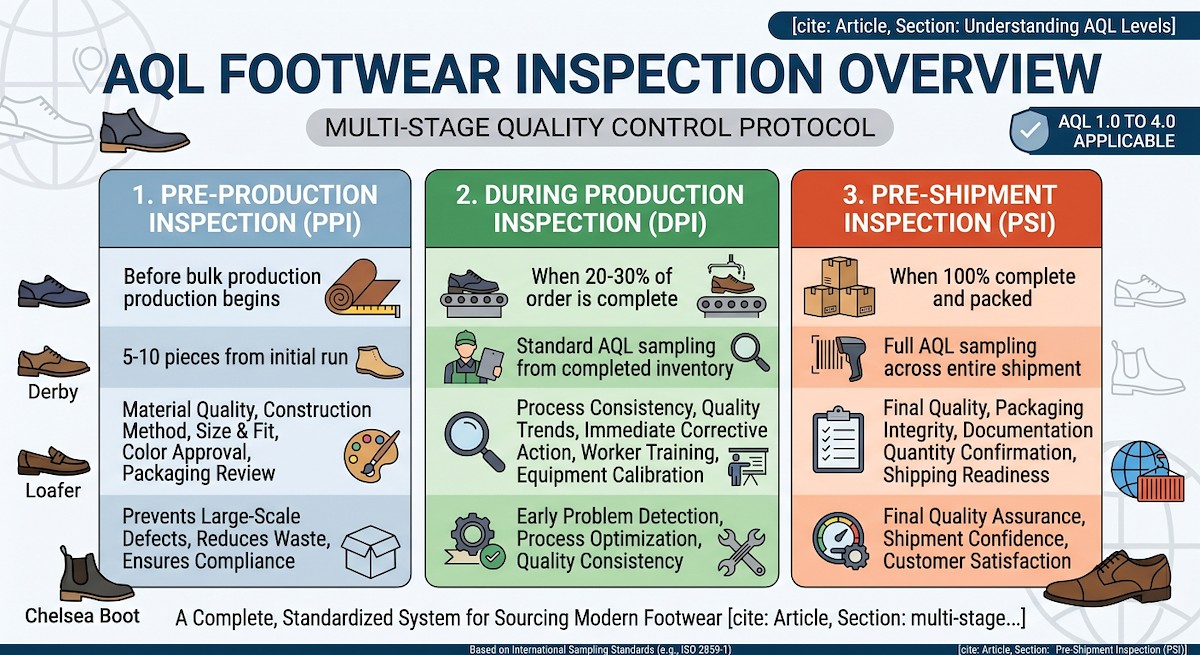
Multi-Stage Inspection Protocol
Effective quality control requires inspection at three critical production stages:
Pre-Production Inspection (PPI)
Timing: Before bulk production begins
Sample size: 5-10 pieces from initial production run
Focus areas:
- Material quality verification
- Construction method validation
- Size and fit confirmation
- Color approval
- Packaging review
Key benefits: Prevents large-scale defects, reduces waste, ensures specification compliance
During Production Inspection (DPI)
Timing: When 20-30% of order is complete
Sample size: Standard AQL sampling from completed inventory
Focus areas:
- Process consistency monitoring
- Quality trend identification
- Immediate corrective action implementation
- Worker training verification
- Equipment calibration check
Key benefits: Early problem detection, process optimization, quality consistency
Pre-Shipment Inspection (PSI)
Timing: When 100% of order is complete and packed
Sample size: Full AQL sampling across entire shipment
Focus areas:
- Final quality verification
- Packaging integrity
- Documentation accuracy
- Quantity confirmation
- Shipping readiness
Key benefits: Final quality assurance, shipment confidence, customer satisfaction
Defect Rate Economics: Why 1% vs 3% Matters
Many buyers treat defect rates as abstract numbers, but the financial impact is concrete and measurable. Understanding the real cost of defects helps justify investment in stricter AQL standards and better manufacturing partners.
Direct Cost of Defects
For a typical 5,000-pair order at $30/pair factory cost:
At 1% defect rate (50 pairs defective):
- Replacement production cost: $1,500
- Shipping replacements: $200
- Customer service handling: $500
- Total direct cost: $2,200 (0.73% of order value)
At 3% defect rate (150 pairs defective):
- Replacement production cost: $4,500
- Shipping replacements: $600
- Customer service handling: $1,500
- Total direct cost: $6,600 (2.2% of order value)
Indirect Cost Multipliers
Direct costs represent only 30-40% of the true defect impact:
- Return processing: Receiving, inspecting, and restocking or disposing of defective pairs costs $8-15 per unit
- Brand reputation damage: Each negative review influences 10-25 potential buyers
- Customer lifetime value loss: A customer who receives a defective pair has a 70% lower repeat purchase rate
- Retailer relationship strain: Consistent defect issues lead to chargebacks, order reductions, or partnership termination
Defect Prevention ROI
Investing in quality control pays measurable dividends:
| Prevention Investment | Annual Cost | Defects Prevented | Savings |
|---|---|---|---|
| AQL 1.5 vs 2.5 standard | $2,000-4,000 | 200-400 pairs | $6,000-12,000 |
| Pre-production inspection | $300-500 | 50-100 pairs | $1,500-3,000 |
| Third-party PSI | $500-800 | 100-200 pairs | $3,000-6,000 |
The data is clear: every dollar spent on prevention saves $3-5 in defect remediation costs.
Third-Party Inspection: When and How to Use Professional Services
When to Use Third-Party Inspection
High-value orders: Orders exceeding $50,000 warrant professional inspection
New suppliers: First-time partnerships require independent verification
Quality concerns: Previous issues or supplier inconsistencies
Regulatory requirements: Compliance verification for specific markets
Brand protection: Maintaining quality standards across multiple suppliers
Cost Structure and ROI
| Order Value | Inspection Cost | ROI Threshold |
|---|---|---|
| $10,000-25,000 | $300-500 | 2-5% defect prevention |
| $25,000-50,000 | $500-800 | 1.5-3% defect prevention |
| $50,000-100,000 | $800-1,200 | 1-2% defect prevention |
| $100,000+ | $1,200-2,000 | 0.5-1.5% defect prevention |
Leading Third-Party Inspection Providers
SGS: Global coverage, comprehensive footwear expertise
Bureau Veritas: Strong Asian presence, competitive pricing
Intertek: Technology-focused inspections, detailed reporting
TUV: European standards specialist, regulatory compliance
QIMA: Digital platform integration, real-time reporting
Factory 6-Gate Quality Control vs Industry Standard
| Quality Gate | Our Process | Industry Standard | Advantage |
|---|---|---|---|
| Material Incoming | 100% leather grading, chemical testing | Random sampling, visual check | 15% defect reduction |
| Pattern Cutting | Laser precision, waste tracking | Manual cutting, basic QC | 8% material efficiency |
| Assembly Line | Station-by-station inspection | End-of-line checking | 25% faster issue detection |
| Lasting Process | Automated fit verification | Manual last checking | 12% size accuracy improvement |
| Finishing Stage | 360-degree quality scan | Visual inspection only | 20% finish defect reduction |
| Final Packaging | AQL 1.5 + additional checks | Standard AQL 2.5 | 40% customer satisfaction increase |
This comprehensive approach, implemented across our Jiangmen factory, Guangdong, and our Shanghai/Jiangmen showrooms, enables us to serve 200+ partners across 50+ countries while maintaining our industry-leading 0.8-1.2% defect rate.
Quality Control Decision Framework
Use this checklist to establish your AQL inspection strategy:
Order Assessment
- [ ] Order value exceeds $25,000 (consider third-party inspection)
- [ ] New supplier relationship (require stricter AQL levels)
- [ ] Brand reputation critical (implement AQL 1.5 or better)
- [ ] Regulatory compliance required (verify certification standards)
- [ ] Previous quality issues (increase sampling frequency)
AQL Level Selection
- [ ] Premium positioning = AQL 1.0-1.5
- [ ] Standard commercial = AQL 2.5
- [ ] Budget/promotional = AQL 4.0
- [ ] Critical components = Zero tolerance
- [ ] Cosmetic elements = Higher tolerance acceptable
Inspection Timing
- [ ] Pre-production sample approval secured
- [ ] During-production inspection scheduled at 30% completion
- [ ] Pre-shipment inspection planned for 100% completion
- [ ] Documentation requirements clearly defined
- [ ] Corrective action protocols established
Supplier Communication
- [ ] AQL standards clearly communicated
- [ ] Defect classification examples provided
- [ ] Sampling methodology explained
- [ ] Rejection criteria established
- [ ] Improvement expectations set
Frequently Asked Questions
Q: What’s the difference between AQL 1.5 and AQL 2.5 for footwear orders?
A: AQL 1.5 allows 1.5% defective items in a statistically valid sample, while AQL 2.5 allows 2.5%. For a 1,000-pair order, this translates to accepting 15 vs 25 defective shoes. The stricter AQL 1.5 standard typically costs 10-15% more but significantly reduces customer complaints and returns.
Q: How many shoes should be inspected for a 5,000-pair order?
A: For AQL 2.5 inspection of 5,000 pairs, you would inspect 125 shoes randomly selected from the shipment. If 10 or fewer show defects, the lot passes. If 11 or more show defects, the entire shipment is rejected for rework or replacement.
Q: Can I inspect shoes myself, or do I need a third-party service?
A: Self-inspection is possible with proper training and checklists, but third-party services provide objective evaluation, specialized expertise, and liability protection. For orders over $50,000 or new supplier relationships, professional inspection typically pays for itself through defect prevention.
Q: What happens if my shoe shipment fails AQL inspection?
A: Failed shipments can be reworked (if defects are correctable), replaced (if timeline permits), or accepted at a reduced price with defect documentation. The specific remedy depends on your contract terms, defect severity, and delivery timeline requirements.
Q: How do I handle disputes when suppliers disagree with inspection results?
A: Establish clear defect classification criteria upfront, use photographic documentation, and consider independent re-inspection by a mutually agreed third party. Most disputes arise from unclear standards rather than actual quality differences, making detailed specifications essential.
Ready to Start Your Shoe Line?
Implementing professional AQL inspection standards transforms your footwear sourcing from guesswork into predictable quality outcomes. Whether you’re launching your first shoe line or scaling an existing brand, proper quality control protects your investment and builds customer loyalty.
Ready to work with a manufacturer that understands quality? Visit wincheershoes.com to discuss your footwear project. With a proven 6-gate quality system and 0.8-1.2% defect rate, we’ll help you build a shoe line that exceeds customer expectations.
Aql Inspection Footwear FAQ
Q: What is the most important factor when I want to AQL inspection footwear?
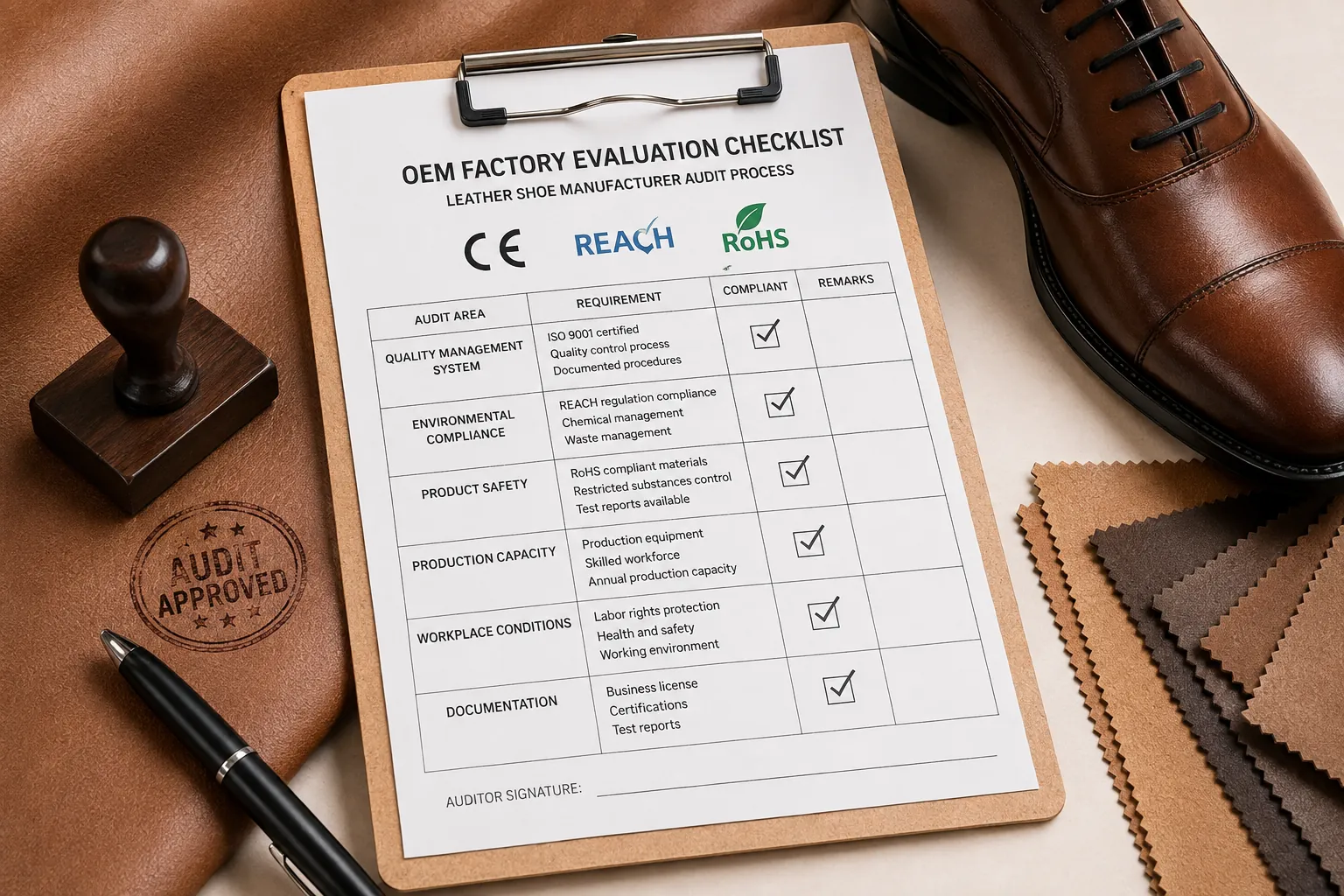
A: Finding a manufacturer with proven quality control and relevant certifications. Check for CE, REACH, or RoHS compliance and request defect rate data before committing.
Q: How much does it cost to AQL inspection footwear?
A: Costs vary by order size and customization level. Factory-direct OEM production from China typically ranges from $25-40 per pair, with lower per-unit costs at higher volumes.
Q: What is the minimum order quantity to AQL inspection footwear?
A: Traditional factories require 300-600 pairs, but some manufacturers like Wincheer Shoes offer as low as 60 pairs for custom designs and zero MOQ for existing styles.
Q: How long does the AQL inspection footwear process take from concept to delivery?
A: Expect 15-25 days for sampling and 30-60 days for bulk production. Established manufacturers can often compress timelines for repeat clients.
Q: What certifications should I verify before I AQL inspection footwear?
A: For EU markets, ensure CE (EN ISO20347) and REACH compliance. For general quality assurance, look for ISO 9001 certification and request third-party inspection reports from SGS or Intertek.