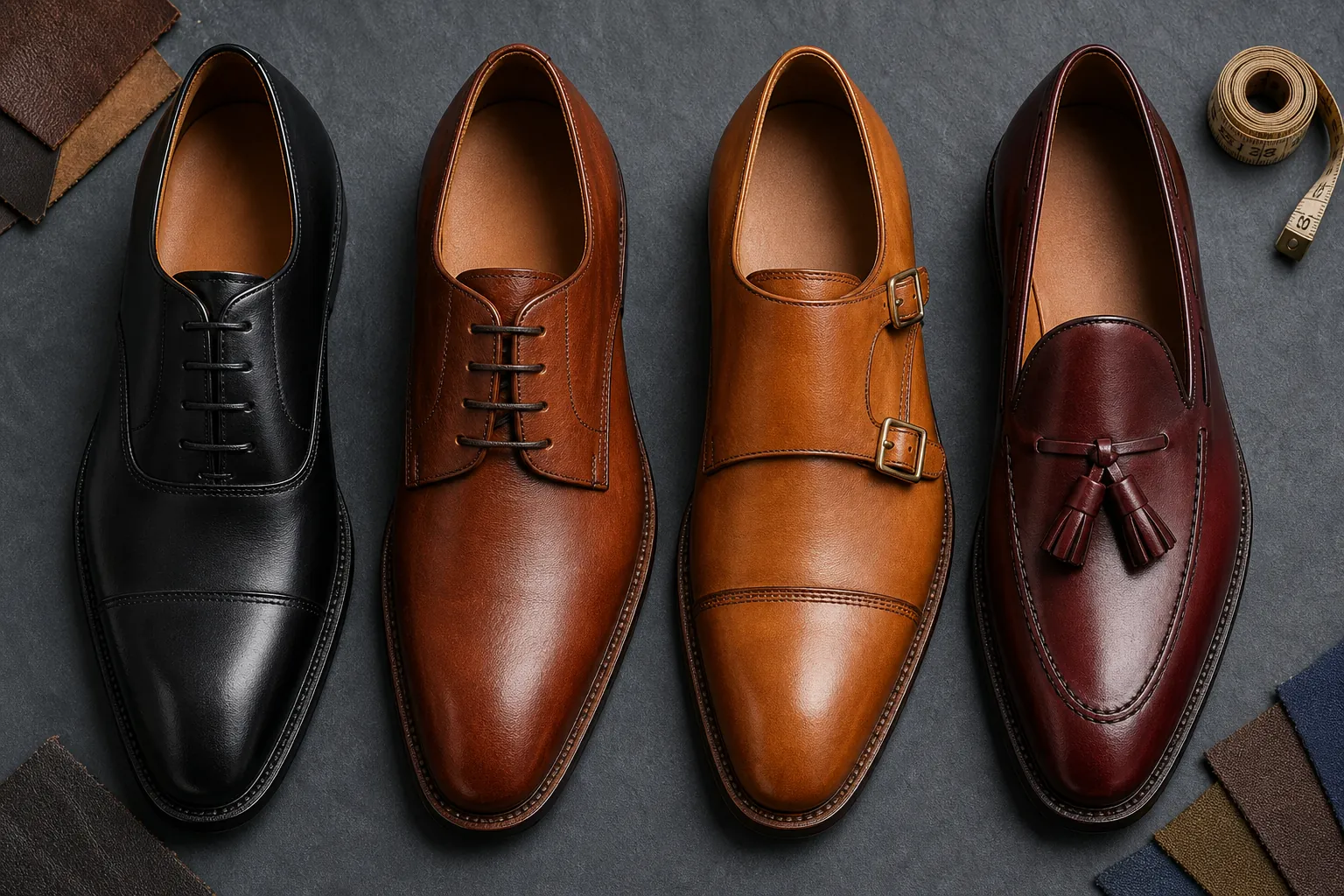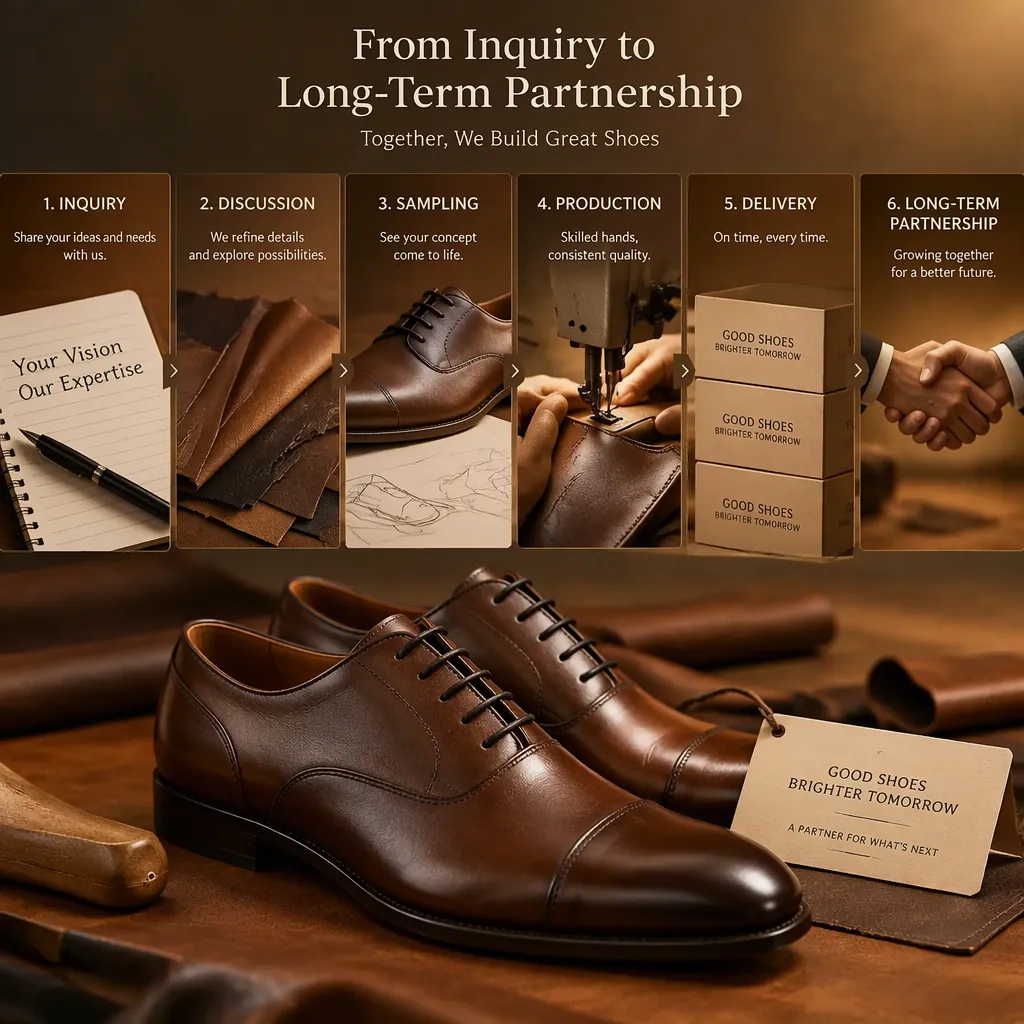

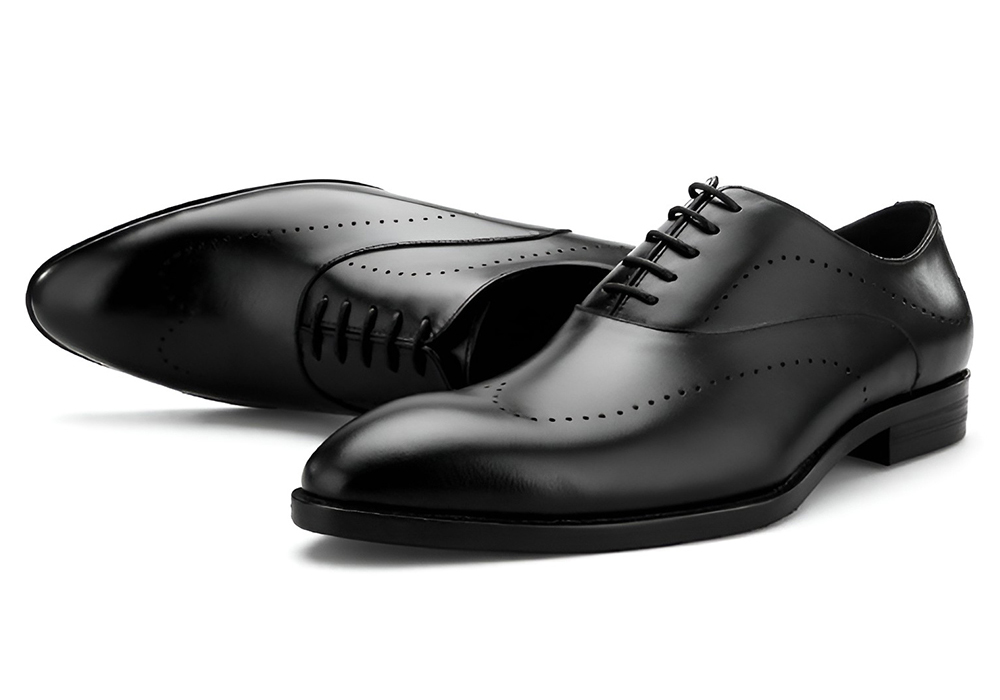
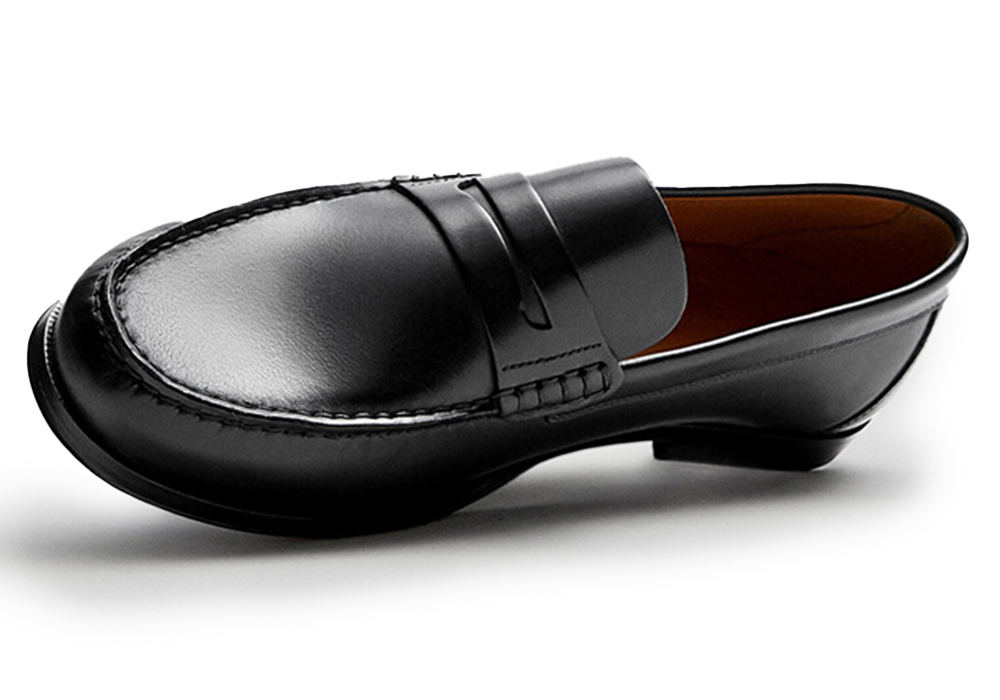
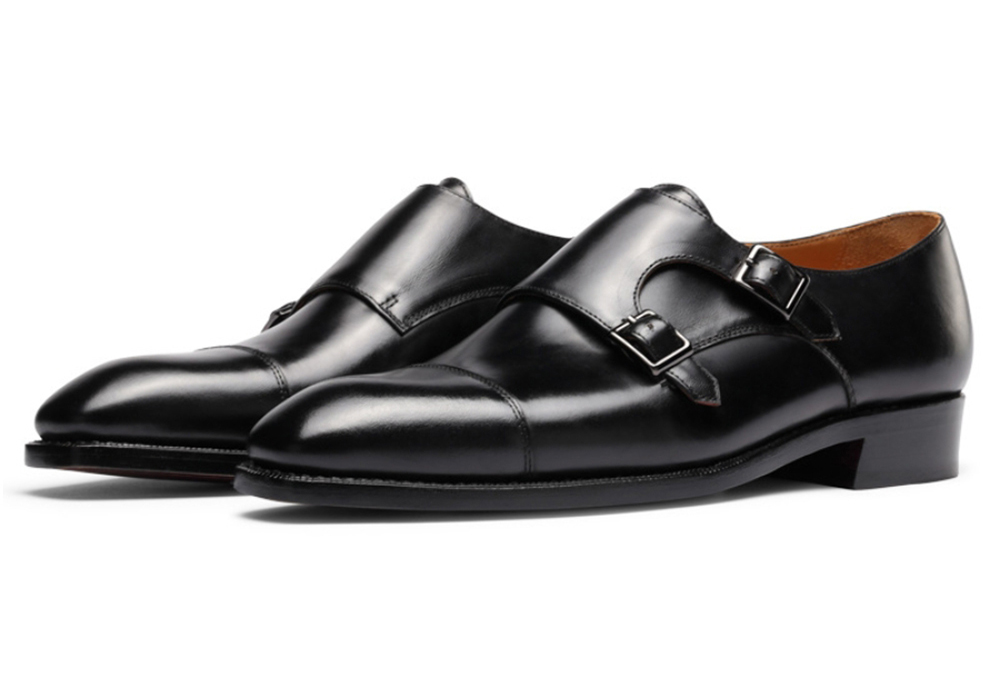
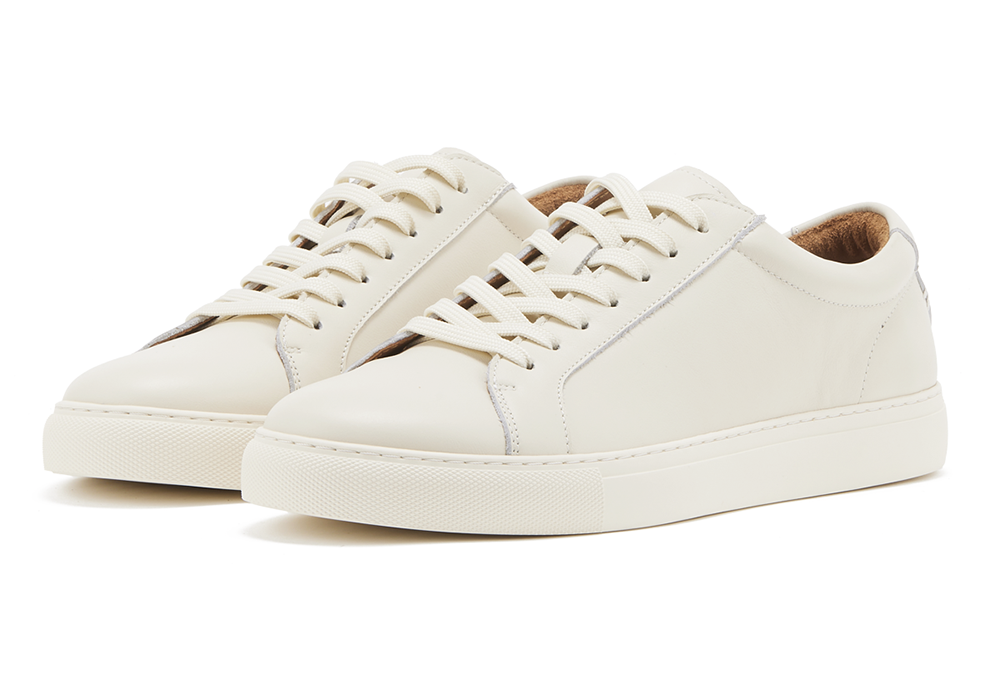
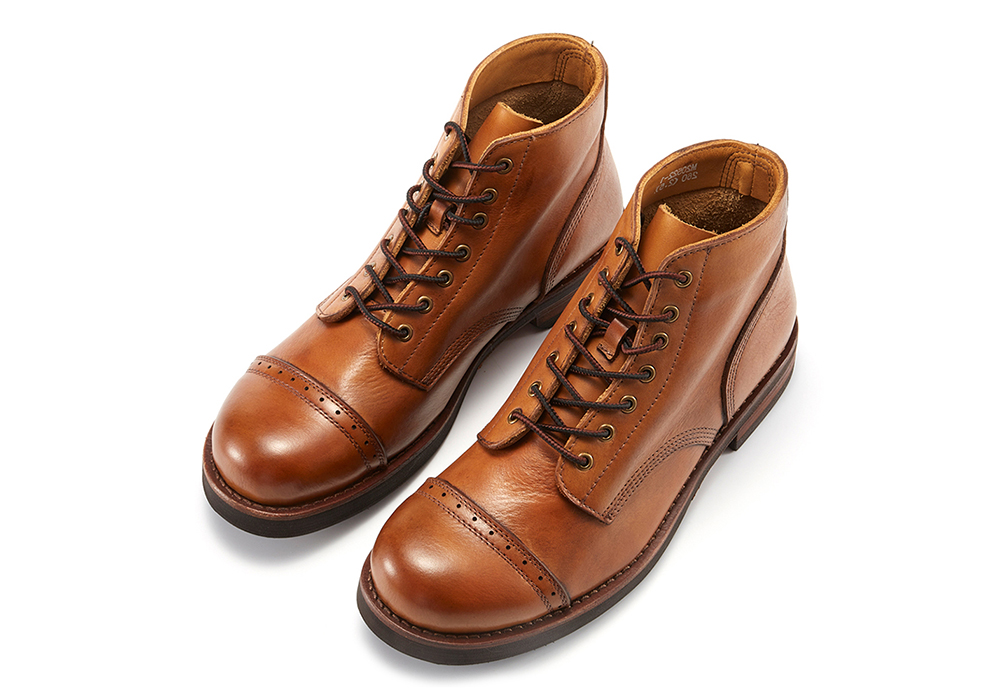
Quick Answer: Buying wholesale men’s shoes means purchasing finished footwear in bulk at trade pricing — typically 100–500 pairs per style at factory FOB, versus retail multiples of 2.5–4× for the same construction quality. The wholesale channel splits into four routes: buying from a manufacturer directly (best margin, needs MOQ), a trading company, a B2B marketplace, or a trade show. A wholesale order is won or lost on four clauses: MOQ, price terms, quality control, and container logistics.
Sourcing wholesale men’s shoes is a different game from retail buying. The prices look attractive — until a shipment arrives with the wrong sole hardness, missing hangtags, or a container that doesn’t fit your warehouse calendar. Most wholesale losses come from terms that were never written down, not from bad shoes.
This guide covers the wholesale vocabulary you need, how factory pricing actually breaks down, what a container physically holds, and the five audit steps that separate a reliable wholesale shoe supplier from an expensive lesson.
As a manufacturer producing 500,000+ pairs annually with a 0.8–1.2% recorded defect rate, Wincheer Shoes — founded in 2007, certified to CE (EN ISO 20347), REACH, and RoHS — runs wholesale programs for brand partners across Europe and North America, including dedicated bulk-production lines at our Jiangmen, Guangdong facility. The playbook below is how we and our buyers actually run bulk orders, not a retelling of generic sourcing advice.
Table of Contents
- What Does Buying Shoes Wholesale Actually Mean?
- Which Wholesale Route Should You Choose?
- What Do the 12 Core Wholesale Terms Actually Mean?
- How Is Wholesale Shoe Pricing Structured?
- How Many Pairs Fit in a Shipping Container?
- How Do You Audit a Wholesale Shoe Supplier?
- What Quality Control Should a Wholesale Order Include?
- How Does OEM/ODM Wholesale Differ from Stock Wholesale?
- FAQ
- Ready to Source Wholesale Men’s Shoes?
What Does Buying Shoes Wholesale Actually Mean?
Wholesale means buying finished goods in quantity directly from the producer or an authorized distributor, at a price tier below retail. In footwear, wholesale pricing typically runs 40–70% below retail for equivalent construction — a $60 retail slip-on usually trades at $12–$20 wholesale FOB from a Chinese factory.
Three structural differences separate wholesale from retail buying:
- Quantity commitment. Retail buys one pair; wholesale buys by the style-color size run, typically 100–500 pairs minimum per style. (MOQ mechanics below.)
- Price basis. Wholesale quotes are FOB (free on board) or EXW (ex-works) — they exclude freight, duties, and clearing. Your landed cost adds ocean/air freight, insurance, and import duty on top.
- Terms enforcement. A wholesale deal is governed by a PI (Proforma Invoice) + sales contract, not a checkout page. Whatever is not in the PI — hangtags, carton marking, QC standard, spare laces — is whatever you will (or won’t) receive.
Which Wholesale Route Should You Choose?
There are four routes to wholesale mens footwear, each with a distinct risk/effort profile:
| Route | Typical Price | MOQ | Best For | Main Risk |
|---|---|---|---|---|
| Direct from manufacturer | Lowest (factory FOB) | 100–500 pairs/style | Brands building a repeatable line | Longer lead time, needs specs |
| Trading company | +8–15% over factory | Often lower | Small mixed orders | Zero control over production |
| B2B marketplace (Alibaba etc.) | Mid | Varies by supplier | First-time buyers | Agent intermediaries, sample-to-bulk gap |
| Trade show (Canton Fair etc.) | Factory-direct at booth | Same as factory | Vetting in person, relationship building | Time cost of the trip |
The manufacturer-direct route costs the least and gives you production control — but it only works if you can communicate specs and accept the MOQ. The trade-show route is underrated: meeting a factory at its booth lets you check real samples in hand, not photos.
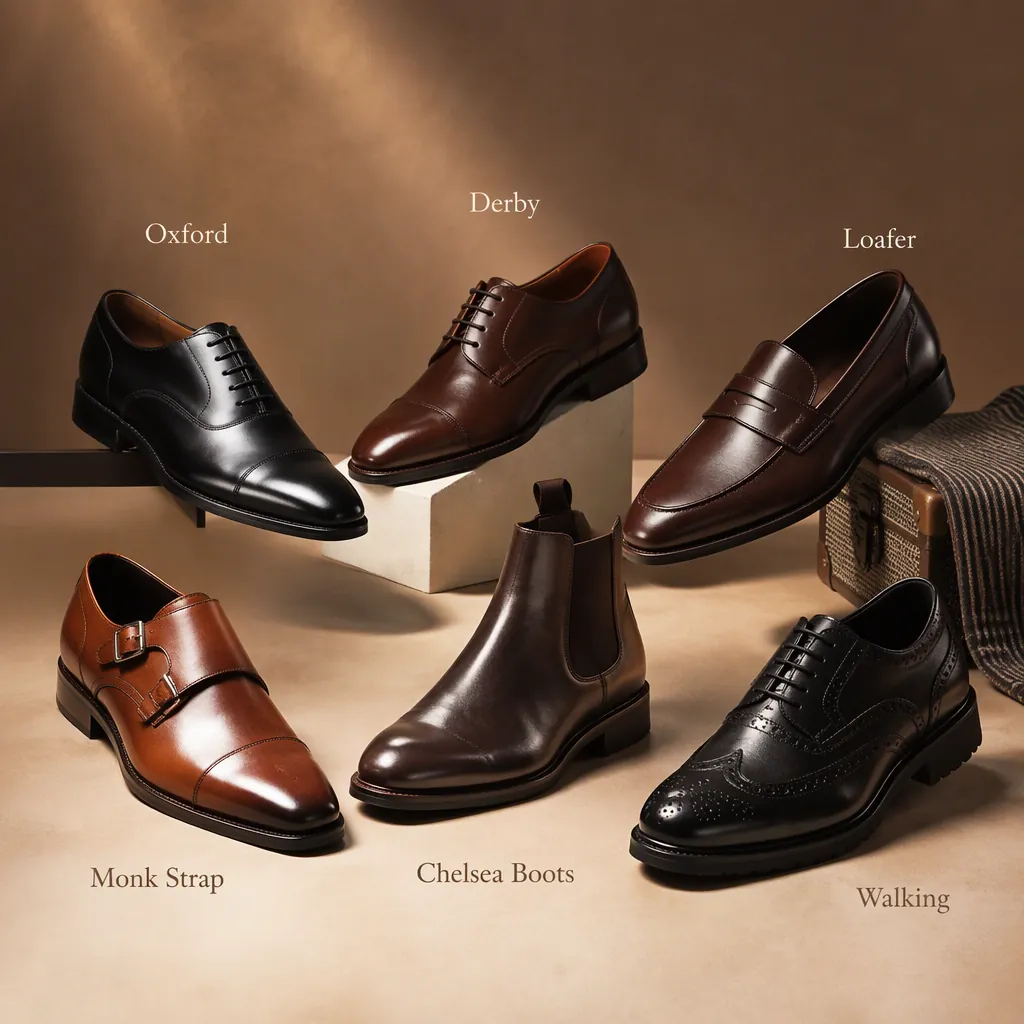
First-hand evidence (company trade-show record): Wincheer Shoes exhibited at the 140th Canton Fair (cantonfair.org.cn, October 2026, Guangzhou) with our full men’s leather line on the booth wall — oxfords, derbies, loafers, monk straps, Chelsea boots, and walking-style shoes. Buyers from the EU, US, and Africa held the actual production samples, checked the stitching in person, and discussed MOQ and price face to face at the booth. If you’re sourcing wholesale, a booth meeting compresses weeks of email vetting into an afternoon. (Source tier: first-hand company record.)
What Do the 12 Core Wholesale Terms Actually Mean?
Wholesale contracts fail on vocabulary before they fail on quality. These twelve terms carry the money:
| Term | Meaning | Why It Matters |
|---|---|---|
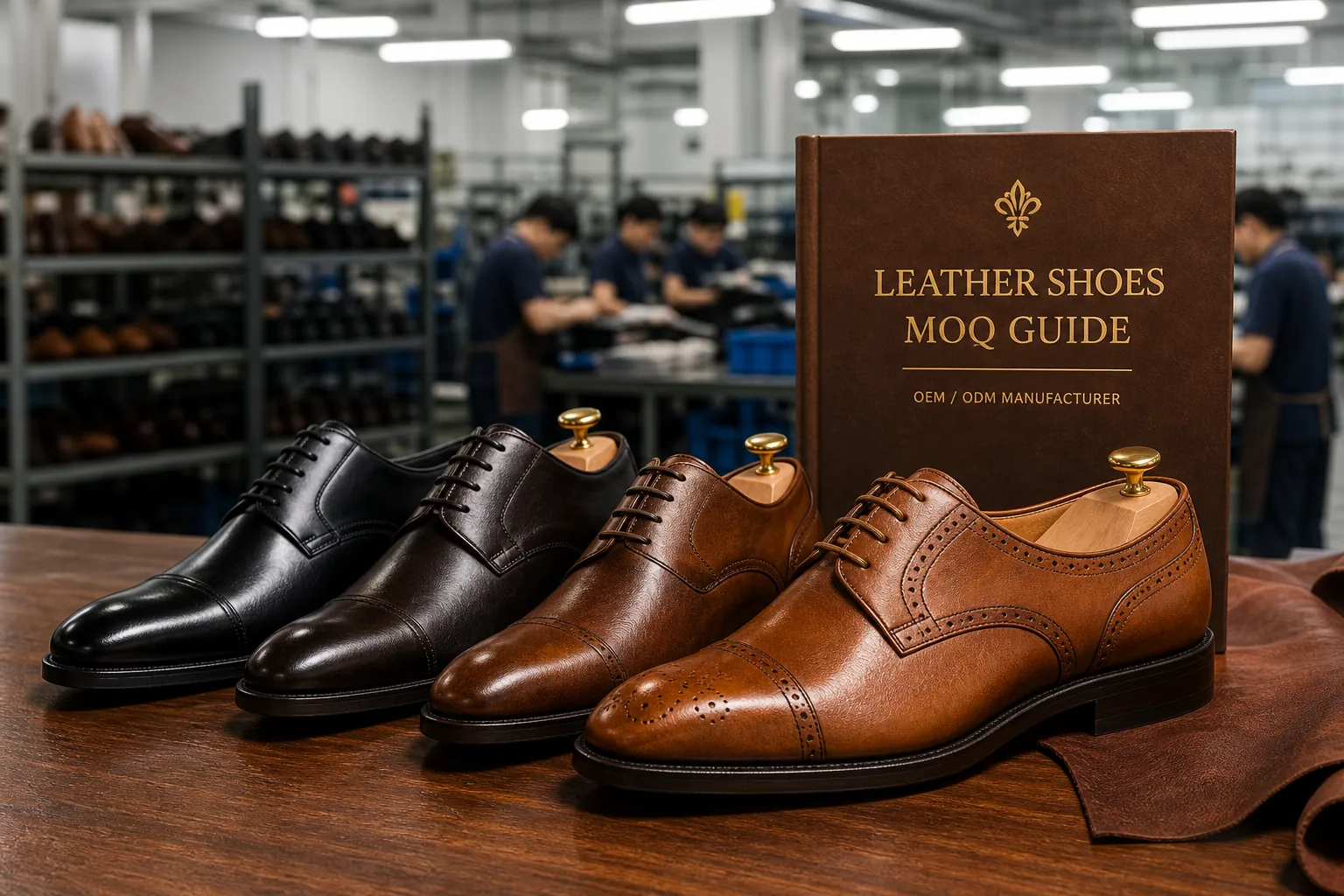
| MOQ | Minimum Order Quantity — fewest pairs per style a factory accepts | Wincheer runs 60 pairs trial-order MOQ for new partners; standard bulk MOQ 300 pairs/style |
| FOB | Free On Board — price includes delivery onto the ship at the Chinese port | The standard comparison basis; excludes freight & duty |
| EXW | Ex Works — factory-gate price; you arrange everything after | Cheapest quote, most work for you |
| L/C at sight | Letter of Credit paid on document presentation | Bank-guaranteed payment for first orders |
| T/T | Telegraphic Transfer — bank wire, usually 30% deposit + 70% before shipment | Standard for repeat orders |
| PI | Proforma Invoice — the offer document that becomes the contract | Every clause you care about lives here |
| Size run | The size breakdown within one style-color (e.g. 40–46) | Determines your sell-through; 40–46 is the common EU men’s band |
| Lead time | Deposit-to-shipment time | Typical bulk: 45–60 days after deposit & samples approved |
| Carton marking | Shipping marks printed on master cartons | Wrong marks = customs/distribution delays |
| ODM | Original Design Manufacturer — factory’s design, your brand | Fastest to market, no design fee |
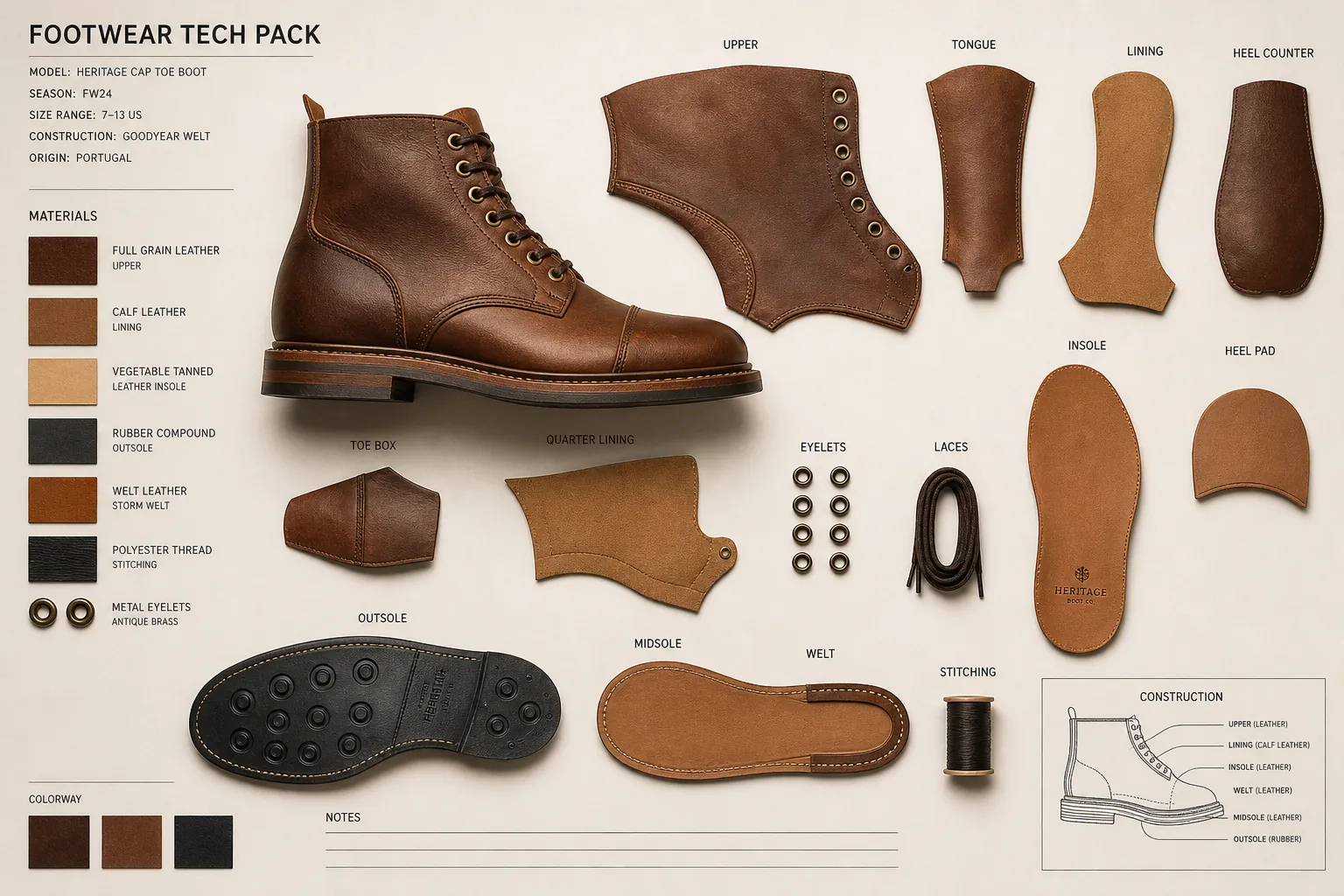
| OEM | Original Equipment Manufacturer — your design, factory executes | Needs a tech pack |
| SGS/BV inspection | Third-party pre-shipment inspection (Bureau Veritas) | Bookable per container, ~$300–500 |
The 60-pair trial MOQ deserves emphasis. Most factories gate new buyers behind 300-pair commitments; a 60-pair trial order lets you test the factory’s quality on a real production run — not a sample-pair hand-made by the sample room — before committing bulk volume. (Full MOQ FAQ here.)
How Is Wholesale Shoe Pricing Structured?
A factory FOB quote decomposes into five cost layers. Understanding them tells you which negotiation levers actually move price:
| Cost Layer | Typical Share | Buyer’s Lever |
|---|---|---|
| Materials (upper, lining, sole, hardware) | 50–65% | Leather grade (full-grain vs corrected), sole type |
| Labor (cutting, stitching, lasting, finishing) | 15–25% | Construction method (cemented vs welted) |
| Factory overhead & margin | 10–20% | Order volume, repeat business |
| Packaging (boxes, hangtags, tissue) | 3–8% | Packaging spec level |
| Export costs (inland, docs, port charges) | 2–5% | Trade terms (EXW vs FOB) |
Two implications:
- Volume discounts are real but bounded. Doubling order quantity typically moves FOB 3–8%, because materials dominate the cost base — a factory can’t discount leather it hasn’t bought cheaper.
- The cheapest quote often signals thinner materials. If one factory quotes $14 and another $19 for the same sketch, the $14 pair is almost always a material-grade difference — corrected-grain vs full-grain upper, cheaper lining, lighter sole. Ask for the material spec in writing before comparing prices.
How Many Pairs Fit in a Shipping Container?
Container planning fails when buyers estimate by “pairs” instead of by carton volume. Men’s dress shoes ship in inner boxes of one pair, master cartons of 10 pairs/carton, with real-world master carton dims around 65×45×35 cm (~0.10 CBM).
| Container | Volume | Usable Load | Practical Capacity (men’s shoes) |
|---|---|---|---|
| 20ft GP | 33 CBM | 28–32 CBM | ~280–320 cartons ≈ 2,800–3,200 pairs |
| 40ft GP | 67 CBM | 55–60 CBM | ~550–600 cartons ≈ 5,500–6,000 pairs |
| 40ft HQ | 76 CBM | 65–70 CBM | ~650–700 cartons ≈ 6,500–7,000 pairs |
Worked example: 400 pairs of men’s oxfords = 40 master cartons ≈ 4 CBM — an LCL (less-than-container-load) shipment, not a container. 10 styles × 500 pairs = 500 cartons ≈ 50 CBM — half-to-full 40ft territory, where most buyers switch from LCL to a dedicated container. You cross into full-container volume around 5,000–6,000 pairs, which is why most first-time buyers ship LCL and consolidate.
First-hand evidence (factory shipping records): Our Jiangmen warehouse loads EU-bound containers weekly. Two practical rules from repeated loadings: (1) never let the factory mix styles inside one master carton unless you approved a packing list — mixed cartons slow down your customs and distribution; (2) boot styles run ~1.4× the carton volume of oxfords — a 40ft HQ that swallows 2,000 cartons of oxfords fits roughly 1,400 of Chelsea boots. Plan your mixed-style container on the bulkiest style, not the average. (Source tier: first-hand company record.)
How Do You Audit a Wholesale Shoe Supplier?
Five checks, in order. A supplier that fails any of the first two is not a wholesale partner — it’s a lottery ticket.
Step 1 — Legal entity & export license. Get the registered company name, business license number, and export rights. A factory without its own export license ships through an agent, which inserts a margin layer and a blame layer.
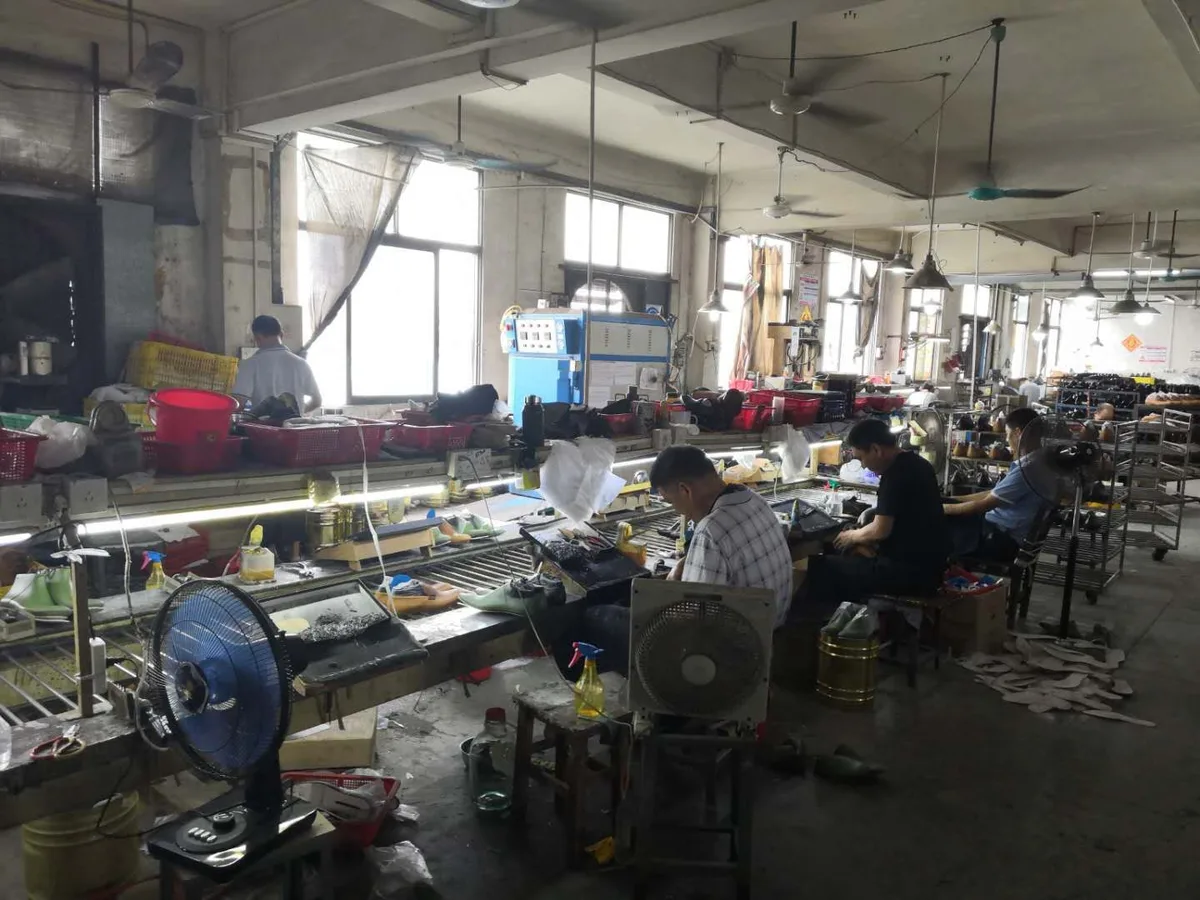
Step 2 — Production site verification. Photos are not verification. Acceptable evidence: a live video walkthrough of the stitching and lasting lines with your style on the line, or a third-party audit report (SGS/BV/TÜV) dated within 12 months. Wincheer’s Jiangmen facility runs 6 dedicated lines; visitors are welcome to tour in person.
Step 3 — Sample-to-bulk consistency check. Ask the supplier: “Will bulk production use the same production line and the same material batch as this sample?” Get the answer in writing. The classic wholesale failure is a beautiful sample-pair made in the sample room, followed by a bulk run on a different line with cheaper leather.
Step 4 — QC standard in the PI. The PI must state: AQL level (e.g. AQL 2.5 for major defects), inspection timing (inline + pre-shipment), and whether you may book third-party inspection. Wincheer ships with a recorded 0.8–1.2% defect rate across bulk orders, verified at inline and pre-shipment gates.
Step 5 — References from your market. One reference call to a brand in your own market tells you more than ten product photos. Ask the reference about two things only: on-time rate and how the factory handled its last defect claim.
What Quality Control Should a Wholesale Order Include?
A wholesale QC plan has three gates. Skipping a gate to save a week usually costs a container.
| Gate | When | What Gets Checked | Fail Action |
|---|---|---|---|
| Incoming (IQC) | Leather & materials arrive | Substrate grade vs spec, azo-dye compliance (REACH), color lot match | Reject lot before cutting |
| Inline | ~20% of production done | Stitching density, lasting symmetry, cement coverage | Correct on the line, not after |
| Pre-shipment (FQC) | 100% produced, ~80% packed | AQL sampling, carton drop test, marking vs packing list | Hold shipment, rework, re-inspect |
Two buyer-side habits that matter more than any certificate:
- Approve a golden sample. Sign and seal one reference pair; bulk is judged against it, not against memory or renders.
- Write the defect disposition. State in the PI what happens at, say, 1.5% major defects — re-inspection at whose cost, re-work, or discount schedule. Unwritten dispositions become negotiated losses.
How Does OEM/ODM Wholesale Differ from Stock Wholesale?
“Wholesale” covers three different procurement modes, and mixing them up is the most common first-order mistake:
| Mode | You Provide | Factory Provides | MOQ Reality | Best For |
|---|---|---|---|---|
| Stock wholesale | Payment | Ready-made designs | As low as 50–100 pairs, ships in days | Testing a market fast |
| ODM | Brand + logo | Factory’s existing designs | 300–500 pairs/style | Fast market entry, no design cost |
| OEM | Complete tech pack | Your design, your spec | 300–500 pairs/style (60-pair trial at Wincheer) | Building a distinct brand line |
OEM wholesale is where margins and brand equity live — but it demands specification discipline. If you’re coming from the stock-mentality side, read the OEM vs ODM explainer and the China B2B sourcing guide before comparing quotes; a $2 FOB gap between two OEM quotes usually means one factory quietly downgraded a material layer.
FAQ
What is a good MOQ for wholesale men’s shoes?
For a new factory relationship, look for a 60–100 pair trial MOQ on real production lines, moving to 300 pairs/style for bulk. Factories demanding 1,000+ pairs from an unknown buyer are shifting their risk onto you. Wincheer’s trial MOQ is 60 pairs.
How much do wholesale men’s shoes cost per pair?
Factory FOB from China: $12–$20 for cemented casual styles, $18–$35 for Blake-stitched dress shoes, $28–$45 for Goodyear-welted boots, depending on leather grade and sole type. Retail multiples are typically 2.5–4× FOB.
Is it cheaper to buy wholesale from a factory or a marketplace?
Factory-direct is cheapest and gives production control, but requires MOQ and spec communication. Marketplaces suit first orders under 300 pairs where convenience outweighs the 8–15% intermediary margin. Once volume is repeatable, direct wins on both price and quality control.
How long does a wholesale shoe order take?
Stock wholesale ships within days. OEM/ODM bulk runs 45–60 days from deposit to shipment: ~7–10 days materials, 20–25 days production, plus inline and pre-shipment inspection windows. Add 25–35 days ocean freight to EU/US coasts.
What certificates should a wholesale shoe supplier have?
For EU-bound goods: REACH (azo dyes and restricted substances), CE where applicable (EN ISO 20347 for occupational footwear), and material declarations. For US-bound: CPSIA compliance and California Prop 65 awareness. Wincheer holds CE (EN ISO 20347), REACH, and RoHS certifications.
Can I mix styles in one wholesale order?
Yes — factories accept multi-style orders, and most buyers mix 4–10 styles to hit MOQ economically. Two rules: keep one style per master carton (mixed cartons slow customs), and plan container volume on your bulkiest style.
Do wholesale suppliers provide private labeling?
Full-service manufacturers do: logo on insole sock, heel counter, shoe bag, and box — plus custom hangtags. Private label is standard at Wincheer; the minimum is usually just your vector logo file. See our private label manufacturing guide.
How do I verify a wholesale shoe factory is real, not a trader?
Three checks: business license with manufacturing scope, live video of the production floor (ask them to walk the stitching line), and a third-party audit report under 12 months old. Traders can fake catalogs but not a live floor tour on demand.
Ready to Source Wholesale Men’s Shoes?
Wincheer Shoes has run wholesale and OEM programs for brand partners across Europe and North America since 2007 — 500,000+ pairs a year across six production lines in Jiangmen, Guangdong, with a 60-pair trial MOQ for new partners and a recorded 0.8–1.2% bulk defect rate.
Request a wholesale quote → · See the factory · Browse men’s styles