China accounts for over $40 billion in annual footwear exports — roughly 60% of global leather shoe supply. For B2B buyers, private label brands, and cross-border sellers, choosing the right leather shoe exporter China strategy directly impacts your landed cost, product quality, and delivery reliability.
This guide cuts through the noise and gives you a factory-level view of how export channels actually work, what documentation you need, and where most buyers lose money.
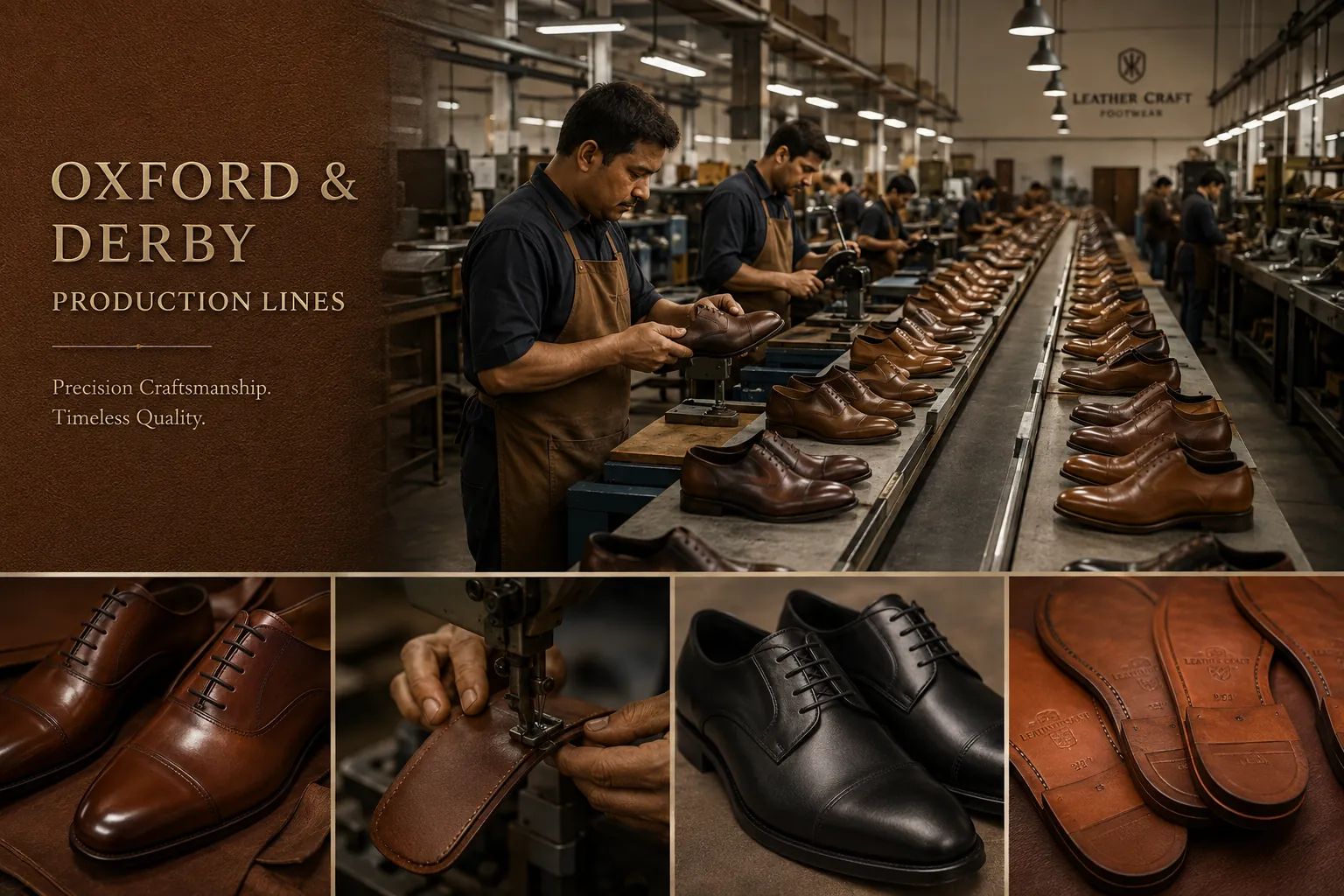
As a manufacturer producing 500,000+ pairs annually since 2007, Wincheer Shoes ships to 50+ countries with a defect rate of 0.8–1.2% (versus an industry average of 2–4%). Our CE (EN ISO20347), REACH, and RoHS certifications cover key markets across the EU, UK, and beyond. That operational context shapes every recommendation in this article.
Leather Shoe Exporter China Shipping Guide: Table of Contents
- Why China Dominates Global Leather Shoe Export
- 5 Export Channels Compared: Cost, Speed, Control
- Export Documentation Checklist
- Certifications Required by Market
- FOB, CIF, and DDP: Real Shipping Cost Examples
- Common Export Pitfalls and How to Avoid Them
- Export Channel Comparison Table
- FAQ
Why China Dominates Global Leather Shoe Export
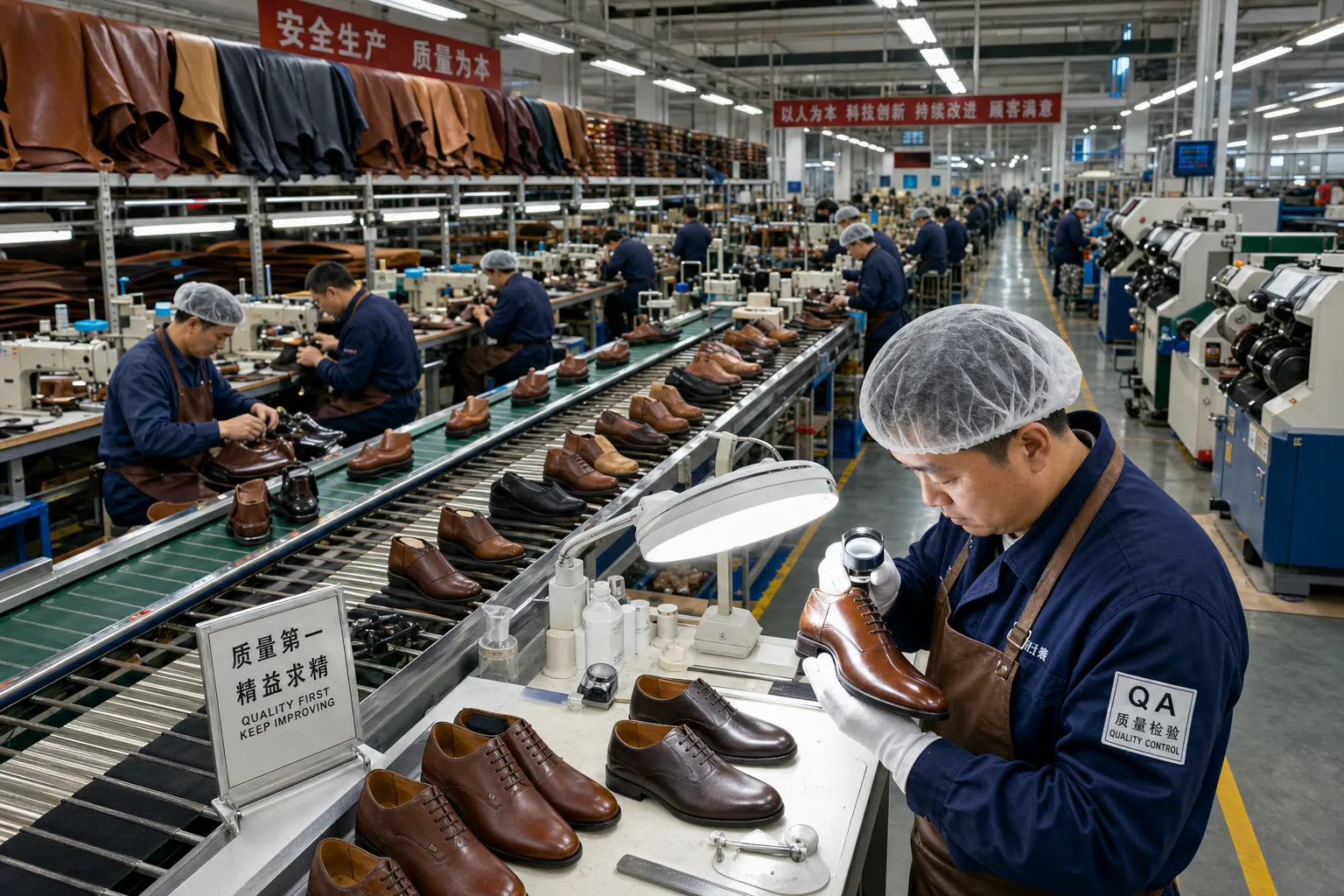
China’s dominance in leather footwear isn’t just about cheap labor. It’s about vertically integrated supply chains — tanneries, component suppliers, last manufacturers, and packaging producers all within a few hundred kilometers of major factories in Guangdong, Zhejiang, and Fujian provinces. For an overview of the leading production facilities, see our guide to the top 10 shoe factories in China.
Guangzhou alone hosts thousands of shoe factories ranging from small workshops to certified export-grade operations. The infrastructure for global shipping — ports, freight forwarders, customs brokers — is mature and highly competitive. To understand why China remains the top choice over other Asian manufacturing hubs, see our analysis on which country is best for manufacturing shoes.
For buyers in Europe, North America, the Middle East, and Southeast Asia, sourcing direct from a China-based leather shoe exporter typically delivers 30–50% cost savings versus importing through regional distributors.
5 Export Channels Compared: Cost, Speed, Control
1. Factory Direct
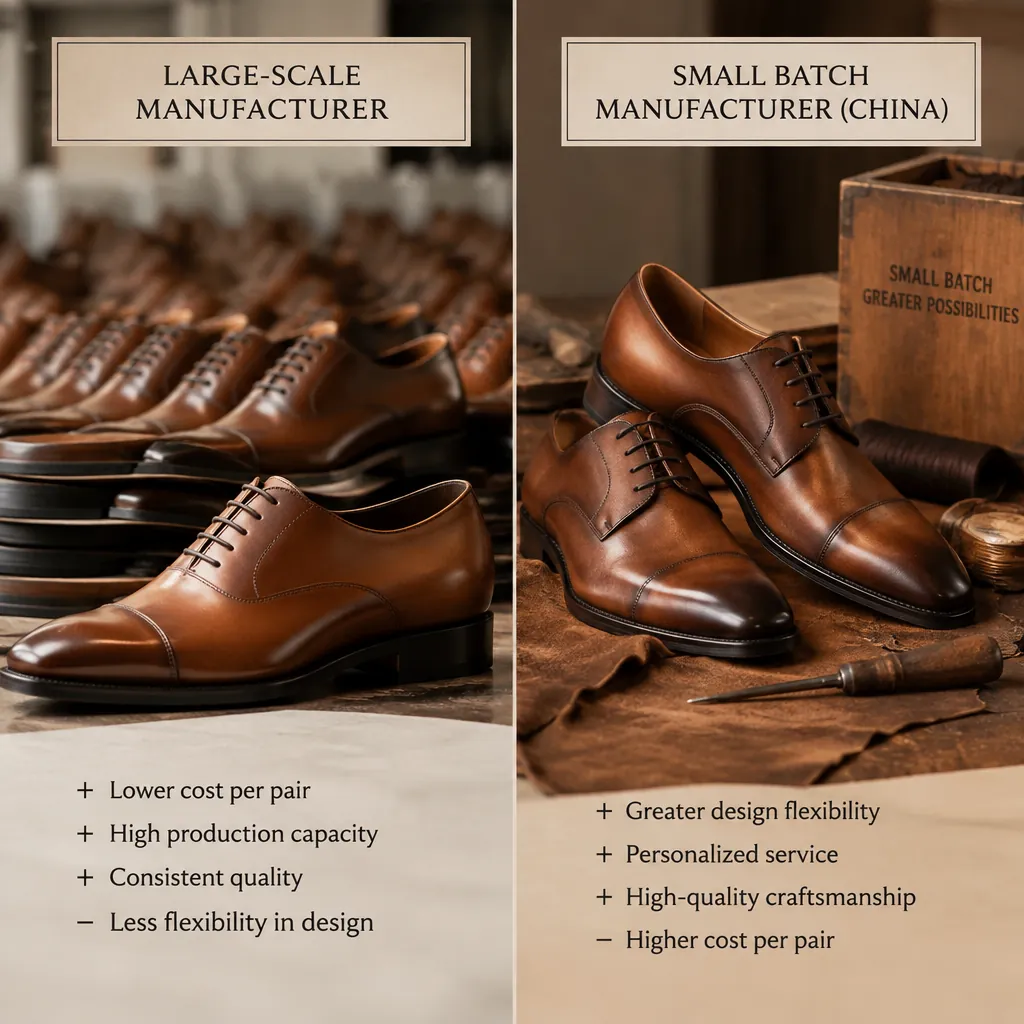
Buying directly from the manufacturer gives you the lowest unit price, direct quality control access, and the ability to customize. You negotiate MOQs, materials, and lead times without a middleman marking up the price.
The tradeoff: you handle more logistics coordination yourself, and vetting a legitimate factory takes time upfront.
Best for: Private label brands, established importers, buyers with 60+ pairs per SKU.
2. Trading Company
Trading companies source from multiple factories, which can be useful if you need a mix of product categories. However, they add a margin of 10–20% on top of factory pricing and often limit your visibility into actual production.
Quality disputes become harder to resolve because you’re two steps removed from the factory floor.
Best for: Very small orders, buyers who need mixed-product consolidation.
3. B2B Platforms (Alibaba, Global Sources)
Platforms like Alibaba connect buyers with both factories and trading companies, often without transparency about which you’re dealing with. Prices can appear competitive, but after platform fees, sample costs, and the risk premium of unknown suppliers, the effective cost rises.
For a detailed breakdown of platform sourcing risks and strategies, see our Alibaba Leather Shoe Sourcing Complete Guide 2026 Shoe Manufacturer Guide.
Best for: Market research, first contact — not as a final sourcing channel.
4. OEM/ODM Factory Partnership
An OEM or ODM arrangement means the factory manufactures to your specifications or develops designs for you. This is the highest-control, highest-value model for private label brands.
Lead times are longer (60–90 days for first production), but you own the design and can build brand equity. MOQs at credible factories typically start at 60 pairs for custom work.
See a full breakdown of this model at OEM ODM Men’s Genuine Leather Shoes Manufacturer Shoe Manufacturer Guide.
Best for: Private label brands, retailers building exclusive product lines.
5. Freight Consolidators with Factory Integration
Some larger factories offer consolidated shipping with other non-competing buyers to fill a container. This reduces per-unit freight costs significantly for mid-volume buyers who can’t fill a 20ft container alone.
This model requires a factory with genuine export infrastructure and established freight partnerships — not all factories offer it.
Export Documentation Checklist
Getting documentation wrong is the #1 cause of customs delays. Every leather shoe shipment requires a standard set of documents, and errors in any one of them can hold your cargo for days or weeks.
Core Export Documents
- Commercial Invoice — must include unit price, total value, country of origin, HS code, and Incoterm. Errors here trigger customs queries in almost every market.
- Packing List — itemized by carton, showing weight, dimensions, and contents. Must match the commercial invoice exactly.
- Certificate of Origin (CO) — required for preferential tariff treatment in many markets. For China exports, this is typically issued by the China Council for the Promotion of International Trade (CCPIT) or local chambers of commerce.
- Bill of Lading (B/L) — issued by the carrier, serves as the title document for the goods. Ocean freight uses a B/L; air freight uses an Air Waybill (AWB).
- Packing Declaration — some markets (Australia, USA) require wood packaging compliance declarations (ISPM-15).
Market-Specific Additions
- EU: CE Declaration of Conformity, REACH compliance statement
- USA: Importer Security Filing (ISF), CBP Form 3461 for entry
- Middle East: Certificate of Conformity for some Gulf states
- UK post-Brexit: UKCA marking (if applicable), separate customs entry
For buyers importing into the US, our Importing Leather Shoes USA Tariff Complete Guide 2026 Shoe Manufacturer Guide covers HS codes, Section 301 tariffs, and filing requirements in detail.
Certifications Required by Market
EU Market: CE, REACH, RoHS
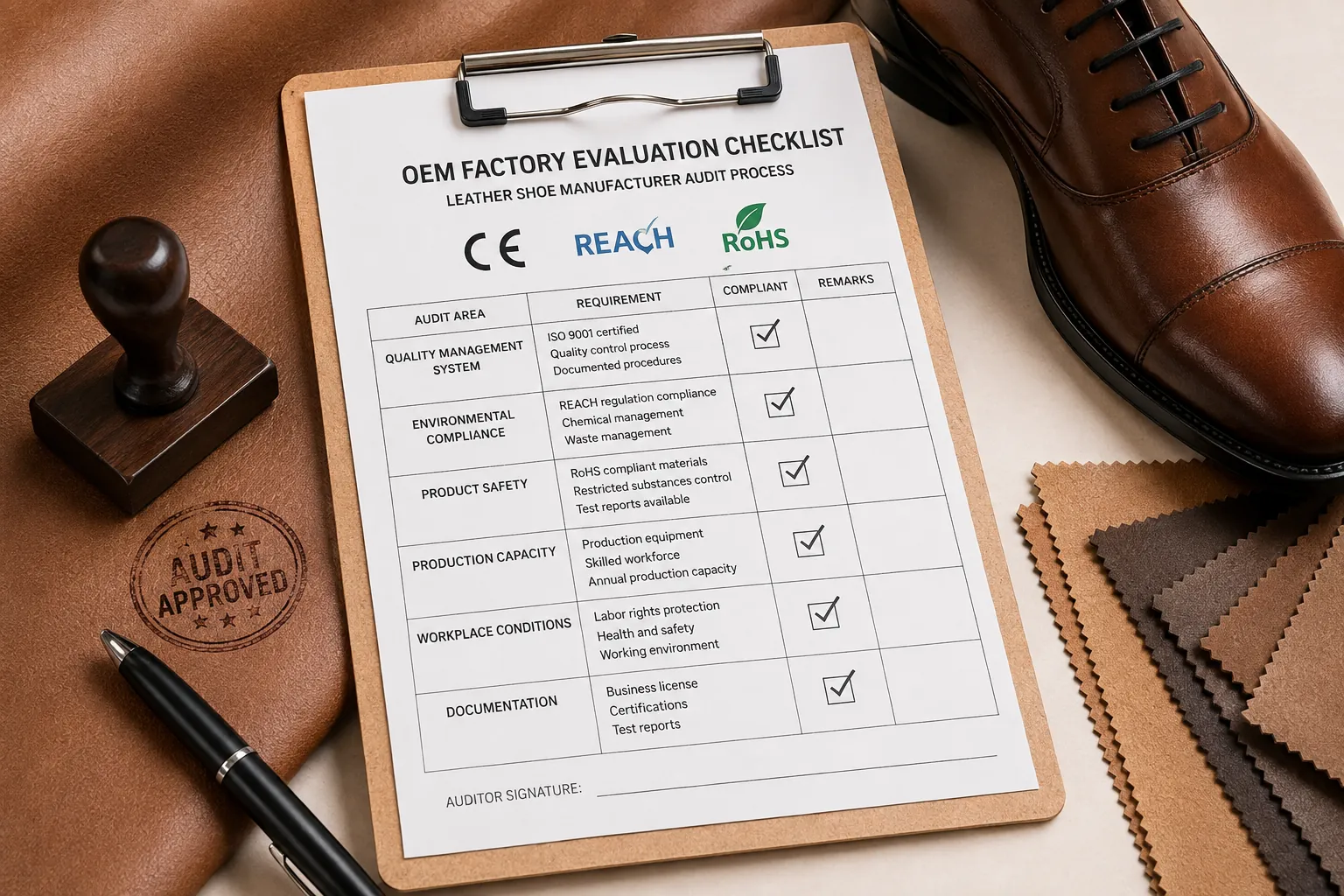
The EU requires footwear sold as occupational or safety-rated to carry CE marking under EN ISO 20347. Even fashion footwear must comply with REACH regulation (EC No 1907/2006) — restricting hazardous substances including chromium VI, azo dyes, and certain adhesives. For a comprehensive look at how these standards apply at the factory level, see our guide to leather footwear quality standards and inspection.
RoHS applies to electronic components (e.g., LED insoles, smart footwear with sensors), but many factories obtain it as a baseline compliance credential.
For a full breakdown of the CE process for footwear, see our CE Marking Footwear 2026 EU Certification Guide Shoe Manufacturer Guide.
US Market: ASTM and CPSC
The US does not require CE marking. Occupational footwear is tested to ASTM F2413 standards. Consumer footwear must comply with CPSC (Consumer Product Safety Commission) regulations on chemical content, especially for children’s products.
Testing through accredited labs (SGS, Bureau Veritas, Intertek) provides the documentation US importers need for customs and retail compliance.
Other Key Markets
| Market | Primary Standard | Notes |
|---|---|---|
| Australia | AS/NZS 2210 | For safety footwear |
| Canada | CSA Z195 | Occupational footwear |
| Middle East (GCC) | GSO standards | Product registration may apply |
| Japan | JIS T 8101 | Safety footwear |
| UK | UKCA / EN ISO 20347 | Post-Brexit CE not always accepted |
The EN ISO 20347 standard https://www.iso.org/standard/61644.html – SATRA Footwear Technology covers occupational footwear requirements in detail for buyers who need to review the technical specification.
FOB, CIF, and DDP: Real Shipping Cost Examples
Your choice of Incoterm determines who pays for what — and who carries risk at each stage of the journey. Here’s how the three most common terms work in practice for leather shoe exports from China.
FOB (Free on Board) — Most Common
The factory delivers goods to the port in China. From that point, the buyer arranges and pays for freight, insurance, and import clearance.
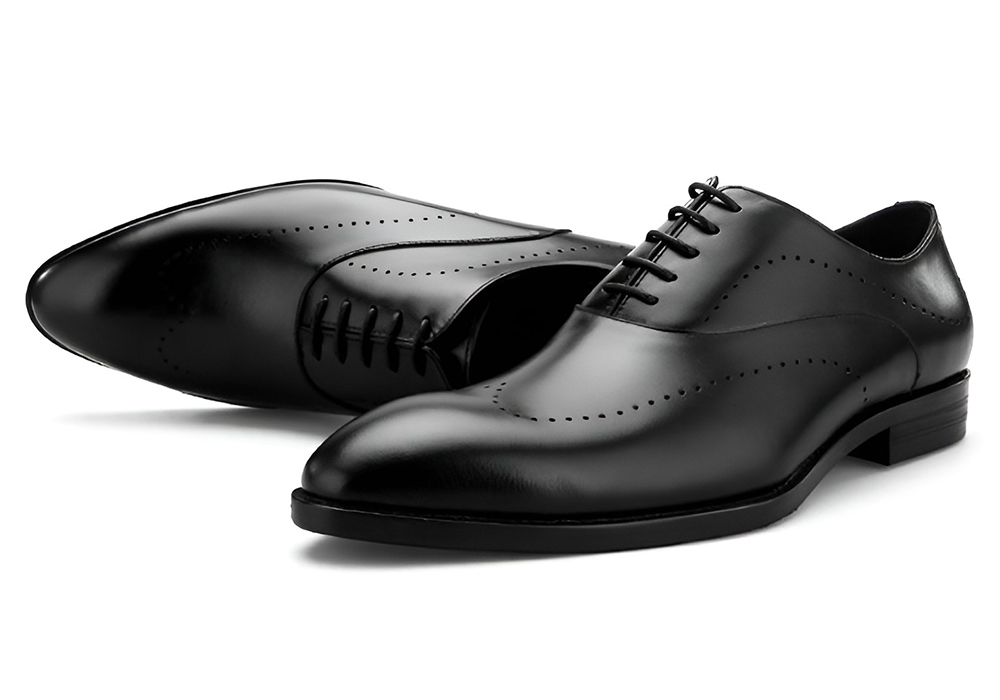
Example: 500 pairs of Oxford shoes at $32/pair = $16,000 product cost. Ocean freight (20ft LCL) from Guangzhou to Hamburg: ~$1,200–$1,800. Customs clearance in Germany: ~$300–$500.
Total landed cost estimate: ~$18,000–$18,500 for 500 pairs.
FOB pricing gives buyers maximum control over freight and often the lowest total cost when working with reliable freight forwarders.
CIF (Cost, Insurance, Freight)
The factory (or exporter) arranges shipping and insurance to the destination port. Buyers pay import duties and local clearance on arrival.
Advantage: Simpler for buyers new to international logistics. The factory’s freight relationships may not offer the best rates.
Typical CIF premium over FOB: 8–15% depending on route and volume.
DDP (Delivered Duty Paid)
The exporter handles everything — freight, insurance, customs duties, and delivery to your warehouse. You pay one price, no surprises.
Advantage: Lowest operational burden for the buyer. Works well for e-commerce sellers who don’t have import infrastructure.
Typical DDP premium over FOB: 20–35% depending on destination country tariffs.
For a deeper comparison of all four major Incoterms with cost modeling, see our FOB Shoe Pricing Guide: 4 Incoterms Compared 2026 Shoe Manufacturer Guide.
Common Export Pitfalls and How to Avoid Them
1. HS Code Misclassification
Using the wrong Harmonized System (HS) code on your commercial invoice is one of the most costly errors. Leather shoes fall under Chapter 64, with specific sub-codes depending on upper material and sole type. A misclassification can trigger incorrect duty rates — in both directions.
Fix: Confirm the HS code with your customs broker before the first shipment. China’s export code and the destination country’s import code should be cross-checked.
2. Certificate of Origin Errors
A CO with incorrect information (wrong factory address, wrong product description) will be rejected by destination customs. Many buyers don’t discover this until the cargo is already at port.
Fix: Have your freight forwarder or factory review the CO against the commercial invoice before signing.
3. Quality Disputes After Shipment
Receiving 500 pairs and discovering defects is far more expensive than catching them at the factory. By the time goods arrive, getting replacement or refund from overseas is slow and uncertain.
Fix: Require pre-shipment inspection. AQL Level II inspection at a 1.5 acceptance number is standard for leather footwear. See our guide on AQL Inspection Footwear: Top 5 Quality Control Tips Leather Footwear Quality Standards for inspection criteria by defect category.
4. Customs Holds for Missing Documentation
EU customs increasingly flag shipments without REACH compliance documentation. US CBP holds shipments without complete ISF filings. These holds cost $100–$500/day in demurrage.
Fix: Build a document checklist (see Section 3 above) and confirm with your freight forwarder that all documents are complete before departure.
5. Undervaluing Shipments
Some buyers ask factories to understate invoice values to reduce import duties. This is customs fraud and carries penalties including seizure of goods, fines, and import bans.
Fix: Declare accurate values. Legitimate duty savings come from proper tariff classification, Free Trade Agreement benefits, and GSP (Generalized System of Preferences) where applicable.
Export Channel Comparison Table
| Channel | Unit Price | MOQ | Lead Time | Quality Control | Documentation Support | Risk Level |
|---|---|---|---|---|---|---|
| Factory Direct | $25–$40/pair | 0 (stock) / 60 (custom) | 30–60 days | Direct access | Full | Low |
| Trading Company | $35–$55/pair | 100–500 pairs | 45–75 days | Limited | Partial | Medium |
| Alibaba Platform | $28–$50/pair | Varies | Varies | No direct access | Minimal | High |
| OEM/ODM Factory | $28–$45/pair | 60 pairs (custom) | 60–90 days | Full | Full | Low |
| Consolidator Model | $25–$40/pair | LCL share | 40–65 days | Direct | Full | Low–Medium |
Price ranges reflect genuine leather men’s dress shoes from Guangdong-based factories in 2026. Trading company and platform figures include typical margin additions.
Export Readiness Checklist for Buyers
Before placing your first order with a China leather shoe exporter, confirm:
- Factory has export license and relevant certifications (CE/REACH for EU; ASTM for US)
- You have confirmed the correct HS code for your destination market
- Payment terms are defined (30% deposit / 70% before shipment is standard)
- Pre-shipment inspection is arranged through a third-party lab (SGS, Intertek, Bureau Veritas)
- Certificate of Origin has been requested and matches invoice details
- Freight forwarder is briefed on Incoterm, destination port, and any special documentation requirements
- REACH/chemical compliance documentation is on file (EU shipments)
- ISF filing is arranged at least 24 hours before vessel departure (US shipments)
Ready to Start Your Shoe Line?
Choosing the right export channel is just the beginning. Whether you need a 60-pair OEM sample run or a 10,000-pair container shipment, working with a certified factory that has real export infrastructure eliminates the most common sourcing risks.
Wincheer Shoes has shipped to 50+ countries since 2007, holding CE (EN ISO 20347), REACH, and RoHS certifications. Our team handles export documentation, coordinates pre-shipment inspections, and supports both FOB and CIF arrangements — so you can focus on building your brand, not troubleshooting logistics.
Contact Wincheer Shoes to request a quote, discuss your volume requirements, or schedule a factory audit. We respond within 24 hours with pricing tailored to your market and order size.
FAQ
Q: What is the minimum order quantity for a China leather shoe exporter?
A: It varies significantly by channel. Factory-direct orders on existing stock designs can have zero MOQ. Custom OEM orders typically require 60 pairs per style to justify tooling and production setup costs. Trading companies and platform sellers often set higher minimums of 100–500 pairs.
Q: How long does it take to ship leather shoes from China to Europe?
A: Ocean freight from Guangzhou or Shanghai to major European ports (Hamburg, Rotterdam, Antwerp) takes 25–35 days transit. Add 7–15 days for production on stock designs, or 45–60 days for custom orders. Total lead time: 5–10 weeks depending on route and production status.
Q: What certifications should I require from a leather shoe exporter for the EU market?
A: At minimum: CE Declaration of Conformity (EN ISO 20347 for occupational footwear), REACH compliance documentation, and a Certificate of Origin. For products with any electronic components, RoHS documentation applies. Always request test reports from accredited third-party labs, not just factory self-declarations.
Q: Should I choose FOB or CIF when importing leather shoes from China?
A: FOB (Free on Board) is the most common choice for experienced importers because it gives you control over freight costs and carrier selection. CIF is simpler for first-time buyers but typically costs 8–15% more because the factory’s freight arrangements may not be the most competitive. If you have a reliable freight forwarder, FOB almost always delivers lower total landed cost.
Q: How can I verify a leather shoe exporter in China is a legitimate factory?
A: Request a factory audit report, verify their business license (available through local AIC databases), ask for references from existing clients in your market, and require a pre-shipment inspection by a third-party lab (SGS, Intertek, Bureau Veritas). Legitimate export-grade factories will have CE, REACH, or ASTM documentation ready and will welcome an on-site audit. If you want to understand the difference between OEM and ODM arrangements, see our guide on what OEM means in shoes