
Table of Contents
- Why Does Custom Logo Branding Matter for a Shoe Brand?
- Which Logo Application Method Fits Your Shoes?
- What MOQ Should You Expect at Each Customization Level?
- What Does a Custom Logo Order Actually Cost?
- What Files and Specs Does the Factory Need?
- How Does the Sample Process Work?
- How Do You Maximize Value on Small Orders?
- Which Mistakes Should First-Time Buyers Avoid?
- FAQ
- Ready to Start Your Custom Logo Program?
Why Does Custom Logo Branding Matter for a Shoe Brand?
A pair of leather Oxfords that costs $30–$40 FOB from a Chinese factory typically retails at $120–$280 in North America and Europe. That margin exists because consumers buy brands, not shoes. Your logo, where it appears and how well it is executed, is the most visible signal of that brand.
Three market conditions currently favor new entrants running logo programs on factory designs:
- DTC infrastructure is mature. Shopify, Amazon Brand Registry, and social commerce have removed the distribution barriers that once required wholesale relationships.
- Buyer trust has shifted toward micro-brands. Customers under 40 increasingly buy brands with authentic origin stories rather than legacy department-store labels.
- Low-volume production is normal. OEM factories that once required 3,000-pair minimums now routinely accept 60–300 pairs, because production capacity has diversified beyond traditional wholesale channels.
The catch: a low barrier means differentiation matters more. A consistent logo program (same mark on the insole, outsole, packaging, and hardware) signals professionalism that separates serious brands from dropshipping operations. If you are still deciding between logo branding and deeper customization, our B2B shoe MOQ guide breaks down how MOQs differ across full customization levels.
Which Logo Application Method Fits Your Shoes?
Each logo method carries different tooling costs, MOQ impact, and durability. These are the five methods we run most often on men’s leather shoe programs.
Hot Stamping (Debossing / Embossing)
A heated metal die presses your logo into the leather surface. Debossing indents it and embossing raises it. Both work with or without foil (gold, silver, custom colors).
- Best for: Insoles, heel counters, tongue labels, shoe boxes
- Tooling cost: $30–$80 per die (one-time)
- Per-pair cost: $0.30–$0.80 depending on placement count
- MOQ impact: Minimal — applicable from 60 pairs
- Durability: Excellent on insoles and heel areas; moderate on uppers depending on leather type
- File requirement: Vector file (AI, EPS, or high-res PDF), single color, minimum 5 mm letter height
Hot stamping is the default first step for most logo programs: inexpensive, fast to set up, and it reads as premium. Gold-foil debossing on a leather insole is the single most cost-effective branding upgrade available.
Screen Printing / Pad Printing
Ink is applied directly to the insole or lining via silicone pad or mesh screen. This is how multi-color logos and detailed graphics get onto areas too fine for a stamping die.
- Best for: Insoles (full-color logos), lining prints, sock liners, packaging
- Tooling cost: $20–$60 per screen/pad
- Per-pair cost: $0.50–$1.50 depending on color count
- MOQ impact: Low — 60–120 pairs
- Durability: Good on insoles; poor on exterior leather exposed to friction
- File requirement: Vector file with separated color layers, Pantone references
A counter-intuitive note from our clients’ programs: printed insoles often outperform exterior logos for brand recall. When a customer removes the shoe, a full-color branded insole creates a reveal moment that feels premium. Many DTC brands deliberately keep exteriors clean and put their branding budget into insoles and packaging instead.
Metal Logo Tags and Hardware
Branded metal plates riveted or sewn onto the shoe, logo buckles on monk straps, and engraved eyelets and aglets make this the most visually distinctive method and the highest perceived value.
- Best for: Loafers (saddle area), monk strap buckles, heel tabs, tongue tags
- Tooling cost: $150–$500 per mold depending on complexity
- Per-pair cost: $1.00–$3.50
- MOQ impact: Moderate — metal component suppliers typically require 250–500 pairs, though factories stocking generic shapes can laser-engrave at lower volumes
- Durability: Excellent
- File requirement: Vector file; specify metal finish (brushed nickel, antique brass, gunmetal, polished gold)
Metal hardware is where small brands overspend early. Unless your positioning is explicitly luxury, start with stamped insoles and printed packaging, then add hardware after the product is validated.
Sole Stamping / Molded Outsole Logos
Your logo is molded directly into the outsole, which combines branding and function in one component, since the mold can also carry tread patterns and size markings.
- Best for: Rubber outsoles, leather sole waist areas
- Tooling cost: $300–$1,500 per outsole mold (rubber); $50–$150 per stamp (leather sole)
- MOQ impact: High for rubber molds — typically 300–500 pairs per size to justify tooling; leather sole stamps work from 60 pairs
- Durability: Permanent
- File requirement: Vector file with precise dimensions; 3D CAD preferred for rubber molds
Laser Engraving
CO2 or fiber lasers etch the logo directly onto leather, metal hardware, or wooden shoe trees, with no physical tooling required.
- Best for: Leather uppers (subtle tone-on-tone effect), metal buckles, packaging accessories
- Tooling cost: $0
- Per-pair cost: $0.80–$2.00 depending on placement and detail
- MOQ impact: Very low — most factories set production minimums at 30–60 pairs
- Durability: Excellent on metal; good on leather (slightly less defined than hot stamping on softer skins)
- File requirement: High-contrast vector file
Logo Application Comparison Table
| Method | Tooling Cost | Per-Pair Cost | Typical MOQ | Colors | Durability | Best Placement | Setup Time |
|---|---|---|---|---|---|---|---|
| Hot Stamp (Deboss) | $30–$80 | $0.30–$0.80 | 60 pairs | Single + foil | ★★★★★ | Insole, heel, tongue | 3–5 days |
| Hot Stamp (Emboss) | $40–$100 | $0.40–$0.90 | 60 pairs | Single + foil | ★★★★☆ | Upper leather, heel tab | 3–5 days |
| Screen/Pad Print | $20–$60 | $0.50–$1.50 | 60–120 pairs | Multi-color | ★★★☆☆ | Insole, lining, box | 2–4 days |
| Metal Tag (Riveted) | $150–$500 | $1.00–$3.50 | 250–500 pairs | Metal finishes | ★★★★★ | Saddle, tongue, heel | 15–25 days |
| Rubber Sole Mold | $300–$1,500 | $0 (amortized) | 300–500 pairs | N/A | ★★★★★ | Outsole | 20–35 days |
| Leather Sole Stamp | $50–$150 | $0.20–$0.50 | 60 pairs | Single | ★★★★☆ | Outsole waist | 3–5 days |
| Laser Engraving | $0 | $0.80–$2.00 | 30–60 pairs | Tone-on-tone | ★★★★☆ | Upper, hardware | 1–2 days |
What MOQ Should You Expect at Each Customization Level?
MOQ scales with customization depth, and it is stepped, not linear. There are thresholds where costs jump, and knowing them shapes what you should order. The boundaries are:
- 60 pairs: custom private label, per model — logo-only orders on existing stock designs can go below 60
- 200–500 pairs: semi-custom
- 500+ pairs: fully custom
Custom rubber sole molds are a special case that falls inside the semi-custom or fully custom tiers. They need 300–500 pairs per size, regardless of which tier the rest of the shoe sits in.
Tier 1: Logo-Only Customization (Below 60 Pairs)
You pick from the factory’s existing stock design catalog and add your branding. This is the fastest, cheapest, lowest-risk entry. Logo-only orders on existing stock designs can go below 60 pairs. The 60-pair per-model minimum is the MOQ for custom private label, meaning any modification beyond a logo on a stock design.
- Included: Existing shoe design + debossed/printed insole + branded box + optional tongue label
- Price range: $25–$40 per pair FOB
- Tooling: $50–$200 total
- Timeline: 30–45 days after sample approval
- Best for: New brands testing the market, Amazon private-label sellers, corporate gift programs
Our own catalog spans six product categories (Oxfords, Derbys, loafers, monk straps, Chelsea boots, and leather walking shoes), all available for logo application on existing stock designs, including below 60 pairs. Browse the current ranges in our men’s Oxford shoes and men’s Derby shoes categories to see the base designs.
Tier 2: Semi-Custom (200–500 Pairs)
You modify an existing design (leather colors, sole types, construction details) plus full branding.
- Included: Modified design + custom leather color/texture + full branding package + optional metal hardware
- Price range: $30–$48 per pair FOB
- Tooling: $200–$800 total
- Timeline: 35–50 days after sample approval
- Special case: If the modification includes a custom rubber outsole mold, plan for 300–500 pairs per size.
- Best for: Established DTC brands expanding the line, boutique retailers, hospitality/uniform programs
Tier 3: Fully Custom Design (500+ Pairs)
Ground-up design: proprietary lasts, original patterns, custom outsole molds, bespoke hardware.
- Included: New last development + original pattern + custom outsole mold + proprietary hardware + packaging design
- Price range: $35–$55 per pair FOB. To read this against the other price bands: $25–$40 FOB is the 60-pair MOQ base tier (cemented/Blake constructions). $35–$55 FOB covers semi-custom and full-custom work with upper-leather and construction upgrades inside that band. Goodyear-welted construction at $65–$120 FOB sits above all tiers. Fully custom luxury positioning starts from the $35–$55 band and goes upward.
- Tooling: $1,500–$5,000+ total
- Timeline: 60–90 days after sample approval
- Special case: The custom rubber outsole mold requires 300–500 pairs per size, so multi-size runs set the practical total quantity.
- Best for: Brands with proven sales data, wholesale programs needing differentiated product, luxury positioning
The MOQ Reality Check
The advertised MOQ and the practical MOQ are different numbers. A factory may accept 60 pairs technically, but at that volume you will pay 15–25% more per pair than at 300 pairs, because line setup time is the same regardless of quantity. The efficiency sweet spot for logo-only customization is typically 200–300 pairs per style/color. Below that you pay for flexibility; above 500 pairs, per-unit savings flatten. If your volume cannot yet support these tiers, our low MOQ leather shoes manufacturer page covers the 60-pair entry path in detail.
What Does a Custom Logo Order Actually Cost?
Here is a realistic cost scenario from our quotation sheets: 300 pairs of custom-logo Derby shoes, full-grain leather, shipped to the US East Coast.
Sample Costs
| Item | Cost | Notes |
|---|---|---|
| Initial sample (existing design) | $80–$150 | Often refundable against production order |
| Revised sample | $60–$120 | If design changes are requested |
| Pre-production sample | $0–$80 | Final confirmation before mass production |
| Sample shipping to US/EU | $40–$80 | Express, 4–7 days |
Production Costs (300 Pairs, Derby, Full-Grain Leather)
| Component | Cost Per Pair | Total (300 Pairs) |
|---|---|---|
| Base shoe (FOB) | $32.00 | $9,600 |
| Debossed insole logo | $0.50 | $150 |
| Printed insole (full color) | $1.00 | $300 |
| Leather sole stamp | $0.30 | $90 |
| Custom printed shoe box | $1.50 | $450 |
| Printed dust bags | $0.60 | $180 |
| Subtotal | $35.90 | $10,770 |
One-Time Tooling
| Item | Cost |
|---|---|
| Hot stamp die (insole) | $50 |
| Leather sole stamp | $80 |
| Box printing plate | $60 |
| Dust bag screen | $30 |
| Total tooling | $220 |
Logistics (to US East Coast)
| Method | Cost | Transit Time |
|---|---|---|
| Sea freight (LCL) | $800–$1,200 | 30–40 days |
| Air freight | $2,500–$3,500 | 7–10 days |
| Rail (to EU) | $1,000–$1,800 | 18–25 days |
US Import Duty
Duty is assessed on the FOB portion of the order ($10,770). For US-bound leather footwear from China, this combines the MFN rate of 8.5–10% with the Section 301 tariff of 7.5%, a combined 16–17.5%. On this order that is roughly $1,723–$1,885.
Total Landed Cost (Duty-Inclusive)
Production $10,770 + tooling $220 + sea freight $800–$1,200 + US import duty $1,723–$1,885 = $13,513–$14,075 total, or $45.04–$46.92 per pair landed, before customs brokerage and other import fees. Before duty, the cost to your door is $11,790–$12,190 ($39.30–$40.63 per pair), so budget duty as a separate line. At a $159 retail price, gross margin on the duty-inclusive landed cost runs roughly 70–72%. The wholesale terms behind these numbers (FOB basis, what the quote includes, inspection clauses) are covered clause by clause in our wholesale men’s shoes sourcing guide.
What Files and Specs Does the Factory Need?
Getting files right the first time eliminates the most common source of program delays.
Logo Files
- Format: Adobe Illustrator (.AI) or EPS with outlined fonts; vector PDF acceptable
- Resolution: Vector preferred; if raster, minimum 300 DPI at actual application size
- Color: Pantone (PMS) numbers for every color — never CMYK or RGB, which render differently across leather, cardboard, and fabric
- Versions: Full color, single color (for stamping), reversed (white on dark), monochrome black
Shoe Specifications (Semi-Custom and Fully Custom)
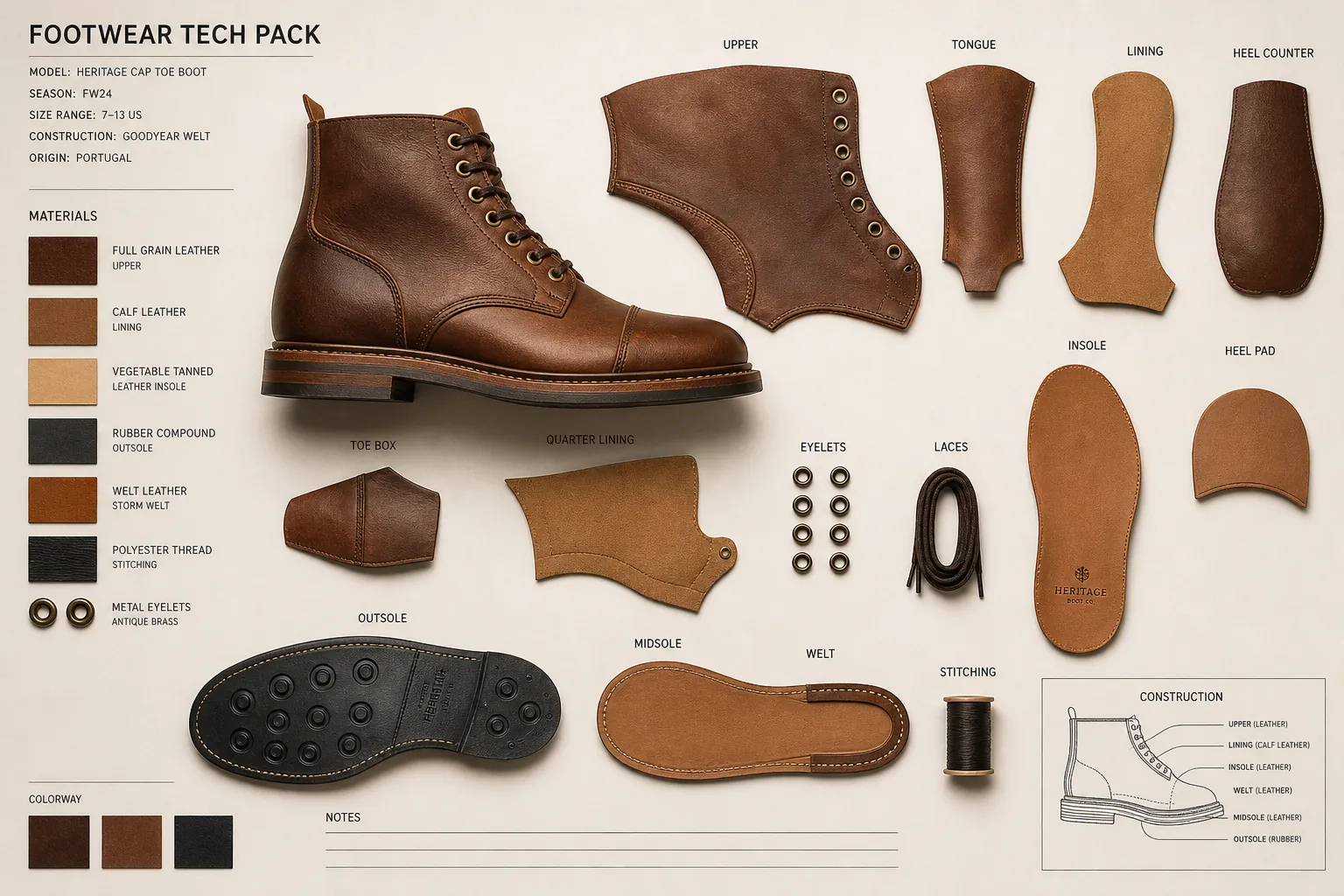
- Tech pack: Sketches or CAD with dimensions, material callouts, construction notes — our footwear tech pack template shows the sheet format factories actually work from
- Material swatches: Physical samples or Pantone TPX references for leather colors
- Reference images: Annotated photos of what to replicate or change
- Size run: Range (e.g., US 7–13) and half-size requirements
- Last preferences: Toe shape (round, chisel, almond, square), width (D, E, EE), fit notes
Packaging Design
- Box: Dieline template from the factory + print-ready artwork at 300 DPI + Pantone colors
- Dust bag: Logo placement, dimensions, drawstring color
- Tissue/hang tags/care cards: Print-ready PDF with bleed marks
File Mistakes That Cause Delays
- JPG/PNG logos instead of vector files (adds 3–5 days for recreation)
- No Pantone specification (the factory guesses; the sample comes back wrong)
- RGB values that look different on leather than on screen
- Fonts not outlined (the factory does not have your font installed)
- Missing size/width specifications in the tech pack
How Does the Sample Process Work?
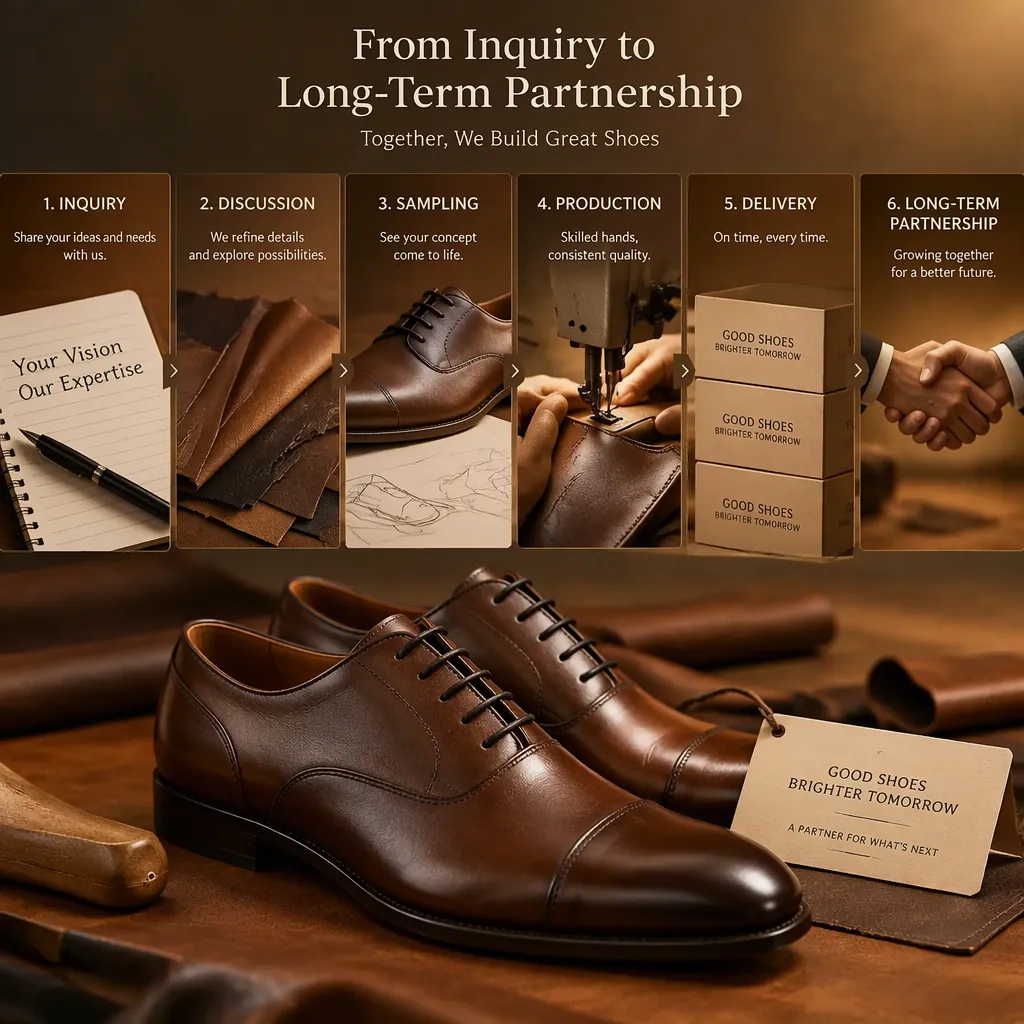
The sample phase is where the buyer–factory relationship is built or broken. Here is the sequence we run with logo-program clients. Sampling itself takes 7–15 days including revisions. From the day you send your brief to the day counter-samples are in your hands, allow 3–5 weeks.
Step 1: Inquiry and Design Confirmation (Days 1–5)
Send logo files, design preferences, and target price. A responsive factory returns recommended base designs, material options with pricing implications, a preliminary quotation with MOQ and timeline, and questions about your target market (which affects compliance requirements).
Step 2: Sample Development (7–15 Days, Including Revisions)
The factory produces a physical sample. You receive one pair in your specified size with logo applications, in proposed materials. Evaluate leather quality, construction, logo placement accuracy, color match, fit, sole attachment, and finishing.
Step 3: Review and Revision (Within the Sampling Window)
Provide written feedback with marked-up photos. Common revisions: logo position adjustments, leather color corrections, construction changes, fit adjustments. Most programs need 1–2 revision rounds, and these fall inside the 7–15 day sampling window. Fast, clear feedback keeps you at the short end of it.
Step 4: Pre-Production Sample Approval
The final check before mass production. Approve in writing, covering materials, logo placement and quality, color accuracy, construction method, and packaging.
Step 5: Mass Production (30–45 Days After Sample Approval)
Bulk production runs 30–45 days after sample approval. Request in-line production photos at roughly 30% and 70% completion, pre-shipment inspection photos, and consider third-party inspection (SGS, Bureau Veritas, or QIMA) for orders above $10,000. The quality criteria to inspect against are detailed in our leather shoe quality inspection guide.
How Do You Maximize Value on Small Orders?
Orders under 300 pairs reward a different strategy than bulk buying. These are the tactics that consistently work for our small-program clients.
Choose From Existing Designs
Selecting from a proven design library and adding your logo saves $3–$8 per pair versus custom development. The shoes are already pattern-graded, last-tested, and production-proven, so you pay for branding, not R&D.
Consolidate Styles, Minimize Colors
300 pairs of one style in one color prices better per pair than 100 pairs each of three styles. If you need variety, choose styles sharing the same last and outsole to reduce line changeover.
Negotiate Tooling Ownership
Specify in the contract that logo dies, sole molds, and printing screens are your property. This protects you if you switch factories and prevents your branding assets being used for other clients.
Time Your Orders Strategically
Chinese shoe factories have seasonal capacity waves. January–March (after Chinese New Year) and July–August are typically slower, when factories are more willing to take small orders on favorable terms. September–November is peak season for holiday orders, so book early or expect longer queues.
Request Plain Packaging for Samples
If samples are for fit and quality evaluation only, ask for plain packaging. Custom packaging tooling adds $150–$300 that is wasted if the design does not pass review.
Pick a Partner Structured for Small Programs
The factory matters more than any tactic. For small logo programs you need a manufacturer that treats 60–300 pair orders as a core business, not an afterthought. Check that defect-rate discipline carries down to small volumes: industry averages run 2–4%, while programs focused on brand clients typically hold below 1.5%. Wincheer’s recorded 0.8–1.2% reflects that focus. At 200 pairs, the gap between a 1% and a 3% defect rate is the gap between zero complaints and a dozen. Our private label shoe manufacturers overview compares what to look for across suppliers.
Which Mistakes Should First-Time Buyers Avoid?
These are the most frequent and most expensive errors we see in first logo programs.
Overcomplicating the First Order
Keep order one simple: one style, one or two colors, logo on insole and box. Prove the concept, gather customer feedback, then expand. Launches that combine five styles, custom outsole molds, and metal hardware usually strand at least two styles as dead inventory.
Ignoring Compliance Requirements
EU-bound goods need REACH compliance documentation; California requires Proposition 65 awareness. Importing without proper certification risks customs holds, fines, or forced destruction. Confirm certifications before placing the order, not after. The verification steps are in our compliance guides.
Skipping the Pre-Shipment Inspection
A $200–$400 third-party inspection (SGS, Bureau Veritas, or QIMA) is cheap insurance on a $10,000+ order. Inspect logo accuracy, color consistency across pairs, construction defects, and size labeling.
Choosing a Factory on Price Alone
The cheapest quote often comes from factories cutting corners on leather grade, adhesives, or QC steps. A $22/pair shoe producing 5% returns costs more than a $32/pair shoe producing 1%. Always evaluate physical samples before committing to production.
Not Securing Your Brand Assets
Register your trademark before sharing logo files with any factory, and use NNN agreements (non-disclosure, non-use, non-circumvention) governed by Chinese law. Standard US/EU NDAs are largely unenforceable in Chinese courts.
FAQ
What is the minimum order quantity for custom logo leather shoes?
Logo-only branding on existing stock designs (debossed insole, printed box) can go below 60 pairs. 60 pairs per model is the MOQ for custom private label, meaning any modification beyond a logo on a stock design, at established Chinese OEM factories. Wincheer’s own custom private label minimum is 60 pairs. Semi-custom orders with modified materials or colors typically require 200–500 pairs, and fully custom shoes with proprietary lasts and outsole molds generally start at 500+ pairs. Custom rubber sole molds are a special case within those tiers and need 300–500 pairs per size. The efficiency sweet spot for logo-only orders is 200–300 pairs, where per-unit pricing drops meaningfully compared with the smallest runs.
How much does it cost to put my logo on leather shoes?
Logo application has two cost components: one-time tooling and per-pair application. A basic hot stamp die costs $30–$80 and adds $0.30–$0.80 per pair. A full branding package (debossed insole, printed insole, sole stamp, custom box, and dust bag) typically adds $3.00–$5.00 per pair with $150–$300 in total tooling. Metal logo tags add $1.00–$3.50 per pair with $150–$500 in mold costs. For a typical 300-pair order with standard branding, expect roughly $1,100–$1,500 in total branding cost including tooling.
What file format do I need for my shoe logo?
Factories need vector files: Adobe Illustrator (.AI) or EPS with fonts converted to outlines; vector PDF is acceptable. Vector files scale without quality loss and feed directly into die-making and screen setup. Raster files (JPG/PNG) must be at least 300 DPI at application size and usually require recreation as vectors, adding 3–5 days. Always specify Pantone (PMS) numbers rather than RGB or CMYK, and provide full-color, single-color, reversed, and monochrome versions.
How long does it take to get custom logo shoes produced?
From inquiry to shipment, budget 45–60 days for logo-only, 60–75 days for semi-custom, and 75–105 days for fully custom. Sampling takes 7–15 days including revisions (plan for at least one round), and 3–5 weeks from brief to counter-samples in hand. Bulk production runs 30–45 days after sample approval, plus 5–10 days air or 25–40 days sea freight. The most common delay is the sample approval phase: unclear feedback or slow responses can add 2–4 weeks. Complete files upfront and written feedback within 48 hours of receiving samples keep the timeline tight.
Can I order just one sample pair with my logo before committing to bulk?
Yes. Reputable OEM factories produce a branded sample pair before production. Sample costs run $80–$150 per pair for existing designs with logo application, and many factories refund part or all of it against the production order. Expect 7–15 days for sampling including revisions plus 4–7 days express shipping, and ask the factory to photograph the sample before shipping so obvious issues can be flagged without paying for a second shipment.