Quick Answer: Italy’s footwear market was valued at about USD 6.04 billion in 2025, and the country remains the world’s reference standard for leather dress shoes — exporting roughly EUR 11.5 billion of footwear in 2025, including EUR 11.57 billion in leather-upper footwear. The United States alone imported USD 1.43 billion of leather footwear from Italy in 2025, nearly matching its imports from China (USD 1.55 billion) at a fraction of the volume — which tells you everything about Italian price positioning. The brand landscape runs from Gucci and Prada through craft houses like Santoni and Church’s to thousands of small Marche and Tuscan workshops, and an increasing share of diffusion-line production now happens outside Italy.
Which Italian formal shoe brands should B2B buyers know?
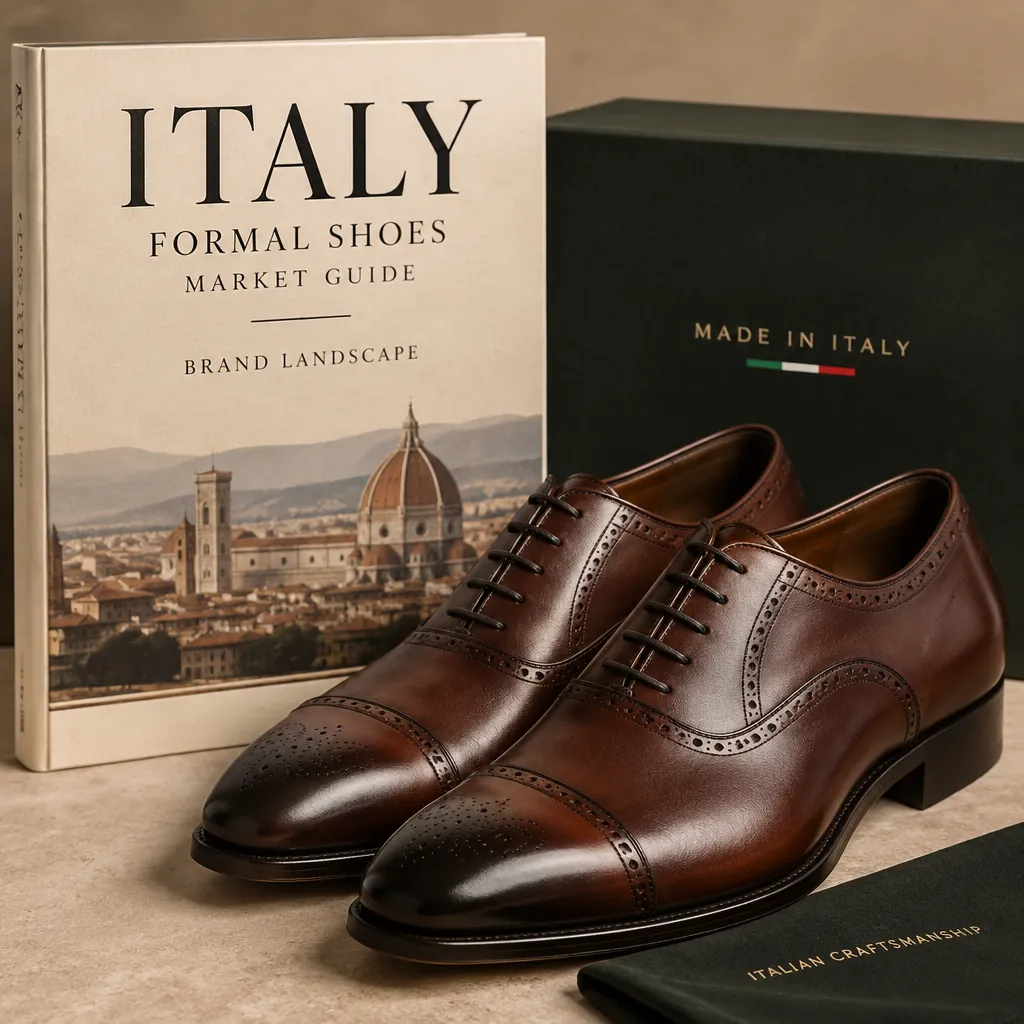
The Italian landscape layers into four tiers, each with a different sourcing implication.
Luxury fashion houses. Gucci, Prada, Ferragamo, and Dolce & Gabbana define the global perception of Italian footwear. Their formal lines are made in dedicated Italian factories, and their pricing (EUR 600–1,200+ retail for dress shoes) is driven as much by brand equity as by construction.
Premium craft brands. Santoni, Church’s (owned by Prada), Silvano Lattanzi, and a cluster of Marche-region houses produce the bench-made classics that wholesale at EUR 300–700. This is the tier most buyers mean when they say “Italian quality”: hand-lasting, closed-channel soles, and vegetable-tanned leathers.
Mid-market Italian brands. Brands like Fratelli Rossetti, Barracuda, and the diffusion lines of the luxury houses serve EUR 150–350 retail. This is where offshore production is most common — the design and QC stay Italian while manufacturing moves to lower-cost workshops.
The workshop economy. Beyond brands, thousands of small workshops in Marche, Tuscany, and Veneto produce for other brands under contract — including, increasingly, for non-Italian labels that want “Made in Italy” certification on part of their range.
Why does Italian-made footwear cost 2–4 times more?
Because you are paying for three stacked premiums, not one.
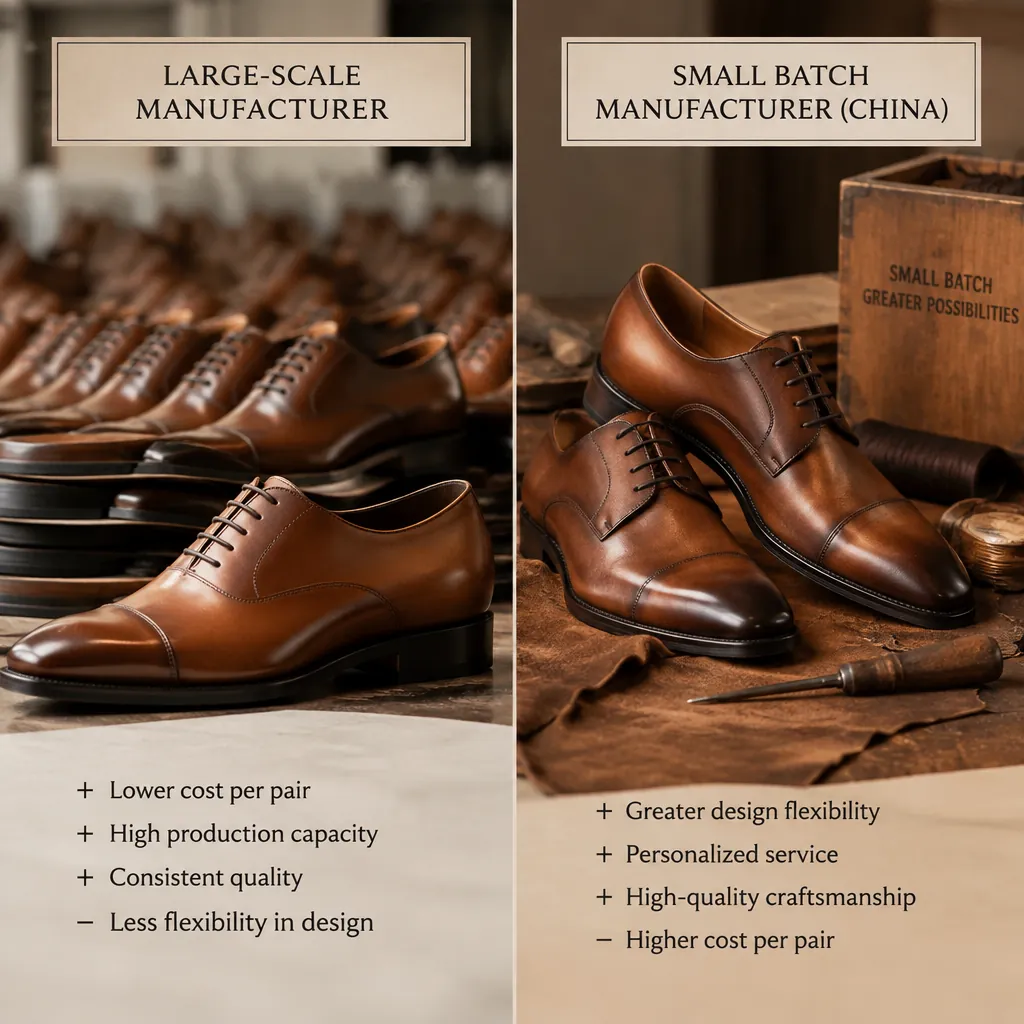
Craft labor. An Italian bench-made pair involves 150–200 manual operations by specialized artisans whose hourly cost is a multiple of Chinese factory wages. Brand and heritage premium. “Made in Italy” carries protected-labeling rules (Italian regulations govern when the mark can be used) and centuries of accumulated reputation, which lets brands price on story as much as on cost. Scale economics. Italian workshops are small; a typical artisan factory produces tens of thousands of pairs annually, while a mid-size Chinese facility like Wincheer Shoes Co., Ltd. runs 500,000+ pairs per year — the fixed costs of tooling and development spread over far more units.
The market data reflects this structure. Italy exported EUR 11.5 billion of footwear in 2025 on relatively modest volumes, while its turnover declined about 3.1% for the full year; Q1 2026 exports slipped another 1.6% in value to roughly EUR 3 billion. Volume trends tell the sharper story: Italian export volumes are actually rising in some channels (led by Middle East demand), but value per pair is compressing — Italian producers are competing harder at lower price points, exactly where Chinese OEMs are strongest.
For buyers comparing sourcing countries on cost and capability, see our China vs Vietnam vs India vs Indonesia comparison and the German market guide for the parallel European analysis.
Should your brand buy Italian or go Chinese OEM?
Match the decision to your price point and volume, not to the romance of the origin.
| Factor | Italian workshop | Chinese OEM (Jiangmen tier) |
|---|---|---|
| FOB cost, men’s leather dress shoe | EUR 60–120 equivalent | EUR 25–40 |
| Typical MOQ, custom program | Often 100+ pairs, artisan-dependent | From 60 pairs |
| Production capacity scale | Tens of thousands of pairs/year | 500,000+ pairs/year |
| “Made in Italy” story | Yes (protected label) | No (brand story instead) |
| Construction range | Bench-made, hand-welted focus | Goodyear welt, Blake, cemented, Opanka |
Choose Italian production when “Made in Italy” is the product itself — luxury positioning above EUR 400 retail, or a capsule collection whose marketing depends on the origin label. Choose a Chinese OEM when you are building a brand at EUR 100–250 retail: the same Goodyear-welted construction available from Italian bench workshops can be produced in Jiangmen at a third of the FOB cost, freeing margin for marketing and distribution. Run this checklist before deciding:
- Benchmark your target retail price against the FOB bands in the table above
- Decide whether the origin label itself drives sales in your channel
- Order construction samples from both an Italian workshop and a Chinese OEM
- Compare landed cost — including duties — at your realistic first-order volume
The hybrid pattern is increasingly common here too: brands keep a “Made in Italy” line for flagship retail while running their volume line from Chinese OEM partners — and use the Italian line’s design language to set quality expectations for both.
What does this mean for brands targeting the Italian market?
Italy is a demanding import market, and a shrinking one for volume players — which is precisely why sourcing strategy matters more there, not less.
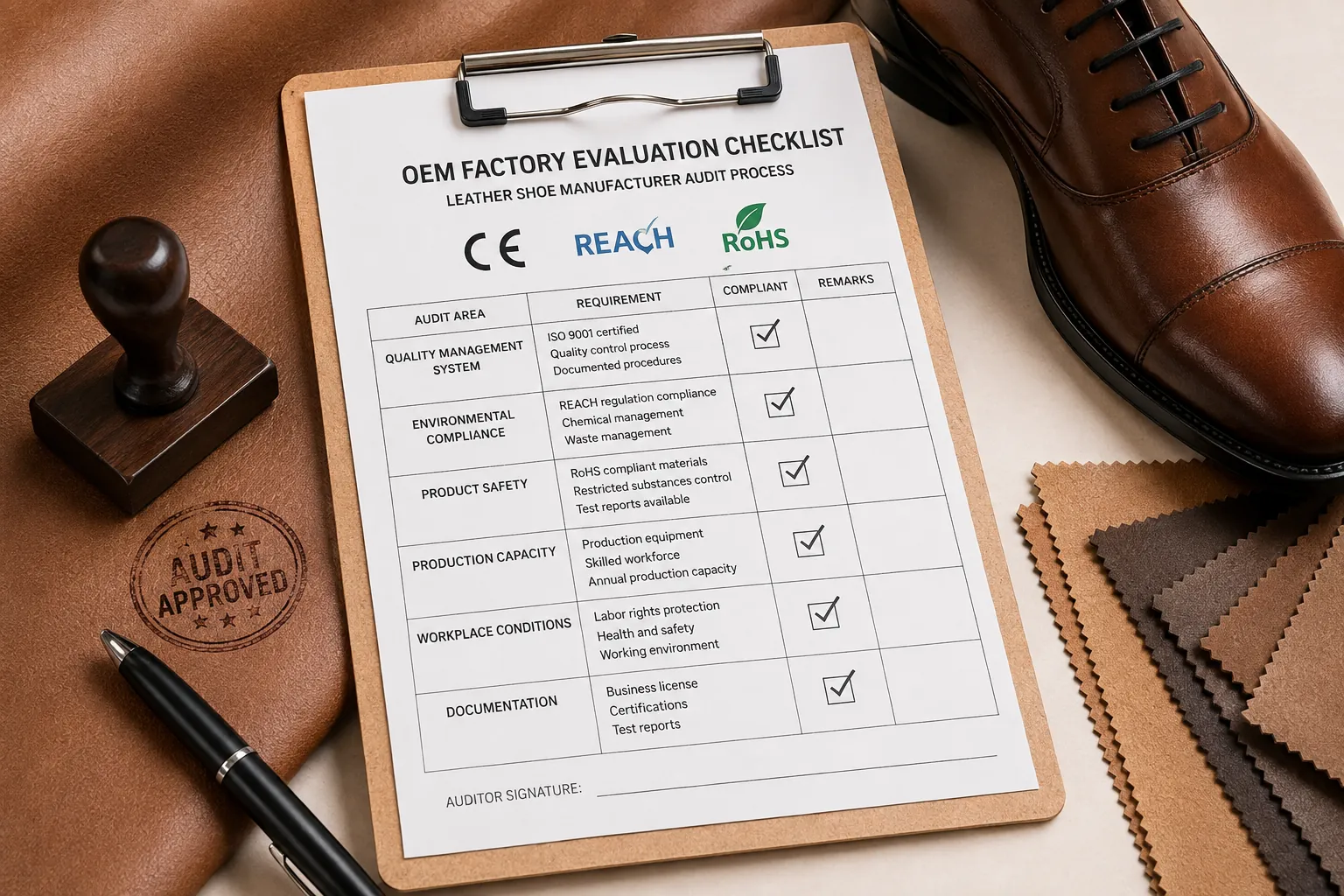
Domestic consumption sits within a USD 6 billion market where consumers already own Italian-made shoes at accessible prices, so imported formal footwear competes mainly on differentiation rather than price. Meanwhile the export picture pushes Italian brands themselves toward offshore partnerships: with turnover down and value-per-pair compressing, Italian labels are actively seeking production partners who can hold quality while lowering cost. A Chinese OEM with documented certifications (CE, REACH (Azo Dyes), RoHS, EN ISO 20347) and small-batch flexibility fits both directions — supplying brands that sell into Italy, and partnering with Italian labels restructuring their supply chain.
For supply-chain context within Italy itself, our top shoe-making supplies in Italy guide maps the component and materials landscape.
How does Wincheer serve brands in the Italian-quality price band?
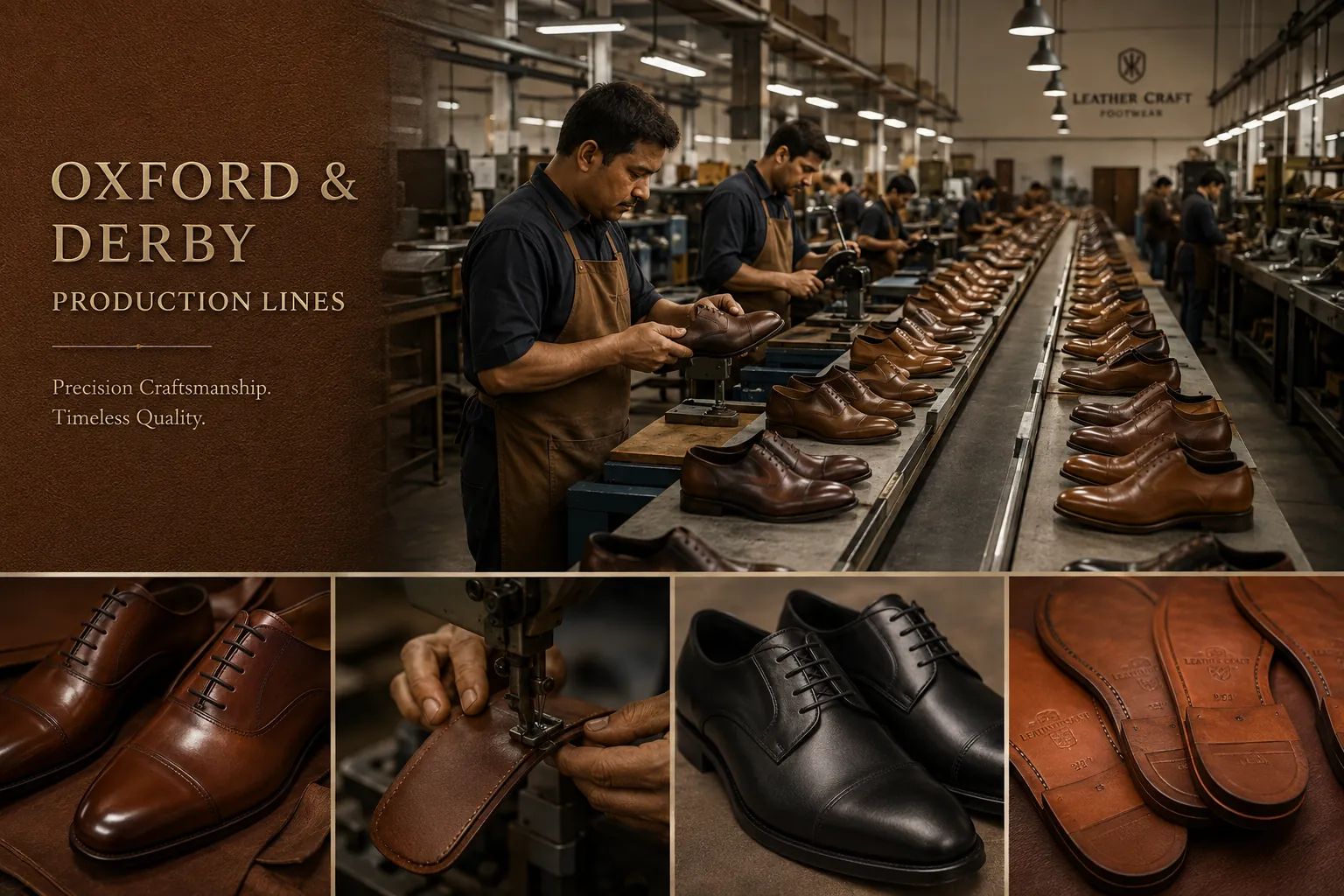
Wincheer Shoes Co., Ltd. (est. 2007) produces men’s leather dress shoes — Oxfords, Derbies, loafers, monk straps, Chelsea boots — in Jiangmen, Guangdong, roughly 1.5 hours from Guangzhou, with showrooms in Shanghai and Jiangmen open to buyer visits. Custom programs start at 60 pairs with tier pricing at 100, 300, and 500 pairs; first samples complete in 15–30 days; annual capacity is about 500,000 pairs.
For brands moving production out of the EUR 60–120 FOB band or launching against Italian-priced competitors, the practical first step is a sample comparison: order Goodyear-welted and Blake-stitched samples from a Chinese OEM and benchmark them against your Italian references on leather grade, stitching density, and finishing. Our guide to finding a shoe manufacturer in China covers the vetting checklist, and our US and EU reputation guide documents the reference-checking process European buyers apply.
FAQ: Italy Formal Shoes Market and Sourcing
How big is the Italian formal shoe market?
Italy’s total footwear market was valued at about USD 6.04 billion in 2025 (IMARC Group), projected to reach USD 8.65 billion by 2034. Formal leather shoes represent the premium core of that market, anchored by EUR 11.5 billion in annual footwear exports.
Who are the top Italian formal shoe brands?
Gucci, Prada, and Ferragamo lead the luxury tier; Santoni, Church’s, and Silvano Lattanzi anchor premium bench-made craftsmanship; Fratelli Rossetti and diffusion lines serve the mid-market.
Why are Italian shoes more expensive than comparable Chinese OEM shoes?
Three stacked premiums: artisan labor costs, the EU-protected “Made in Italy” brand premium, and small-workshop scale economics. Equivalent Goodyear-welted construction runs EUR 60–120 FOB in Italy versus EUR 25–40 from a Chinese OEM.
Do Italian brands manufacture outside Italy?
Increasingly yes, especially for diffusion and mid-market lines — design and QC stay in Italy while production moves to lower-cost workshops. Luxury flagship lines remain predominantly Italian-made.
Can a Chinese OEM match Italian dress shoe quality?
For Goodyear-welted and Blake-stitched construction at the EUR 100–250 retail band, a capable Chinese OEM delivers comparable construction quality at a third of the FOB cost. The honest gap is at the extreme artisan tier (hand-welted, 150+ operations), where Italian bench-made work remains distinctive.
Sources (retrieved 2026-09-16):
- IMARC Group — Italy Footwear Market Report (imarcgroup.com)
- World Footwear — Italian footwear industry signals potential turnaround despite 2025 turnover decline (Assocalzaturifici data)
- OEC — US leather footwear import origins, 2025 (oec.world)
Written by the Wincheer editorial team — men’s leather shoe OEM/ODM manufacturing since 2007. Last updated: September 2026.