TL;DR
Goodyear welted shoes last 3-5x longer (10+ years with resoling) than cemented shoes (3-5 years), but cost 2-3x more upfront ($120-280 vs $35-70 per pair). Choose Goodyear for premium positioning and longevity; choose cemented for mid-market accessibility. Wincheer Shoes’ 17 years of manufacturing experience produces both types with equal quality commitment.
Introduction
The construction method of a leather shoe determines its fundamental characteristics: durability, repairability, flexibility, weight, and ultimately the relationship between price and lifetime value. For B2B footwear buyers, understanding construction methods enables informed decisions that align product choices with brand positioning, consumer expectations, and business models.
Two construction methods dominate the leather dress shoe market: Goodyear welted and cemented (also called adhesive construction). Each has passionate advocates, and each serves legitimate market needs. This guide provides comprehensive technical comparison of both methods, enabling B2B buyers to specify products confidently for their target markets.
The global leather footwear market reflects this choice across price segments. Premium and luxury segments predominantly use Goodyear welted and comparable traditional constructions. Mid-market and accessible luxury segments often feature cemented construction with premium materials. Value segments rely almost exclusively on cemented construction optimized for cost efficiency.
Wincheer Shoes produces both construction types, giving us unique perspective on the genuine trade-offs involved. This guide shares our technical knowledge to help B2B buyers navigate these decisions.
Table of Contents
- Understanding Shoe Construction Fundamentals
- Goodyear Welted Construction Deep Dive
- Cemented Construction Deep Dive
- Durability Comparison and Analysis
- Cost and Value Analysis
- Market Positioning Considerations
- FAQ: Construction Method Questions
Understanding Shoe Construction Fundamentals
What Construction Methods Actually Do
A shoe construction method describes how the upper part of the shoe (the vamp and quarters) connects to the sole. This connection point determines most of the shoe’s performance characteristics: how it flexes, how it wears, how it can be repaired, and how it ultimately fails.
The Three Primary Construction Elements:
| Element | Function | Impact on Construction Choice |
|---|---|---|
| Upper | Covers and protects foot | Materials and design similar across constructions |
| Insole | Foundation layer, foot contact | Construction method attachment point |
| Outsole | Ground contact, wear surface | Replaceable component, varies by construction |
Key Distinction: Temporary vs. Permanent Attachment
The fundamental difference between Goodyear welted and cemented construction lies in how permanently the upper and sole connect:
- Welted construction: Provides a semi-permanent join that a skilled cobbler can separate for resoling
- Cemented construction: Creates a permanent bond that cannot be cleanly separated for resoling
Construction Method Overview
| Construction Type | Market Segment | Typical Lifespan | Resoleable | Price Positioning |
|---|---|---|---|---|
| Goodyear Welted | Premium/Luxury | 8-15 years | Yes | $300-1000+ |
| Blake Stitched | Mid-Premium | 5-10 years | Yes (specialist) | $200-500 |
| Cemented | Mid-Market to Value | 2-4 years | No | $80-250 |
| Vulcanized | Athletic/Casual | 1-3 years | No | $40-100 |
Leather Shoe Quality Guide: How to Identify Premium Cowhide vs. Bonded Leather
Goodyear Welted Construction Deep Dive
The Goodyear Welted Process
The Goodyear welted construction—developed in 1869 and named after Charles Goodyear Jr. (son of the vulcanized rubber inventor)—represents one of the most sophisticated shoemaking methodologies. The process creates a shoe through a series of precise mechanical operations.
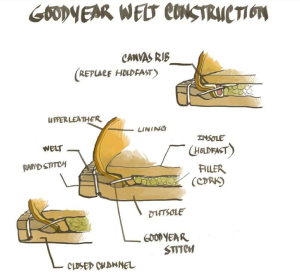
The Goodyear Welted Process:
| Stage | Operation | Description |
|---|---|---|
| 1 | Gemming | Temporary tacks attach insole to last |
| 2 | Welt preparation | Leather strip cut to size |
| 3 | Upper lasting | Upper stretched and lasted over insole |
| 4 | Welt stitching (Channel) | Welt sewn to insole through upper leather |
| 5 | Outsole preparation | Channel cut in outsole for stitching |
| 6 | Outsole stitching | Outsole sewn to welt through channel |
| 7 | Bottom filling | Cork or other filler applied between insole and outsole |
| 8 | Heel attachment | Leather or rubber heel attached |
| 9 | Finishing | Edge dressing, polishing, final inspection |
The Role of the Welt:
The welt—a strip of leather, rubber, or plastic—serves as the foundational element of Goodyear construction:
- Creates a defined seam between upper and sole
- Provides consistent stitch anchor point
- Enables clean separation for resoling
- Allows some moisture protection through the seam
Goodyear Welted Advantages
Durability Characteristics:
| Advantage | Explanation | Practical Impact |
|---|---|---|
| Structural integrity | Welt stitching provides mechanical (not chemical) bond | Consistent performance over years |
| Resoleability | Welt can be removed without damaging upper | 3-5 resoles typical, 10+ year shoe lifespan |
| Moisture barrier | Welt seam provides water resistance | Improved wet weather performance |
| Consistent fit | Insole structure maintains shape | Long-term comfort retention |
| Quality signaling | Traditional construction commands premium perception | Brand positioning value |
Construction Detail Benefits:
The Goodyear process creates specific performance advantages:
- Channel stitching (stitches hidden in groove cut into outsole) protects thread from abrasion
- Cork footbed (between insole and outsole) provides custom foot molding over time
- Insole board maintains consistent arch support throughout shoe life
- Goodyear ribs (in rubber welters) provide integral lasting and stitching channels
Goodyear Welted Limitations
| Limitation | Impact | Market Consideration |
|---|---|---|
| Higher cost | 40-60% price premium over cemented equivalent | Not suitable for value positioning |
| Heavier weight | Additional materials and construction layers | Less suitable for casual/flexible applications |
| Stiffer initial break-in | Firm insole structure requires wearing to soften | Consumer expectation management needed |
| Limited to specialized facilities | Requires expensive Goodyear machinery | Supply chain constraints |
| Longer production time | Process complexity requires more labor hours | Not suitable for rapid scaling |
Goodyear Welted Production Requirements
| Resource | Requirement | Impact on Manufacturing |
|---|---|---|
| Machinery | Goodyear welted equipment ($200,000+) | Significant capital investment |
| Skilled operators | 3-5 years training for consistent quality | Labor cost premium |
| Production speed | 40-60 pairs per operator per day | Lower throughput than cemented |
| Space requirements | Larger footprint per production unit | Facility efficiency |
Cemented Construction Deep Dive
The Cemented Construction Process
Cemented construction relies on chemical adhesives rather than mechanical stitching to bond sole to upper. Modern cemented shoes bear little resemblance to the often-poor-quality cemented shoes of decades past—advances in adhesive technology have created bonded shoes with impressive performance characteristics.
The Cemented Construction Process:
| Stage | Operation | Description |
|---|---|---|
| 1 | Last preparation | Last cleaned and prepared |
| 2 | Upper lasting | Upper stretched and lasted over insole |
| 3 | Insole cementing | Adhesive applied to insole perimeter |
| 4 | Sole cementing | Adhesive applied to outsole |
| 5 | Sole attachment | Sole positioned and pressed to upper |
| 6 | Activation | Adhesive cured through heat/pressure |
| 7 | Quality verification | Flex, attachment, appearance check |
| 8 | Finishing | Edge treatment, final inspection |
Modern Adhesive Technology:
Contemporary cementing uses sophisticated adhesive systems:
| Adhesive Type | Characteristics | Common Use |
|---|---|---|
| Polyurethane (PU) | Flexible, durable, water-resistant | Premium cemented |
| Chloroprene (Neoprene) | Strong initial tack, heat-resistant | Standard cemented |
| Water-based | Environmental compliance | Green manufacturing |
| UV-curing | Rapid production, precise curing | Automated lines |
Cemented Construction Advantages
Modern Cemented Benefits:
| Advantage | Explanation | Practical Impact |
|---|---|---|
| Design flexibility | No stitching constraints | More diverse styling options |
| Lighter weight | No metal components, thinner layers | Improved comfort for extended wear |
| Softer feel | Immediate flexibility, minimal break-in | Consumer comfort preference |
| Faster production | Simpler process, higher throughput | Lower manufacturing cost |
| Broader manufacturing access | No specialized equipment required | Supply chain accessibility |
Production Efficiency Metrics:
| Metric | Cemented | Goodyear Welted | Advantage |
|---|---|---|---|
| Production speed (pairs/operator/day) | 25-40 | 8-15 | Cemented 2-3x faster |
| Equipment investment per line | $30,000-60,000 | $200,000-350,000 | Cemented 85% lower |
| Labor skill requirement | Moderate | High | Cemented lower barrier |
| Factory space per pair capacity | Standard | 40% more | Cemented more efficient |
Cemented Construction Limitations
| Limitation | Impact | Mitigation Strategies |
|---|---|---|
| Non-resoleable | End of life when outsole wears | Design for planned obsolescence |
| Moisture vulnerability | Adhesive bond can weaken with water | Waterproof treatment options |
| Initial bond variability | Some adhesive systems need break-in | Quality adhesive selection |
| Bond failure risk | Poor application causes delamination | Rigorous QC processes |
| Perceived quality signal | Some consumers equate cement with cheap | Brand positioning and education |
Cemented Quality Variables
The quality range in cemented shoes is vast—spanning from poorly constructed shoes that fail within months to premium cemented shoes that outperform budget Goodyear welted options.
Quality Distinguishing Factors:
| Factor | Premium Cemented | Economy Cemented |
|---|---|---|
| Adhesive quality | European industrial adhesives | Commodity adhesives |
| Application precision | Automated spray/robotics | Manual application |
| Surface preparation | Controlled texture for bonding | Inconsistent preparation |
| Curing process | Controlled heat/pressure chambers | Ambient curing |
| Material quality | Premium leather, solid components | Variable quality materials |
Durability Comparison and Analysis
Expected Lifespan by Construction Type
Controlled Wear Test Results:
Independent testing and field performance data reveal durability patterns:
| Construction | Lab Flex Cycles to Failure | Field Average (normal wear) | Field Average (heavy use) |
|---|---|---|---|
| Goodyear Welted | 150,000+ | 8-12 years | 5-8 years |
| Blake Stitched | 100,000-150,000 | 5-8 years | 3-5 years |
| Premium Cemented | 80,000-120,000 | 4-7 years | 2-4 years |
| Standard Cemented | 40,000-80,000 | 2-4 years | 1-2 years |
| Value Cemented | 20,000-50,000 | 6-18 months | < 1 year |
Note: Field performance varies dramatically based on material quality within each construction type. A premium cemented shoe often outperforms an economy Goodyear welted.
Failure Mode Analysis
Understanding how shoes fail helps buyers set appropriate expectations:
Goodyear Welted Failure Modes:
| Failure Type | Typical Cause | Prevention | Repairability |
|---|---|---|---|
| Welt seam separation | Excessive stress or stitching damage | Quality construction, proper use | Yes (rewelt) |
| Outsole wear through | Normal abrasion | Resoling before complete wear | Yes (resole) |
| Insole compression | Long-term use | Cork replacement possible | Yes (cork refill) |
| Upper leather failure | Material quality or wear | Quality materials, care | Sometimes (rebuild) |
| Heel wear | Normal abrasion | Heel replacement | Yes |
Cemented Failure Modes:
| Failure Type | Typical Cause | Prevention | Repairability |
|---|---|---|---|
| Sole delamination | Adhesive failure, water exposure | Quality adhesives, seam sealing | Limited (rebuild) |
| Outsole wear through | Normal abrasion | Quality outsole materials | No |
| Upper failure | Material quality or wear | Quality materials, care | Limited |
| Flex cracking | Material brittleness | Quality materials, rotation | No |
Lifetime Cost Analysis
Total Cost of Ownership Comparison:
| Shoe Type | Initial Price | Expected Lifespan | Cost Per Year (Normal Wear) | Resoling Costs | Total 10-Year Cost |
|---|---|---|---|---|---|
| Goodyear Welted ($400) | $400 | 10 years | $40 | $200 (2 resoles) | $600 |
| Premium Cemented ($200) | $200 | 5 years | $40 | $0 | $400 |
| Standard Cemented ($120) | $120 | 2.5 years | $48 | $0 | $480 |
| Value Cemented ($80) | $80 | 1 year | $80 | $0 | $800 |
Analysis: Despite higher initial cost, premium Goodyear welted shoes often provide lower annual cost than frequently replaced cemented alternatives. However, this calculation assumes:
- Adequate care and rotation
- Availability of quality resoling services
- Consumer willingness to invest initially
- Stable sizing over time
The True Cost of Quality: Understanding Leather Shoe Pricing from Chinese Manufacturers
Cost and Value Analysis
Manufacturing Cost Breakdown
Goodyear Welted Manufacturing Costs:
| Cost Component | Percentage of Cost | Typical Range (per pair) |
|---|---|---|
| Upper leather | 25-30% | $25-50 |
| Outsole leather | 8-12% | $10-20 |
| Other materials | 10-15% | $12-25 |
| Labor (construction) | 30-40% | $40-80 |
| Machinery amortization | 5-8% | $8-15 |
| Quality control | 5-8% | $8-15 |
| Overhead | 10-15% | $15-30 |
| Total Manufacturing | 100% | $118-235 |
Cemented Construction Manufacturing Costs:
| Cost Component | Percentage of Cost | Typical Range (per pair) |
|---|---|---|
| Upper leather | 30-35% | $20-45 |
| Outsole materials | 15-20% | $10-25 |
| Other materials | 10-15% | $8-15 |
| Labor (construction) | 20-28% | $15-35 |
| Adhesives/consumables | 3-5% | $3-8 |
| Quality control | 5-8% | $5-12 |
| Overhead | 10-15% | $10-20 |
| Total Manufacturing | 100% | $71-160 |
When Goodyear Welted Makes Sense
Appropriate Applications:
| Scenario | Recommendation | Rationale |
|---|---|---|
| Premium/luxury brand positioning | Goodyear welted essential | Construction quality signals premium |
| Consumer expects 10+ year shoe | Goodyear welted necessary | Only construction reliably supports this |
| Resoleability important | Goodyear welted required | No cemented option provides this |
| Traditional/craft positioning | Goodyear welted aligns | Heritage association valuable |
| High per-pair transaction value | Goodyear welted proportionate | Higher cost manageable at higher price |
When Cemented Construction Makes Sense
Appropriate Applications:
| Scenario | Recommendation | Rationale |
|---|---|---|
| Value/mid-market positioning | Cemented appropriate | Cost efficiency essential |
| Trend/fashion-forward product | Cemented preferred | Design flexibility advantage |
| Disposable/minimal wear use case | Cemented proportionate | Full durability unnecessary |
| Youth market with changing tastes | Cemented sensible | Fashion cycles shorter than shoe life |
| Large volume orders | Cemented practical | Production efficiency benefits scale |
Custom vs. Standard Sizing: The Hidden Costs and Benefits for Shoe Brands
Market Positioning Considerations
Consumer Segment Expectations
Different consumer segments have fundamentally different relationships with shoe construction:
| Segment | Construction Preference | Key Decision Factors |
|---|---|---|
| Luxury consumers | Goodyear welted expected | Heritage, craftsmanship, longevity |
| Premium consumers | Variable, often Goodyear preferred | Quality perception, price-value |
| Mid-market consumers | Both depending on brand | Brand story, styling, price |
| Young/fashion consumers | Cemented often preferred | Style, price, disposability acceptance |
| Professional/corporate | Goodyear or quality cemented | Durability for heavy use, appearance |
Brand Positioning Framework
Construction Method Selection Decision Tree:
Is your brand positioned above $250 MSRP?
├── YES → Goodyear welted should be primary construction
└── NO ↓

Is your brand positioned above $150 MSRP?
├── YES → Consider both; Goodyear signals quality, premium cemented offers value
└── NO ↓

Is your consumer likely to keep shoes 3+ years?
├── YES → Consider Goodyear for key styles despite lower price point
└── NO ↓

Cemented construction appropriate; focus on material quality within cemented category
Wincheer Shoes Construction Capabilities
Our Manufacturing Capabilities:
| Construction Type | Minimum Order | Lead Time | Price Range (FOB Shanghai) |
|---|---|---|---|
| Goodyear Welted | 100 pairs/style | 12-16 weeks | $120-280 per pair |
| Blake Stitched | 100 pairs/style | 10-14 weeks | $90-200 per pair |
| Premium Cemented | 100 pairs/style | 8-10 weeks | $60-120 per pair |
| Standard Cemented | 60 pairs/style | 6-8 weeks | $35-70 per pair |
FAQ: Construction Method Questions
Q1: Can most shoe repair shops resole Goodyear welted shoes?
Quality resoling requires specialized knowledge and equipment. In major markets, 30-50% of standard shoe repair shops claim Goodyear resoling capability, but only 15-20% have consistent quality. Look for cobblers advertising “Goodyear welting” specifically. Costs typically range from $80-150 for quality resoling. In markets without quality resoling access, Goodyear construction loses significant value.
Q2: How do I tell if a shoe is genuinely Goodyear welted?
Genuine indicators: Look for visible stitching groove on the outsole edge, a distinct seam between insole and outsole perimeter, “Goodyear welt” labeling in the shoe (not just “welted”—this can mean other constructions), and a cork footbed visible in some designs through the insole. Price below $200 rarely indicates genuine Goodyear welted construction.
Q3: Why do some premium brands use cemented construction?
Premium brands choose cemented construction for several legitimate reasons: design flexibility for fashion-forward styles, lighter weight for comfort, specific aesthetic outcomes that Goodyear cannot achieve, and consumer segments that prioritize style over longevity. Premium cemented doesn’t mean compromising quality—it means investing material budgets differently.
Q4: Does cemented construction mean poor quality?
No. Modern premium cemented construction often outperforms budget Goodyear welted in controlled comparisons. Quality depends on materials, adhesive technology, construction precision, and quality control—not construction method alone. A premium cemented shoe with quality leather and industrial adhesives will outperform a poorly made Goodyear welted shoe every time.
Q5: How many times can a Goodyear welted shoe be resoled?
Typically 3-5 resoles before the welt itself becomes too worn or the insole loses integrity. With quality construction and care, 10+ year shoe lifespans are achievable with 2-3 resoles. Cost per resoling typically ranges from $80-150 depending on market and sole choice.
Q6: What construction should I choose for a work/dress shoe hybrid?
For professional footwear subjected to heavy use, Goodyear welted typically provides better long-term value despite higher initial cost. The combination of regular wear, need for durability, and professional appearance expectations favors traditional construction. Consider a dress shoe with Goodyear construction and rubber heel for practical professional use.
Conclusion
The choice between Goodyear welted and cemented construction is not about identifying the “best” method—it’s about matching construction characteristics to brand positioning, consumer expectations, and business model requirements.
Goodyear welted construction offers superior long-term value for consumers who can invest initially, expect to keep shoes for years, and value sustainability through longevity and repairability. The construction method carries heritage and craftsmanship associations that support premium positioning.
Cemented construction offers cost efficiency, design flexibility, and comfort characteristics that serve mid-market and fashion-forward positioning well. Premium cemented construction provides genuine quality within accessible price points.
Wincheer Shoes produces both construction types with equal commitment to quality within each category’s characteristics. Our 17 years of experience enables informed guidance on construction selection based on your specific market and positioning needs.
About Wincheer Shoes
Wincheer is a professional leather shoe manufacturer based in Shanghai, China. Established in 2007, we specialize in OEM/ODM manufacturing of men’s leather shoes including Oxford, Derby, Loafer, Monk, and Chelsea styles. With 19 years of experience and CE/REACH/RoHS certifications, we export quality footwear to global markets at competitive prices ($25-$40/pair).