Choosing the wrong manufacturing model costs brands real money — not just in unit price, but in wasted sampling rounds, IP disputes, and missed market windows. When buyers ask about OEM vs ODM footwear, they’re really asking: how much control do I need, and how fast do I need to move?
This guide breaks down all four models — OEM, ODM, Private Label, and White Label — with a side-by-side comparison table, a decision framework by brand stage, and a real-world sourcing example.
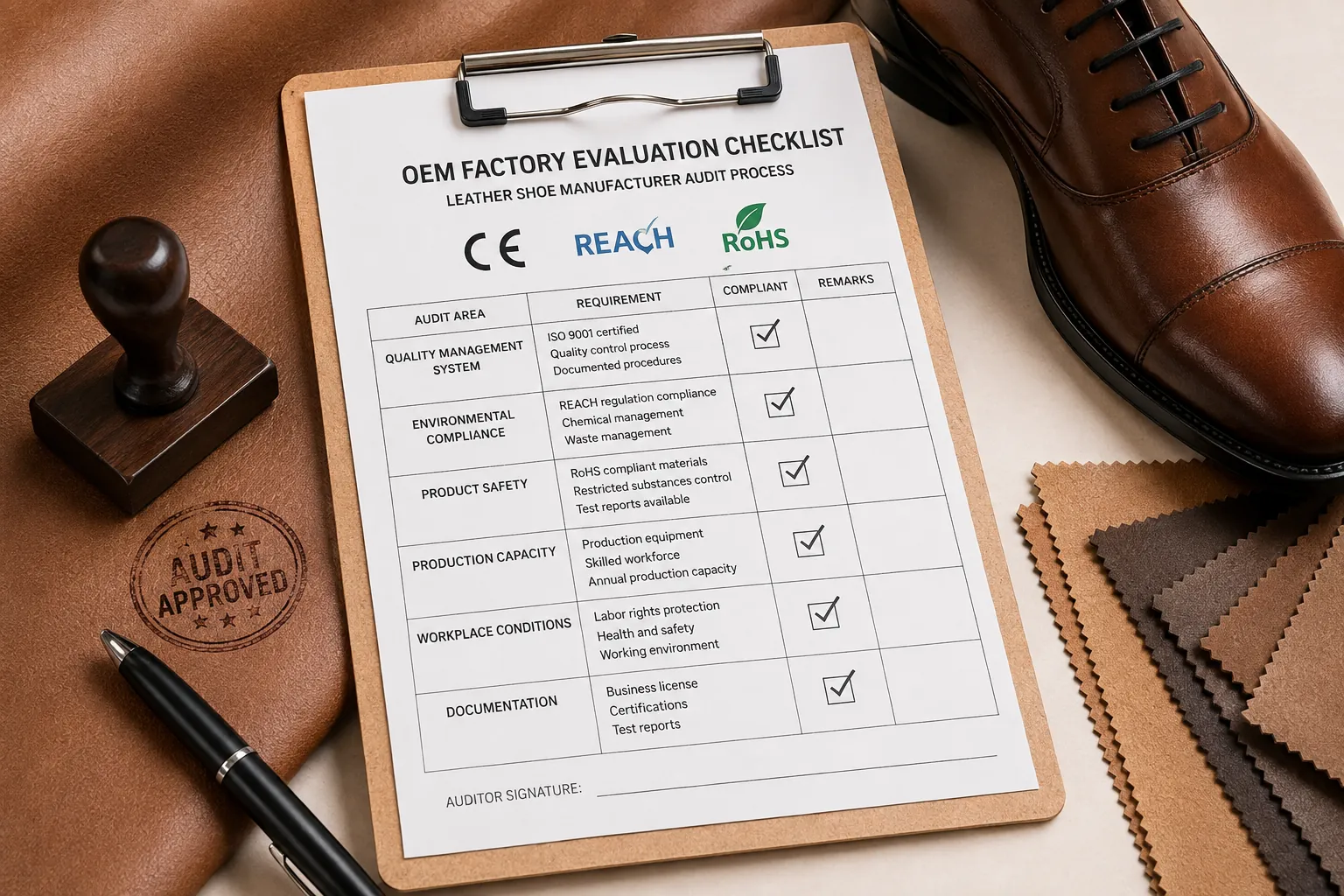
At a factory producing 500,000+ pairs annually across 50+ countries, the team at Wincheer Shoes sees all four models in active use. Founded in 2007 with certifications including CE (EN ISO20347), REACH, and RoHS, the operation offers MOQ of 0 on existing designs and 60 pairs for custom orders — which means the model you choose directly shapes your entry cost and timeline.
Oem Vs Odm Vs Private Label Shoe Manufacturing Guide: Table of Contents
- What Each Model Means
- OEM: Original Equipment Manufacturing
- ODM: Original Design Manufacturing
- Private Label Shoes
- White Label Footwear
- 4-Model Comparison Table
- Decision Framework by Brand Stage
- DTC Brand Case Example
- FAQ
- Ready to Start Your Shoe Line?
What Each Model Means
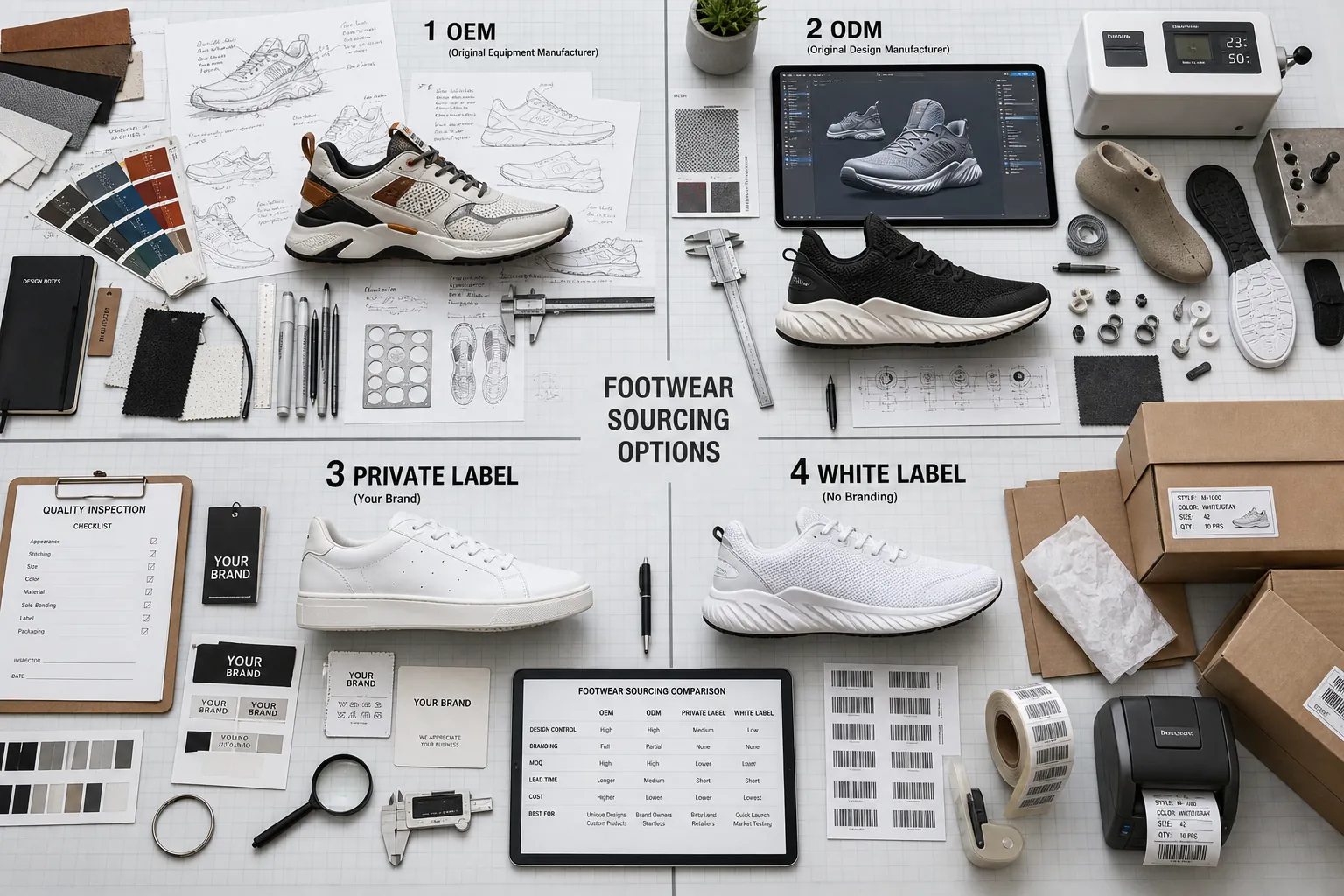
The four manufacturing models sit on a spectrum from zero customization to full design ownership. Before diving into OEM vs ODM footwear specifics, here’s the one-line version of each:
- OEM — You provide the design; the factory builds it.
- ODM — The factory provides the design; you sell it under your brand.
- Private Label — You select and modify an existing factory design, brand it fully as your own.
- White Label — You take a finished, unbranded product and apply your label with minimal or no changes.
Each model has a different risk profile, cost structure, and IP implication. The right choice depends on your budget, timeline, and how differentiated your product needs to be.
OEM: Original Equipment Manufacturing
How It Works
In OEM, the buyer owns the design — technical drawings, last specifications, material callouts, construction method. The factory is contracted to manufacture to those exact specs. You control every detail; the factory provides labor, equipment, and production management.
This is the model used by established footwear brands that have in-house design teams and want full IP ownership from day one.
Pros
- Full IP ownership — your design, your patent potential
- Maximum differentiation — no other brand runs the same product
- Spec control — materials, construction, and tolerances are yours to define
- Long-term cost efficiency — amortized tooling costs drop over volume
Cons
- High upfront investment — lasts, molds, and tooling can run $800–$3,000+ per style
- Longer lead time — 90–150 days from tech pack to first production run
- Requires design capability — you need a product developer or footwear designer on staff
- Higher sampling risk — more rounds needed to hit spec
Best For
Established brands with design teams, footwear labels scaling beyond 5,000 pairs per style, and companies entering markets where product differentiation is a core competitive advantage.
ODM: Original Design Manufacturing
How It Works
In ODM, the factory already has the design — developed internally or from prior client projects. You license that design, often with some degree of modification (colorway, material, branding elements), and sell it under your own brand name.
The factory retains the underlying design IP. You own your brand and the commercial relationship with your customer.
Pros
- Faster to market — existing tooling means 30–60 day lead times are realistic
- Lower entry cost — no tooling investment for base construction
- Reduced sampling risk — the design has already been proven in production
- Access to 1,000+ proven styles — factories with large ODM libraries give you real range
Cons
- Limited exclusivity — another brand may sell the same base design
- Design IP stays with factory — you can’t take the design to a different supplier
- Modification limits — structural changes may require new tooling anyway
- Less differentiation — harder to build a truly unique product story
Best For
Growing brands that need speed-to-market, DTC sellers testing new categories, and buyers entering a new market segment without committing to full design development.
For a deeper look at how ODM works in practice, see OEM ODM Men’s Genuine Leather Shoes Manufacturer Shoe Manufacturer Guide.
Private Label Shoes
How It Works
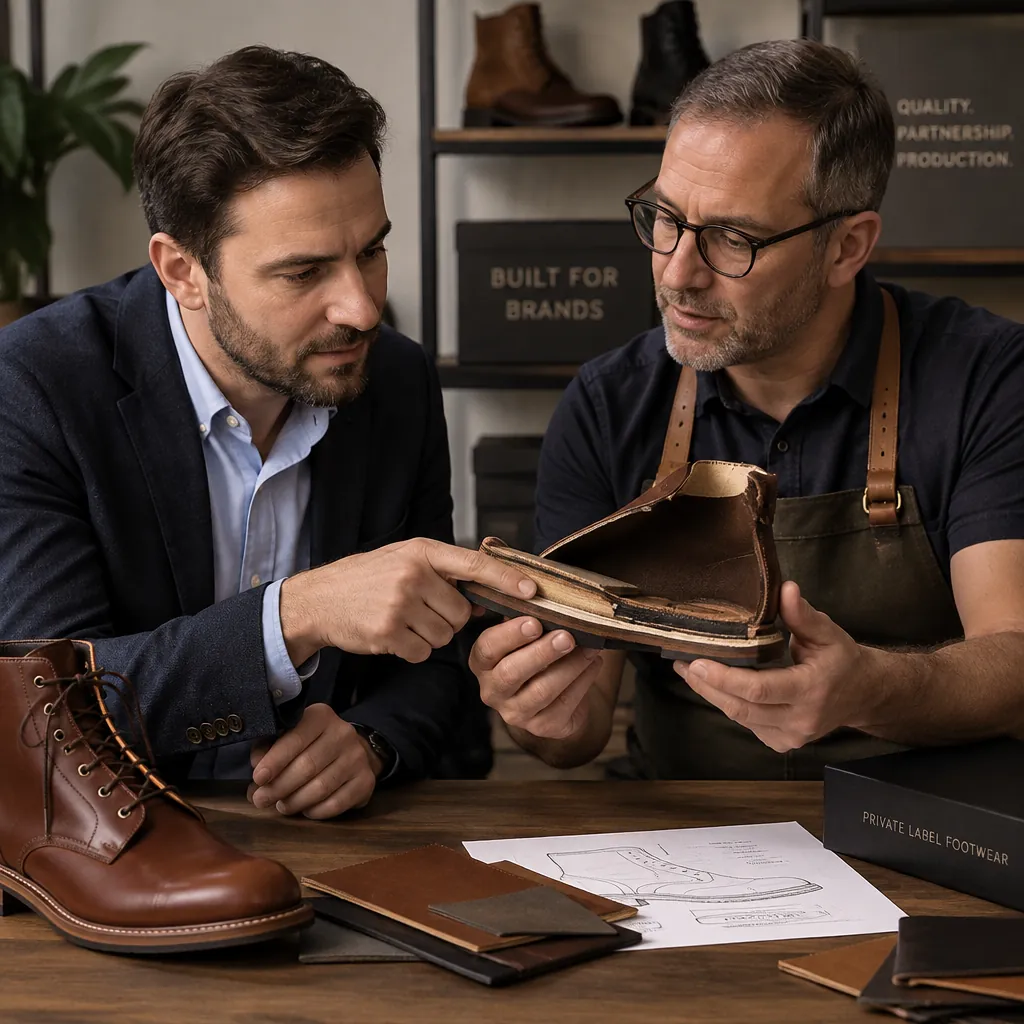
Private label sits between ODM and OEM. You select an existing factory design, then customize it — logo, lining, insole branding, colorway, packaging — to create a product that reads as fully your own. The base construction is the factory’s; the brand identity is yours.
This is the most common model for new brands launching on Amazon, Shopify, or through wholesale channels.
Pros
- Strong brand identity — full logo and packaging control
- Lower MOQ — factories with existing tooling can offer 60-pair minimums on custom branding
- Faster than full OEM — no tooling development required for base construction
- Proven product quality — you’re building on a tested design
Cons
- Base design not exclusive — competitors can source the same base
- Customization ceiling — structural changes push you into OEM territory
- Margin pressure — branding add-ons (custom insoles, boxes, dust bags) increase unit cost
- IP is partial — you own the brand, not the underlying design
Best For
Startups launching their first shoe line, e-commerce sellers building a branded catalog, and retailers wanting house-brand products without full design investment.
The Private Label Shoes 10 Step Brand Launch Guide 2026 Shoe Manufacturer Guide walks through the full launch sequence.
White Label Footwear
How It Works
White label is the simplest model. The factory produces a finished, standardized shoe. You apply your brand label — sometimes just a sticker or hangtag — and sell it. There is typically no customization beyond the label itself.
This model is common in promotional merchandise, corporate gifting, and low-cost retail channels where price is the primary driver.
Pros
- Lowest cost and fastest speed — no development, no sampling, no tooling
- Zero design risk — the product already exists and sells
- Minimal MOQ — some suppliers offer white label with no minimum on existing stock
- Immediate availability — suitable for urgent replenishment orders
Cons
- Zero differentiation — identical product available to any buyer
- No IP ownership — you own nothing except the label
- Brand vulnerability — customers can find the same product cheaper elsewhere
- Limited market positioning — difficult to justify premium pricing
Best For
Promotional campaigns, market testing before committing to private label, and low-margin volume channels where brand equity is not the goal.
4-Model Comparison Table
| Factor | OEM | ODM | Private Label | White Label |
|---|---|---|---|---|
| Design Ownership | Buyer | Factory | Shared/Brand only | Factory |
| Customization Level | Full | Moderate | Moderate (surface) | Label only |
| Typical MOQ | 300–1,000+ pairs | 60–300 pairs | 60–200 pairs | 0–50 pairs |
| Lead Time | 90–150 days | 30–60 days | 30–45 days | 7–14 days |
| Tooling Cost | High ($800–$3,000+) | None | None | None |
| Unit Price Range | $30–$60+ | $25–$45 | $25–$40 | $18–$30 |
| IP Risk | Low (buyer owns) | Medium | Medium | High |
| Best Brand Stage | Established | Growing | Startup/Growing | Testing/Promo |
| Speed to Market | Slow | Fast | Fast | Immediate |
| Differentiation | Maximum | Moderate | Moderate | Minimal |
Decision Framework by Brand Stage
Startup (0–12 months, <$50K budget)
Recommended: Private Label or White Label
At this stage, capital preservation and speed matter more than exclusivity. Use white label to validate a market, then graduate to private label once you have proof of demand.
Checklist:
- Do you have a validated customer segment?
- Can you sell 60–200 pairs in 90 days?
- Is your brand identity more important than product uniqueness?
- Are you selling on a platform (Amazon/Shopify) where speed matters?
If yes to 3 of 4 → Private Label. If no → White Label to test first.
Growing Brand (1–3 years, $50K–$200K budget)
Recommended: ODM with selective OEM
You have sales data. You know which styles move. Use ODM for your core catalog and invest in OEM for 1–2 hero styles where differentiation drives premium pricing.
Checklist:
- Do you have 3+ months of sales data by style?
- Are competitors selling similar products to your customers?
- Can you commit to 300+ pairs per style for tooling amortization?
- Do you have a product developer or design consultant?
If yes to 3 of 4 → ODM + selective OEM. If no → stay on ODM.
Established Brand (3+ years, $200K+ budget)
Recommended: OEM as primary model
At scale, IP ownership and product exclusivity protect margin. Full OEM gives you designs that competitors cannot replicate without their own tooling investment.
Checklist:
- Do you sell 1,000+ pairs per style per season?
- Do you have an in-house or contracted design team?
- Is product differentiation a stated brand pillar?
- Are you filing or planning to file design patents?
If yes to 3 of 4 → Full OEM. If no → ODM with heavy modification.
DTC Brand Case Example
A European DTC men’s accessories brand wanted to add a leather shoe line in 2025. They had a strong brand identity, a Shopify store with 40,000 subscribers, and a $35,000 product development budget for the first season.
Their initial instinct: Full OEM — they wanted complete design control.
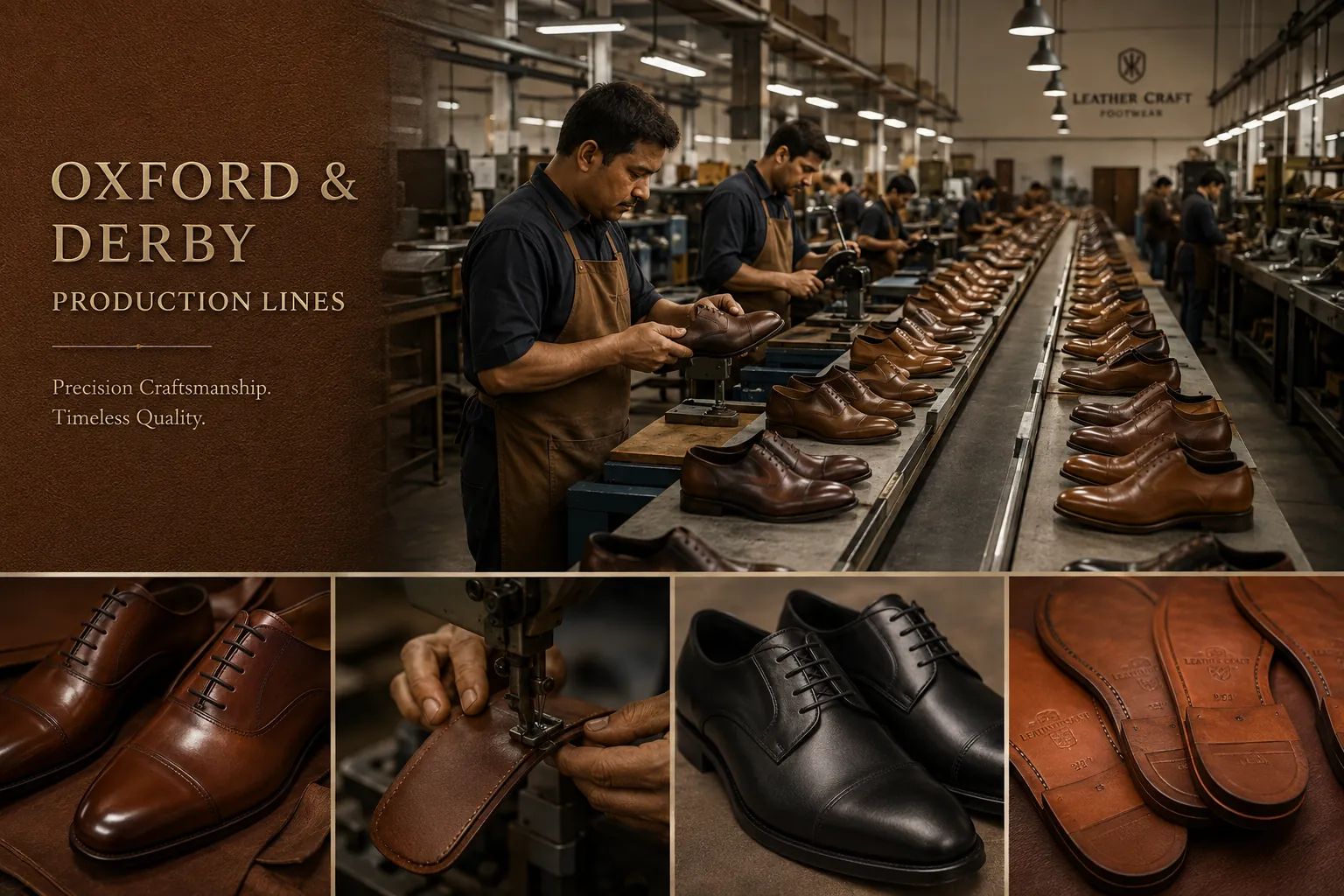
The problem: Their target styles (Oxford and Derby) required last development at $1,200 each, plus outsole tooling at $800 per style. For four styles, tooling alone would consume $8,000 before a single pair was produced. With 300-pair MOQs, their cash was tied up before any market validation.
What they did instead: They sourced four ODM base designs from a factory’s existing library — proven Oxford and Derby constructions with documented production quality. They customized colorways, added branded leather insoles, and commissioned custom shoe boxes. Total development cost: under $2,000.
Result: First order of 240 pairs (60 per style) at $28–$32/pair. Sold out in 11 weeks. Second order doubled volume. By season three, they had sales data to justify OEM investment on their two best-selling styles.
The lesson: ODM is not a compromise — it’s a capital-efficient bridge to OEM.
For context on pricing structures across models, the FOB Shoe Pricing Guide: 4 Incoterms Compared Shoe Manufacturer Guide covers how landed cost changes by sourcing model.
Buyers sourcing from China should also review the Red Flags When Sourcing Leather Shoes from China What Does OEM Mean in Shoes checklist before committing to any model.
For regulatory compliance context, the ISO 20347 standard https://www.iso.org/standard/65695.html – SATRA Footwear Technology defines occupational footwear requirements that apply regardless of which manufacturing model you use.
FAQ
Q: What is the main difference between OEM and ODM footwear?
A: In OEM, you supply the design and the factory manufactures to your spec — you own the IP. In ODM, the factory owns the design and you license it, often with surface-level modifications. OEM gives more control; ODM gives faster speed to market.
Q: Can I switch from ODM to OEM with the same factory?
A: Yes, and it’s common. Many brands start with ODM to validate styles, then commission OEM tooling for their best performers. A good factory will retain your production history and quality benchmarks, making the transition smoother.
Q: What’s the real difference between private label and white label shoes?
A: Private label involves meaningful customization — branded insoles, colorways, packaging, sometimes material changes. White label is a finished product with only a label swap. Private label builds brand equity; white label is a commodity play.
Q: Who owns the IP in a private label arrangement?
A: You own your brand, logo, and packaging design. The factory retains IP on the underlying shoe construction. If you want to move the design to another factory, you may face restrictions. Always clarify IP terms in your contract before sampling.
Q: What MOQ should I expect for each model?
A: White label can be zero MOQ on stock items. Private label and ODM typically start at 60 pairs per style when working with factories that support small-batch orders. OEM with custom tooling usually requires 300+ pairs to amortize tooling costs, though this varies by factory and style complexity.
Ready to Start Your Shoe Line?
Whether you’re validating a new category with white label, building a branded catalog through private label, or scaling into full OEM — the right manufacturing model depends on your stage, budget, and differentiation goals.
Wincheer Shoes works with brands across all four models, with pricing from $25–$40/pair, MOQ of 0 on existing designs, and 60 pairs for custom orders. Explore the full product range at wincheershoes.com Shoe Manufacturer Guide or reach out directly:
📧 peterwang@shwincheer.com
🌐 wincheershoes.com