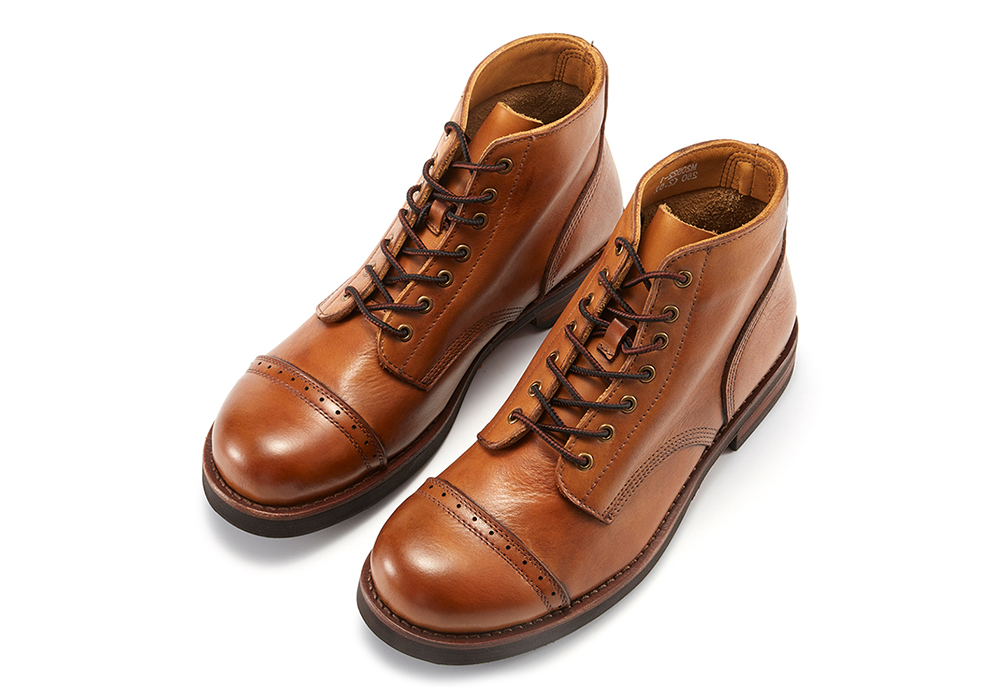
A single bad shipment can wipe out months of margin. When buyers skip structured AQL inspection footwear protocols, they’re essentially gambling with every order. AQL — Acceptable Quality Limit — is the statistical framework that tells you exactly how many units to inspect and how many defects are tolerable before you reject an entire lot.
This guide breaks down every layer of the system: sampling levels, defect classification, the 50-point shoe inspection checklist, and when to bring in a third-party inspector.
Table of Contents
- What AQL Means and Why the Numbers Matter
- AQL Levels Explained: 1.0, 1.5, 2.5, and 4.0
- The 50-Point Shoe Inspection Checklist
- Critical vs Major vs Minor Defects in Footwear
- Three Inspection Stages: Pre-Production, During-Production, Pre-Shipment
- Third-Party Inspection: When to Use It and What It Costs
- 6-Gate QC Process vs Industry Standard
- FAQ
What AQL Means and Why the Numbers Matter
AQL stands for Acceptable Quality Limit. It defines the maximum percentage of defective units that is still considered acceptable in a sampled batch. The standard is governed by ISO 2859-1 [EXTERNAL_LINK: https://www.iso.org/standard/7938.html], which sets the statistical framework used across global manufacturing.
Here’s why the number matters in real dollars. If you’re importing 5,000 pairs at $35 each and your supplier runs a 3% defect rate — the industry average sits between 2–4% — you’re looking at 150 defective pairs worth $5,250. At a 1% defect rate, that drops to 50 pairs and $1,750. That $3,500 gap per shipment compounds fast across a full year of orders.
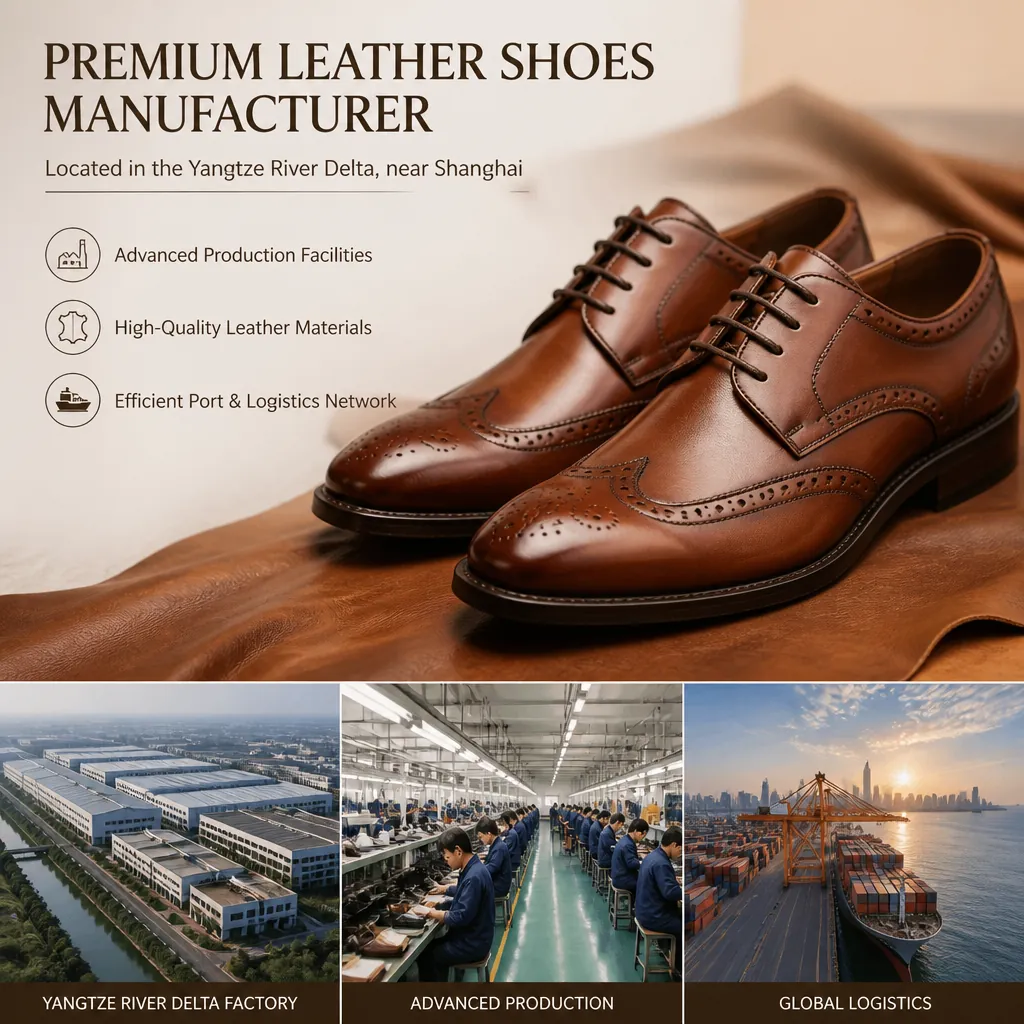
Wincheer Shoes, operating since 2007 with an annual output of 500,000+ pairs, maintains a documented defect rate of 0.8–1.2% — well below the industry average of 2–4%. That performance doesn’t happen by accident. It’s the result of applying structured AQL inspection footwear protocols across every production stage, backed by CE (EN ISO20347), REACH, and RoHS certifications.
For B2B buyers and private label brands, understanding AQL isn’t optional. It’s the baseline for protecting your brand, your margins, and your customers.
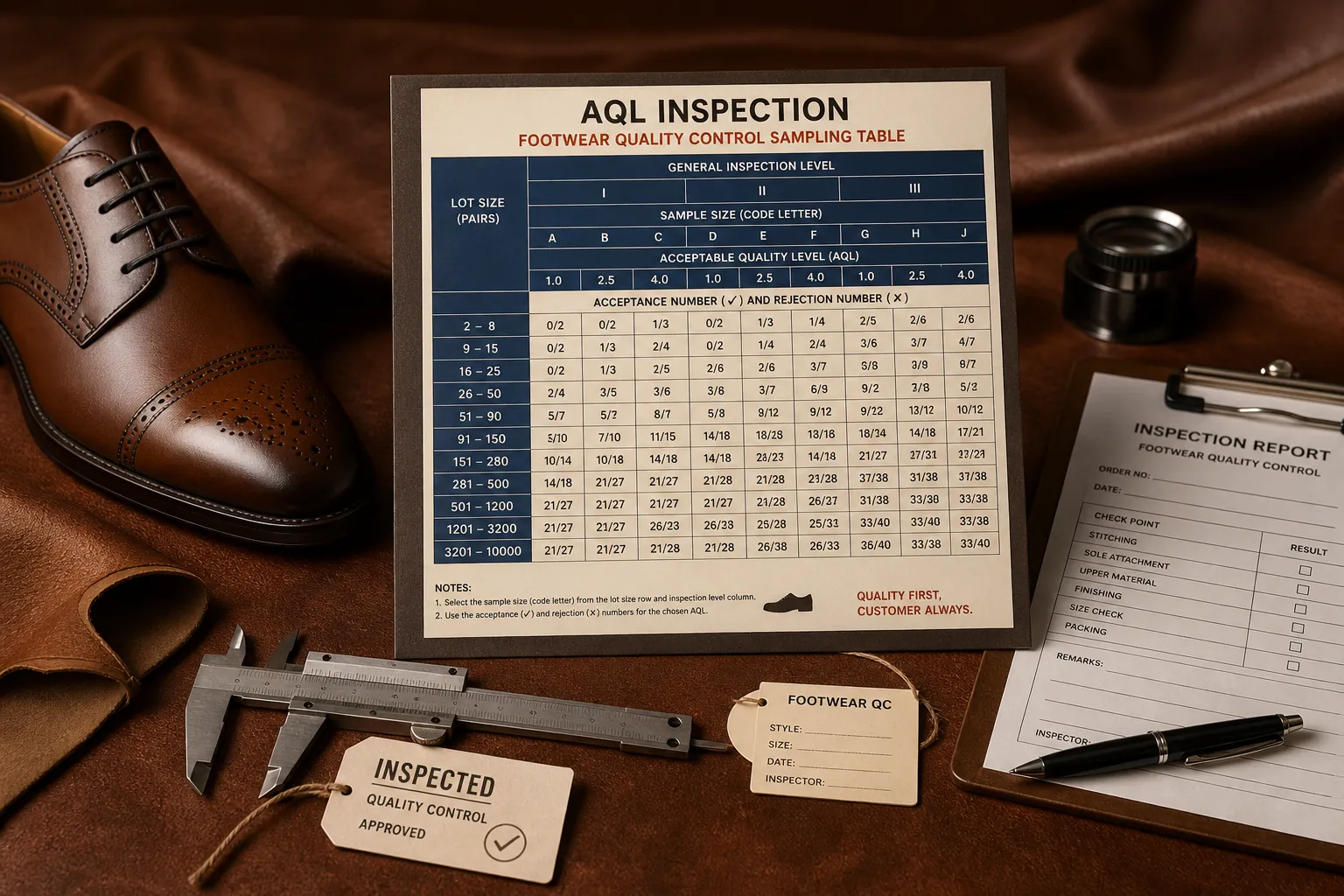
AQL Levels Explained: 1.0, 1.5, 2.5, and 4.0
AQL levels represent the maximum acceptable defect percentage in a shipment. Lower numbers mean stricter standards. Here’s how they map to footwear sourcing:
| AQL Level | Max Defect % | Typical Use Case in Footwear |
|---|---|---|
| 1.0 | 1.0% | Premium leather dress shoes, luxury brands |
| 1.5 | 1.5% | Mid-to-high-end branded footwear |
| 2.5 | 2.5% | Standard commercial footwear (most common) |
| 4.0 | 4.0% | Low-cost, high-volume commodity shoes |
AQL 2.5 is the most widely used level for commercial footwear. It balances statistical rigor with practical production realities.
How Sampling Tables Work
The AQL system uses two variables: your lot size and your inspection level (typically General Inspection Level II for footwear). These two inputs give you a sample size code letter, which then determines how many pairs to pull and how many defects trigger rejection.
Example: 3,000-pair shipment at AQL 2.5, GIL II
- Lot size 3,000 → Code Letter K
- Sample size: 125 pairs
- Accept if defects ≤ 7
- Reject if defects ≥ 8
For a 5,000-pair lot at the same level, you’d pull 200 pairs (Code Letter L), accepting up to 10 defects and rejecting at 11 or more.
The key takeaway: you never inspect 100% of a shipment. AQL gives you a statistically valid sample that represents the whole lot. If your sample fails, the entire shipment is subject to re-inspection or rejection.
The 50-Point Shoe Inspection Checklist
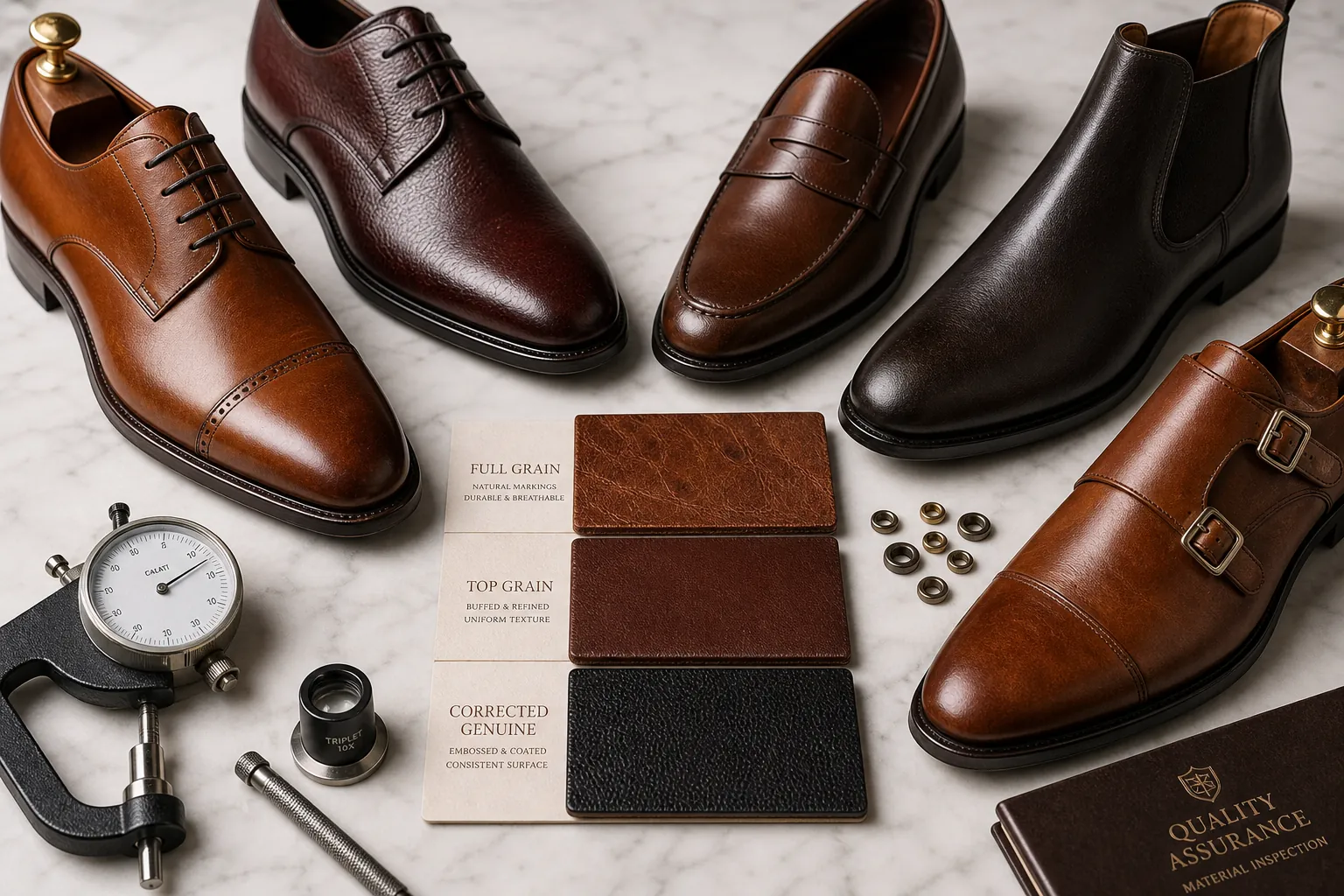
A rigorous AQL inspection footwear checklist covers five major zones. Here’s the full framework used by professional QC inspectors:
1. Upper Leather (10 Points)
- Leather grain consistency across both shoes
- No visible scars, scratches, or blemishes on vamp
- Color uniformity — no fading, patching, or dye migration
- Correct leather thickness (spec tolerance ±0.2mm)
- No peeling or delamination at flex points
- Smooth finish with no rough patches
- Correct toe shape matches approved sample
- No wrinkles or creases from lasting
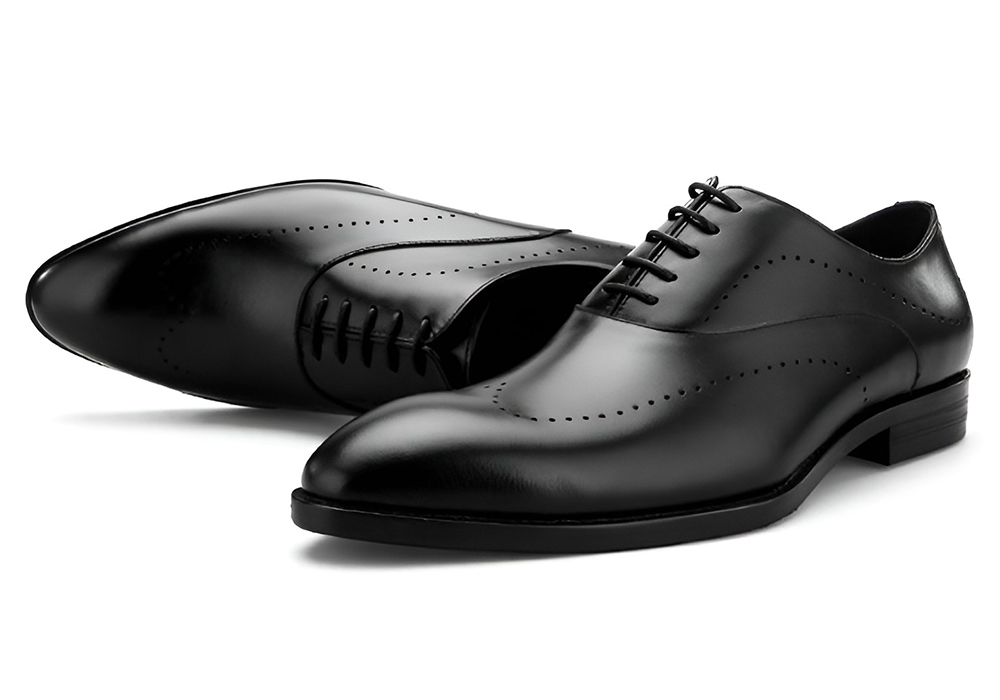
- Perforations (broguing) clean and evenly spaced
- Correct upper height on boots and Chelsea styles
2. Stitching & Construction (10 Points)
- Stitch count per inch matches spec (typically 8–10 SPI for dress shoes)
- No skipped stitches anywhere on the upper
- No loose thread ends or fraying
- Welt stitching is straight and consistent
- Insole stitching is secure with no gaps
- Lining stitching is flat with no bunching
- Heel counter stitching is reinforced
- Toe box stitching is even and symmetric
- No exposed raw edges on interior seams
- Decorative stitching matches approved color
3. Sole & Outsole (10 Points)
- Sole bonding is complete with no air pockets
- Sole edge is trimmed flush with the upper
- No excess adhesive visible on outsole perimeter
- Heel height matches spec (tolerance ±2mm)
- Outsole tread pattern is clean and fully formed
- No bubbling or separation at heel attachment
- Sole flex test: no cracking at standard bend
- Correct outsole material (rubber, TPR, leather)
- Anti-slip rating meets spec where applicable
- Outsole color matches approved sample
4. Fit, Alignment & Symmetry (10 Points)
- Left and right shoes are a matched pair (same last)
- Toe spring is consistent across both shoes
- Heel height is equal on both shoes
- Insole is centered and fully adhered
- Lining is smooth with no bunching at toe
- Tongue is centered and symmetrical
- Eyelets are evenly spaced and properly set
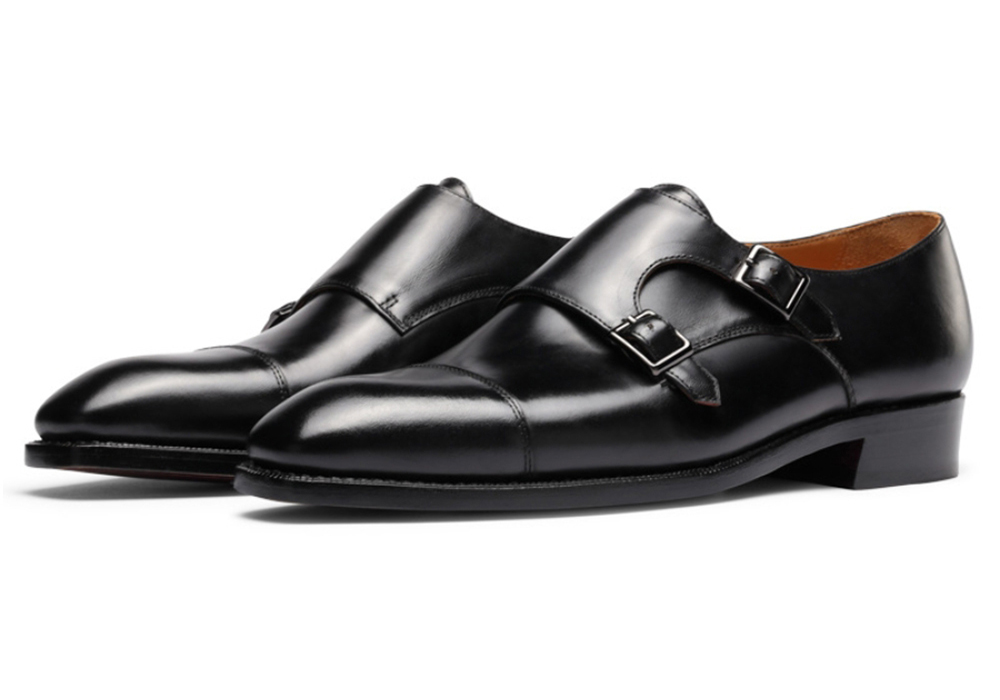
- Buckles (monk strap) are level and functional
- Elastic gussets (Chelsea) are equal tension
- Shoe sits flat on a level surface without rocking
5. Finishing & Packaging (10 Points)
- Shoe trees or toe stuffing inserted correctly
- Tissue wrapping is clean and complete
- Shoebox matches spec (size, color, logo placement)
- Correct size label inside shoe
- Hang tags are attached and correct
- Dust bags included where specified
- Barcode scans correctly
- Country of origin label is present
- No adhesive residue on exterior leather
- Shoes are polished and presentation-ready
Critical vs Major vs Minor Defects in Footwear
Not all defects carry equal weight. AQL inspection footwear protocols classify defects into three tiers, each with different accept/reject thresholds.
Critical Defects — Zero Tolerance
These defects create safety risks or regulatory non-compliance. Any single critical defect in a sample triggers automatic lot rejection.
Examples:
- Sole completely detached from upper
- Exposed nail or tack inside the shoe
- Chemical contamination (REACH violation — restricted substances)
- Heel collapse under standard load test
- Mislabeled size creating fit safety risk
Major Defects — AQL 2.5 Threshold
These defects significantly affect function, appearance, or marketability. They will generate customer complaints and returns.
Examples:
- Visible stitching breaks on the vamp
- Leather color mismatch between left and right shoe
- Sole bonding failure at flex point
- Heel height variance exceeding ±3mm
- Lining bunching that causes discomfort
- Wrong last used (shape doesn’t match spec)
Minor Defects — AQL 4.0 Threshold
These are cosmetic issues that don’t affect function but may affect perceived value.
Examples:
- Light scuff on heel counter (not visible when worn)
- Slight thread trimming imperfection
- Minor ink mark on insole
- Tissue paper wrinkled inside box
- Slight variation in polish sheen
The standard practice is to apply AQL 2.5 for major defects and AQL 4.0 for minor defects simultaneously. Critical defects always use a zero-tolerance rule regardless of lot size.
For a deeper look at how these standards apply to specific shoe styles, the AQL inspection footwear quality control tips guide [INTERNAL_LINK: aql-inspection-footwear-top-5-quality-control-tips] covers practical applications by product category.
Three Inspection Stages: Pre-Production, During-Production, Pre-Shipment
A single pre-shipment check is not enough. Professional buyers run quality control at three distinct stages.
Stage 1: Pre-Production Inspection (PPI)
This happens before a single pair is cut. The goal is to verify that raw materials, components, and production setup match your approved specifications.
What to check:
- Leather grade and tannage matches approved sample
- Outsole compound and hardness is correct
- Thread color and weight matches spec
- Lasts are the correct size run
- Factory has your approved production sample on the floor
Catching a wrong leather grade at this stage costs nothing to fix. Catching it after 5,000 pairs are cut costs everything.
Stage 2: During-Production Inspection (DUPRO)
Run this when 20–40% of the order is complete. You’re looking for systematic errors that will repeat across the entire run.
What to check:
- Stitching consistency on early production units
- Lasting quality and toe shape
- Sole bonding process and adhesive application
- Color consistency across the batch
- Any deviation from the approved sample
A DUPRO inspection that catches a systematic stitching error at 30% completion saves you from rejecting 70% of the order later.
Stage 3: Pre-Shipment Inspection (PSI)
This is the final gate before goods leave the factory. Run this when 80–100% of production is complete and packed.
What to check:
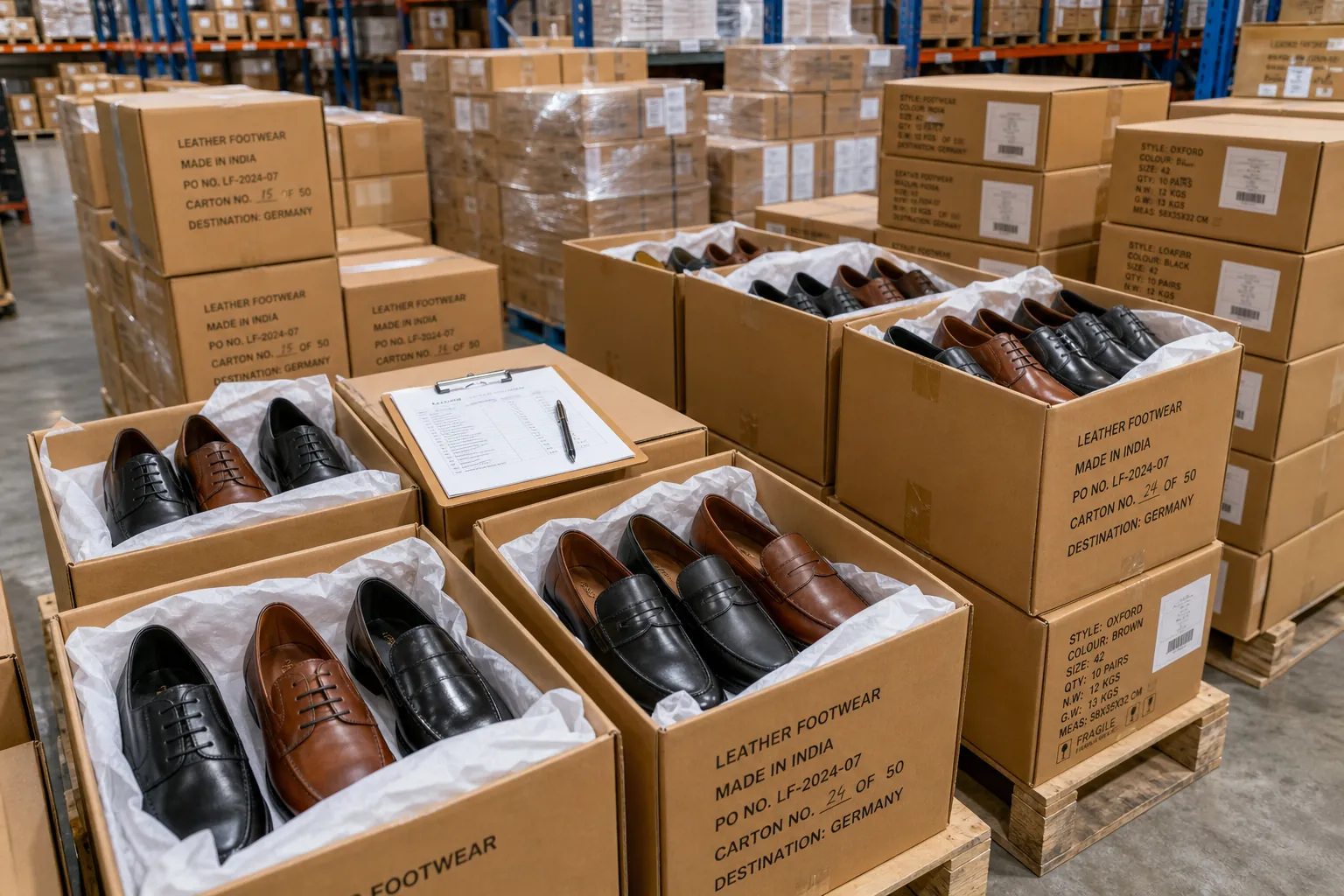
- Full AQL sampling from packed cartons
- Carton markings, labeling, and barcode verification
- Quantity count against purchase order
- Packaging integrity for export transit
- Random wear test on sample pairs
The complete guide to leather Oxford shoes for wholesale buyers [INTERNAL_LINK: complete-guide-to-leather-oxford-shoes-for-wholesale-buyers] includes product-specific inspection criteria that complement this three-stage framework.
Third-Party Inspection: When to Use It and What It Costs
Third-party inspection makes sense in specific scenarios. It’s not always necessary — but when it is, it’s worth every dollar.
When to Use Third-Party Inspection
- New supplier relationship (first 2–3 orders minimum)
- Order value exceeds $15,000 — the inspection cost is trivial relative to the risk
- You cannot visit the factory yourself
- Previous quality issues with the supplier
- Regulated markets (EU, USA) where compliance documentation is required
What It Costs
A standard pre-shipment inspection in China runs $250–$400 per man-day. Most footwear orders require 1–2 man-days depending on lot size and complexity. That’s $250–$800 to protect a $30,000+ shipment.
Top Third-Party Inspection Providers for Footwear
| Provider | Coverage | Footwear Specialization |
|---|---|---|
| SGS | Global | Strong — full lab testing available |
| Bureau Veritas | Global | Strong — REACH/RoHS compliance focus |
| Intertek | Global | Strong — CE marking verification |
| QIMA | Asia-focused | Strong — tech-enabled, fast turnaround |
| Asia Quality Focus | China/Vietnam | Specialist footwear QC |
For orders going into the EU market, third-party inspection should also verify CE marking compliance. The CE marking footwear 2026 EU certification guide [INTERNAL_LINK: ce-marking-footwear-2026-eu-certification-guide] explains exactly what documentation you need.
6-Gate QC Process vs Industry Standard
Understanding how a manufacturer’s internal QC compares to minimum industry standards helps buyers evaluate supplier risk before placing orders.
| QC Gate | Industry Standard Practice | 6-Gate QC Process | Pass Rate Target |
|---|---|---|---|
| Gate 1: Raw Material Incoming | Spot check on delivery | Full leather grade + component verification | 100% spec match |
| Gate 2: Cutting QC | Visual check on cut panels | Dimensional check on every 10th panel | ±1mm tolerance |
| Gate 3: Stitching Line QC | End-of-line batch check | In-line inspector every 50 pairs | 0 skipped stitches |
| Gate 4: Lasting & Assembly QC | Supervisor spot check | Dedicated lasting QC station | Symmetry ±1mm |
| Gate 5: Finishing QC | Pre-packing visual | 20-point finishing checklist per pair | 0 critical, ≤1 minor |
| Gate 6: Pre-Shipment AQL | Optional or buyer-requested | Mandatory AQL 2.5 sampling from packed cartons | Defect rate ≤1.2% |
The difference between a 2–4% industry defect rate and a sub-1.2% defect rate comes down to how many gates exist between raw material and packed carton. Factories that inspect only at the end catch defects too late to fix them efficiently.
For buyers evaluating OEM and ODM partners, understanding the full manufacturing process is essential. The OEM ODM men’s genuine leather shoes manufacturer overview [INTERNAL_LINK: oem-odm-mens-genuine-leather-shoes-manufacturer] explains how production structure affects quality outcomes.