Top grain leather sits at the sweet spot between luxury full grain and budget genuine leather — and that’s exactly why it dominates the B2B wholesale market. For private label brands, Amazon sellers, and retail chains targeting the $60–120 retail price window, top grain delivers the look, durability, and margin structure that makes business sense.
This guide breaks down everything you need to know before placing a factory direct order: leather grade definitions, price tiers by shoe type, how to write a proper tech pack specification, and what to watch for when comparing supplier quotes.
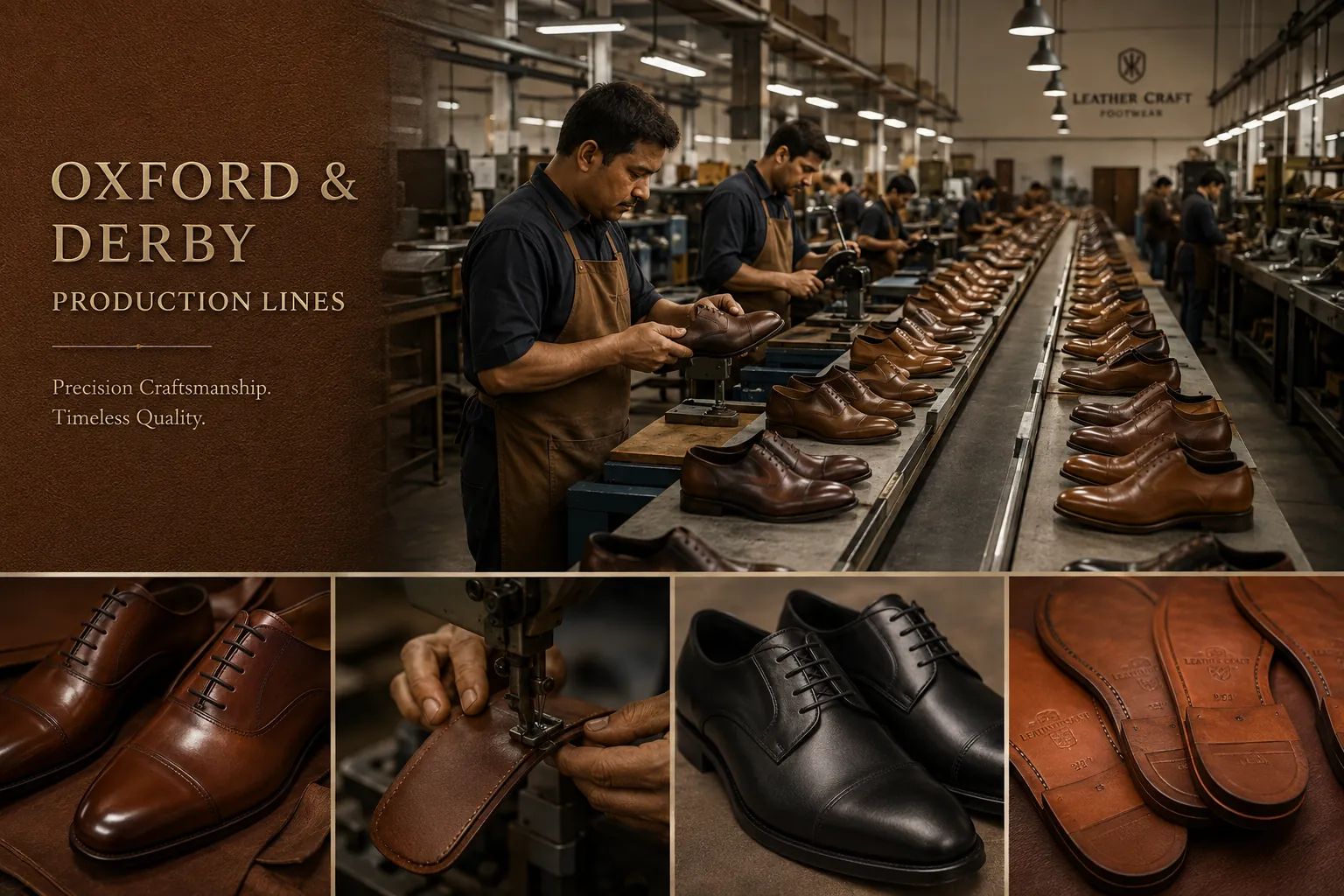
At Wincheer Shoes — a manufacturer founded in 2007 with annual output exceeding 500,000 pairs and a defect rate of just 0.8–1.2% (versus an industry average of 2–4%) — top grain leather accounts for the majority of wholesale orders across Oxford, Derby, Loafer, and Chelsea Boot styles. That real-world volume gives the data in this guide practical weight.
Top Grain Leather Shoes Wholesale Guide: Table of Contents
- Top Grain vs Full Grain vs Genuine Leather: What B2B Buyers Need to Know
- Why Top Grain Dominates the $60–120 Retail Segment
- Factory Direct Price Tiers by Shoe Type
- Leather Grade × Shoe Type × Price Comparison Table
- How to Specify Top Grain in Your Tech Pack
- Ordering Checklist: Factory Direct Top Grain Shoes
- FAQ
- Ready to Start Your Shoe Line?
Top Grain vs Full Grain vs Genuine Leather: What B2B Buyers Need to Know
Understanding leather grades is non-negotiable for top grain leather shoes wholesale sourcing. Misidentifying the grade on your purchase order can mean receiving a product that doesn’t match your retail price point — or your customer’s expectations.
Full Grain Leather
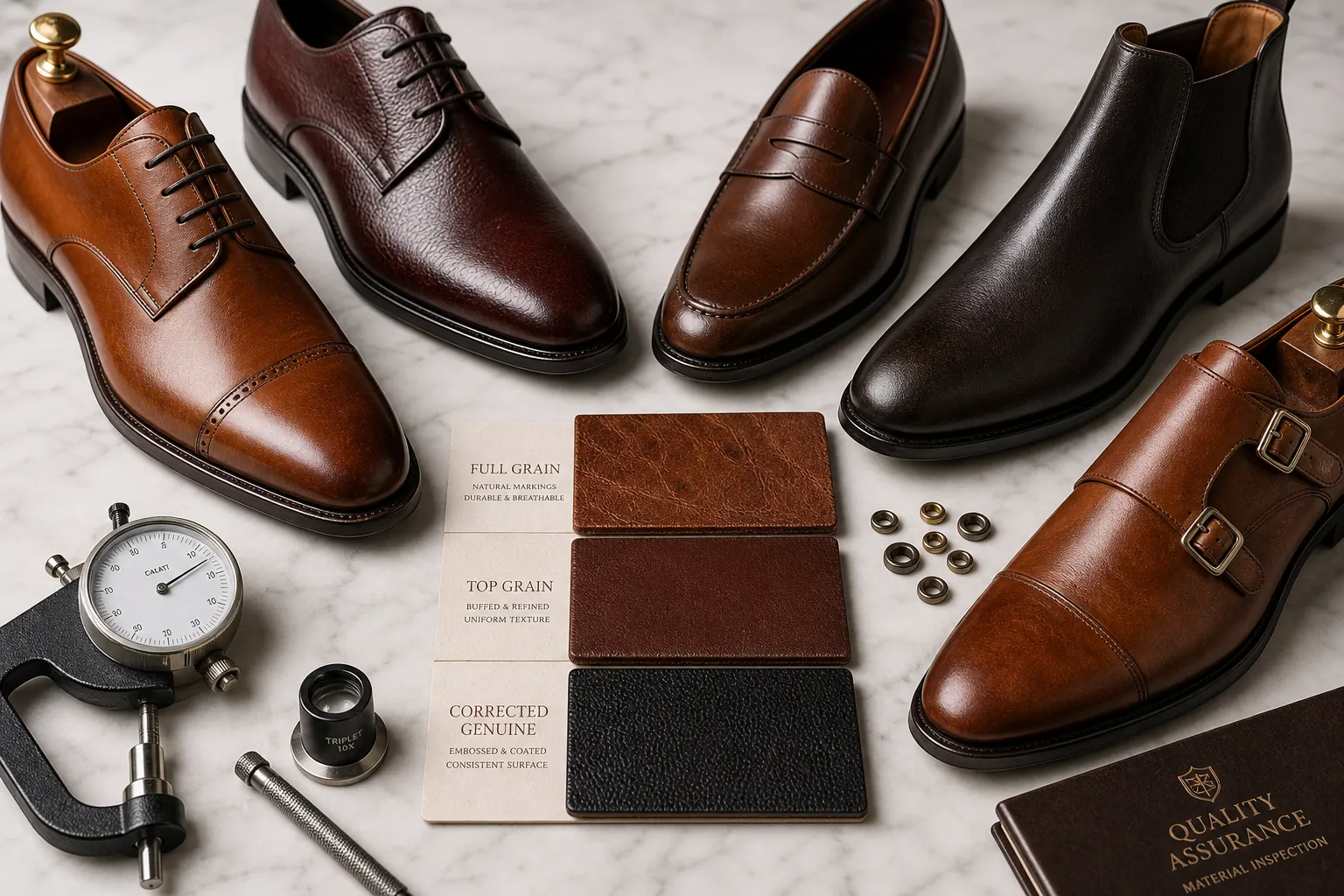
Full grain is the top layer of the hide with the natural grain surface completely intact. No sanding or buffing is applied. It retains all the original fiber structure, which means it’s the strongest, most breathable, and most durable leather available.
It also carries the highest cost. Factory prices for full grain leather shoes typically run 20–35% above equivalent top grain styles. For most $60–120 retail products, that margin compression is hard to justify unless you’re building a premium positioning story.
Top Grain Leather
Top grain is the same top layer of the hide, but the surface has been lightly sanded or buffed to remove natural imperfections — small scars, insect marks, uneven texture. A finish coat is then applied, which adds consistency and light surface protection.
The result is a shoe that looks uniform and polished at retail, holds up well under normal wear, and can be manufactured at scale with consistent quality. This is the dominant grade for the $60–120 retail segment globally.
Genuine Leather (Corrected Grain)
“Genuine leather” is a legally accurate but commercially misleading term. It refers to lower layers of the hide — split leather — that have been heavily sanded and embossed with an artificial grain pattern to simulate the look of top grain.
It’s cheaper to produce, but it cracks faster, breathes poorly, and generates significantly more customer returns. For any brand building long-term reputation, genuine leather is a quality risk that rarely pays off.
Bonded Leather
Not worth serious consideration for B2B wholesale. Bonded leather is reconstituted leather fiber mixed with polyurethane binders. It degrades rapidly and is increasingly rejected by major retail buyers and EU compliance frameworks.
According to the Leather Working Group’s material standards the Leather Working Group standards, responsible sourcing now includes traceability requirements that bonded leather suppliers typically cannot meet.
Why Top Grain Dominates the $60–120 Retail Segment
The $60–120 retail window is the largest volume segment in men’s dress and smart casual footwear. It’s where department stores, mid-tier e-commerce brands, and corporate uniform buyers spend the majority of their leather shoe budget.
Top grain leather fits this segment for three structural reasons.
Margin math works. Factory direct pricing for top grain leather shoes runs $24–35/pair depending on style. At a standard 2.5–3× wholesale markup and a 1.5–2× retail markup, a $28 factory price yields a $65–85 retail price — right in the sweet spot.
Consistency at scale. Because the surface is finished, top grain leather accepts dye and embossing uniformly. That means color consistency across a 500-pair run is far more reliable than with full grain, where natural variation is part of the product.
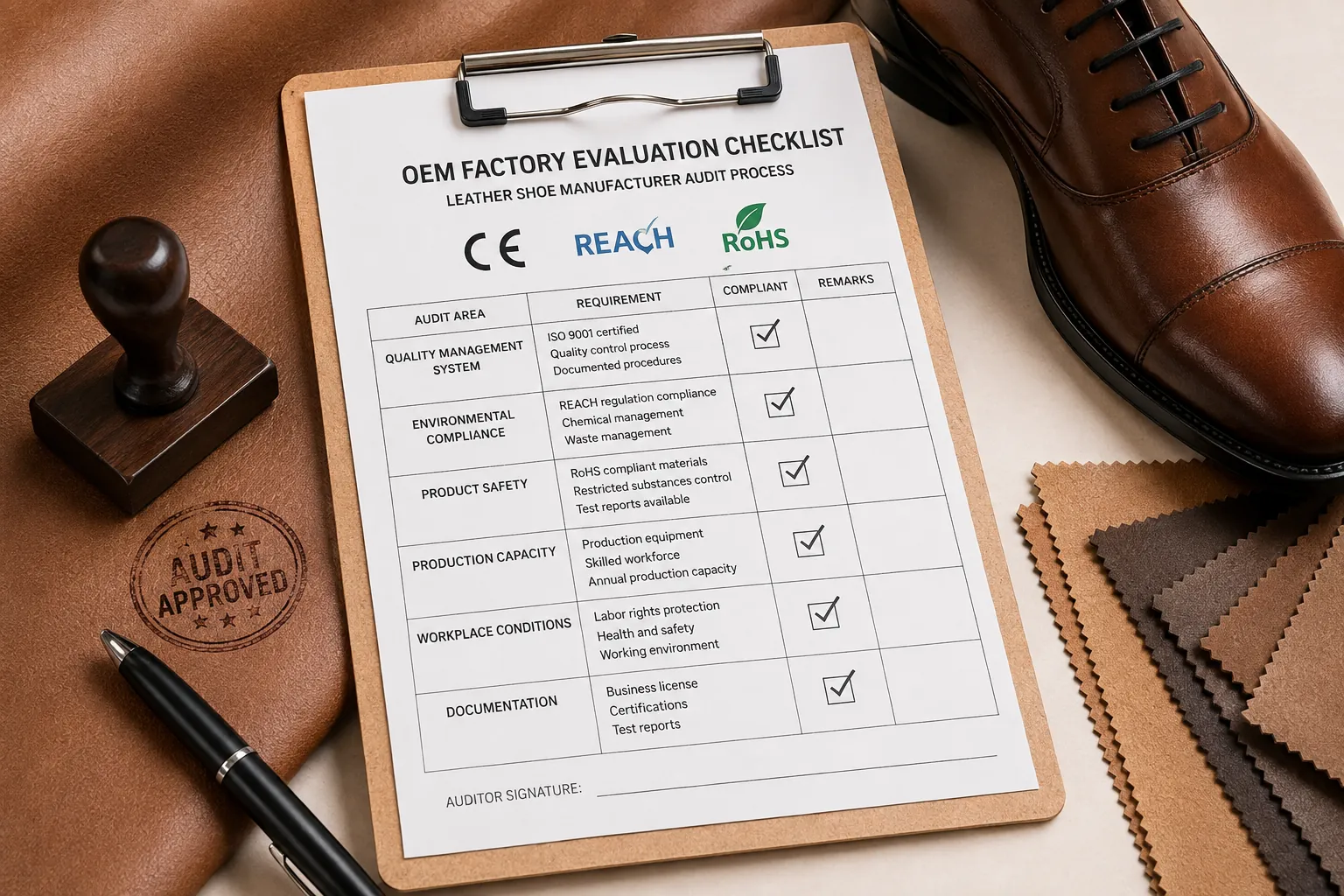
Compliance-ready. Top grain leather from reputable tanneries consistently meets REACH regulation https://echa.europa.eu/regulations/reach/understanding-reach – BLC Leather Technology Centre limits on restricted substances — a requirement for EU market entry. Factories producing at volume for 50+ countries typically maintain CE (EN ISO20347), REACH, and RoHS certifications as baseline.
Factory Direct Price Tiers by Shoe Type
Factory direct pricing for top grain leather shoes wholesale varies by construction complexity, hardware, and sole type. The ranges below reflect standard FOB Guangzhou pricing for top grain leather with a PU or rubber outsole.
Oxford Shoes — $28–35/pair
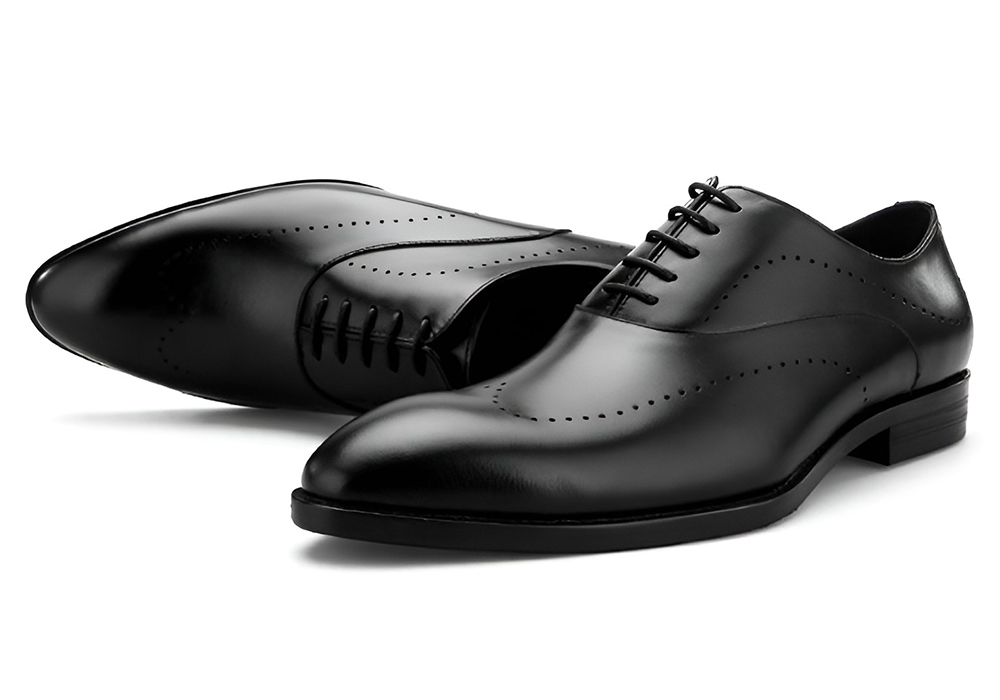
Oxfords carry the highest price within the dress shoe category due to the closed lacing system, which requires more precise lasting and stitching. Brogue detailing, cap toes, and Goodyear welt construction all push toward the upper end of this range.
For a plain-toe Oxford in top grain calf leather with a TPR outsole, expect $28–30. A full brogue with leather outsole and welt construction lands at $32–35.
Browse our Oxford shoe catalog What Does OEM Mean in Shoes to see current styles available for private label ordering.
Derby Shoes — $26–32/pair
Derbies use an open lacing system, which is slightly simpler to construct than an Oxford. The price difference is modest — typically $2–3/pair — but meaningful at volume.
Derby styles in top grain leather with contrast stitching or medallion detailing sit at $28–30. Plain Derby in smooth top grain with rubber outsole: $26–28.
Loafers — $24–30/pair
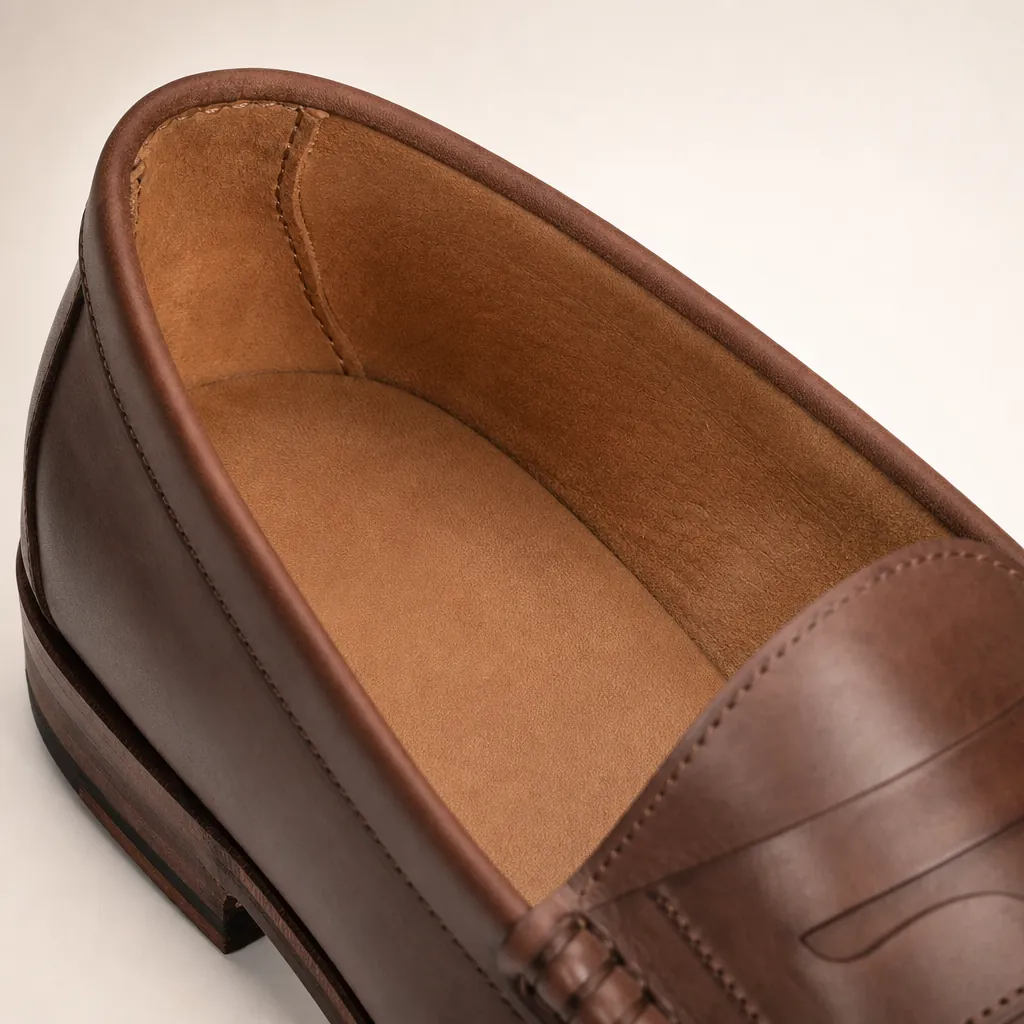
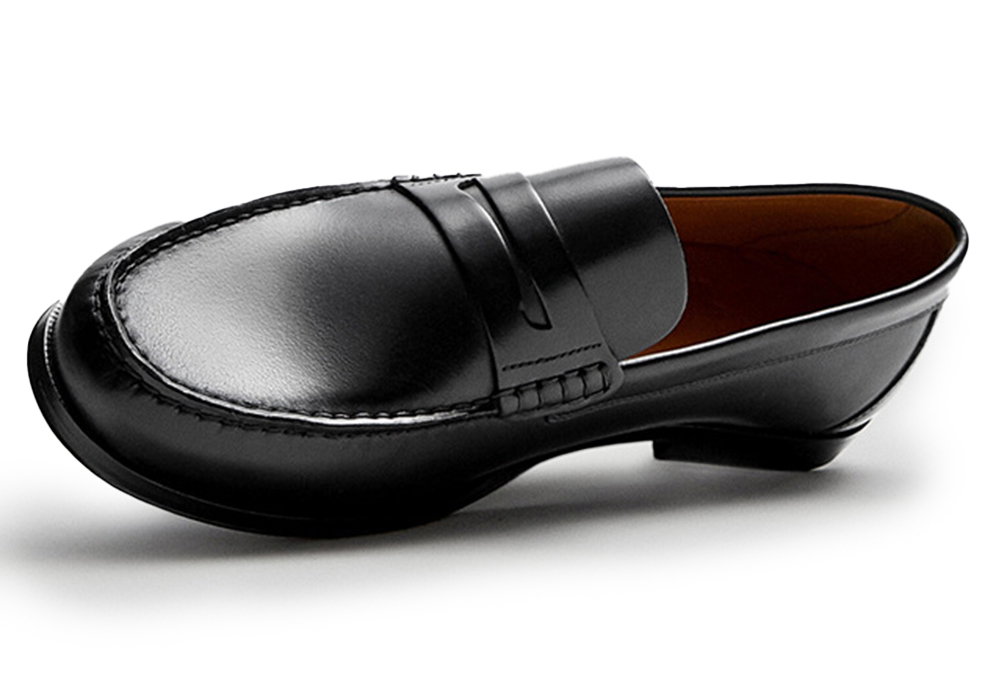
Loafers have no lacing hardware and a simpler upper construction, which brings factory cost down. Penny loafers and tassel loafers in top grain leather start at $24–26. Horsebit loafers with metal hardware run $27–30 due to hardware cost and assembly time.
Monk Strap Shoes — $27–33/pair
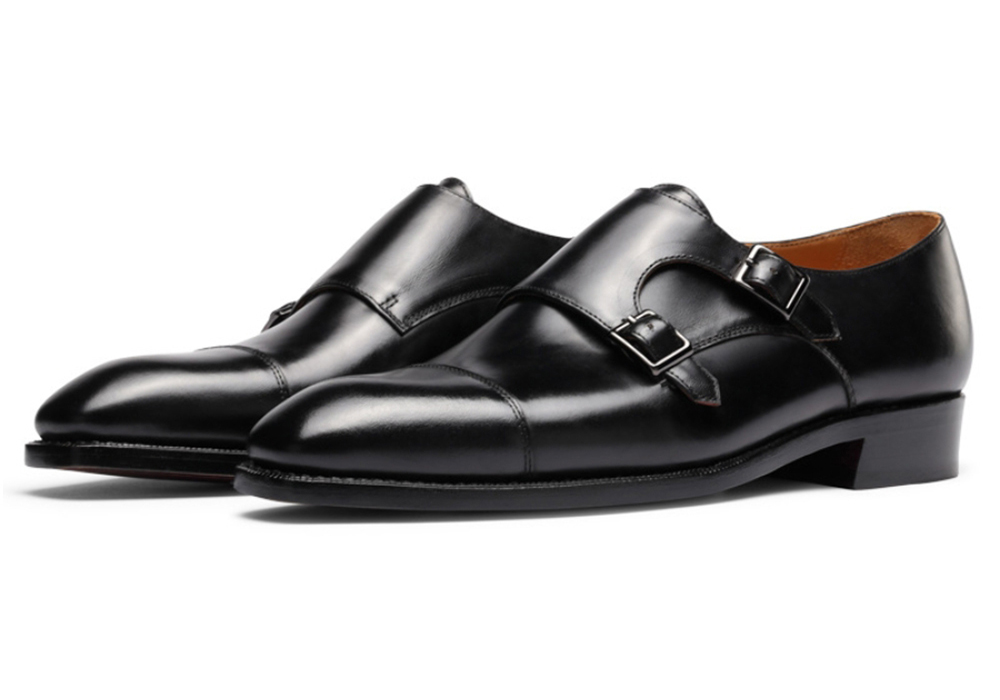
Single monk straps sit at $27–29. Double monks, which require two buckles and additional strap construction, run $30–33. Metal buckle quality is a key cost variable here.
Chelsea Boots — $29–38/pair
Chelsea boots require more leather per pair (higher shaft) and elastic gusset components. Standard ankle height in top grain leather: $29–32. Taller shaft or Goodyear welt construction: $34–38.
Leather Grade × Shoe Type × Price Comparison Table
This table gives B2B buyers a direct reference for factory pricing and suggested retail positioning across leather grades and shoe types.
| Shoe Type | Genuine Leather (Factory) | Top Grain (Factory) | Full Grain (Factory) | Suggested Retail (Top Grain) |
|---|---|---|---|---|
| Oxford | $18–22 | $28–35 | $38–48 | $65–105 |
| Derby | $16–20 | $26–32 | $35–45 | $60–95 |
| Loafer | $15–19 | $24–30 | $33–42 | $55–90 |
| Monk Strap | $17–21 | $27–33 | $36–46 | $62–98 |
| Chelsea Boot | $20–25 | $29–38 | $40–52 | $70–115 |
All factory prices are FOB Guangzhou, top grain prices based on standard calf leather with PU or rubber outsole. Full grain pricing assumes natural grain finish with leather or Goodyear welt construction.
How to Specify Top Grain in Your Tech Pack
Vague leather specifications are one of the most common causes of quality disputes in wholesale shoe orders. “Top grain leather” alone is not a sufficient specification. Here’s what your tech pack must include.
Leather Thickness
Specify thickness in millimeters. For dress shoes (Oxford, Derby, Monk Strap), the standard upper leather thickness is 1.2–1.4mm. For casual styles and loafers, 1.0–1.2mm is acceptable. Chelsea boot uppers should be 1.4–1.6mm for structural integrity.
Insist that your supplier confirms thickness with a caliper measurement report at the pre-production sample stage.
Surface Finish Type
Top grain leather comes in several finish types that affect appearance and price:
- Semi-aniline finish: Light pigment coat over natural grain. Shows some natural character. Most common for premium-positioned products.
- Full pigment finish: Heavier coating for maximum color consistency and scuff resistance. Standard for volume orders.
- Pull-up / wax finish: Develops a patina with use. Niche positioning, higher cost.
- Patent finish: High-gloss lacquer coat. Used for formal Oxford styles.
State the finish type explicitly. “Top grain with full pigment finish, gloss level 30–40 GU” is a specification. “Top grain leather” is not.
Leather Origin and Tannery
Leather origin affects both quality consistency and compliance. Key sourcing regions:
- Chinese tanneries (Hebei, Zhejiang): Cost-efficient, REACH-compliant options available, variable quality — specify tannery name or approved supplier list.
- Indian tanneries (Chennai, Kanpur): Good calf and buffalo leather, competitive pricing, verify LWG certification.
- Brazilian tanneries: Strong for bovine leather, common in volume orders.
For EU market orders, require a REACH compliance declaration https://echa.europa.eu/regulations/reach/understanding-reach – World Footwear from the tannery, not just the shoe factory.
Color Specification
Use Pantone TPX (textile/paper) codes for color matching, not just color names. “Dark brown” means different things to different factories. “Pantone TPX 19-1217” is unambiguous.
Stitching and Edge Finishing
Specify thread color, stitch count per inch (8–10 SPI is standard for dress shoes), and edge finishing method (painted edge, burnished edge, or raw edge). These details affect the perceived quality tier at retail.
For a deeper look at how construction methods interact with leather grade choices, see our complete shoe construction comparison Shoe Manufacturer Guide.
Ordering Checklist: Factory Direct Top Grain Shoes
Use this checklist before confirming any top grain leather shoes wholesale order.
Leather Specification
- Leather grade confirmed as top grain (not genuine/split)
- Thickness specified in mm (1.0–1.6mm depending on style)
- Surface finish type stated (semi-aniline, full pigment, patent, etc.)
- Tannery origin confirmed and REACH compliance document requested
- Color specified by Pantone TPX code
Pricing and MOQ
- FOB price confirmed in writing with Incoterm stated
- MOQ confirmed (0 pairs for existing designs, 60 pairs for custom)
- Price valid period stated (commodity leather prices fluctuate quarterly)
- Payment terms agreed (standard: 30% deposit, 70% before shipment)
Quality Control
- Pre-production sample approved before bulk production
- AQL inspection level agreed (AQL 2.5 is standard for footwear)
- Defect rate expectation documented (industry benchmark: 2–4%; target: under 1.5%)
- Third-party inspection option confirmed
Compliance
- CE (EN ISO20347) certification confirmed if selling in EU
- REACH compliance documentation requested
- Country of origin documentation confirmed for import duty purposes
Branding and Packaging
- Logo placement and method confirmed (emboss, deboss, metal badge)
- Insole branding specification included in tech pack
- Packaging spec confirmed (box dimensions, tissue, hang tag)
For more detail on avoiding sourcing mistakes, the red flags checklist for sourcing leather shoes from China What Does OEM Mean in Shoes is worth reviewing before you send your first PO.
Buyers building a private label line from scratch should also read our private label shoes 10-step brand launch guide Shoe Manufacturer Guide for a full sourcing-to-launch framework.
FAQ
Q: What is the minimum order quantity for top grain leather shoes wholesale?
A: For existing catalog designs, there is no minimum order quantity — you can order as few pairs as needed to test the market. For custom designs (your own last, upper pattern, or branding), the minimum is 60 pairs per style per color. Custom orders require a pre-production sample approval before bulk production begins.
Q: How do I verify that a supplier is actually using top grain leather and not genuine/split leather?
A: Request a material certification from the tannery (not just the factory), and ask for a cross-section photo of the leather showing the grain layer. During pre-production sample review, check that the leather surface shows some natural character under the finish — heavily embossed uniform grain patterns are a common indicator of split leather. Third-party lab testing (e.g., fiber structure analysis) can confirm leather grade if you have quality disputes.
Q: What’s the typical lead time for a top grain leather shoes wholesale order?
A: For existing designs with no customization, lead time is typically 30–45 days from deposit payment. For custom designs requiring new lasts or patterns, add 15–20 days for sample development. Peak season (September–November) can add 10–15 days to production schedules, so factor that into your inventory planning.
Q: Are top grain leather shoes compliant with EU REACH regulations?
A: Top grain leather from certified tanneries is REACH-compliant, but compliance depends on the specific tannery and finishing chemicals used — not the grade itself. Always request a REACH compliance declaration from the tannery, and confirm that the factory holds CE (EN ISO20347) certification if your products will be sold as occupational or safety footwear in the EU. For standard dress shoes, REACH compliance on the leather and lining materials is the primary requirement.
Q: How does factory direct pricing compare to buying through a trading company or Alibaba sourcing agent?
A: Trading companies and sourcing agents typically add 8–15% to factory direct prices, plus commission fees. For top grain leather shoes, that can mean paying $32–40/pair for product that costs $28–35 direct from the factory. The trade-off is that agents handle communication, QC coordination, and logistics