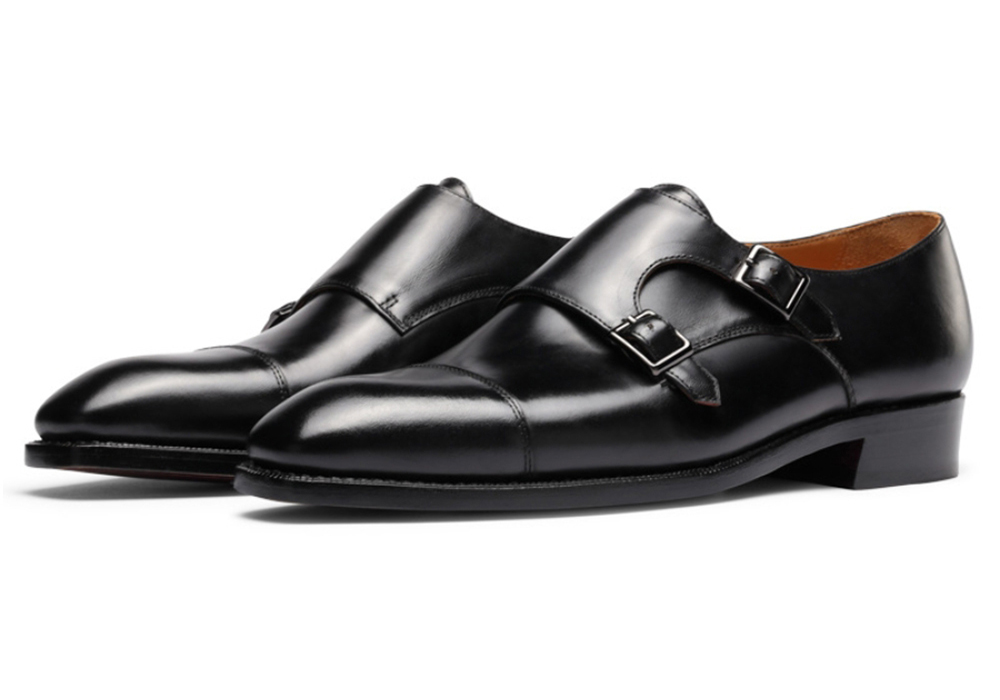
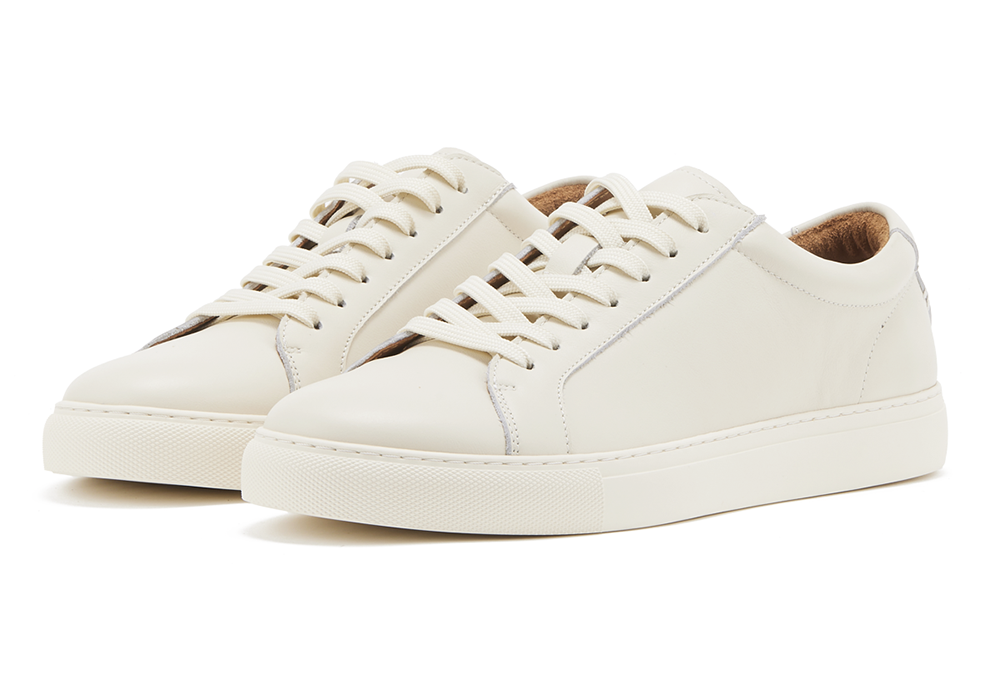
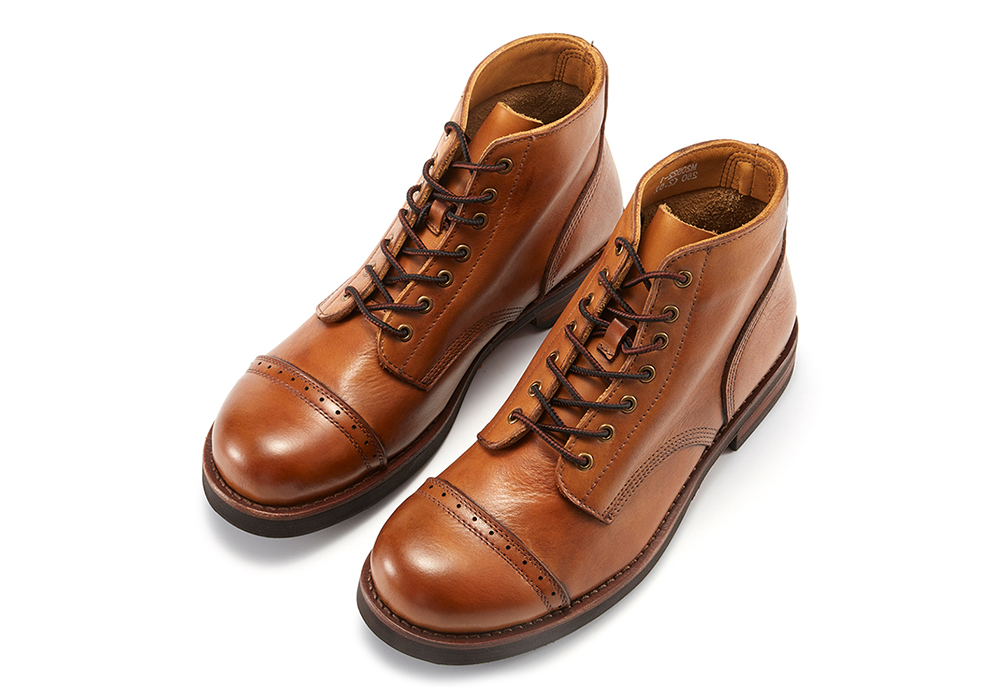
Custom Dress Shoes: Everything You Need to Know About
Custom dress shoes represent a growing segment in the B2B footwear market, with private label brands and retailers seeking differentiation through personalized designs. Whether you’re launching a new shoe line or expanding your existing catalog, understanding the manufacturing process, minimum order quantities, and quality standards is critical for success. This guide breaks down everything from initial design consultation to final delivery, helping you navigate the complexities of ordering bespoke footwear from manufacturers.
The custom dress shoes market has evolved significantly, with modern factories now offering flexible MOQs and faster turnaround times than ever before. With 19 years of production experience and an annual output exceeding 500,000 pairs, we at Wincheer have seen firsthand how the industry has shifted from rigid mass production to accommodating smaller, more specialized orders. Our facility maintains a defect rate of 0.8-1.2%—well below the industry average of 2-4%—while offering zero MOQ on existing designs and just 60 pairs for fully custom orders.
Table of Contents
- What Are Custom Dress Shoes and Why Order Them
- The Custom Shoe Manufacturing Process: 7 Key Stages
- MOQ, Pricing, and Lead Time Realities
- Design Specifications and Technical Requirements
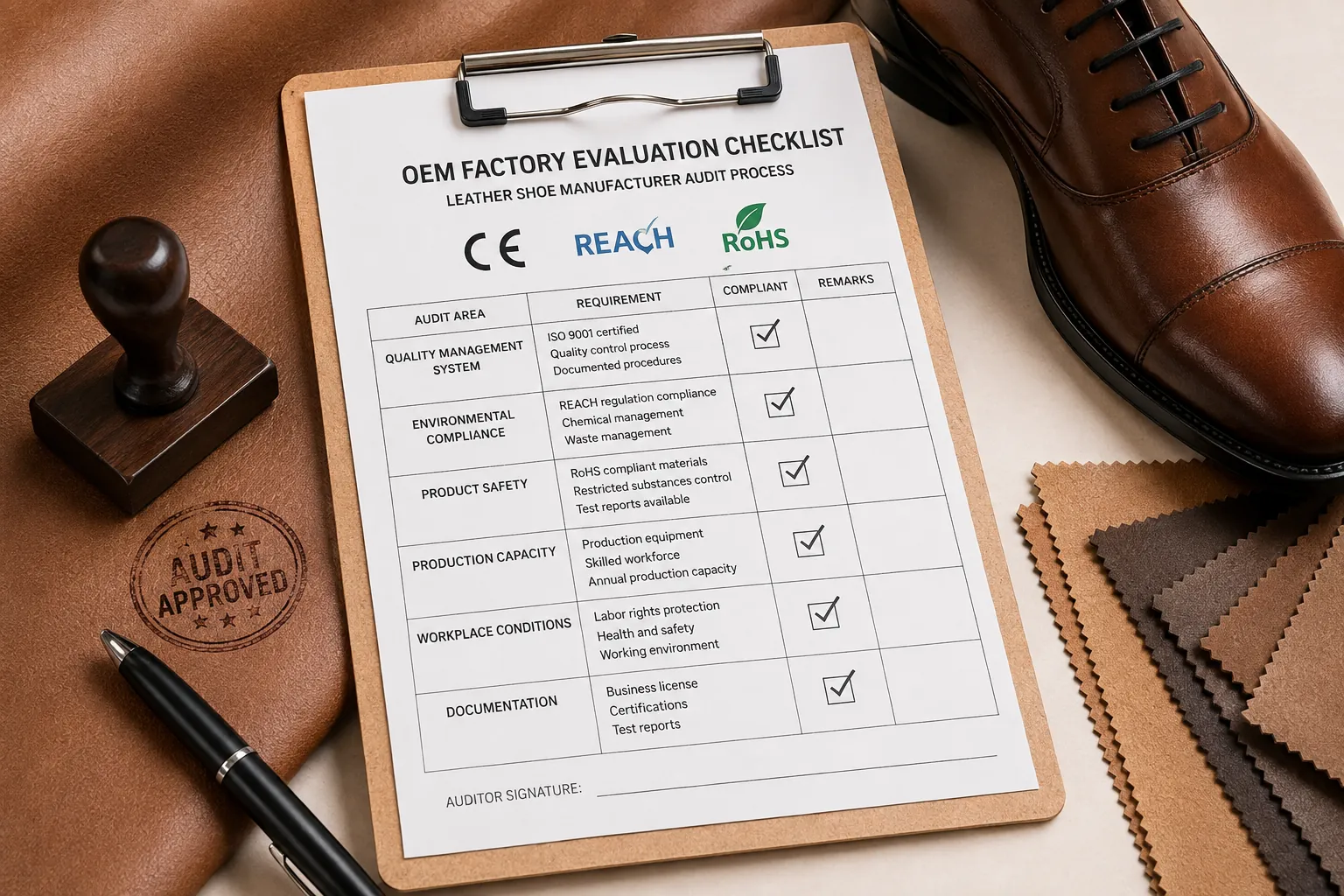
- Quality Control and Certification Standards
- Common Mistakes When Ordering Custom Dress Shoes
- Ready to Start Your Shoe Line?
What Are Custom Dress Shoes and Why Order Them
Custom dress shoes are made-to-order footwear manufactured according to specific design requirements, materials, and branding elements provided by the buyer. Unlike off-the-shelf wholesale products, these shoes allow complete control over every aspect—from leather selection and construction method to sole type and finishing details.
B2B buyers typically pursue custom dress shoes for three primary reasons: brand differentiation, market-specific adaptations, and margin optimization. A private label brand can create unique designs that competitors cannot replicate, while retailers can adjust sizing, colors, or materials to match regional preferences.
The customization spectrum ranges from simple modifications (changing hardware or adding logos to existing designs) to fully bespoke creations requiring new lasts, patterns, and tooling. Understanding where your project falls on this spectrum directly impacts your MOQ, pricing, and timeline expectations.
Types of Customization Available
Design Modifications involve altering existing shoe patterns with new colors, materials, or minor structural changes. These typically require lower MOQs since the factory already has the base tooling and patterns. Common modifications include leather type changes, sole swaps, and branding additions.
Semi-Custom Development starts with a factory’s existing last but creates new upper patterns and design elements. This approach balances uniqueness with cost efficiency, as you’re not paying for new last development. It’s ideal for brands wanting distinctive styles without the investment of full bespoke production.
Fully Bespoke Creation means developing everything from scratch—new lasts, patterns, tooling, and construction methods. This option provides complete design freedom but requires higher MOQs and longer development timelines. It’s best suited for established brands with clear market positioning and volume commitments.
The Custom Shoe Manufacturing Process: 7 Key Stages
Understanding the production workflow helps you set realistic expectations and communicate effectively with manufacturers. Each stage has specific timelines, approval points, and potential bottlenecks that can impact your launch schedule.
Stage 1: Design Consultation and Specification
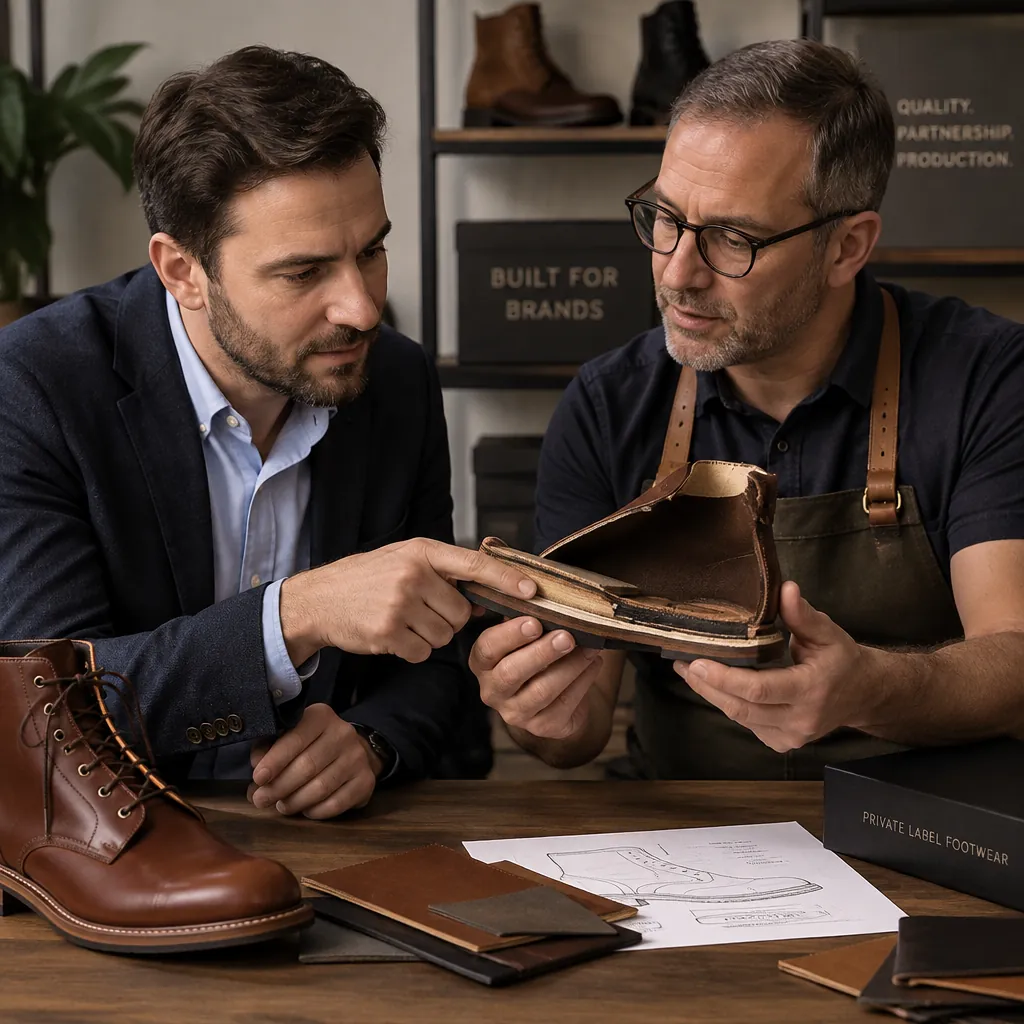
The process begins with detailed discussions about your vision, target market, and technical requirements. You’ll need to provide reference images, material preferences, construction methods, and any specific performance requirements. Manufacturers will assess feasibility and provide initial feedback on design elements that may need adjustment.
This stage typically takes 3-7 days for simple modifications and 10-14 days for fully custom designs. Clear communication here prevents costly revisions later in the process.
Stage 2: Sample Development
Once specifications are finalized, the factory creates initial samples. First samples rarely match expectations perfectly—they’re working prototypes meant to identify fit issues, material mismatches, or construction problems. Expect 2-3 sample rounds for modified designs and 3-5 rounds for fully bespoke shoes.
Sample development timelines vary: 15-20 days per round for standard constructions, 25-30 days for complex builds like Goodyear welted shoes Shoe Manufacturer Guide. Budget for this iteration time in your launch planning.
Stage 3: Material Sourcing and Approval
After sample approval, the factory sources production materials. This includes leather, linings, insoles, outsoles, hardware, and packaging components. Material lead times range from immediate availability (for common leathers) to 30-45 days for specialty materials or custom-dyed leathers.
You’ll receive material swatches or samples for final approval before bulk production begins. This is your last chance to catch color mismatches or quality issues, so inspect carefully.
Stage 4: Last and Pattern Finalization
For custom lasts, the factory finalizes the wooden or plastic forms that shape your shoes. Pattern makers create the cutting templates for all upper components. These are permanent tools that will be used for all future production runs, so accuracy is critical.
This stage overlaps with material sourcing and typically adds 20-30 days to the timeline for new lasts. Modifications to existing lasts take 7-10 days.
Stage 5: Bulk Production
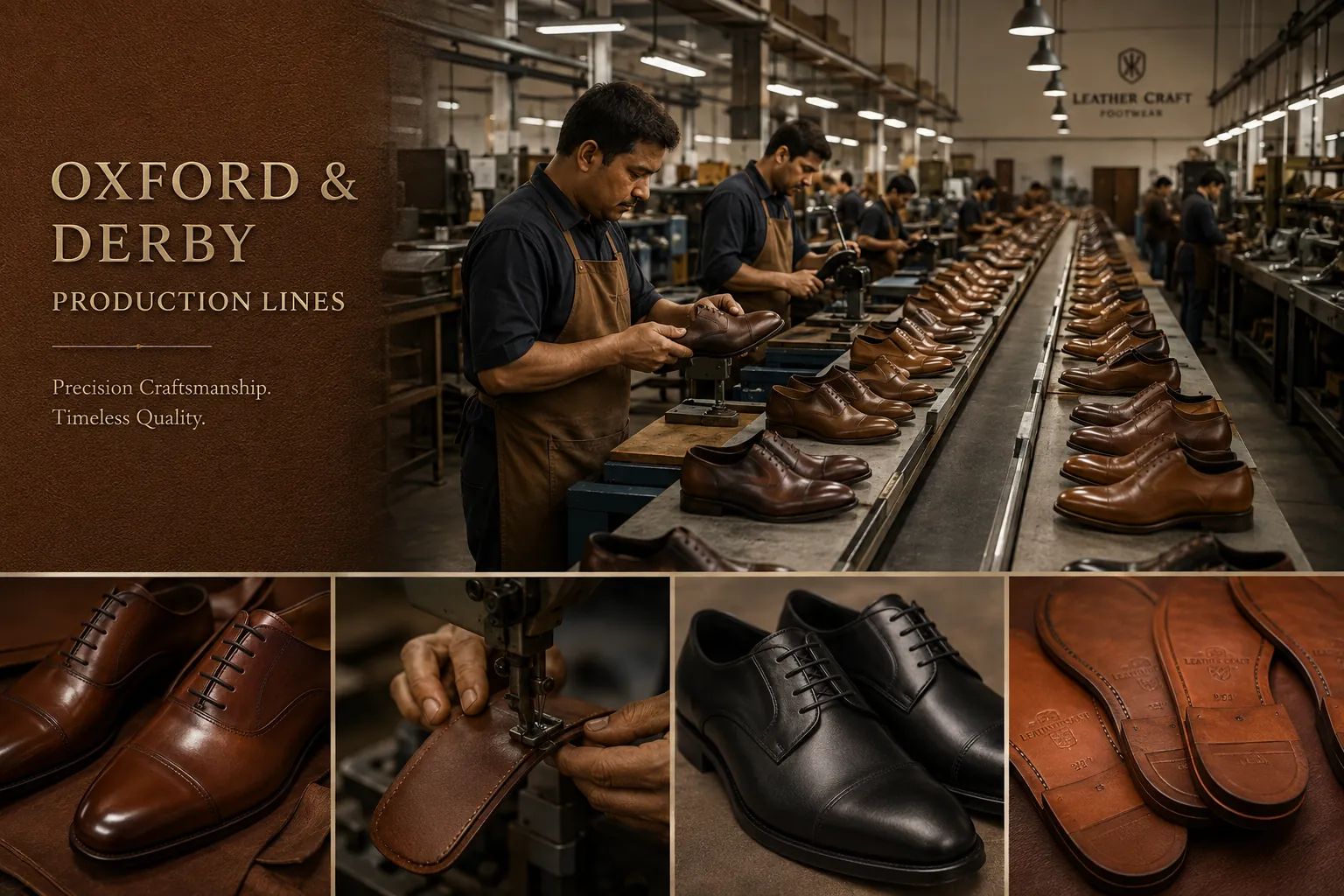
With materials and tooling ready, production begins. Modern factories use assembly line methods with specialized stations for cutting, stitching, lasting, sole attachment, and finishing. Production speed depends on construction complexity and order volume.
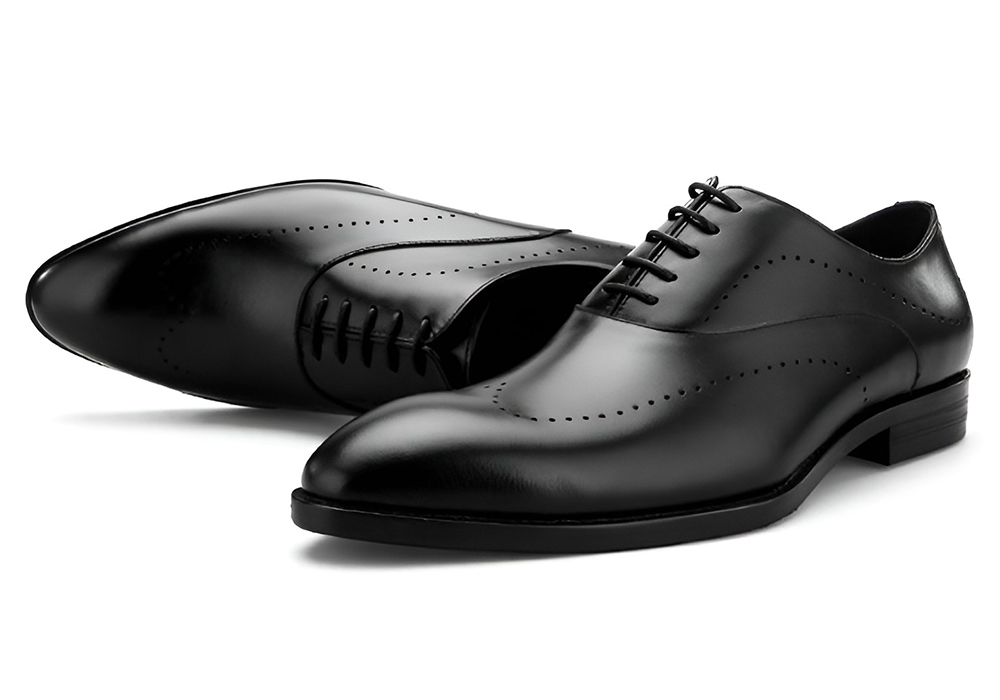
Standard production rates: 80-120 pairs per day for basic cement construction, 40-60 pairs per day for Goodyear welt, 30-50 pairs per day for hand-welted or complex designs. A 500-pair order of Oxford shoes Shoe Manufacturer Guide in cement construction takes roughly 5-7 production days.
Stage 6: Quality Inspection
Every pair undergoes multiple inspection points during production and a final comprehensive check before packing. Inspections cover material defects, stitching quality, lasting accuracy, sole attachment, finishing consistency, and dimensional accuracy.
Reputable manufacturers follow AQL (Acceptable Quality Limit) standards Leather Footwear Quality Standards with typical acceptance levels of 2.5 for critical defects and 4.0 for major defects. Third-party inspection services add 2-3 days but provide independent verification.
Stage 7: Packaging and Shipping
Final pairs are packed according to your specifications—individual boxes, master cartons, and shipping marks. The factory prepares export documentation including commercial invoices, packing lists, and certificates of origin. Shipping methods (air, sea, express) depend on your urgency and budget.
Sea freight from China to major ports: 25-35 days to US West Coast, 35-45 days to US East Coast, 30-40 days to Europe. Air freight takes 5-7 days but costs 4-6 times more per pair.
MOQ, Pricing, and Lead Time Realities
Understanding the economics of custom dress shoes helps you plan inventory investments and pricing strategies. These three factors are interconnected—pushing one affects the others.
Minimum Order Quantities Explained
MOQs exist because factories need to cover setup costs, material minimums, and production efficiency thresholds. For custom dress shoes, typical MOQs are:
- Existing designs with minor changes: 0-100 pairs (some factories offer zero MOQ on catalog items with simple customization)
- Semi-custom with new patterns: 200-500 pairs per style
- Fully bespoke with new lasts: 500-1,000 pairs per style
- Per color/material within a style: 60-120 pairs
Lower MOQs are possible but come with higher per-pair costs. A 100-pair order might cost $38/pair while a 500-pair order of the same shoe costs $28/pair due to setup cost distribution.
Pricing Structure Breakdown
Custom dress shoes pricing for B2B orders typically falls into these ranges based on construction and materials:
Basic Cement Construction (bonded sole): $25-35/pair for 500+ pairs, $30-40/pair for 100-300 pairs. Uses synthetic or corrected grain leather, basic linings, rubber or PU soles. Suitable for entry-level brands or high-volume retailers.
Blake Stitch Construction: $32-45/pair for 500+ pairs, $38-52/pair for 100-300 pairs. Full-grain leather uppers, leather or synthetic linings, leather or rubber soles. Good balance of quality and cost for mid-market brands.
Goodyear Welt Construction: $45-65/pair for 500+ pairs, $55-75/pair for 100-300 pairs. Premium full-grain leather, leather linings and insoles, leather or Dainite soles. Targets premium and luxury market segments.
These prices assume standard materials and moderate complexity. Premium leathers (shell cordovan, exotic skins), hand-finishing, or complex designs add 20-40% to base costs.
Lead Time Planning
Total time from order confirmation to delivery:
| Order Type | Sample Phase | Production | Shipping | Total Timeline |
|---|---|---|---|---|
| Existing design, minor changes | 15-20 days | 20-30 days | 5-45 days | 40-95 days |
| Semi-custom, new patterns | 30-45 days | 25-35 days | 5-45 days | 60-125 days |
| Fully bespoke, new lasts | 45-60 days | 30-40 days | 5-45 days | 80-145 days |
Add 10-15 days for peak season orders (August-October for spring collections, February-April for fall collections). Chinese New Year causes 3-4 week factory closures in January-February.
Design Specifications and Technical Requirements
Proper specification documentation prevents miscommunication and ensures your custom dress shoes match your vision. Manufacturers need detailed technical information to quote accurately and produce correctly.
Essential Design Documentation
Technical Drawings should show top view, side view, bottom view, and back view with all design elements clearly marked. Include measurements for toe shape, heel height, platform thickness, and shaft height (for boots). Professional CAD drawings aren’t required—clear hand sketches with dimensions work fine.
Material Specifications must detail every component: upper leather type and grade, lining material, insole material, midsole (if applicable), outsole material and pattern, heel material and height, hardware specifications (eyelets, buckles, zippers), thread type and color, and adhesives or cements used.
Construction Method defines how the shoe is assembled. Common methods include cement construction (bonded), Blake stitch, Goodyear welt, Norwegian welt, hand-welted, and Bologna construction. Each method has different cost, durability, and aesthetic implications. Reference our complete shoe construction comparison Shoe Manufacturer Guide for detailed breakdowns.
Size Range and Grading specifies which sizes you need and how the design scales across sizes. Standard men’s ranges are US 7-13 or EU 40-46. Grading rules ensure proportional changes—a size 13 shouldn’t just be a stretched size 9.
Material Selection Guidelines
Upper Leather Choices dramatically impact appearance, durability, and price. Full-grain leather shows natural grain patterns and develops patina—it’s the highest quality but most expensive. Top-grain leather has the surface buffed and embossed with artificial grain—more uniform appearance, lower cost. Corrected grain leather has heavy surface treatment to hide imperfections—lowest cost, least breathable.
Sole Material Trade-offs balance durability, flexibility, and aesthetics. Leather soles offer classic appearance and breathability but wear faster and aren’t water-resistant. Rubber soles (natural or synthetic) provide excellent durability and traction but less formal appearance. Dainite rubber combines durability with refined looks. PU (polyurethane) soles are lightweight and cheap but less durable.
Lining Materials affect comfort and longevity. Full leather linings provide best breathability and moisture management but increase cost by $3-5/pair. Synthetic linings (microfiber, textile) reduce cost and can offer moisture-wicking properties. Unlined shoes save cost but may cause comfort issues.
Color and Finish Options
Standard colors (black, brown, tan, burgundy) have no minimum quantities since factories stock these leathers. Custom colors require minimum leather purchases—typically 200-300 square feet, enough for 80-120 pairs depending on shoe style.
Finish options include high-polish (formal dress shoes), semi-matte (versatile business casual), matte/natural (casual styles), antiqued/burnished (hand-finished edges and creases), and patina (hand-painted color variations). Complex finishes add $2-5/pair in labor costs.
Quality Control and Certification Standards
Quality assurance separates professional manufacturers from problematic suppliers. Understanding inspection standards and certifications helps you evaluate factory capabilities and protect your brand reputation.
Industry Quality Standards
The ISO 20347 standard https://www.iso.org/standard/68794.html – SATRA Footwear Technology defines performance requirements for occupational footwear, though many manufacturers apply these principles to dress shoes as well. Key testing areas include upper material strength, sole abrasion resistance, flexing endurance, and dimensional stability.
Professional factories maintain defect rates below 2%. Critical defects (unwearable shoes) should be under 0.5%, major defects (aesthetic issues affecting salability) under 1.5%, and minor defects (small imperfections not affecting function or appearance) under 3%.
Pre-Production Inspection Checklist
Before bulk production begins, verify:
- Sample matches approved specifications exactly
- All materials match approved swatches
- Construction method is correct
- Sizing is accurate across the range
- Branding elements (logos, labels) are correct
- Packaging meets your requirements
- Factory has capacity for your timeline
- Payment terms and shipping arrangements are confirmed
During-Production Monitoring
For orders over 1,000 pairs, consider hiring third-party inspection services to visit the factory mid-production. They check material usage, construction quality, and production progress. This catches problems early when corrections are still feasible.
Key inspection points: material cutting accuracy, stitching quality and consistency, lasting precision, sole attachment strength, finishing uniformity, and dimensional accuracy.
Final Pre-Shipment Inspection
Comprehensive final inspection should occur when 80% of production is complete and packed. Inspectors randomly sample cartons following AQL standards, checking each pair for:
Critical Defects: wrong size, wrong color, wrong style, severe material damage, sole separation, broken hardware, missing components. Acceptance level: 0 defects in sample.
Major Defects: visible stitching errors, color mismatches, poor lasting, uneven finishing, minor sole issues, incorrect branding. Acceptance level: 2.5 AQL (2-3 defects allowed depending on sample size).
Minor Defects: small scratches, slight color variations, minor finishing inconsistencies, packaging imperfections. Acceptance level: 4.0 AQL (5-7 defects allowed depending on sample size).
Certifications for Export Markets
CE Marking is mandatory for footwear sold in the European Union. It indicates compliance with EU safety, health, and environmental protection standards. The certification process takes 4-6 weeks and costs $800-1,500 per style family.
REACH Compliance restricts hazardous substances in products sold in the EU. Leather, adhesives, and dyes must meet REACH requirements. Compliant factories provide test reports from accredited laboratories.
RoHS Certification limits hazardous materials in electrical components (if your shoes include electronic elements like heated insoles or LED lights). Standard dress shoes don’t require RoHS.
CPSIA Compliance applies to children’s footwear sold in the United States, limiting lead content and requiring tracking labels. Adult dress shoes are exempt.
Common Mistakes When Ordering Custom Dress Shoes
Learning from others’ errors saves time and money. These mistakes appear repeatedly across B2B buyers, from first-time entrepreneurs to experienced retailers.
Mistake 1: Inadequate Sample Testing
Approving samples without thorough wear-testing leads to production problems discovered too late. One sample pair isn’t enough—order 3-5 pairs in different sizes and have multiple people wear them for several days. Check for fit issues, comfort problems, material performance, and construction durability.
Test in conditions matching your target market. If selling in humid climates, test moisture management. If targeting office workers, test all-day comfort on hard floors.
Mistake 2: Unrealistic Timeline Expectations
Rushing production compromises quality. A buyer once demanded 1,000 pairs of fully custom Goodyear welted shoes in 45 days—physically impossible without cutting corners. The factory declined, and the buyer found a supplier who agreed but delivered shoes with poor lasting, weak sole attachment, and inconsistent sizing.
Build realistic timelines with buffer for delays. Sample revisions, material sourcing issues, and production problems happen. Plan for 90-120 days minimum for custom orders.
Mistake 3: Ignoring Material Minimums
Ordering 200 pairs in 8 different leather colors sounds appealing but creates problems. Tanneries sell leather in minimum quantities—typically 200-300 square feet per color. Your 25 pairs per color don’t meet minimums, forcing the factory to either refuse the order or charge premium prices for small-lot materials.
Limit color options in small orders. Offer 2-3 colors maximum for orders under 500 pairs. Expand the palette as volumes grow.
Mistake 4: Vague Quality Standards
Saying “I want high quality” means nothing without specific standards. What’s acceptable stitching variation? How much color variation is tolerable? What defects warrant rejection? Without clear criteria, you and the factory will disagree about what constitutes acceptable quality.
Define quality standards in writing before production. Use AQL levels, reference photos of acceptable/unacceptable examples, and specify testing requirements.
Mistake 5: Overlooking Import Regulations
Discovering your shoes don’t meet destination country requirements after production is costly. Different markets have different rules for materials, labeling, safety standards, and documentation. US customs requires country of origin marking. EU requires CE marking for certain shoe types. Some countries restrict certain leather types or dyes.
Research import requirements early. Consult with customs brokers or freight forwarders before finalizing designs. Ensure your factory understands and can meet these requirements.
Mistake 6: Poor Communication About Branding
Assuming the factory knows where and how to place your logo leads to disappointment. Specify exact placement (insole, outsole, heel counter, tongue, etc.), size, color, and application method (embossing, printing, metal plate, etc.). Provide high-resolution artwork files in vector format.
Request branded samples before bulk production to verify placement and appearance. Logo positioning affects both aesthetics and production feasibility.
Decision Framework: Choosing Between Modification and Full Custom
Use this framework to determine the right customization level for your project:
Choose Design Modification If:
- Your budget is under $10,000 for initial order
- You need products within 60 days
- You’re testing market response before major investment
- Your brand positioning is entry to mid-market
- You want 2-3 style variations to start
Choose Semi-Custom If:
- Your budget is $10,000-30,000 for initial order
- You can wait 90-120 days for delivery
- You want distinctive designs but not completely unique
- Your brand positioning is mid to premium market
- You plan to order 300-800 pairs initially
Choose Fully Bespoke If:
- Your budget exceeds $30,000 for initial order
- You can wait 120-150 days for delivery
- You need completely unique designs for brand differentiation
- Your brand positioning is premium to luxury market
- You plan to order 800+ pairs initially and have reorder commitments
FAQ
Q: What’s the minimum order quantity for custom dress shoes?
A: MOQs vary by customization level. For simple modifications to existing designs (changing leather color or adding your logo), some manufacturers offer zero minimum or as low as 60 pairs. Semi-custom designs with new patterns typically require 200-500 pairs. Fully bespoke shoes with new lasts need 500-1,000 pairs minimum. Per-color minimums within a style usually range from 60-120 pairs. Lower quantities are sometimes possible but expect 20-40% higher per-pair costs due to setup expenses.
Q: How long does it take to produce custom dress shoes from order to delivery?
A: Total timeline depends on customization complexity and shipping method. Existing designs with minor modifications take 40-95 days (15-20 days sampling, 20-30 days production, 5-45 days shipping). Semi-custom designs with new patterns need 60-125 days (30-45 days sampling, 25-35 days production, 5-45 days shipping). Fully bespoke shoes with new lasts require 80-145 days (45-60 days sampling, 30-40 days production, 5-45 days shipping). Add 10-15 days during peak seasons and account for 3-4 week closures during Chinese New Year.
Q: What certifications should I require from a custom shoe manufacturer?
A: Essential certifications depend on your target markets. For EU sales, require CE marking (EN ISO 20347 compliance) and REACH compliance for restricted substances. For US sales, ensure the factory can provide proper country of origin documentation and meets CPSIA requirements if producing children’s shoes. RoHS certification matters only if shoes contain electronic components. Request copies of current certificates and lab test reports from accredited facilities. Reputable manufacturers maintain these certifications and update them regularly—if a factory can’t provide current documentation, consider it a red flag.
Q: How much do custom dress shoes cost for B2B orders?
A: Pricing ranges from $25-65 per pair depending on construction method, materials, and order volume. Basic cement construction with synthetic or corrected grain leather costs $25-35/pair for 500+ pairs. Blake stitch construction with full-grain leather runs $32-45/pair for similar volumes. Goodyear welt construction with premium materials costs $45-65/pair. Smaller orders (100-300 pairs) add $5-10/pair due to setup cost distribution. Premium leathers, hand-finishing, or complex designs increase costs by 20-40%. These are FOB prices—add shipping, duties, and logistics costs for landed cost calculations.
Q: What’s the difference between OEM and ODM for custom dress shoes?
For B2B buyers ready to develop custom dress shoes, working with established manufacturers who understand export requirements, maintain quality certifications, and offer flexible MOQs makes the difference between smooth production and costly problems.
Contact us to discuss your custom dress shoe project. Email peterwang@shwincheer.com or visit wincheershoes.com to explore our capabilities, review our existing designs, and start your development process. We provide detailed quotations, technical consultation, and sample development services for brands and retailers worldwide.