TL;DR
Launch a private label shoe brand in 12-18 months: 2-3 months positioning, 3-4 months manufacturer selection and development, 4-6 months sample production, 3-5 months first order production and shipping. Total investment: $30,000-100,000 for initial inventory and setup. Success requires clear brand positioning, not just low pricing. Wincheer Shoes supports brand founders from vision to retail shelf.
Introduction
The private label shoe market represents one of the most accessible pathways to brand ownership in the footwear industry. By partnering with established manufacturers, entrepreneurs and businesses can launch branded footwear lines without capital investment in manufacturing facilities—redirecting resources toward brand development, marketing, and customer relationships where brand value is actually created.
Market data indicates the private label footwear market growing at 8.2% annually, outpacing branded footwear growth of 4.1%. This growth reflects consumer openness to quality private label products, particularly in categories where manufacturing expertise determines product quality more than design heritage. Leather dress shoes occupy a category where private label production can achieve quality parity with established brands at significantly reduced branding premiums.
Launching a private label shoe brand, however, requires systematic approach across multiple dimensions: brand positioning, manufacturer partnership, product development, operational setup, and go-to-market execution. The difference between successful private label brands and struggling ventures often lies not in product quality but in the strategic clarity and operational discipline applied to these foundational decisions.
Table of Contents
- Private Label Fundamentals
- Brand Development and Positioning
- Manufacturer Selection Process
- Product Development Roadmap
- Operational Setup
- First Order Management
- Scaling Your Private Label Brand
- FAQ
- Conclusion
Private Label Fundamentals
Understanding Private Label in Footwear
Private label footwear involves commissioning manufacturers to produce shoes bearing the buyer’s brand name rather than the manufacturer’s. The brand owner controls design, marketing, and distribution while leveraging manufacturer production capabilities.
Private label differs from OEM (Original Equipment Manufacturing): OEM typically refers to manufacturing-only relationships where the manufacturer controls design specifications for buyer modification. Private label more specifically implies brand-focused relationships where the buyer’s brand is the primary identity.
Private label differs from ODM (Original Design Manufacturing): ODM relationships involve manufacturers offering pre-designed products that buyers rebrand. Private label relationships more commonly involve custom product development aligned to brand specifications.
Private Label Market Opportunity
The business case for private label leather shoes rests on several market dynamics:
Quality convergence: Manufacturing expertise in regions like China, particularly in clusters around Wenzhou and Shanghai, has advanced to the point where private label products achieve quality parity with premium branded alternatives. Consumers increasingly recognize that significant portions of branded footwear prices reflect marketing investment rather than quality differentiation.
Margin improvement: Private label enables 40-60% margin structures compared to 20-35% margins typical for branded wholesale distribution. Brand value captures the margin that would otherwise flow to established brand owners.
Brand relationship ownership: Private label builds directly owned customer relationships rather than depending on established brand distribution channels. Long-term brand equity appreciation benefits the private label owner entirely.
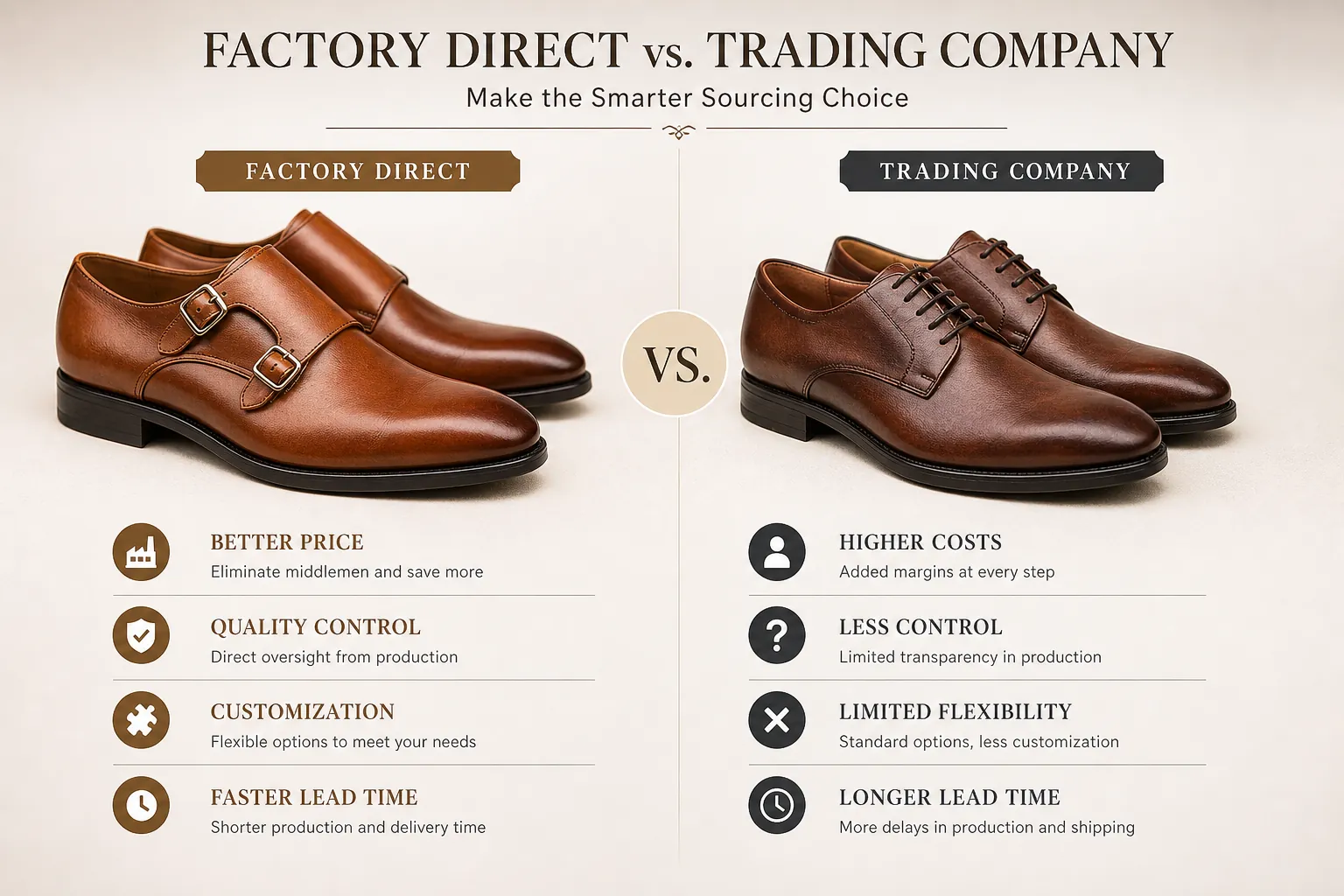
Supply chain control: Direct manufacturer relationships provide visibility and control unavailable through branded distribution where supply chains are controlled by brand owners.
Private Label Challenges
Upfront investment requirements: Private label launch requires capital for product development, minimum order quantities, initial inventory, and brand development—typically $30,000-100,000 for modest initial launches.
Expertise requirements: Successful private label demands competence across multiple domains: product development, manufacturing coordination, logistics, marketing, and retail/wholesale management.
Time to market: Building brand recognition requires sustained marketing investment over 2-3 years before significant market traction typically develops.
Manufacturer dependency: Despite best efforts, private label brands remain dependent on manufacturer execution for product quality and delivery reliability.
Brand Development and Positioning
Strategic Brand Positioning Framework
Before engaging manufacturers, develop clear brand positioning answers to fundamental questions:
Who is the target customer?: Define specific customer segments rather than “everyone.” Private label success typically concentrates in clearly defined niches where brand can establish meaningful differentiation.
What problem does the brand solve?: Identify the specific need, occasion, or aspiration the brand addresses. Effective positioning connects product features to customer benefits and brand values.
What makes this brand different?: Private label faces competition from established brands with marketing budgets far exceeding private label capabilities. Differentiation must come from authenticity, specialization, or value proposition that branded alternatives cannot replicate efficiently.
What price position does the brand occupy?: Define the brand’s price tier: budget/value, mid-market, premium, or luxury. Pricing drives all subsequent decisions about product specifications, distribution channels, and marketing approach.
Positioning Examples for Leather Shoes
Value Position: “Quality leather shoes accessible to every professional”
- Target: Cost-conscious young professionals entering workforce
- Price: $80-150 retail
- Differentiation: Quality construction at accessible price
- Channels: Online retail, department stores
Craft Position: “Handcrafted leather shoes for discerning professionals”
- Target: Professionals seeking quality without luxury branding premium
- Price: $200-350 retail
- Differentiation: Construction quality, leather selection, craftsmanship details
- Channels: Specialty retailers, professional outfitters
Occasion Position: “The go-to leather shoe for important moments”
- Target: Professionals for whom appearance is career-critical
- Price: $250-400 retail
- Differentiation: Reliability, consistency, style correctness
- Channels: Professional outfitters, specialist retailers
Sustainable Position: “Luxury leather shoes made responsibly”
- Target: Environmentally conscious luxury consumers
- Price: $400-600 retail
- Differentiation: Full lifecycle sustainability, transparency
- Channels: Sustainable retailers, brand flagship stores
Brand Identity Development
Brand Name: Choose memorable, pronounceable names that translate acceptably across target markets. Avoid names with negative connotations in key languages. Test names with target market representatives before committing.
Visual Identity: Develop logo, color palette, and typography creating brand recognition and appropriate positioning signals. Premium positioning requires visual sophistication; value positioning requires clarity and accessibility.
Brand Story: Articulate authentic narrative explaining brand origin, values, and commitment. Private label stories often emphasize manufacturing partnership quality, founder journey, or specific expertise development.
Brand Guidelines: Document visual identity standards, voice guidelines, and usage rules ensuring consistent brand expression across all customer touchpoints.
Manufacturer Selection Process
Identifying Potential Manufacturers
Direct search approaches:
- Alibaba and similar platforms provide manufacturer access but require careful verification
- Trade show attendance (Micam Milan, GLS Las Vegas, China trade shows)
- Industry directories and B2B databases
- Referrals from established industry participants
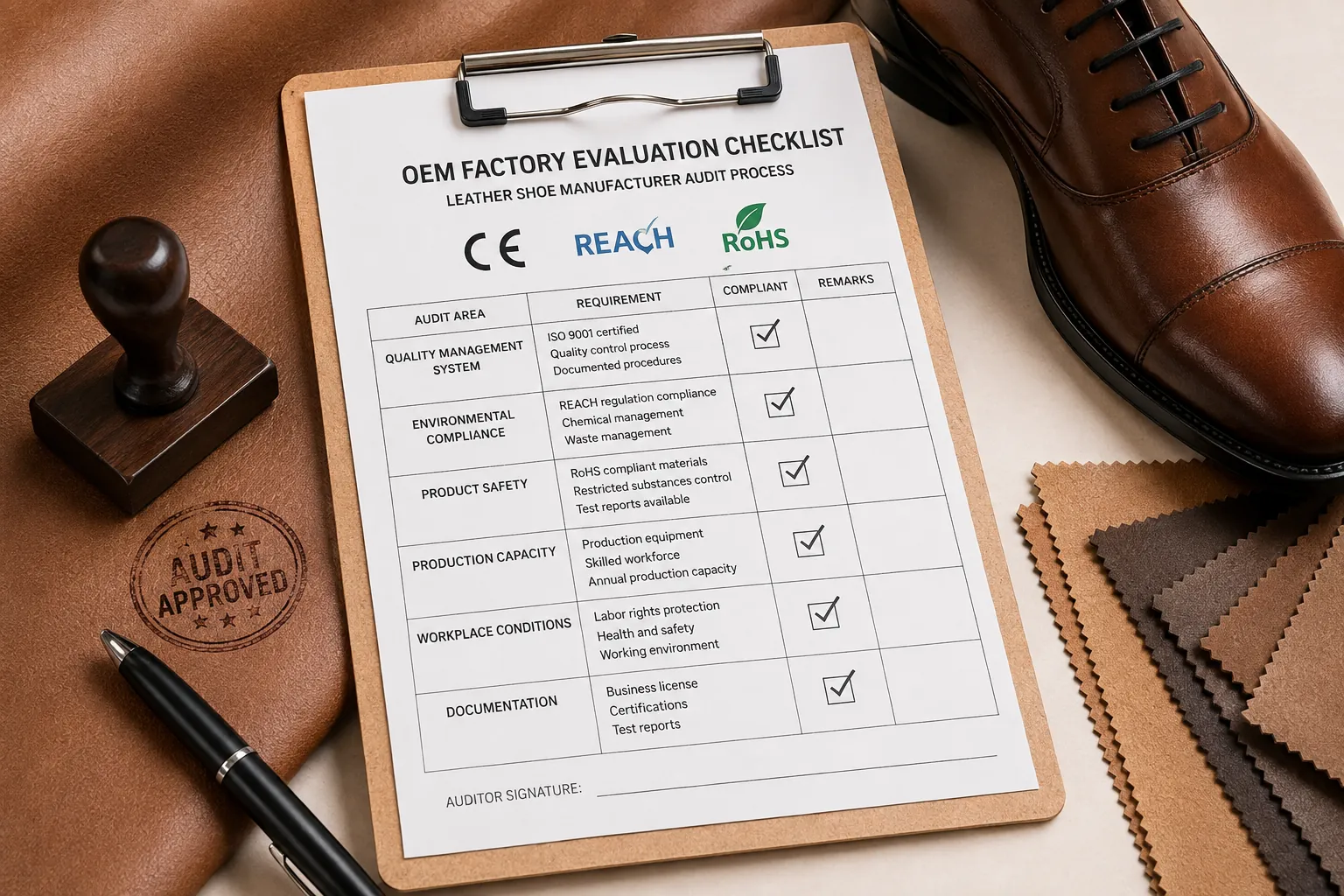
Verification framework:
| Verification Element | Minimum Requirement | Preferred Standard |
|---|---|---|
| Business registration | 3+ years operation | 5+ years with clean record |
| Export experience | Documented export history | Direct experience with your target markets |
| Production capability | Capacity for your MOQ | Capacity exceeding your growth projections |
| Quality certification | Basic quality management | ISO 9001 or equivalent |
| Facility verification | Third-party audit | Direct factory visit |
Manufacturer Capability Assessment
Production capability indicators:
- Size range availability (should span your target markets)
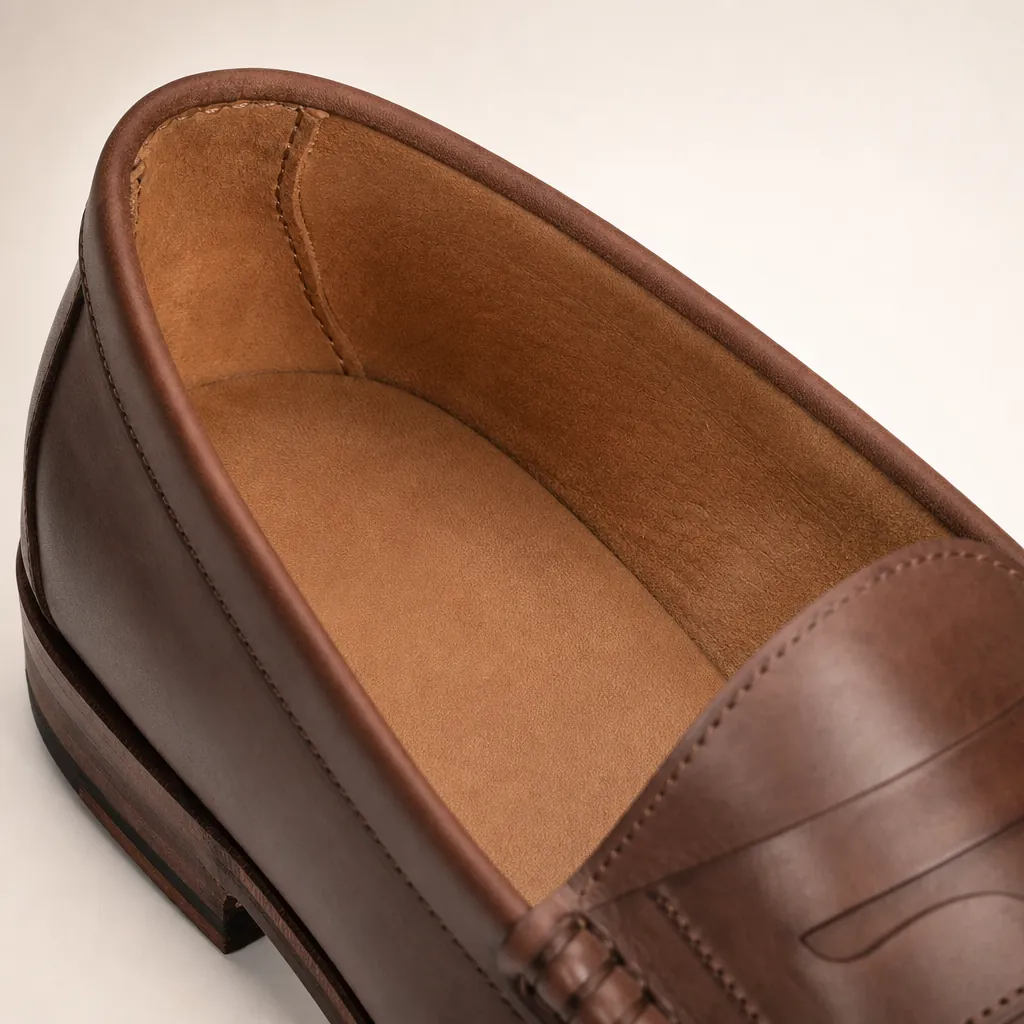
- Leather type capabilities (full-grain, top-grain, specific finishes)
- Last development options (custom last creation vs. standard lasts)
- Sample development timeline and process
- Production lead time for your order quantities
- Current production capacity utilization
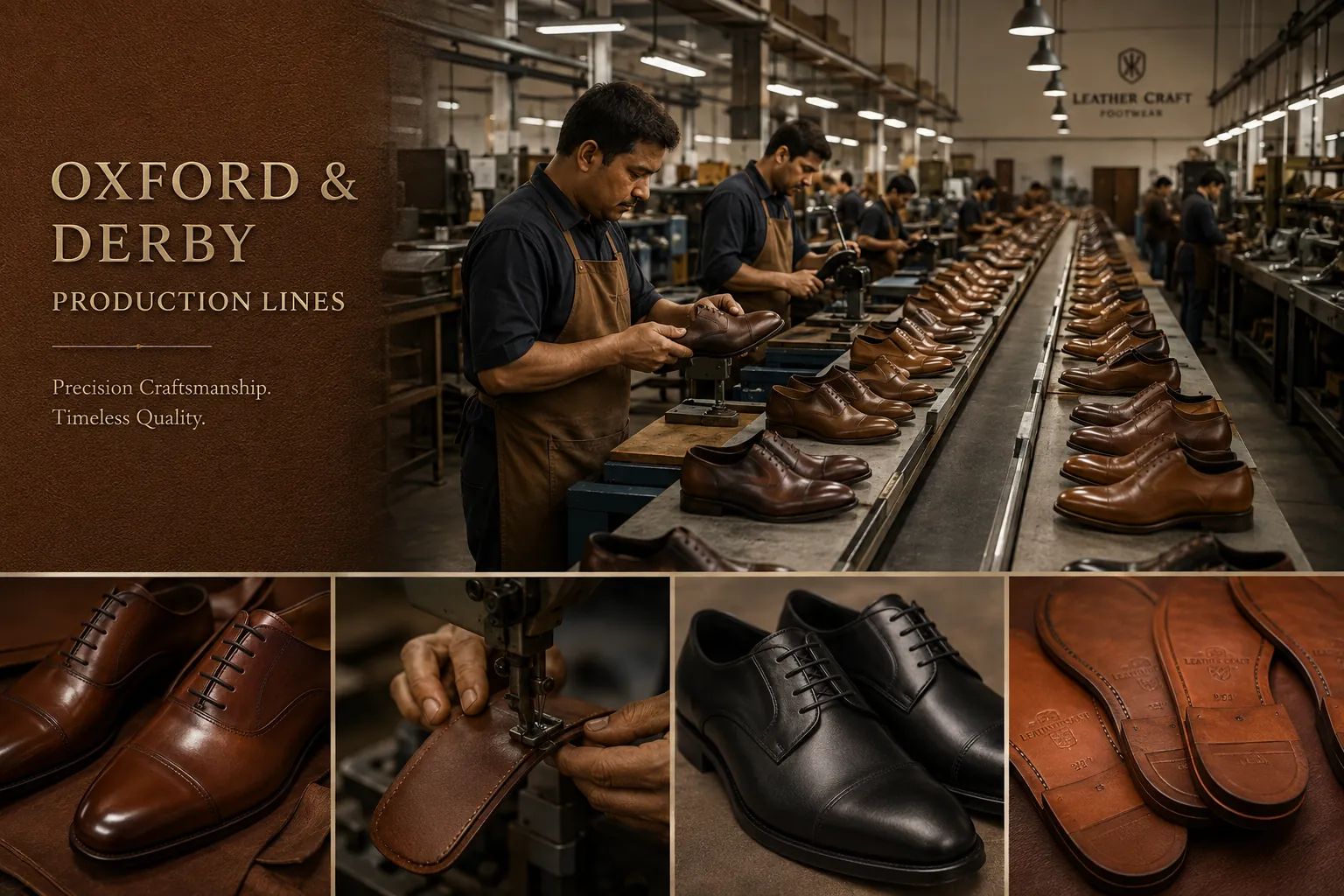
Quality capability indicators:
- Incoming material inspection procedures
- In-process quality control checkpoints
- Pre-shipment inspection protocols
- Defect classification and AQL standards
- Third-party testing access and relationships
- Quality documentation and traceability
Communication capability indicators:
- English language proficiency
- Direct communication with production management
- Responsiveness and transparency
- Documentation standards
- Problem escalation procedures
Sample Development Process
Before committing to production orders, develop and approve samples:
Development sample stage: Initial samples against specifications demonstrating manufacturing capability for your specific product. Evaluate leather quality, construction, fit, and finishing.
Proto sample stage: Samples incorporating revisions from development stage, closer to production intent.
Pre-production sample stage: Samples from actual production materials and processes, representing what production will deliver.
Shipping sample stage: Samples from production run for final approval before shipment release.
Each stage may require 2-4 weeks and iteration. Budget $2,000-5,000 in sample costs for initial development.
Product Development Roadmap
Phase 1: Specification Development (Weeks 1-4)
Style definition:
- Identify reference styles (existing shoes you want to emulate or improve upon)
- Define silhouette, toe shape, and design elements
- Sketch or photograph style direction
Technical specifications:
- Size range (typically 38-48 EU for men’s dress shoes)
- Width options (narrow, standard, wide)
- Leather specifications (type, origin, weight, finish)
- Sole specifications (material, construction, heel height)
- Lining specifications (material, breathability requirements)
- Closure specifications (laces, straps, etc.)
Documentation requirements:
- Complete specification document with all details
- Reference samples or photographs
- Physical samples of leather and components
- Measurement specifications for each size
Phase 2: Sample Development (Weeks 5-12)
First samples (Weeks 5-8):
- Manufacturer creates initial samples against specifications
- Evaluate against specification requirements
- Document discrepancies and required changes
Sample revision (Weeks 9-12):
- Manufacturer addresses specification discrepancies
- Second sample review
- Final specification adjustments
Sample approval (Week 12+):
- Formal sample sign-off
- Approved sample retention for production reference
- Proceed to production planning
Phase 3: Production Planning (Weeks 13-16)
Order quantity determination:
- MOQ confirmation (typically 300-500 pairs per style)
- Size ratio planning within MOQ
- Color variation planning if applicable
- Total order value calculation
Production scheduling:
- Production timeline confirmation
- Quality milestone checkpoints
- Shipping timeline and method
- Total lead time calculation
Cost finalization:
- Final pricing confirmation
- Payment term agreement
- Total order value confirmation
Phase 4: Production and Delivery (Weeks 17-26)
Production monitoring:
- In-progress quality checks
- Timeline monitoring
- Issue identification and resolution
Pre-shipment inspection:
- Final quality inspection
- Quantity verification
- Documentation review
Shipment and delivery:
- Shipping document preparation
- Freight forwarding arrangement
- Customs clearance
- Final delivery
Operational Setup
Business Entity Requirements
Entity formation considerations:
- Legal structure enabling international trade
- Trademark registration in relevant jurisdictions
- Import/export licensing if required
- Tax structure optimization for international operations
Brand protection:
- Trademark registration in manufacturing country (China)
- Trademark registration in target market countries
- Domain name registration matching brand name
- Social media handle registration
Supply Chain Setup
Logistics partnerships:
- Freight forwarder with footwear experience
- Customs broker relationships in target markets
- Domestic distribution partnerships if applicable
Inventory management:
- Warehouse/fulfillment arrangement
- Inventory management system
- Reorder trigger points and processes
Quality control infrastructure:
- Third-party inspection service arrangement (SGS, Bureau Veritas, etc.)
- Inspection protocol documentation
- Defect handling procedures
Sales Channel Strategy
Direct-to-consumer channels:
- E-commerce website development
- Amazon or similar marketplace presence
- Social commerce integration
Wholesale channels:
- Retailer outreach and relationship development
- Wholesale pricing and terms
- Buyer presentation materials
Multi-channel balance:
- Channel mix optimization
- Channel conflict prevention
- Margin structure across channels
First Order Management
Order Quantity Strategy
First orders balance multiple considerations:
Minimum order economics: MOQ requirements may exceed initial sales projections. Balance inventory investment against per-unit economics achieved at MOQ.
Size range economics: Full size range (38-48) may require 200+ pairs before reaching MOQ. Consider core-size-only initial orders if market testing priority.
Color/variation economics: Each color variation typically adds MOQ requirements. Limit initial orders to core colors to minimize inventory risk.
First Order Best Practices
Conservative initial quantities: First orders 20-30% below projected sales to limit inventory risk while gaining production experience.
Concentrated specifications: Minimize variation (single color, single width) for first orders to isolate quality feedback.
Enhanced inspection: Commission third-party inspection on first production runs to catch quality issues before shipment.
Close monitoring: Maintain intensive communication with manufacturer during first orders to identify issues quickly.
Post-First-Order Evaluation
Assess manufacturer performance across key dimensions:
- Quality consistency vs. approved samples
- Delivery timeline reliability
- Communication responsiveness
- Problem resolution effectiveness
- Documentation accuracy
Document findings for relationship development decisions.
Scaling Your Private Label Brand
Scaling Principles
Replicate what works: Scale products and channels demonstrating traction rather than diversifying into unproven areas.
Maintain quality consistency: Scaling often strains quality systems. Monitor quality metrics closely as volumes increase.
Deepen manufacturer relationships: Volume growth enables better terms and priority treatment. Invest in relationship quality.
Build inventory capability: Scaling requires inventory investment. Develop inventory financing relationships before scaling needs arise.
Scaling Triggers
Indicators suggesting readiness to scale:
- Sell-through rates exceeding 80% within planned timeframes
- Positive customer feedback and repeat purchase behavior
- Manufacturer relationships performing consistently
- Brand recognition metrics improving
- Team capability expanding to manage increased complexity
Growth Levers
Product line expansion:
- Additional styles leveraging existing manufacturing relationships
- Price tier extension (up or down from current position)
- Geographic expansion to new markets
Channel expansion:
- New retail channel development
- International market entry
- Wholesale relationship scaling
Operational scaling:
- Inventory system enhancement
- Quality control infrastructure expansion
- Team capability addition
FAQ
What is the minimum investment to start a private label shoe brand?
Initial investment typically ranges from $30,000-100,000 depending on brand positioning, product complexity, and initial order quantities. This includes: brand development ($3,000-15,000), sample development ($2,000-10,000), initial inventory ($20,000-60,000 based on 300-1000 pairs at $25-80 FOB), and operational setup ($5,000-15,000). The lower end represents value-positioned brands with modest initial orders; the higher end represents premium positioning requiring higher-quality specifications.
How do I protect my brand when manufacturing in China?
Trademark protection requires filing in China (China Trademark Office) before manufacturing begins—filing after production exposes brands to counterfeiting risk. File in target export markets simultaneously or before launch. Work with manufacturers under clear manufacturing agreements specifying confidentiality and non-compete terms. Conduct due diligence on manufacturer integrity. Consider third-party quality control inspections as both quality assurance and deterrent to specification偷工减料.
What minimum order quantities should I expect?
MOQ for private label leather dress shoes typically ranges from 300-500 pairs per style from Chinese manufacturers. Some manufacturers offer lower MOQs (150-200 pairs) with price premiums of 15-25%. Value-positioned brands may accept higher MOQs (600-1000 pairs) for better pricing. Size ranges within MOQ typically include 6-8 sizes per style with quantity distribution guidance from manufacturer.
How long does private label shoe development take?
Timeline from specification finalization to delivery typically spans 4-6 months:
- Sample development: 8-12 weeks
- Production lead time: 6-10 weeks
- Shipping: 3-5 weeks
Total: 17-27 weeks from specification lock to retail-ready inventory. Premium positioning often requires longer sample development; standard positioning can move faster.
What quality standards should I specify?
Specify quality standards appropriate to brand positioning:
Entry-level: Basic AQL 4.0, standard materials, acceptable finish variation
Mid-market: AQL 2.5, specified leather grades, tighter finish standards
Premium: AQL 1.5, premium leather requirements, near-zero defect tolerance
Luxury: Beyond AQL metrics, specific craftsmanship requirements, individual piece inspection
Document specifications comprehensively rather than relying on brand positioning language.
How do I find customers for my private label brand?
Customer acquisition approaches vary by channel:
Direct-to-consumer: Digital marketing (search, social, content), e-commerce optimization, customer experience differentiation
Wholesale: Trade show attendance, retailer outreach, buyer relationship development, professional presentation materials
Multi-channel: Balance direct and wholesale to avoid channel conflict while maximizing reach
Start with channels aligned to your capabilities; expand as the brand establishes traction.
Conclusion
Launching a private label shoe brand represents a significant entrepreneurial undertaking—but one with proven pathway to success when approached systematically. The combination of accessible manufacturing expertise, particularly in Chinese production clusters, and market openness to quality private label products creates favorable conditions for brand builders.
Success requires more than finding capable manufacturers. It demands clear brand positioning, disciplined product development, operational excellence in supply chain management, and effective customer acquisition. The brands that succeed treat private label as a real business requiring professional management rather than a simple arbitrage opportunity.
The journey from concept to retail shelf typically spans 12-18 months, with meaningful traction requiring 2-3 years of sustained investment. But for those who persist through the challenging establishment phase, private label footwear offers genuine brand ownership, margin structures unavailable through distribution alternatives, and the satisfaction of building something truly your own.
How to Select a Reliable B2B Leather Shoe Manufacturer: A Complete Guide for Global Buyers
The Complete OEM/ODM Shoe Development Process: From Concept to Mass Production
The True Cost of Quality: Understanding Leather Shoe Pricing from Chinese Manufacturers
About Wincheer Shoes
Wincheer is a professional leather shoe manufacturer based in Shanghai, China. Established in 2007, we specialize in OEM/ODM manufacturing of men’s leather shoes including Oxford, Derby, Loafer, Monk, and Chelsea styles. With experience since 2007 and CE/REACH/RoHS certifications, we export quality footwear to global markets at competitive prices ($25-$40/pair).