The honest answer: cheap shoe production Italy is largely a myth for most B2B buyers. Italian factories produce some of the world’s finest leather footwear, but their cost structure — skilled artisan labor, premium raw materials, and strict EU compliance — makes sub-$60 FOB pricing nearly impossible for quality dress shoes. That said, understanding why Italy costs what it does helps you make smarter sourcing decisions. This article breaks down real numbers, compares global alternatives, and shows you where to find the best value without sacrificing quality.
As a manufacturer producing 500,000+ pairs annually with a defect rate of just 0.8–1.2% (versus an industry average of 2–4%), and holding CE (EN ISO20347), REACH, and RoHS certifications, WinCheer Shoes, established in 2007, has spent years benchmarking Italian production costs against Asian alternatives — the data tells a clear story.
Cheap Shoe Production In Italy Is It Possible Cost Analysi: Table of Contents
- Why Italy Has a Premium Cost Structure
- Cheap Shoe Production Italy: What the Numbers Actually Say
- Global Sourcing Alternatives: Cost Comparison
- How to Evaluate Cheap Shoe Production Italy vs. China
- Decision Framework: Which Sourcing Model Fits Your Brand?
- FAQ
- Ready to Start Your Shoe Line?
Why Italy Has a Premium Cost Structure
The “Made in Italy” Brand Premium
Italy’s footwear industry is centered in districts like Brenta (Veneto), Marche, and Tuscany. These clusters have built a global reputation over decades, and that reputation is priced into every pair. Retailers and consumers pay a premium for the label — which means factories charge accordingly.
For B2B buyers, this brand equity is only valuable if your end customer recognizes and pays for it. For mass-market or mid-tier private label brands, that premium rarely converts to proportional retail margin.
Labor Costs in Italian Shoe Factories
Italian shoemaking relies heavily on skilled artisans. According to Eurostat labor cost data https://ec.europa.eu/eurostat/statistics-explained/index.php/Labour_costs_in_the_EU – SATRA Footwear Technology, Italian manufacturing labor costs average €28–€35 per hour — roughly 8–10x higher than comparable roles in China’s Guangdong province.
A single pair of Goodyear-welted Oxford shoes requires 150–200 individual operations. At Italian labor rates, direct labor alone can account for $35–$55 per pair before materials, overhead, or profit margin.
Raw Material Sourcing in Italy
Italian tanneries (Santa Croce sull’Arno, for example) produce world-class full-grain and vegetable-tanned leathers. These materials are genuinely superior — but they carry a corresponding price tag. Top-grade Italian calf leather for uppers alone can cost $18–$28 per pair equivalent.
When you add lasts, insoles, outsoles, thread, and hardware, material costs for a quality Italian dress shoe typically run $40–$70 per pair at factory input level.
Cheap Shoe Production Italy: What the Numbers Actually Say
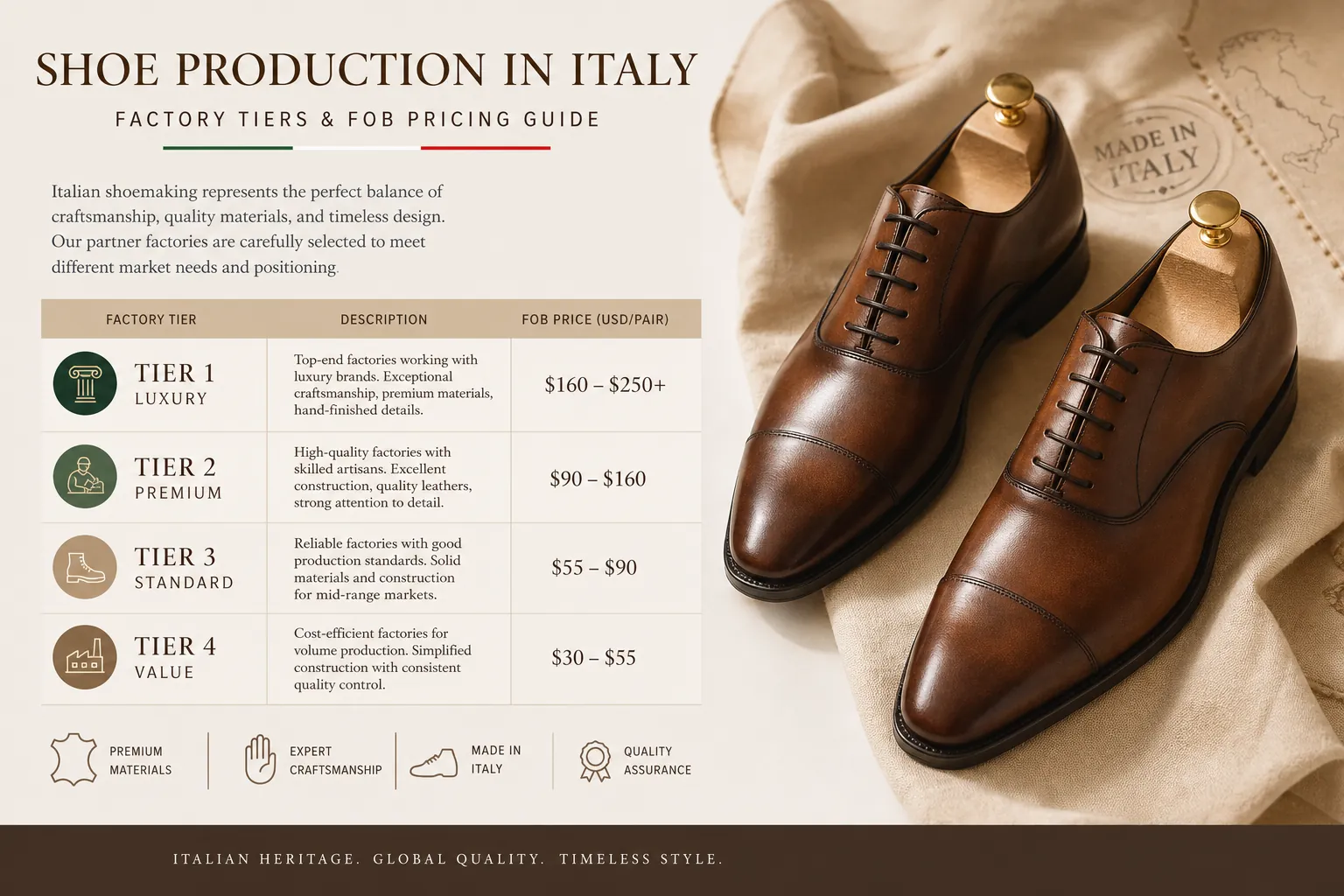
Real FOB Price Ranges by Factory Tier
Here is what B2B buyers realistically encounter when requesting quotes from Italian shoe factories in 2026:
| Factory Tier | MOQ | FOB Price Range | Lead Time | Typical Buyer |
|---|---|---|---|---|
| Luxury artisan workshop | 50–200 pairs | $180–$400+/pair | 16–24 weeks | Luxury brands, designers |
| Mid-tier certified factory | 300–500 pairs | $90–$160/pair | 12–16 weeks | Premium private label |
| Lower-tier Italian factory | 500–1,000 pairs | $60–$90/pair | 10–14 weeks | Mid-market brands |
| “Made in Italy” finishing only | 1,000+ pairs | $45–$70/pair | 8–12 weeks | Volume brands (partial claim) |
The last row is important. Some factories import partially assembled uppers from Eastern Europe or Asia, complete the finishing in Italy, and legally label the product “Made in Italy.” This is a legitimate practice under EU rules (substantial transformation), but buyers should understand what they are actually getting.
Hidden Costs That Inflate Italian Production
Beyond FOB price, Italian sourcing carries structural costs that many buyers underestimate:
- Sampling fees: €500–€2,000 per style, rarely refundable
- Pattern and last development: €800–€3,500 per last shape
- Minimum order enforcement: Most factories will not negotiate below 300 pairs per colorway
- Communication overhead: Time zone differences and language barriers add 2–4 weeks to development cycles
- Payment terms: Italian factories typically require 30–50% deposit, with balance before shipment
When you total these costs across a 4-style launch, the development investment alone can reach $15,000–$25,000 before a single pair ships.
Is Cheap Shoe Production Italy Possible for Niche Cases?
There are narrow scenarios where Italian production makes financial sense:
- Ultra-premium positioning where $250+ retail price justifies $120+ FOB cost
- EU market compliance where “Made in Italy” is a genuine sales driver
- Small-batch luxury where craftsmanship storytelling is the core brand value
- Hybrid sourcing where Italian leather is used with Asian construction
For most B2B buyers targeting $80–$180 retail price points, Italian production simply does not pencil out.
Global Sourcing Alternatives: Cost Comparison
China: The Volume and Value Leader
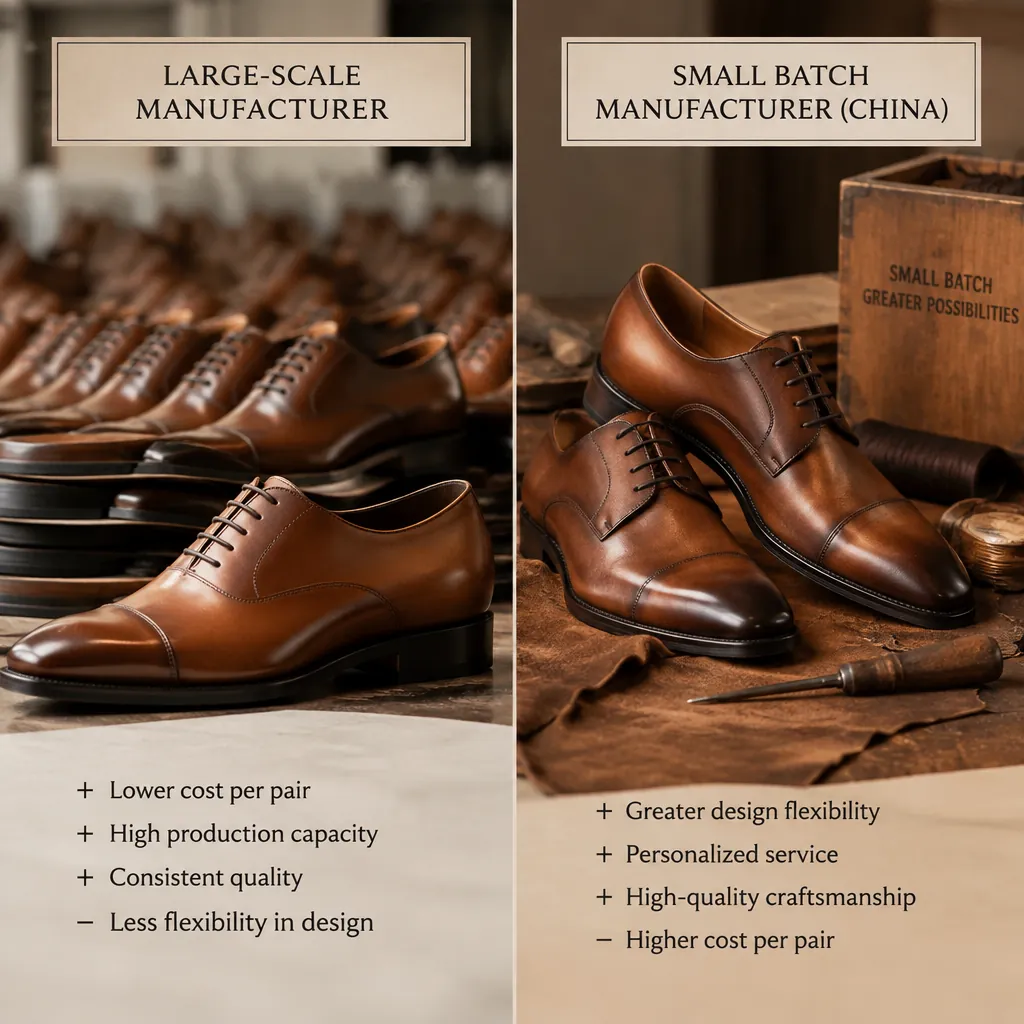
China remains the world’s largest footwear exporter, accounting for over 55% of global shoe production by volume. Guangdong province — home to Dongguan, Guangzhou, and surrounding clusters — concentrates the highest density of men’s leather dress shoe factories.
Certified Chinese factories producing Goodyear-welted or Blake-stitched leather dress shoes typically quote $25–$40 FOB per pair at commercial volumes. That price range covers genuine leather uppers, leather or rubber outsoles, and full OEM/ODM customization including private label branding.
For context, a comparable product from a lower-tier Italian factory would cost $60–$90 FOB — and require 3–5x the MOQ.
Portugal: The European Middle Ground
Portugal has emerged as a credible alternative to Italy for European brands that need EU origin and reasonable cost. The Felgueiras and Guimarães regions host factories producing quality leather dress shoes at €45–€80 FOB.
Portuguese factories offer better MOQ flexibility than Italian ones (often 200–300 pairs per style) and faster communication for European buyers. However, they still cannot match Asian pricing for volume buyers.
India and Bangladesh: Emerging Leather Shoe Hubs
India (Agra, Chennai, Kolkata) produces significant volumes of leather footwear at $18–$35 FOB. Quality consistency has improved substantially, but compliance documentation (REACH, RoHS) is less standardized than in China’s established export factories.
Bangladesh is competitive on price but primarily focused on casual and athletic footwear rather than structured men’s dress shoes.
Vietnam: Growing Capacity for Mid-Range
Vietnam has captured significant shoe manufacturing share since 2018, particularly from brands diversifying away from China. FOB prices for leather dress shoes run $28–$45, slightly above China for comparable quality, but with competitive lead times and improving compliance infrastructure.
How to Evaluate Cheap Shoe Production Italy vs. China
Quality Comparison: Closing the Gap
The quality gap between top Chinese factories and Italian mid-tier factories has narrowed significantly over the past decade. Chinese factories serving European and North American premium brands have invested in:
- Goodyear welt and Blake stitch construction lines
- Full-grain and corrected-grain leather sourcing from Italian and Spanish tanneries
- ISO and CE-equivalent quality management systems
- Third-party AQL inspection protocols
For a detailed breakdown of construction methods and their impact on quality, see our complete shoe construction comparison Shoe Manufacturer Guide.
Compliance and Certification
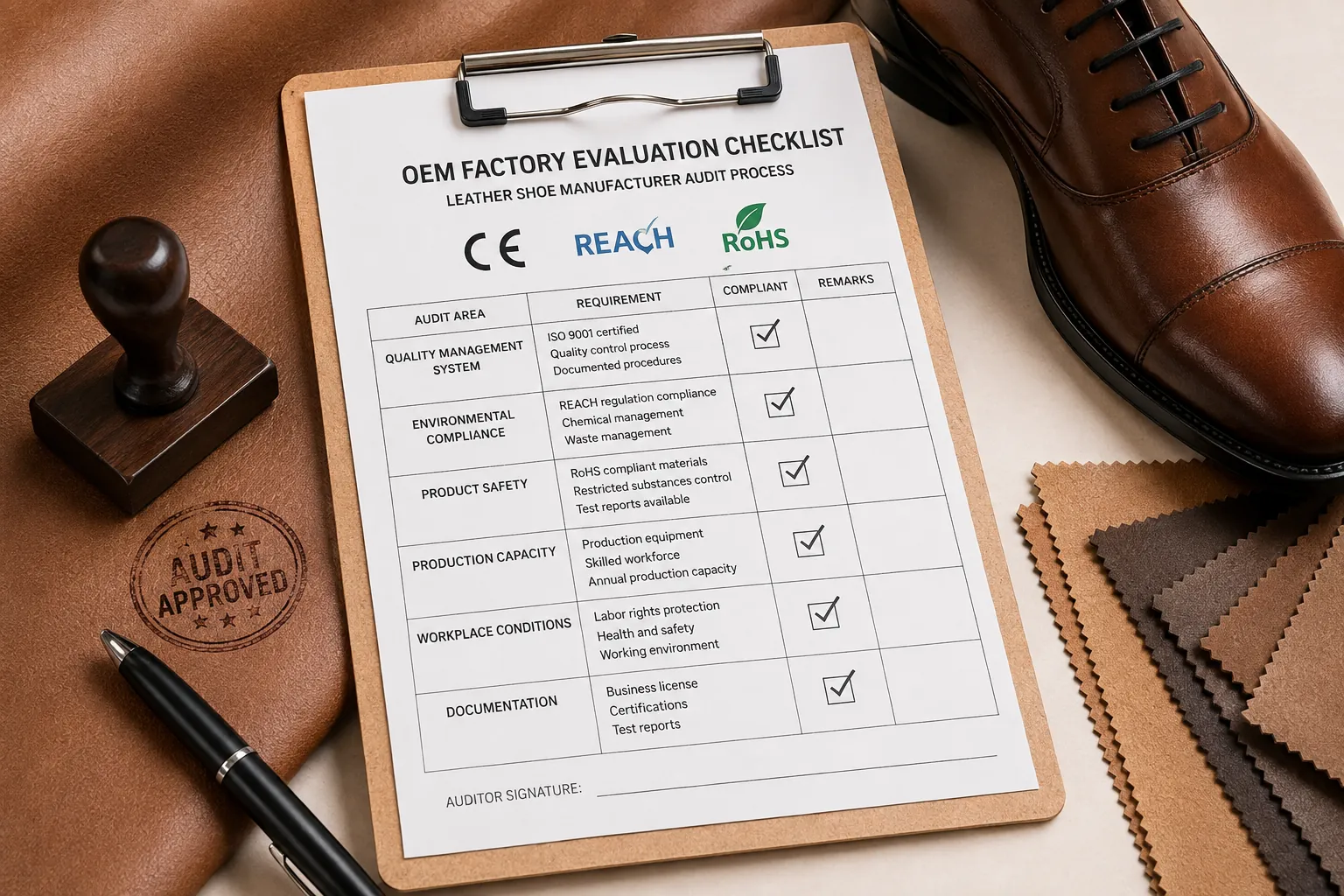
EU market entry requires REACH compliance for chemical substances in leather and adhesives, and CE marking for occupational footwear under EN ISO20347. Italian factories are inherently compliant with EU standards — but so are certified Chinese factories that export specifically to European markets.
When evaluating any factory outside Italy, request:
- REACH test reports (SGS, Bureau Veritas, or Intertek)
- RoHS compliance documentation
- CE certification if targeting occupational/safety footwear
Our guide on CE marking footwear EU certification Shoe Manufacturer Guide covers exactly what documentation you need.
Lead Time Reality Check
Italian factories are not necessarily faster. Custom development cycles in Italy run 12–24 weeks for new styles. Established Chinese factories with existing lasts and tooling can deliver custom orders in 45–75 days from approved sample.
For private label brands launching seasonal collections, lead time is often as critical as unit cost.
Decision Framework: Which Sourcing Model Fits Your Brand?
Use this checklist to determine whether Italian production, a European alternative, or Asian manufacturing fits your business model.
Sourcing Decision Checklist
Step 1 — Define your retail price point
- Under $120 retail → Italian production is not viable at quality
- $120–$250 retail → Evaluate Portuguese or hybrid Italian leather/Asian construction
- $250+ retail → Italian production may be justifiable
Step 2 — Assess your “Made in” marketing value
- Does your target customer actively seek “Made in Italy”?
- Are you selling into markets where EU origin commands a measurable premium?
- Can you substantiate the claim fully (not just finishing)?
Step 3 — Calculate total landed cost
- FOB price × units
- Add: freight, insurance, import duties (EU: 3.7–8.5% for leather shoes from China; 0% intra-EU)
- Add: sampling, development, and tooling amortized over first order
- Add: quality inspection costs ($300–$600 per inspection visit)
For a full breakdown of import duty implications, see our import duties on leather shoes What Does OEM Mean in Shoes guide.
Step 4 — Evaluate MOQ against your cash flow
- Can you commit 300–500 pairs per style for Italian production?
- Or does 60-pair custom MOQ (available from certified Asian factories) better match your launch volume?
Step 5 — Verify compliance requirements
- List all target markets and their specific footwear regulations
- Confirm factory holds relevant certifications before sampling
Step 6 — Request samples before committing
- Never place a production order without approving a physical sample
- Compare samples from 2–3 factories across different countries at the same price tier
For buyers new to private label sourcing, our private label shoes 10-step brand launch guide Shoe Manufacturer Guide walks through the full process.
Full Country Comparison Table
| Criteria | Italy | Portugal | China | Vietnam | India |
|---|---|---|---|---|---|
| FOB Price (dress shoes) | $60–$180+ | $45–$80 | $25–$40 | $28–$45 | $18–$35 |
| MOQ (custom) | 300–500 pairs | 200–300 pairs | 60–200 pairs | 200–300 pairs | 200–500 pairs |
| Lead Time (custom) | 12–24 weeks | 10–16 weeks | 6–10 weeks | 8–12 weeks | 8–14 weeks |
| REACH/CE Compliance | Native | Native | Available (certified factories) | Partial | Partial |
| “Made in” Premium | Very High | Moderate | Low | Low | Low |
| Quality Ceiling | Very High | High | High | Medium-High | Medium |
| OEM/ODM Flexibility | Limited | Moderate | Very High | High | Moderate |
| English Communication | Limited | Good | Good (export factories) | Good | Good |
When to Choose Each Option
Choose Italy when: You are building a genuine luxury brand, your retail price exceeds $250, and “Made in Italy” is a core brand pillar — not just a marketing claim.
Choose Portugal when: You need EU origin, your retail price is $150–$250, and you want better communication than Italy with lower MOQ.
Choose China when: You need competitive FOB pricing ($25–$40), flexible MOQ (starting at 60 pairs for custom), full OEM/ODM capability, and certified compliance documentation. This covers the majority of B2B buyers, private label brands, and cross-border e-commerce sellers.
Choose Vietnam when: You are diversifying supply chain risk away from China and can absorb slightly higher FOB costs.
For buyers comparing OEM and ODM models specifically, our OEM ODM men’s genuine leather shoes manufacturer Shoe Manufacturer Guide page covers the key distinctions.
FAQ
Q: Is cheap shoe production Italy genuinely possible, or is it always expensive?
A: Cheap shoe production Italy is possible only in very narrow circumstances — specifically, factories that use partially imported components and complete finishing in Italy, or lower-tier workshops in less-known regions. Even then, $60 FOB is typically the floor, and quality at that price point is inconsistent. For most B2B buyers targeting competitive retail price points, Italian production is not cost-viable.
Q: What is the minimum order quantity for Italian shoe factories?
A: Most Italian factories require 300–500 pairs per style per colorway for custom production. Luxury artisan workshops may accept 50–200 pairs but at significantly higher per-unit costs. This contrasts sharply with certified Asian factories, where custom MOQs can start at 60 pairs per style.
Q: How does “Made in Italy” labeling work legally?
A: Under EU rules, a product can be labeled “Made in Italy” if it has undergone substantial transformation in Italy — meaning the last significant manufacturing process occurred there. This allows some factories to import partially assembled uppers from lower-cost countries, complete assembly or finishing in Italy, and legally use the label. Buyers should ask factories specifically what percentage of operations occur in Italy and request documentation.
Q: Can Chinese factories match Italian quality for leather dress shoes?
A: For the mid-to-premium segment (retail $80–$200), certified Chinese factories producing Goodyear-welted or Blake-stitched shoes with full-grain leather uppers can deliver quality that is functionally comparable to Italian mid-tier production. The gap narrows further when Chinese factories source Italian or Spanish leather for their uppers. The key is factory selection — not all Chinese factories operate at this level, so certification, audit history, and defect rate data matter enormously.
Q: What certifications should I require from any shoe factory, regardless of country?
A: For EU market entry: REACH compliance (chemical safety in leather and adhesives) and CE marking under EN ISO20347 for occupational footwear. For US market: CPSC compliance for any children’s footwear, and general ASTM standards for construction. For all markets: request third-party