Table of Contents
- Why Certifications Determine Market Access
- CE Marking and EN ISO20347 Explained
- REACH Compliance for Leather Shoes
- RoHS and Footwear Hardware
- OEKO-TEX, SATRA, and ISO 9001
- Certification Costs and Timelines
- How to Verify a Factory’s Certifications
- Full Certification Comparison Table
- FAQ
- Ready to Start Your Shoe Line?
Why Certifications Determine Market Access
CE marking footwear is not a quality badge — it is a legal requirement for selling occupational and safety footwear in the European Union. Miss it, and your shipment gets detained at customs, your retail partners cancel orders, and your brand takes a reputational hit that takes years to recover from.
For B2B buyers, private label brands, and cross-border e-commerce sellers, certifications are the single most overlooked sourcing risk. Most buyers focus on price, MOQ, and lead time. Certifications get treated as an afterthought — until a customs hold or product recall forces the issue.
The EU, UK, US, and Australian markets each have distinct chemical and safety standards. A shoe that sells legally in one market may be banned in another. Understanding which certifications apply to your target market before you place an order is the difference between a profitable product launch and a costly compliance failure.
At Wincheer Shoes — a manufacturer located in Jiangmen, Guangdong (1.5 hours from Guangzhou), founded in 2007 producing 500,000+ pairs annually — every production run is certified to CE (EN ISO20347), REACH, and RoHS before shipment. That baseline compliance covers the EU, UK, and most of the 50+ countries in their export network, and it is the minimum standard any serious B2B buyer should demand from a supplier.
CE Marking and EN ISO20347 Explained
What CE Marking Actually Covers
CE marking on footwear signals conformity with EU health, safety, and environmental protection standards. For occupational footwear (non-safety, non-protective), the governing standard is EN ISO20347:2012+A1:2022. For safety footwear with toe protection, the relevant standard is EN ISO20345.
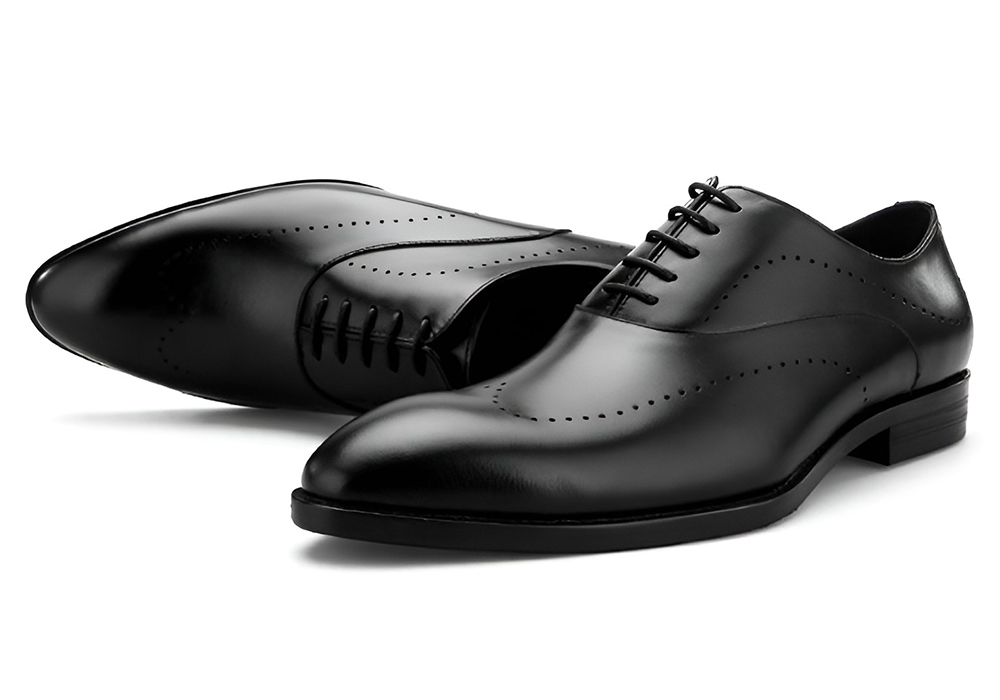
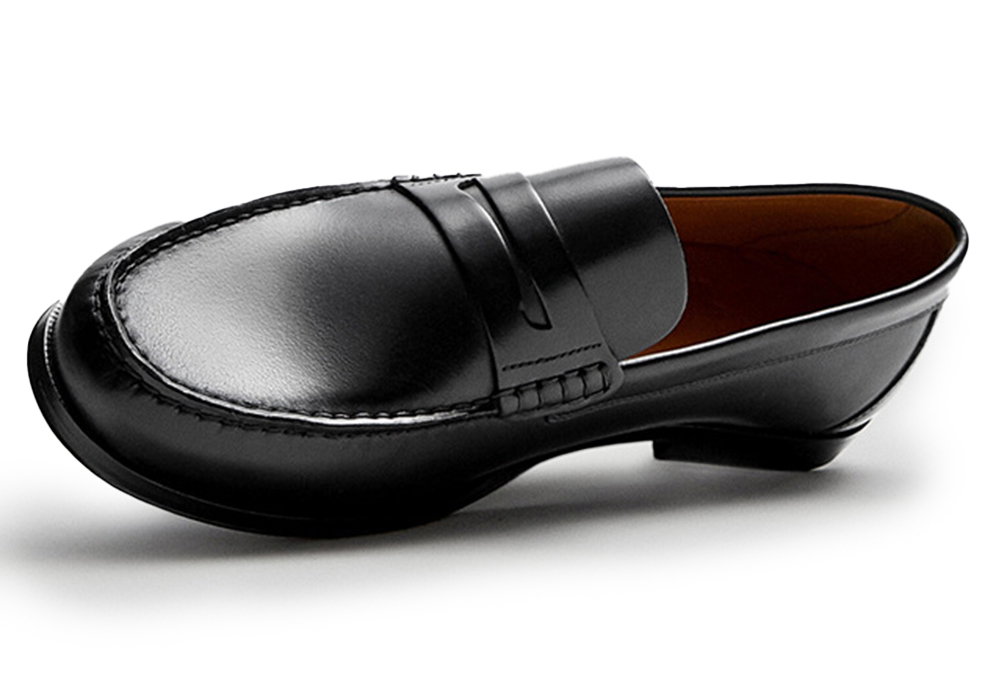
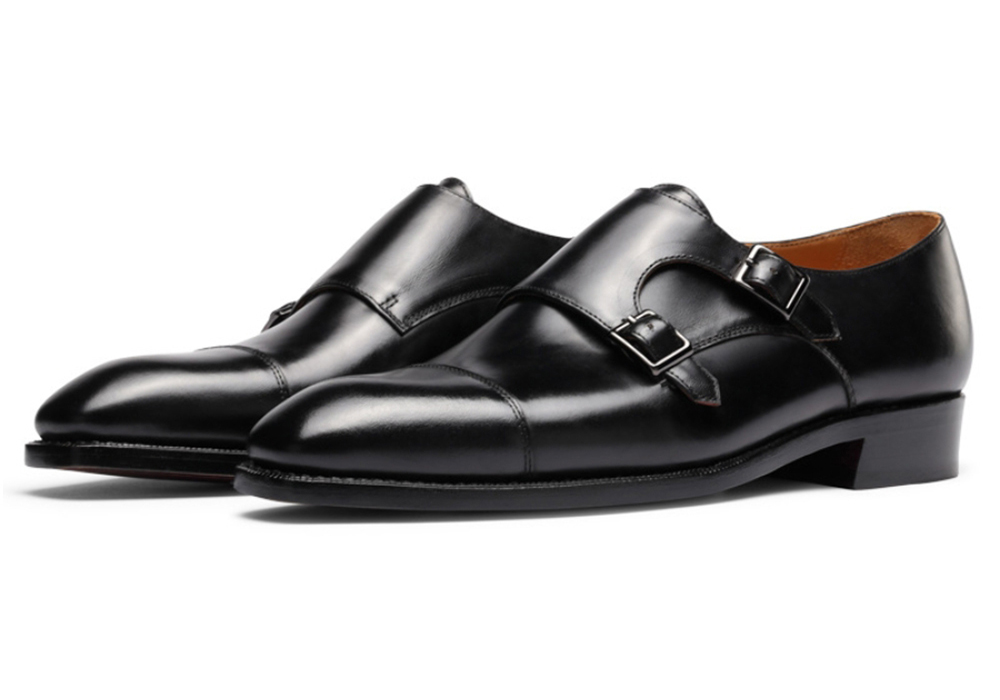
Most men’s leather dress shoes — Oxfords, Derbies, Loafers, Monk Straps, Chelsea Boots — fall under EN ISO20347 as occupational footwear. This standard covers:
- Slip resistance (SRA, SRB, SRC ratings on specific test surfaces)
- Upper material durability (flexing, tear strength, water penetration)
- Insole and lining requirements (pH levels, colourfastness, dimensional stability)
- Outsole adhesion strength (minimum bond strength between upper and sole)
- Ergonomic requirements (heel height, toe box clearance)
Who Needs CE Marking?
If you are selling leather shoes into the EU or UK market — whether through retail partners, Amazon EU, your own DTC store, or B2B wholesale — CE marking footwear compliance is mandatory for occupational categories. Purely fashion footwear sold as non-occupational may fall outside mandatory CE scope, but most retailers require it regardless as a risk management measure.
The CE Testing Process
CE conformity for footwear follows a self-declaration route under the Personal Protective Equipment Regulation (EU 2016/425) for basic risk products, but most buyers use a notified body (third-party lab) for credibility. The standard testing pathway:
- Submit samples (typically 6–12 pairs per style) to an accredited lab (SGS, Bureau Veritas, Intertek, TÜV)
- Lab conducts physical and chemical testing per EN ISO20347
- Technical file compiled (test reports, design drawings, material declarations)
- Declaration of Conformity (DoC) issued
- CE mark applied to product and packaging
For a deeper breakdown of the CE process specific to footwear, see our CE marking footwear 2026 EU certification guide.
REACH Compliance for Leather Shoes
What REACH Restricts in Footwear
REACH (Registration, Evaluation, Authorisation and Restriction of Chemicals) is the EU’s primary chemical regulation. For leather footwear, three substance groups create the highest compliance risk:
1. Azo Dyes
Certain azo colorants can cleave to release carcinogenic aromatic amines. EU Regulation (EC) No 1907/2006 Annex XVII restricts these in leather goods that contact skin. The limit is 30 mg/kg per restricted amine. Black, navy, and dark brown leathers carry the highest risk — these colorways require specific dye chemistry confirmation from your tannery.
2. Chromium VI (Cr VI)
Chrome-tanned leather can contain residual hexavalent chromium, a known skin sensitizer and carcinogen. The EU limit under REACH is 3 mg/kg in leather articles that contact skin. This is one of the most frequently failed tests in leather shoe imports. Always request Cr VI test reports dated within 12 months from your supplier.
3. Formaldehyde
Used in leather finishing and textile linings, formaldehyde is restricted under REACH and various national regulations. Japan’s Household Goods Quality Labeling Law sets limits as low as 75 ppm for items contacting skin. Even if you are not targeting Japan, formaldehyde-free finishing is a baseline quality indicator.
REACH Compliance Process for Buyers
- Request a full material declaration from your supplier covering upper leather, lining, insole board, adhesives, and outsole compound
- Require test reports from accredited labs (CNAS or ILAC-accredited) for Cr VI, azo dyes, and formaldehyde
- Confirm your tannery’s leather is tested per EN ISO17075 (Cr VI method) and EN ISO17234 (azo dyes)
- Check the ECHA SVHC Candidate List for any newly added substances of very high concern that may affect your product category
RoHS and Footwear Hardware
Why RoHS Applies to Shoes
RoHS (Restriction of Hazardous Substances Directive, EU 2011/65/EU) primarily targets electrical and electronic equipment. Most buyers assume it does not apply to footwear. That assumption is wrong.
Modern leather shoes increasingly incorporate electronic elements: LED light-up soles, smart insoles with embedded sensors, NFC chips for authentication, heated insole systems. Any shoe with electronic components sold in the EU must comply with RoHS.
Beyond electronics, RoHS restrictions on lead, cadmium, mercury, and hexavalent chromium in hardware components (buckles, zippers, eyelets, monk strap buckles) are enforced under overlapping REACH restrictions. For practical purposes, buyers should treat RoHS and REACH as complementary frameworks covering the same hazardous substances from different regulatory angles.
RoHS Testing Requirements for Footwear Hardware
| Component | Key RoHS Substances | Test Method |
|---|---|---|
| Metal buckles/eyelets | Lead (Pb), Cadmium (Cd) | XRF screening + ICP-OES confirmation |
| Zippers | Lead, Nickel (under REACH) | XRF + EN 1811 |
| Smart insoles/LED soles | All 10 RoHS substances | IEC 62321 series |
| Plated hardware | Hexavalent Chromium (Cr VI) | IEC 62321-7-2 |
For most traditional leather dress shoes without electronics, RoHS compliance is achieved by confirming hardware is lead- and cadmium-free through supplier declarations and periodic XRF testing. Budget for XRF screening on every new hardware component introduced into your line.
OEKO-TEX, SATRA, and ISO 9001
OEKO-TEX STANDARD 100
OEKO-TEX STANDARD 100 is a voluntary certification testing for harmful substances in textiles and leather. It covers over 100 substances including pesticides, heavy metals, and allergenic dyes. For leather shoes, OEKO-TEX Leather Standard is the relevant module.
OEKO-TEX is not legally required anywhere, but it is a powerful commercial differentiator — particularly for premium retail, sustainable fashion brands, and markets like Germany, Scandinavia, and Japan where consumer chemical sensitivity is high. Retailers like Zalando and About You increasingly require it for new supplier onboarding.
SATRA Testing
SATRA Technology is the UK’s leading footwear research and testing organization. SATRA certification (particularly SATRA TM methods) is recognized globally as a mark of physical performance testing credibility. Key SATRA tests relevant to leather dress shoes:
- SATRA TM144 — Slip resistance
- SATRA TM92 — Outsole flexing resistance
- SATRA TM411 — Upper leather tensile strength
SATRA membership and testing is particularly valuable if you are targeting UK retail chains, hospitality sector buyers, or corporate workwear procurement.
ISO 9001
ISO 9001 is a quality management system standard, not a product certification. A factory holding ISO 9001:2015 certification has demonstrated documented process controls, traceability, and continuous improvement systems. It does not guarantee product quality directly, but it signals that the factory has the organizational infrastructure to maintain consistent output.
When evaluating suppliers, ISO 9001 combined with product-level certifications (CE, REACH, RoHS) gives you a more complete picture than product certifications alone.
For a practical look at how quality control intersects with certifications in footwear production, our AQL inspection footwear quality control guide covers the inspection frameworks that work alongside these standards.
Certification Costs and Timelines
Realistic Budget and Lead Time Expectations
Certification costs vary by lab, scope, and number of styles. Below are realistic 2026 market ranges for a single style tested at a Tier 1 lab (SGS, Bureau Veritas, Intertek):
| Certification | Typical Cost (per style) | Timeline |
|---|---|---|
| CE (EN ISO20347) — physical | $800–$1,500 | 3–5 weeks |
| REACH (Cr VI + azo dyes + formaldehyde) | $300–$600 | 2–3 weeks |
| RoHS (hardware XRF + confirmation) | $200–$400 | 1–2 weeks |
| OEKO-TEX Leather Standard | $1,500–$3,000 (factory-level) | 6–10 weeks |
| ISO 9001 (factory audit) | $3,000–$8,000 (factory-level) | 3–6 months |
| SATRA physical testing | $500–$1,200 | 2–4 weeks |
Key cost-saving strategies:
- Bundle CE physical testing with REACH chemical testing in a single lab submission — most labs offer 15–25% bundle discounts
- Use factory-held certifications where available rather than re-testing every order
- Limit full re-testing to new styles or when materials/suppliers change; use supplier declarations for repeat orders with documented material consistency
How to Verify a Factory’s Certifications
The Verification Checklist
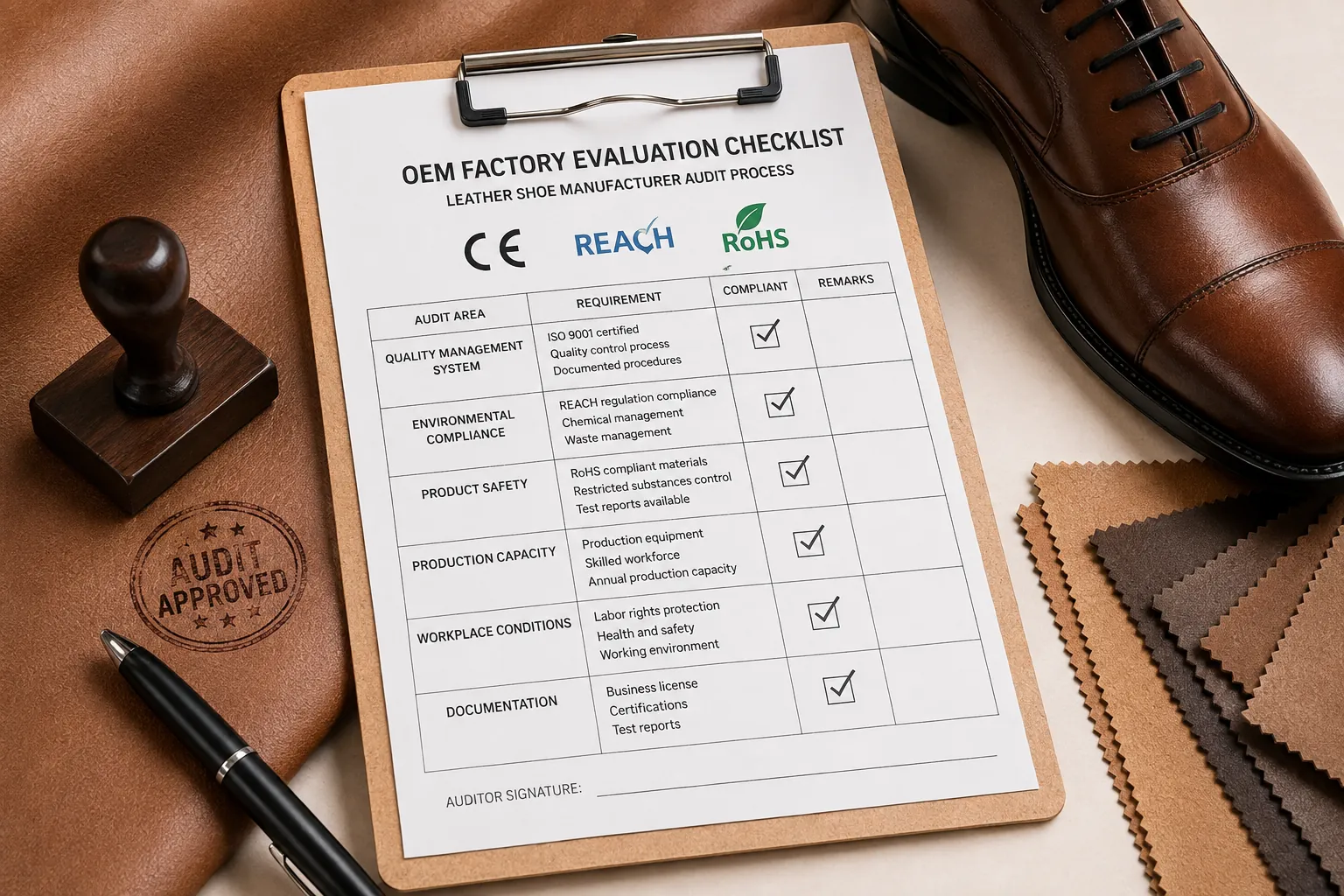
Receiving a certificate PDF from a supplier is not verification. Fraudulent or expired certificates are common in the footwear sourcing space. Use this checklist:
Document-Level Checks
- [ ] Certificate shows the correct issuing lab name and accreditation number
- [ ] Test date is within 12 months (REACH) or within the validity period stated (CE)
- [ ] Certificate covers the specific materials/components in your order (not a generic factory certificate)
- [ ] Product description on certificate matches your SKU specifications
- [ ] Lab is CNAS, ILAC, or A2LA accredited — verify on the lab’s official accreditation body website
Lab Verification
- [ ] Cross-reference the certificate number directly on the issuing lab’s online verification portal (SGS, Bureau Veritas, and Intertek all offer this)
- [ ] Check the lab’s accreditation scope covers EN ISO20347, EN ISO17075, and EN ISO17234
Red Flags
- Certificate PDF has no unique report number
- Lab name is unfamiliar and has no verifiable ILAC membership
- Certificate covers “all leather shoes” without style-specific test data
- Supplier is reluctant to provide the full test report (not just the certificate cover page)
- Test reports are more than 24 months old
For a broader list of sourcing warning signs, our red flags when sourcing leather shoes from China checklist covers the full supplier evaluation process.
Full Certification Comparison Table
| Certification | Mandatory? | Market | Scope | Who Applies? | Renewal |
|---|---|---|---|---|---|
| CE (EN ISO20347) | Yes (occupational) | EU, UK | Physical performance, safety | Importer/brand | Per style; review on standard update |
| REACH | Yes | EU, UK | Chemical restrictions (Cr VI, azo, formaldehyde) | Importer/brand | Annual or on material change |
| RoHS | Yes (if electronic components) | EU, UK | Hazardous substances in electronics/hardware | Importer/brand | Per product revision |
| OEKO-TEX STANDARD 100 | No (voluntary) | Global | 100+ harmful substances in leather/textiles | Factory | Annual |
| SATRA | No (voluntary) | UK, Global | Physical performance testing | Brand/factory | Per test campaign |
| ISO 9001 | No (voluntary) | Global | Quality management system | Factory | 3-year cycle + annual surveillance |
| EN ISO20345 | Yes (safety footwear) | EU, UK | Toe protection, penetration resistance | Importer/brand | Per style |
Sourcing Compliant Leather Shoes: A Practical Decision Framework
Before placing any order for EU or UK market distribution, run through this sequence:
- Confirm end market — EU, UK, US, Australia each have different mandatory requirements
- Classify your product — occupational footwear (EN ISO20347), safety footwear (EN ISO20345), or fashion footwear
- Check for electronic components — any smart features trigger RoHS mandatory compliance
- Request material declarations — upper leather, lining, insole, adhesive, outsole, hardware
- Verify existing certificates — use lab portals, not just PDF copies