Table of Contents
- The State of Global Shoe Manufacturing in 2026
- China: The Benchmark Every Country Is Measured Against
- Vietnam: The Fastest-Growing Alternative
- India: The Underrated Contender
- Indonesia: The Sportswear Giant With Dress Shoe Potential
- Full Comparison Table: All 4 Countries
- Decision Framework: Which Country Fits Your Order?
- FAQ
The State of Global Shoe Manufacturing in 2026
The global footwear industry is in the middle of a genuine supply chain realignment. Tariff pressure, post-pandemic logistics lessons, and rising labor costs across Asia have pushed B2B buyers and private label brands to seriously reconsider where they manufacture. A shoe manufacturing comparison that made sense in 2020 looks very different today.
China still accounts for roughly 57% of global footwear exports by volume, but that share is slowly eroding. Vietnam, India, and Indonesia are all aggressively positioning themselves as credible alternatives — each with real strengths and real limitations that buyers need to understand before committing capital.
This guide cuts through the marketing noise. Whether you’re placing your first 200-pair order or scaling to 50,000 pairs per season, the country decision affects your cost, quality, lead time, and long-term brand risk.
China: The Benchmark Every Country Is Measured Against
Why China Still Dominates Leather Dress Shoes
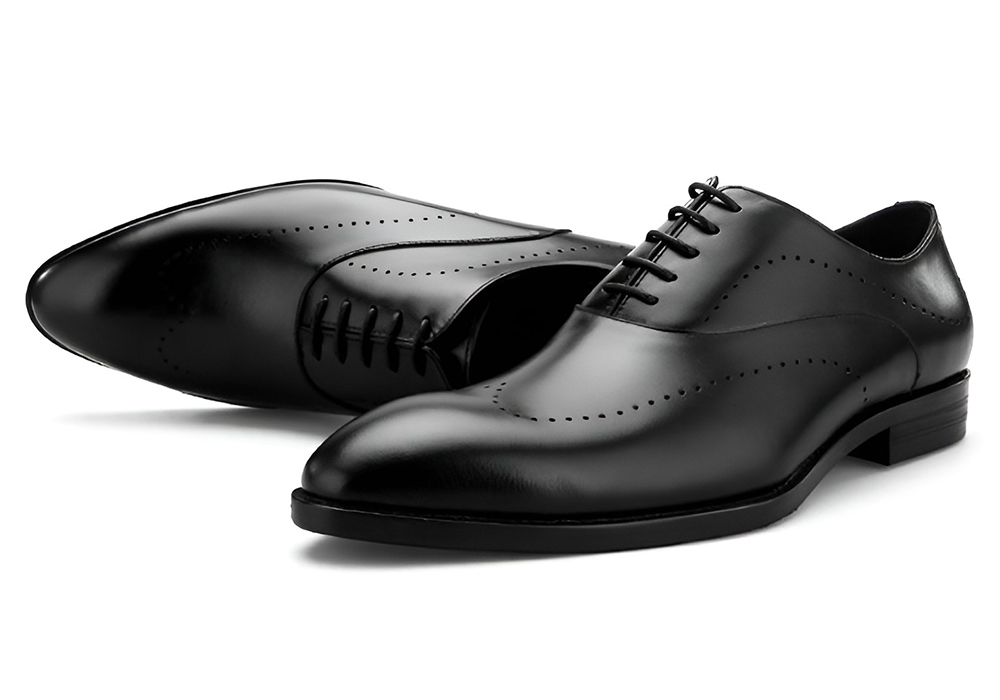
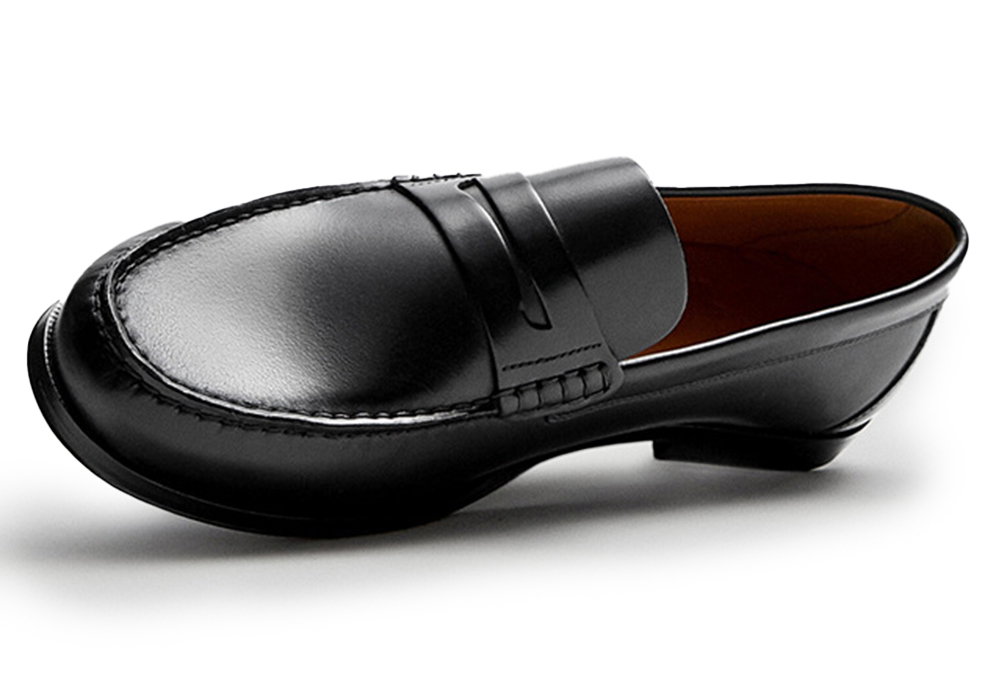
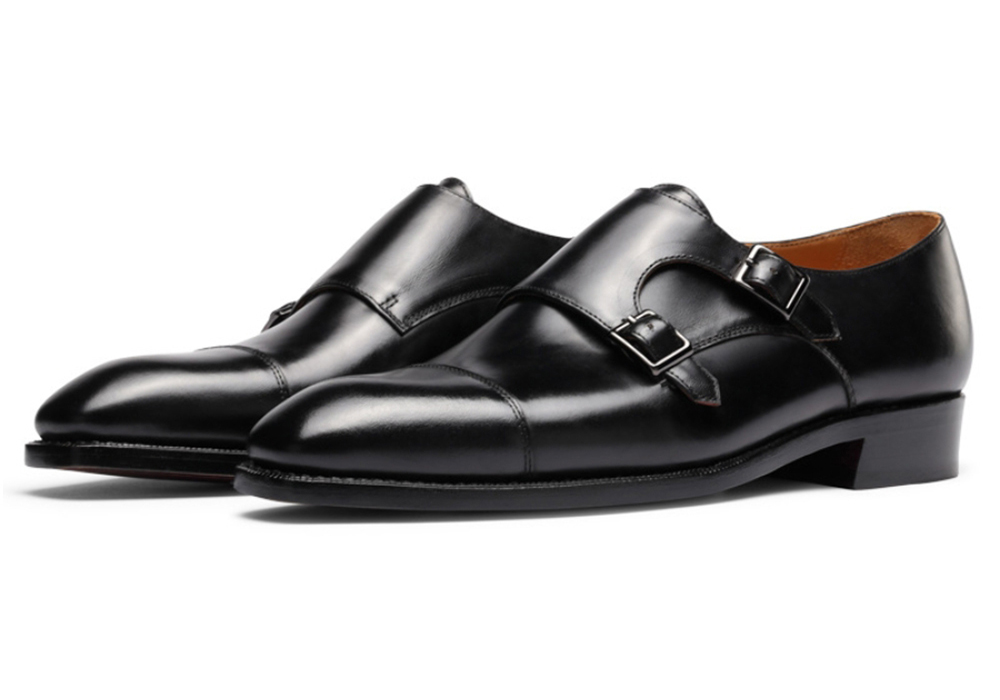
For men’s leather shoes specifically — Oxfords, Derbies, Monk Straps, Chelsea Boots, Loafers — China remains the single most capable manufacturing ecosystem on the planet. The Guangzhou-Dongguan corridor, Wenzhou in Zhejiang, and Jinjiang in Fujian collectively house thousands of specialized factories, tanneries, component suppliers, and tooling workshops within a 200-kilometer radius.
That concentration matters enormously. When a factory in Guangzhou needs a new last, a specific Goodyear welt, or a particular grade of full-grain calf leather, it can source it domestically within 48-72 hours. No other country in this shoe manufacturing comparison can match that supply chain density for dress footwear.
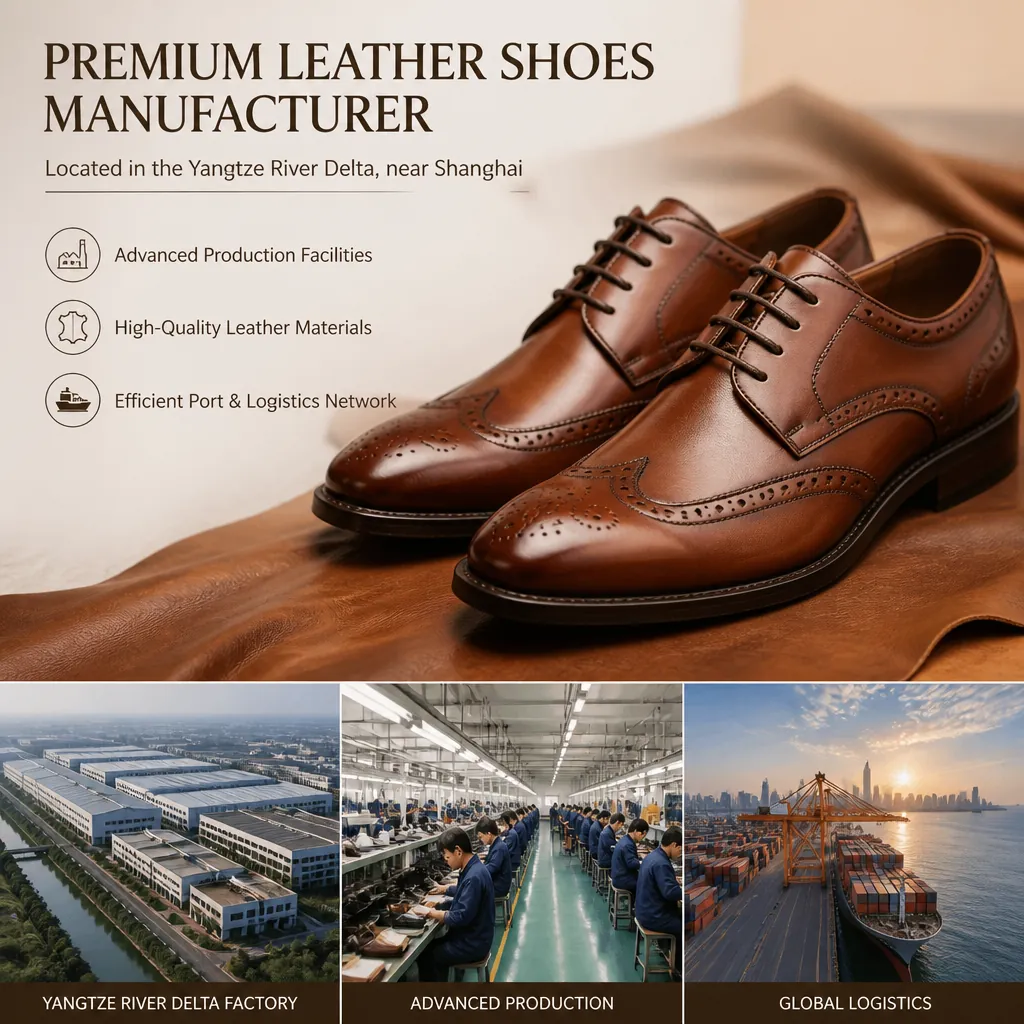
As a real-world benchmark: a manufacturer producing 500,000+ pairs annually from a Guangzhou factory — holding CE (EN ISO20347), REACH, and RoHS certifications — can offer FOB pricing in the $25–$40/pair range for genuine leather dress shoes, with a defect rate of 0.8–1.2% against an industry average of 2–4%. That’s the quality and cost floor China sets for this product category. Wincheer Shoes, founded in 2007 and operating from Shanghai (HQ) and Guangzhou (main factory), is one example of what a mature Chinese leather shoe manufacturer looks like at scale.
China’s Strengths in 2026
- Full vertical integration: tanning, component manufacturing, lasting, finishing, and export logistics under one regional ecosystem
- Design depth: 1,000+ existing designs available from established factories; rapid sampling in 7–14 days
- Certification infrastructure: CE, REACH, RoHS, and SGS testing labs are embedded in the supply chain
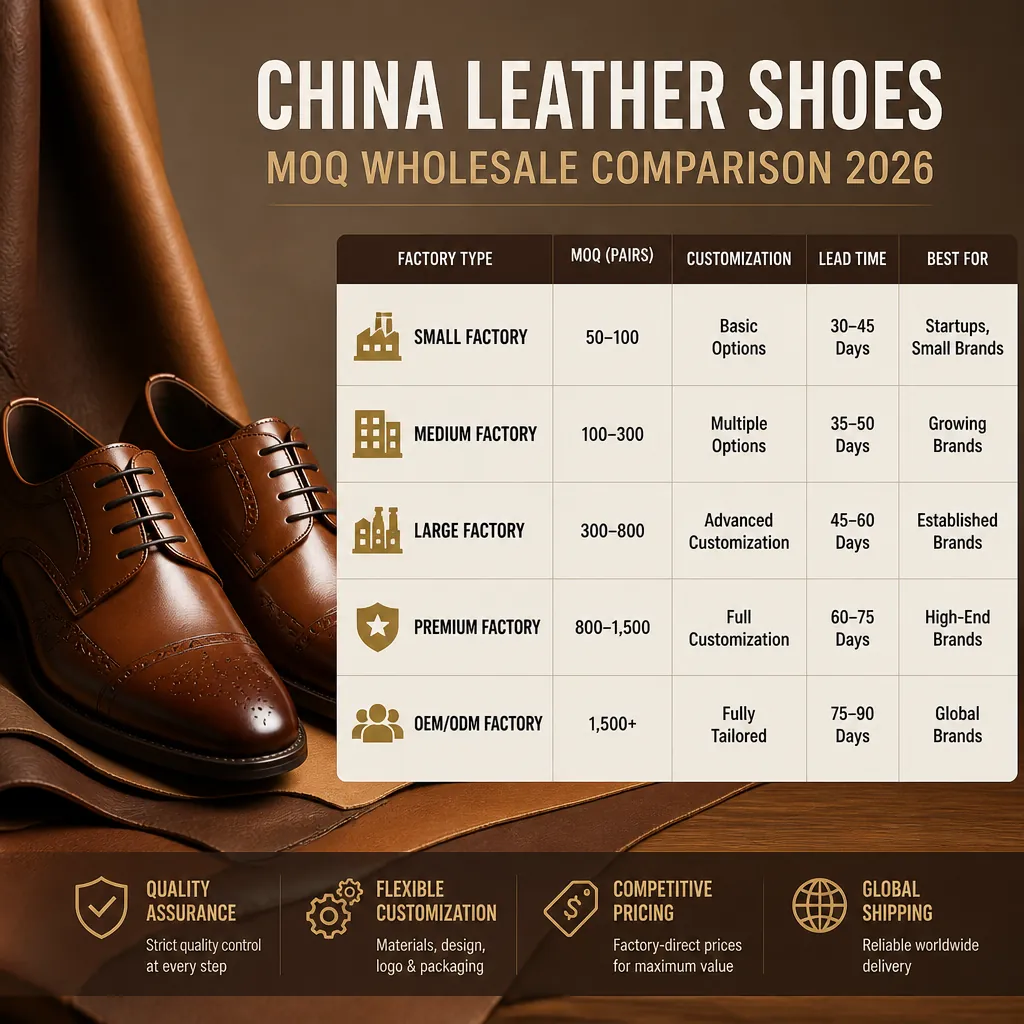
- MOQ flexibility: established factories can offer 0 MOQ on existing designs, 60 pairs for custom work
- Logistics maturity: direct container routes to 50+ countries, bonded warehouses, and experienced freight forwarders
China’s Limitations
- US Section 301 tariffs (currently 20–35% on leather footwear, with ongoing review in 2026) add landed cost pressure for American buyers
- Labor costs have risen significantly — Guangzhou factory workers now earn $550–$750/month, up from $300 in 2015
- Intellectual property protection requires careful contract structuring
- Some buyers face reputational pressure from ESG stakeholders around “China dependency”
Vietnam: The Fastest-Growing Alternative
Vietnam’s Rise in Footwear
Vietnam is the world’s second-largest footwear exporter, and its growth story is real. Ho Chi Minh City, Binh Duong, and Dong Nai provinces host major manufacturing clusters. Nike, Adidas, and Clarks have all shifted significant production here over the past decade.
For athletic footwear and casual canvas shoes, Vietnam is genuinely competitive. The labor cost advantage is meaningful — factory workers earn approximately $280–$380/month, roughly 40–50% less than comparable Chinese workers.
Vietnam’s Strengths
- Lower labor costs than China, especially for labor-intensive assembly
- Favorable trade agreements: EVFTA (EU-Vietnam Free Trade Agreement) and CPTPP provide tariff advantages for European and Asia-Pacific buyers
- US tariff avoidance: Vietnamese footwear faces lower US import duties than Chinese goods under current Section 301 rules
- Growing quality tier: mid-range athletic and casual shoes are well-established
Vietnam’s Limitations for Leather Dress Shoes
This is where the shoe manufacturing comparison gets nuanced. Vietnam’s strength is in athletic, casual, and synthetic-upper footwear. For genuine leather dress shoes — the kind requiring hand-lasting, welt construction, and complex finishing — the ecosystem is significantly thinner.
- Tannery infrastructure is limited: most leather must be imported from China, Brazil, or Italy, adding 2–4 weeks to lead times
- Skilled craftsmen for dress shoes are scarce: the workforce is trained for athletic assembly, not Goodyear welting or Blake stitching
- MOQs are typically higher: most Vietnamese factories require 300–500 pairs per style minimum
- Sampling lead times: 21–35 days vs. 7–14 days in China
- Component sourcing: heels, shanks, insoles, and welts often need to be imported
Bottom line for leather dress shoes: Vietnam is not yet a credible alternative to China. For athletic or casual synthetic footwear, it’s a strong option.
India: The Underrated Contender
India’s Footwear Manufacturing Reality
India is the world’s second-largest footwear producer by volume and has genuine leather heritage. The Agra-Kanpur belt in Uttar Pradesh, Chennai in Tamil Nadu, and Kolkata in West Bengal are established manufacturing zones. India has its own cattle leather supply chain, which is a structural advantage no other country in this comparison possesses at the same scale.
Labor costs are competitive — $150–$250/month for factory workers — making India the lowest-cost option in this shoe manufacturing comparison for labor.
India’s Strengths
- Domestic leather supply: India is one of the world’s largest cattle hide producers; tanneries in Chennai and Kanpur supply quality upper leather
- Government support: the Indian government’s Production Linked Incentive (PLI) scheme for footwear is actively subsidizing capacity expansion in 2026
- Artisan craftsmanship: hand-stitching, Kolhapuri-style construction, and bespoke finishing are genuine competencies
- Cost: for buyers willing to invest time in supplier development, India can deliver quality at $18–$28/pair FOB for mid-range leather shoes
India’s Limitations
- Infrastructure gaps: port congestion at JNPT (Mumbai), inconsistent power supply in manufacturing zones, and road logistics inefficiencies add unpredictable lead time variance
- Quality consistency: without rigorous AQL inspection protocols, batch-to-batch variation is higher than China
- MOQ requirements: most factories require 500–1,000 pairs per style; finding flexible MOQ suppliers is difficult
- Certification gaps: CE and REACH compliance documentation is less standardized; buyers must audit carefully
- Lead times: 60–90 days from order to shipment is common, vs. 35–50 days in China
- Design library: existing design catalogs are narrower; custom development capability varies widely by factory
India is best suited for buyers with longer development timelines, strong on-the-ground sourcing relationships, and a focus on casual leather or heritage-style footwear.
Indonesia: The Sportswear Giant With Dress Shoe Potential
Indonesia’s Manufacturing Profile
Indonesia is the world’s fourth-largest footwear producer. The Tangerang-Serang corridor in Banten province and Surabaya in East Java are the main clusters. Like Vietnam, Indonesia’s manufacturing base was built largely around athletic footwear for global brands — Nike has operated major production here for decades.
Factory worker wages sit at approximately $220–$320/month, competitive but not dramatically lower than Vietnam once you factor in productivity differences.
Indonesia’s Strengths
- Scale for athletic and casual footwear: large factories with strong compliance infrastructure (BSCI, ISO 9001 common)
- Competitive labor costs relative to China
- Growing leather sector: East Java has a developing cattle leather tannery cluster
- ASEAN trade advantages: preferential access to ASEAN markets and some EU GSP benefits
Indonesia’s Limitations for Leather Dress Shoes
The picture is similar to Vietnam. Indonesia’s dress shoe manufacturing capability is limited compared to China.
- Leather supply chain is underdeveloped for dress shoe grades; most quality upper leather is imported
- Skilled dress shoe craftsmen are concentrated in small artisan workshops, not scalable factories
- MOQs for dress shoes: 500–1,000 pairs typical; flexible custom work is rare
- Certification for EU markets: CE/REACH documentation requires third-party testing that adds cost and time
- Sampling capability: limited for complex constructions (Goodyear welt, Blake, etc.)
Indonesia makes sense for buyers sourcing athletic, casual, or injection-molded footwear at volume. For leather dress shoes, it’s not a primary recommendation in 2026.
Full Comparison Table: All 4 Countries
| Factor | China | Vietnam | India | Indonesia |
|---|---|---|---|---|
| Labor Cost/Month | $550–$750 | $280–$380 | $150–$250 | $220–$320 |
| FOB Price (leather dress shoe) | $25–$40 | $28–$45* | $18–$28 | $30–$48* |
| MOQ (custom) | 60–300 pairs | 300–500 pairs | 500–1,000 pairs | 500–1,000 pairs |
| Sampling Lead Time | 7–14 days | 21–35 days | 21–45 days | 21–35 days |
| Production Lead Time | 35–50 days | 45–65 days | 60–90 days | 50–75 days |
| Leather Supply Chain | ✅ Fully domestic | ⚠️ Mostly imported | ✅ Strong domestic | ⚠️ Partially imported |
| CE/REACH Certification | ✅ Standard | ⚠️ Available, less common | ⚠️ Requires audit | ⚠️ Requires audit |
| Dress Shoe Expertise | ✅ Excellent | ⚠️ Limited | ⚠️ Moderate | ❌ Limited |
| Athletic/Casual Expertise | ✅ Strong | ✅ Excellent | ⚠️ Moderate | ✅ Excellent |
| US Tariff Exposure | 🔴 High (20–35%) | 🟡 Lower | 🟢 Low | 🟢 Low |
| EU Market Access | 🟡 Standard MFN | ✅ EVFTA advantage | 🟡 GSP | 🟡 GSP |
| Design Catalog Depth | ✅ 1,000+ designs | ⚠️ Limited | ⚠️ Limited | ⚠️ Limited |
| Defect Rate (typical) | 0.8–2% | 1.5–3% | 2–4% | 1.5–3% |
*Vietnam and Indonesia dress shoe pricing is higher due to imported leather and lower production efficiency for this category.
Decision Framework: Which Country Fits Your Order?
Use this checklist to match your sourcing needs to the right manufacturing country.
✅ Choose China if:
- Your product is genuine leather dress shoes (Oxford, Derby, Monk Strap, Chelsea Boot, Loafer)
- You need low MOQ (under 300 pairs per style)
- You require CE, REACH, or RoHS certification for EU/UK markets
- You need fast sampling (under 14 days)
- You want access to a deep existing design catalog
- You’re sourcing for European, Middle Eastern, Australian, or Southeast Asian markets
- Quality consistency and low defect rates are non-negotiable
- You need custom OEM/ODM development with complex construction (Goodyear welt, Blake stitch)
✅ Choose Vietnam if:
- Your product is athletic, casual, or synthetic-upper footwear
- You’re selling primarily into the US market and want to reduce Section 301 tariff exposure
- You’re selling into EU markets and want EVFTA tariff benefits
- You can accommodate 300–500 pair MOQs and 45–65 day lead times
- Quality requirements are mid-tier (not premium leather dress shoes)
✅ Choose India if:
- You’re sourcing casual leather, sandals, or heritage-style footwear
- You have an established local sourcing agent or buying office
- Price is the primary driver and you have flexibility on lead time (60–90 days)
- You’re targeting markets where Indian origin carries brand value (some EU sustainable fashion segments)
- You can invest in supplier development and AQL inspection infrastructure
✅ Choose Indonesia if:
- Your product is athletic, casual, or injection-molded footwear at volume (5,000+ pairs)
- You’re already working with large-format factories that have Indonesian capacity
- You want ASEAN supply chain diversification alongside a primary China or Vietnam source
The Hybrid Strategy (Used by Experienced Buyers in 2026)
Many sophisticated B2B buyers now run a dual-source model: China for leather dress shoes (quality-critical, complex construction, lower MOQ) + Vietnam or Indonesia for athletic/casual lines (volume-driven, tariff-sensitive). This approach balances quality, cost, and geopolitical risk without sacrificing either.
For more detail on how tariffs affect your landed cost calculation, the FOB shoe pricing guide comparing 4 Incoterms [INTERNAL_LINK: fob-shoe-pricing-guide-4-incoterms-compared-in-2026] is worth reading before you finalize your sourcing structure.
If you’re evaluating Chinese suppliers specifically, the red flags checklist for sourcing leather shoes from China [INTERNAL_LINK: red-flags-when-sourcing-leather-shoes-from-china-a-buyers-checklist] will help you filter out unreliable factories before you commit.
For buyers building a private label brand, the 10-step private label shoe brand launch guide [INTERNAL_LINK: private-label-shoes-10-step-brand-launch-guide-2026] covers how country selection fits into the broader brand development process.