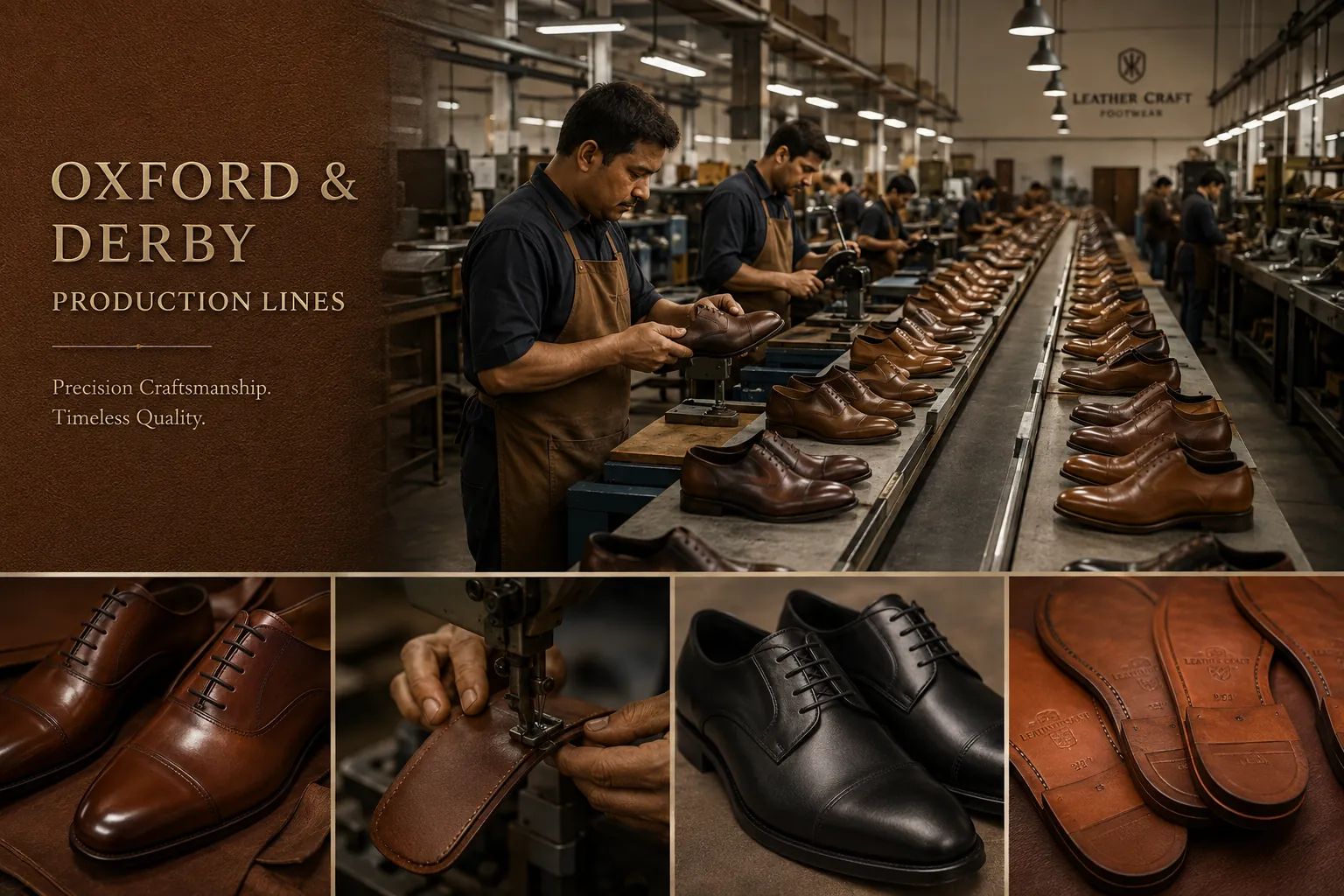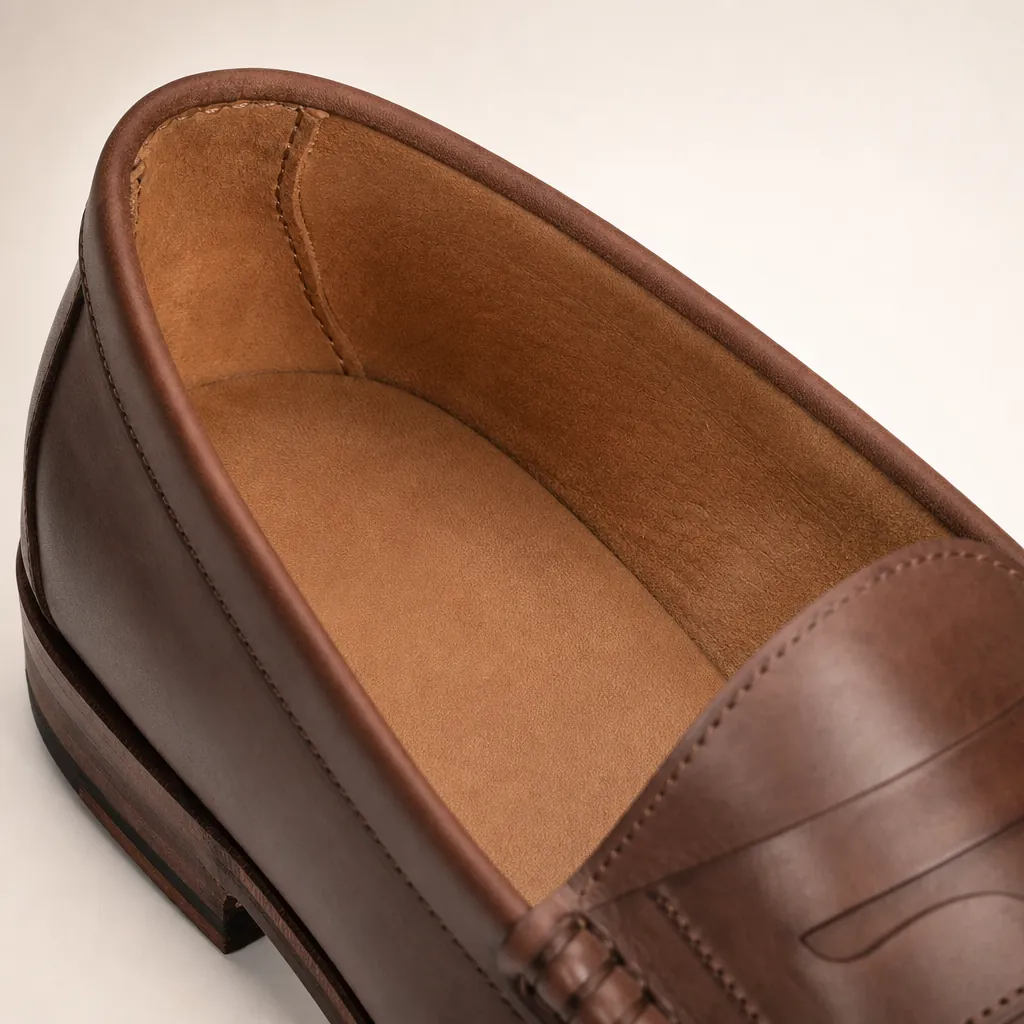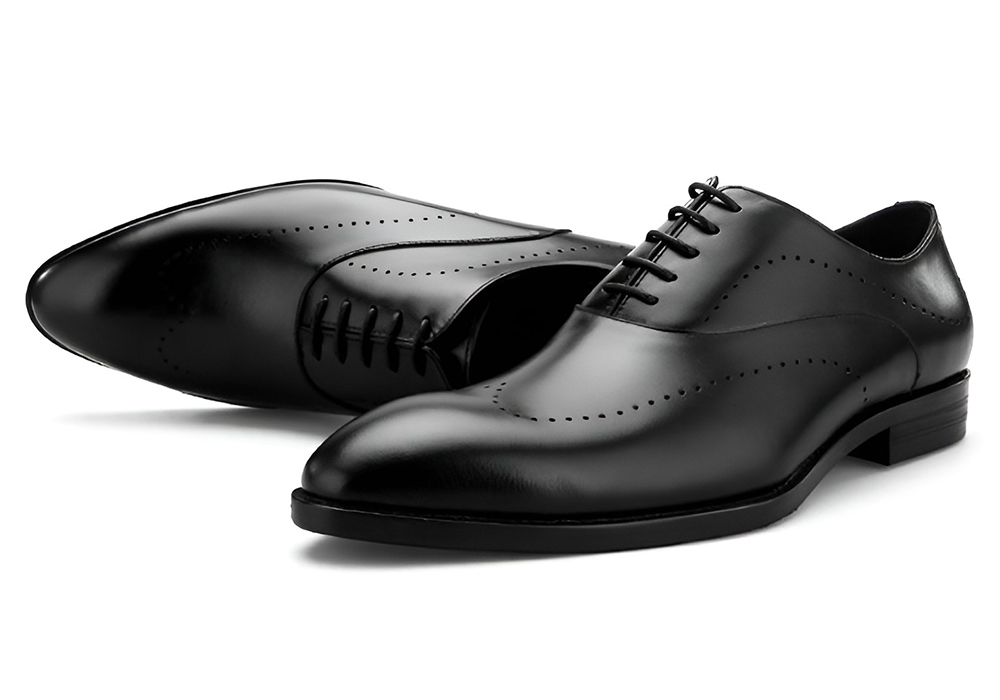
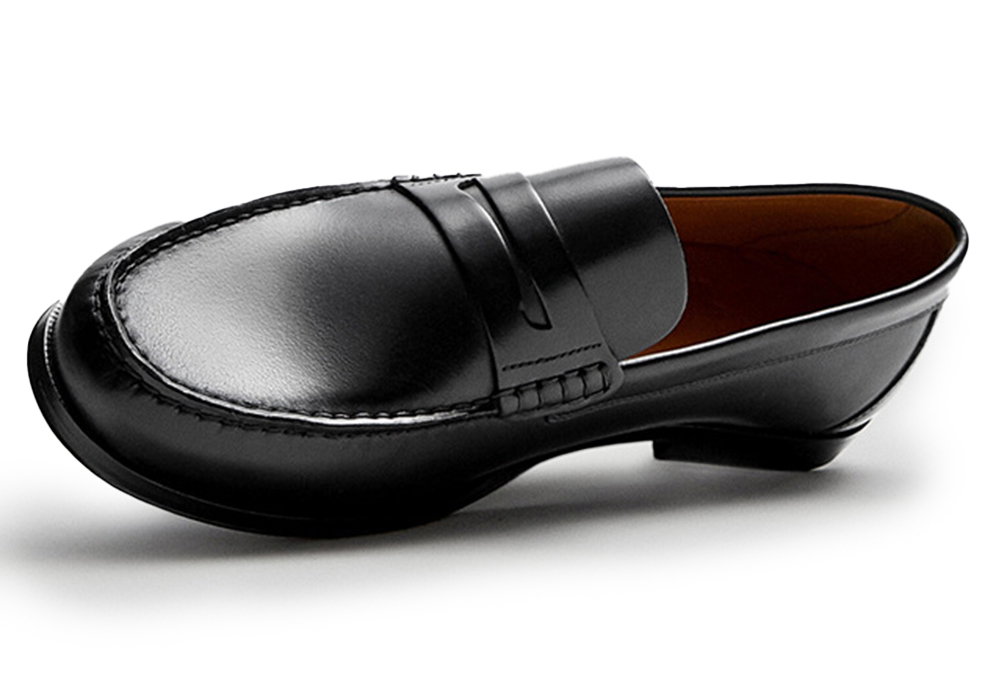
Top grain leather sits at the exact sweet spot most B2B buyers are looking for — better surface consistency than genuine leather, more accessible pricing than full grain, and a finish that photographs well for e-commerce listings. For brands targeting the $60–120 retail segment, it is the dominant material choice for a reason.
This guide breaks down everything you need to make confident sourcing decisions: how leather grades actually differ on the factory floor, what factory-direct pricing looks like by shoe type, and how to write a tech pack specification that locks in the quality you expect.
At Wincheer Shoes — a manufacturer founded in 2007, producing 500,000+ pairs annually with a defect rate of just 0.8–1.2% against an industry average of 2–4% — top grain leather accounts for the majority of Oxford, Derby, and Loafer orders from wholesale buyers across 50+ countries. The patterns in those orders reveal exactly which specs matter and which ones buyers routinely overlook.
Table of Contents
- Top Grain vs Full Grain vs Genuine: What B2B Buyers Need to Know
- Why Top Grain Dominates the $60–120 Retail Segment
- Factory-Direct Price Tiers by Shoe Type
- Leather Grade × Shoe Type × Price Comparison Table
- How to Specify Top Grain in Your Tech Pack
- Sourcing Checklist: 10 Questions Before You Place an Order
- FAQ
Top Grain vs Full Grain vs Genuine: What B2B Buyers Need to Know
Understanding leather grades is not about memorizing definitions — it is about knowing what each grade means for your product’s durability, appearance, and landed cost.
Full Grain Leather
Full grain retains the entire natural grain surface of the hide, including all the natural markings, pores, and texture variation. No sanding or buffing is applied to the surface. This produces the most durable leather available, one that develops a patina over years of wear.
For wholesale buyers, full grain commands a significant price premium — typically 30–50% more per pair at the factory level. It is best suited for premium positioning above $150 retail, heritage-style brands, or Goodyear-welted constructions where the leather’s longevity justifies the cost.
Top Grain Leather
Top grain is full grain leather with the outermost surface layer lightly sanded or buffed to remove natural imperfections — blemishes, scars, insect marks. A finish coat is then applied to create a consistent, uniform appearance.
The result is leather that looks cleaner and more consistent across a production run, which matters enormously when you are selling online and need product photos to match the physical goods. Thickness typically runs 1.2–1.8mm for shoe uppers, and the surface accepts dyes evenly, giving you reliable color consistency across hundreds of pairs.
Genuine Leather
“Genuine leather” is the most misunderstood term in the industry. It does not mean high quality — it means the material is technically made from real leather, but it is typically split leather (the lower fibrous layers separated from the grain) with a heavy polyurethane coating applied on top.
Genuine leather has a shorter lifespan, lower breathability, and a surface that tends to peel or crack under repeated flexing. For B2B buyers building a brand with repeat customers, genuine leather creates return and review problems that erode margin over time.
The table below summarizes the key differences:
| Attribute | Full Grain | Top Grain | Genuine Leather |
|---|---|---|---|
| Surface treatment | None | Light buffing + finish | Heavy PU coating |
| Consistency across run | Variable | High | Very high |
| Durability | Highest | High | Low–Medium |
| Breathability | Excellent | Good | Poor |
| Typical factory price uplift | +30–50% vs top grain | Baseline | –20–30% vs top grain |
| Best retail price point | $150+ | $60–120 | $30–60 |
Why Top Grain Dominates the $60–120 Retail Segment
The $60–120 retail bracket is where the largest volume of men’s dress and smart-casual shoes are sold globally — particularly in North America, Western Europe, and the Gulf markets. Three structural reasons explain why top grain leather shoes wholesale orders dominate this segment.
Consistent appearance at scale. When a buyer orders 300 pairs across 6 colorways, the finished goods need to look uniform. Full grain’s natural variation is a selling point for artisan brands but a quality control headache for e-commerce sellers who photograph one hero pair and ship hundreds. Top grain’s buffed and finished surface eliminates that inconsistency.
Photography and listing performance. Top grain leather reflects light evenly and holds color saturation well. On Amazon, Shopify, or Zalando listings, this translates directly to higher click-through rates. Buyers who have tested both materials consistently report that top grain product images outperform full grain in A/B tests — the surface simply looks more polished to a non-specialist consumer eye.
Margin math works. At a factory-direct price of $26–35 per pair (depending on style), a brand retailing at $89–109 achieves a 2.5–3× markup before shipping and duties. That margin supports paid acquisition, returns, and brand-building spend. Full grain at $40–55 factory direct compresses that margin to a point where the business model becomes fragile for early-stage brands.
For a deeper look at how retail price positioning connects to sourcing decisions, the complete guide to leather Oxford shoes for wholesale buyers covers the Oxford segment in detail.
Factory-Direct Price Tiers by Shoe Type
Factory-direct pricing for top grain leather shoes wholesale varies by construction method, hardware, and sole type — not just the leather grade. The ranges below reflect standard cemented construction with top grain cow leather uppers, rubber or TPR outsoles, and basic branded lining. Goodyear-welted or Blake-stitched construction adds $6–12 per pair.
Oxford Shoes — $28–35/pair
Oxfords carry a slight premium due to the closed lacing system, which requires more precise lasting and stitching. Broguing (perforations) adds minimal cost — typically $0.50–1.00 per pair — but increases perceived value significantly at retail.
Cap-toe Oxfords in black or dark brown are the highest-volume SKU in this category. Wingtip and full-brogue variants index toward the upper end of the range.
Derby Shoes — $26–32/pair
Derbies have an open lacing system that is slightly easier to construct, bringing the price floor down by $2–3 compared to Oxfords. They also have broader consumer appeal for smart-casual positioning, which makes them a strong entry point for new private label brands.
Plain-toe and cap-toe Derbies in tan and cognac are the fastest-moving colorways in European and Middle Eastern markets.
Loafers — $24–30/pair
Loafers eliminate the lacing hardware entirely and use a slip-on construction. Penny loafers and tassel loafers are the two most common styles. The lower hardware cost and simpler construction bring the price floor down, making loafers the most accessible entry point for top grain leather shoes wholesale orders.
Horsebit loafers require metal hardware sourced separately and typically land at $28–32 depending on hardware quality.
Chelsea Boots — $30–38/pair
Chelsea boots require elastic gusset panels and a higher shaft, which adds material and labor cost. They are the strongest-performing style in UK, Australian, and Scandinavian markets. Top grain leather Chelsea boots at $30–38 factory direct retail comfortably at $95–130.
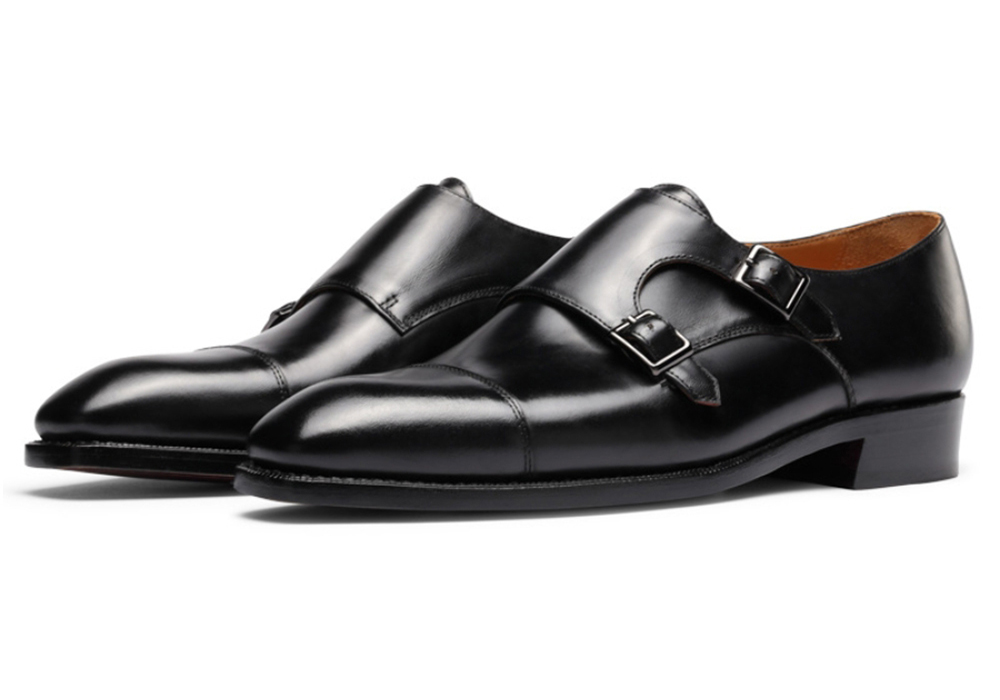
Monk Strap Shoes — $27–34/pair
Single-monk straps sit at the lower end; double-monk straps add $2–4 for the additional buckle hardware. Monk straps have seen consistent growth in Southern European and Southeast Asian wholesale orders over the past three years.
For a full breakdown of monk strap sourcing considerations, see the monk strap shoes complete style guide for B2B buyers and retailers.
Leather Grade × Shoe Type × Price Comparison Table
This table consolidates factory-direct pricing across leather grades and shoe types to give buyers a single reference point for budget planning. All prices assume MOQ of 60 pairs per style for custom orders, cemented construction, standard packaging.
| Shoe Type | Genuine Leather | Top Grain Leather | Full Grain Leather | Suggested Retail (Top Grain) |
|---|---|---|---|---|
| Oxford | $18–22 | $28–35 | $42–52 | $79–119 |
| Derby | $16–20 | $26–32 | $38–48 | $69–109 |
| Loafer | $15–19 | $24–30 | $36–46 | $65–99 |
| Chelsea Boot | $20–25 | $30–38 | $45–55 | $89–130 |
| Monk Strap | $17–21 | $27–34 | $40–50 | $75–115 |
| Casual Walking | $14–18 | $22–28 | $34–44 | $59–89 |
Prices are FOB Guangzhou. Shipping, duties, and local taxes are additional. See the FOB shoe pricing guide covering 4 Incoterms for landed cost calculations.
How to Specify Top Grain in Your Tech Pack
A vague material spec is the single most common reason buyers receive goods that do not match their expectations. “Top grain leather” written alone on a purchase order is not a specification — it is a category. Here is how to write a spec that protects you.
1. Leather Thickness
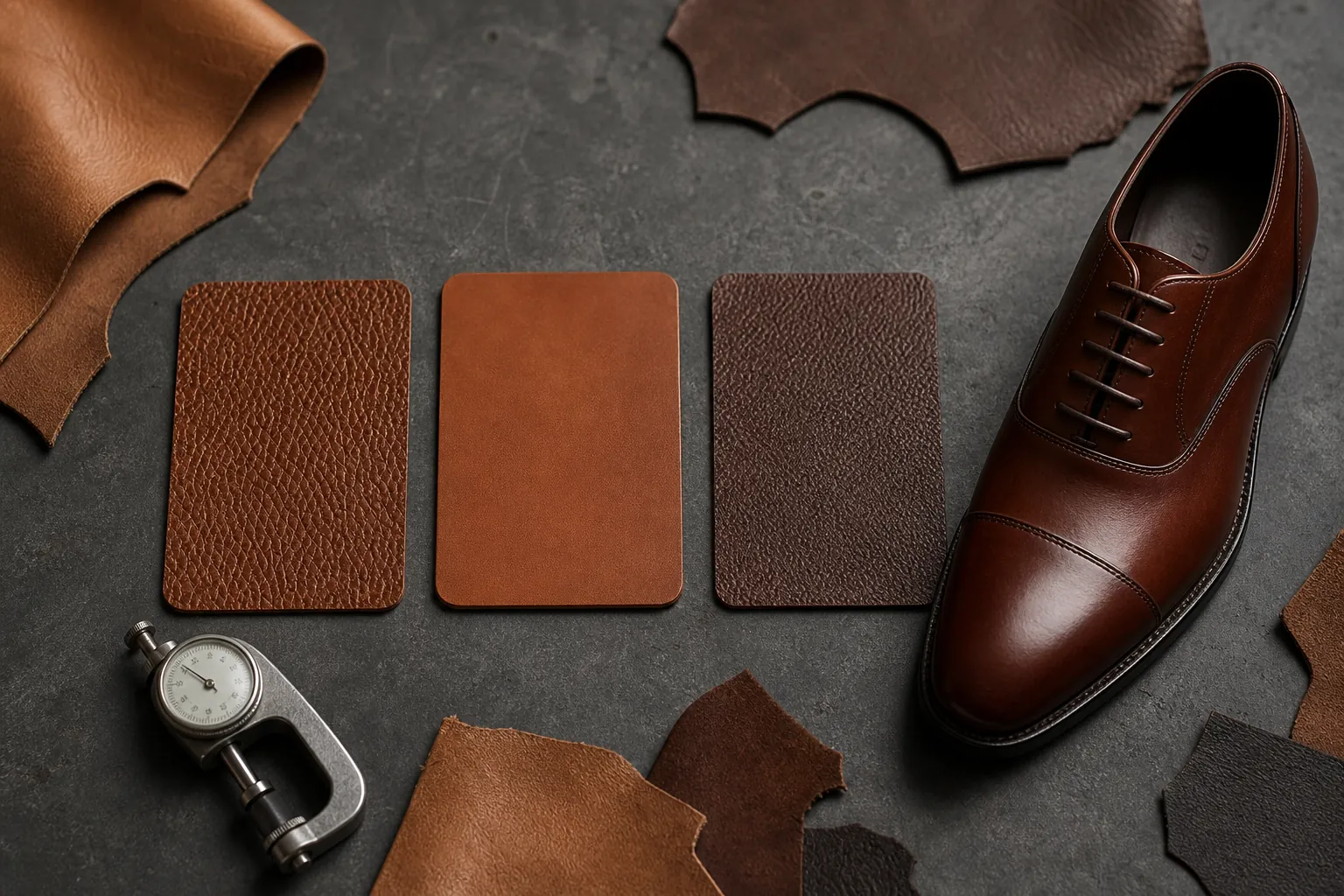
Specify thickness in millimeters, not qualitative terms. For dress shoe uppers, the standard range is 1.2–1.6mm. For Chelsea boot shafts, 1.0–1.4mm is typical to allow flex. Require the factory to provide a thickness gauge reading on the pre-production sample.
2. Finish Type
Top grain leather can be finished in several ways:
- Aniline finish — thin dye coat, more natural look, less scuff resistance
- Semi-aniline finish — light pigment coat over aniline, balances aesthetics and durability
- Full pigment finish — opaque coating, maximum consistency and scuff resistance, less breathable
For wholesale buyers targeting the $70–110 retail segment, semi-aniline or full pigment finish is recommended. It survives shipping, warehousing, and customer handling without surface damage.
3. Hide Origin and Tannage
Specify the tannage method: chrome-tanned (softer, more consistent, faster production) or vegetable-tanned (firmer, develops patina, longer production lead time). For most top grain leather shoes wholesale orders, chrome-tanned is the default and is appropriate for the price point.
Hide origin matters for compliance in certain markets. EU buyers should confirm REACH compliance — specifically restrictions on chromium VI (Cr VI) content. For a deeper comparison of tannage methods, vegetable tanned vs chrome tanned leather for shoes covers the trade-offs in full.
4. Color Standard
Provide a physical color swatch or a Pantone reference. Do not rely on digital color matching alone — screens vary, and leather absorbs dye differently than fabric. Request a pre-production leather strike-off (a small dyed leather sample) before bulk cutting begins.
5. Certification Requirements
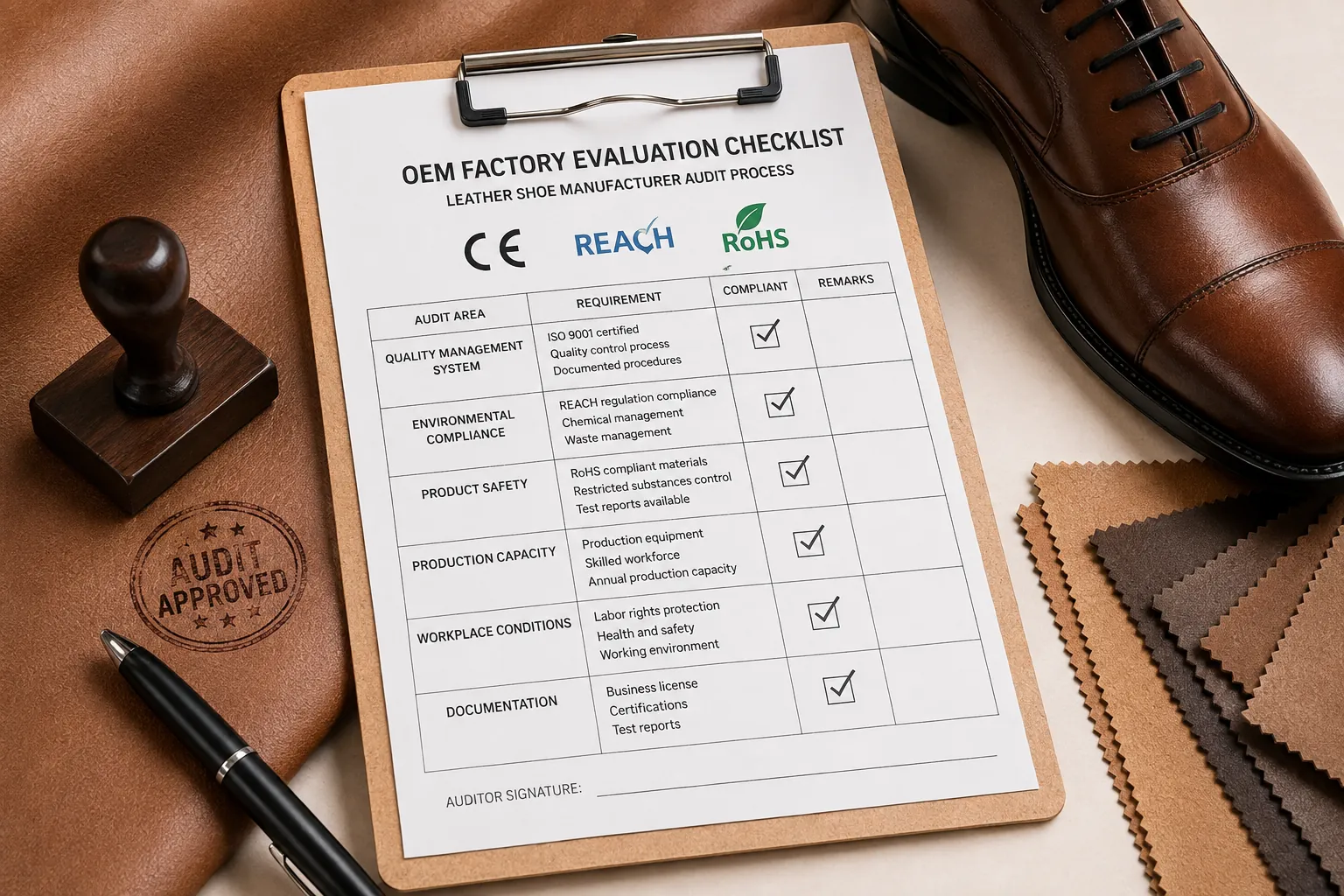
If selling into the EU, confirm the factory holds CE marking under EN ISO 20347 and that materials meet REACH chemical restrictions. These are not optional for EU market entry — they are legal requirements that customs can enforce at the border.
6. AQL Inspection Standard
Specify AQL 2.5 for major defects and AQL 4.0 for minor defects in your purchase order. This gives you a contractual basis for rejection if the factory ships non-conforming goods. Without a stated AQL, you have limited recourse.
Sourcing Checklist: 10 Questions Before You Place an Order
Use this checklist before committing to any top grain leather shoes wholesale order:
- [ ] Has the factory provided a leather spec sheet confirming grade, thickness, and tannage?
- [ ] Is the leather finish specified (aniline / semi-aniline / full pigment)?
- [ ] Have you received a physical pre-production sample, not just photos?
- [ ] Does the factory hold relevant certifications (CE, REACH, RoHS) for your target market?
- [ ] Is the defect rate documented in writing (ask for last 6 months’ QC data)?
- [ ] Are payment terms clearly stated (30% deposit, 70% before shipment is standard)?
- [ ] Is the MOQ per style or per color? (These are different numbers — confirm explicitly.)
- [ ] What is the lead time from order confirmation to FOB ready?
- [ ] Is the factory’s main production facility located where they claim? (Request a video call walkthrough.)
- [ ] Have you confirmed the Incoterm and who is responsible for export customs clearance?
For a broader look at sourcing risks, the red flags when sourcing leather shoes from China checklist covers the warning signs that experienced buyers watch for.
FAQ
Q: What is the minimum order quantity for top grain leather shoes wholesale?
A: MOQ varies by factory and order type. For existing catalog designs, some factories offer zero MOQ for sampling and small test orders. For custom designs with your own branding, 60 pairs per style is a common minimum. Always confirm whether MOQ applies per style, per colorway, or per size run — the answer changes your actual commitment significantly.
Q: How do I verify that a factory is actually using top grain leather and not genuine leather?
A: Request a pre-production leather sample (a cut piece, not a finished shoe) and have it tested by a third-party lab. Key tests include surface abrasion resistance, flex endurance, and Cr VI content. Visual inspection alone is not reliable — a heavy pigment finish on genuine leather can look identical to top grain in photos. Third-party inspection services like SGS or Bureau Veritas can conduct factory-floor material verification.
Q: What is the typical lead time for a top grain leather shoes wholesale order?
A: For existing designs with standard materials, 30–45 days from order confirmation to FOB ready is typical. For custom designs requiring new lasts, new molds, or custom leather colors, add 15–20 days for pre-production development. Peak season (August–October for Q4 delivery) can add 10–15 days to standard lead times. Always confirm your target ship date with the factory at order placement.
Q: What is the lead time for top grain leather shoes?
A: Standard production runs 30–45 days for catalogue styles. Custom orders with new lasts, proprietary colors, or Goodyear-welted construction take 50–65 days. Pre-production sampling adds 7–14 days before bulk production begins. Rush orders under 200 pairs can sometimes be accommodated in 25–30 days depending on factory capacity.
Q: Can I request a leather sample before placing a bulk order?
A: Yes. Reputable factories provide leather strike-off samples (small dyed pieces) and pre-production shoe samples before bulk production. Strike-offs typically take 5–7 days and cost $20–50 per colorway. Full pre-production samples take 10–14 days and cost $80–150 per pair, which is refundable against your first bulk order at most factories. Always request a physical sample rather than relying on photos — color and texture vary significantly on screen.
Ready to Start Your Shoe Line?
If you are ready to source top grain leather shoes at factory-direct prices of $25–$40 per pair, Wincheer Shoes offers a streamlined process from sample to shipment. With 19 years of manufacturing experience, CE/REACH/RoHS certifications, and a defect rate of just 0.8–1.2%, we help B2B buyers and private label brands launch profitable shoe lines with confidence.
Request a free sample or quote today at wincheershoes.com and get your first order into production within 48 hours of approval.