Your product quality is locked in at the factory. But your customer’s first physical experience with your brand happens the moment they touch the box.
For B2B buyers, private label brands, and cross-border e-commerce sellers, leather shoes packaging custom branding is not a cosmetic afterthought — it is a revenue lever. The right box lifts perceived value, reduces return rates, and turns a first-time buyer into a repeat customer.
This guide covers everything: box types, print finishes, inner packaging components, MOQ realities, and a design checklist you can hand directly to your supplier.
Leather Shoes Packaging Custom Branding Guide: Table of Contents
- Why Packaging Is a Marketing Asset, Not a Cost Center
- Shoe Box Types: Structure, Cost, and Use Cases
- Custom Printing Options for Shoe Boxes
- Inner Packaging: What Goes Inside the Box
- MOQ and Cost Breakdown for Custom Packaging
- Packaging Design Checklist for B2B Buyers
- Packaging Tier Comparison Table
- FAQ
- Ready to Start Your Shoe Line?
Why Packaging Is a Marketing Asset, Not a Cost Center
The unboxing moment is your brand’s handshake. In an era where customers post unboxing videos and screenshot product arrivals, a plain brown box signals that you stopped caring the moment the shoes left the factory.
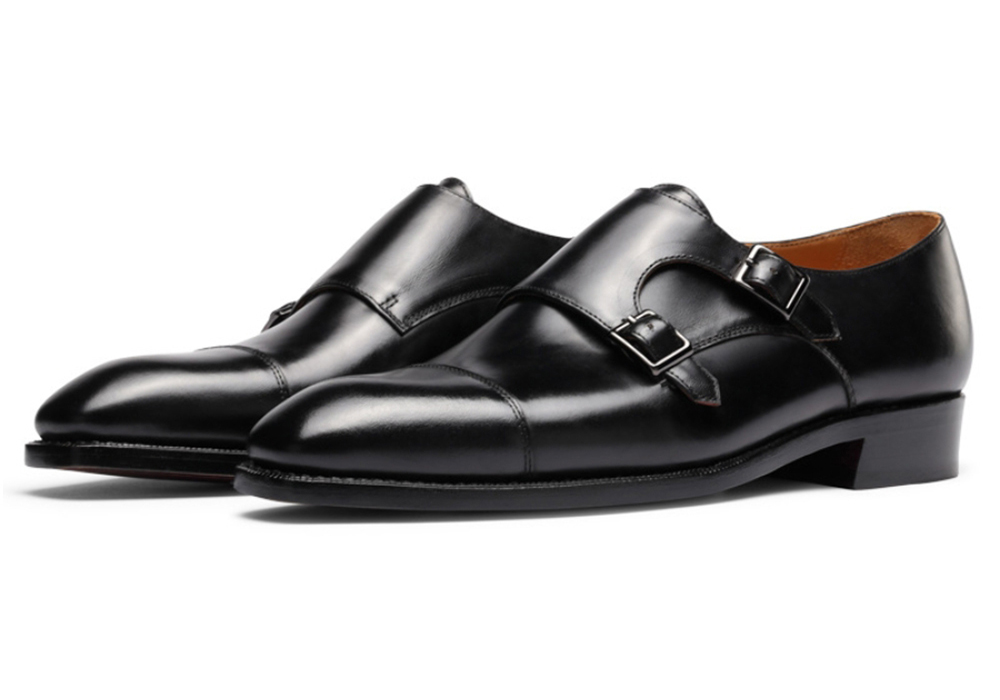
For leather dress shoes — Oxfords, Derbies, Monk Straps, Chelsea Boots — the packaging must match the product’s price positioning. A $120 retail Oxford in a flimsy generic box creates cognitive dissonance. The customer questions the quality before they even try the shoe on.
At Wincheer Shoes, a manufacturer founded in 2007 producing 500,000+ pairs annually across 50+ countries, the packaging specification is treated as part of the product brief — not a separate conversation. With a defect rate of 0.8–1.2% (versus an industry average of 2–4%), the physical product quality is already above benchmark. The packaging strategy is what communicates that quality before the lid comes off.
For private label brands especially, your shoe box is the only brand touchpoint you fully control in the supply chain. Invest in it accordingly.

Shoe Box Types: Structure, Cost, and Use Cases
Standard Folding Carton (Tuck-End Box)
This is the most common format in the industry. It ships flat, assembles quickly on the production line, and costs the least to manufacture and freight.
- Material: 350–450gsm coated board or kraft
- Cost range: $0.80–$1.50 per unit (unprinted base, 1,000+ units)
- Best for: Mid-tier wholesale, high-volume SKUs, markets where retail packaging is reboxed at point of sale
- Weakness: Lower perceived value; corners can crush under stack pressure
Rigid Setup Box (Lift-Off Lid)
A rigid box uses a chipboard core wrapped in printed paper or fabric. It does not fold flat, which increases freight cost, but it signals premium quality immediately.
- Material: 1,200–2,000gsm greyboard with wrap paper
- Cost range: $2.50–$4.50 per unit
- Best for: Premium retail, gift sets, D2C brands with $100+ retail price points
- Weakness: Higher per-unit cost; larger cubic volume increases shipping fees
Magnetic Closure Box
A hybrid of the rigid format, the magnetic closure box uses embedded magnets in the lid flap for a satisfying, tactile open experience. It has become the default format for luxury footwear brands.
- Material: Rigid greyboard with magnetic strip insert
- Cost range: $3.50–$6.00 per unit
- Best for: High-end private label, gift packaging, limited edition runs
- Weakness: Highest cost; magnets can occasionally interfere with RFID tags if used in retail
Shoebox Drawer (Sliding Box)
A sleeve-and-tray format where the inner tray slides out of an outer sleeve. Popular in European markets for mid-to-premium positioning.
- Cost range: $2.00–$3.50 per unit
- Best for: Boutique retail, subscription box formats
Custom Printing Options for Shoe Boxes
The print finish you choose determines how your brand reads at shelf or on camera. Each technique has a different cost profile and minimum run requirement.
Offset Lithographic Printing
The workhorse of packaging print. Offset delivers consistent, high-resolution CMYK color across large runs at the lowest cost per unit.
- Best for: Full-color brand imagery, photographic elements
- Cost impact: Minimal above base box cost at 1,000+ units
- Limitation: Requires plate setup fee ($150–$400 per color); not cost-effective below 500 units
Foil Stamping
A metallic foil (gold, silver, rose gold, holographic) is heat-pressed onto the surface. The result is a reflective logo or pattern that photographs exceptionally well.
- Best for: Logo accent on rigid or magnetic boxes, brand name on lid
- Cost impact: Adds $0.20–$0.60 per unit depending on foil area
- Limitation: Foil does not work well on heavily textured surfaces
UV Spot Coating
A clear UV-cured lacquer is applied selectively over specific design elements — typically a logo or pattern — creating a gloss-on-matte contrast effect.
- Best for: Subtle luxury effect without metallic finish
- Cost impact: Adds $0.15–$0.40 per unit
- Limitation: Effect is less visible under warm or dim lighting
Embossing and Debossing
The board is pressed with a die to create a raised (emboss) or recessed (deboss) tactile effect. No ink or foil required — the effect is purely dimensional.
- Best for: Brand logos on rigid boxes, minimalist premium aesthetics
- Cost impact: Adds $0.25–$0.50 per unit; die cost $80–$200 one-time
- Limitation: Works best on flat, uncoated surfaces; detail is limited by board thickness
Combination Finishes
Most premium shoe brands combine techniques: matte lamination base + foil stamp logo + UV spot pattern. The combined cost adds $0.50–$1.20 per unit but produces packaging that retails at 2–3x the perceived value of a standard box.
Inner Packaging: What Goes Inside the Box
The exterior box gets the customer to open. The interior packaging closes the sale emotionally.
Tissue Paper
Acid-free tissue paper wrapped around each shoe is the baseline inner packaging for any leather product. It prevents scuffing during transit and signals care.
- Custom option: Print your brand name or pattern in one color
- Cost: $0.05–$0.15 per sheet; custom print adds $0.03–$0.08 per sheet
- Recommendation: Use at minimum two sheets per shoe (four total per pair)
Dust Bag
A non-woven or cotton drawstring bag protects the shoe during storage and signals long-term product value. Customers keep dust bags — which means your brand stays visible after the box is discarded.
- Custom option: Woven label or screen print with logo
- Cost: $0.30–$0.80 per bag (non-woven); $0.80–$2.00 (cotton with woven label)
Silica Gel Packets
Essential for leather shoes shipped in humid conditions or stored in warehouses. A 3–5g silica gel packet per box prevents mold and moisture damage to the leather upper and insole.
- Cost: $0.02–$0.05 per packet
- Compliance note: Some markets require food-safe labeling on silica packets even in non-food products; confirm with your freight forwarder
Shoe Trees (Paper or Wood)
Paper shoe trees (stuffed kraft paper or molded paper pulp) maintain the toe box shape during transit. Cedar wood shoe trees are a premium add-on that customers genuinely value.
- Paper stuffing: $0.08–$0.15 per pair
- Molded paper tree: $0.20–$0.40 per pair
- Cedar shoe tree: $1.50–$3.50 per pair (significant perceived value add for premium SKUs)
Care Card and Brand Insert
A printed care card (leather conditioning instructions, brand story, QR code to reorder) costs $0.05–$0.15 per unit and extends the brand relationship beyond the purchase moment.
MOQ and Cost Breakdown for Custom Packaging
One of the most common friction points for new private label brands is packaging MOQ. Here is the realistic picture for 2026 China-sourced custom packaging.
Standard MOQ ranges by box type:
- Folding carton (custom print): 500–1,000 units
- Rigid setup box: 500–1,000 units
- Magnetic closure box: 500–1,000 units
Total landed cost per box (including print, no inner components):
- Basic folding carton, offset print: $1.50–$2.20
- Rigid box, matte lamination + foil stamp: $3.00–$4.50
- Magnetic closure, full finish: $4.00–$6.00
Lead time: 18–25 working days for first production run after artwork approval. Reorders typically 12–15 working days.
Key cost driver: Plate and die setup fees are one-time charges. On a 500-unit first run, setup fees can add $0.40–$0.80 per unit. On a 2,000-unit reorder, that cost drops to $0.10–$0.20 per unit. Scale matters.
For buyers sourcing shoes with a $25–$40 FOB factory price, allocating $2.00–$4.00 per unit to packaging is a standard and defensible margin decision — especially when the packaging supports a $90–$150 retail price point.
Packaging Design Checklist for B2B Buyers
Use this checklist before submitting artwork to your packaging supplier. Missing any of these elements causes production delays or compliance failures.
Brand Identity Elements
- Logo in vector format (AI, EPS, or PDF), minimum 300 DPI for raster elements
- Pantone color codes confirmed (do not rely on RGB or screen color for print matching)
- Brand tagline or secondary text confirmed in final language
Regulatory and Retail Compliance
- Country of origin statement (“Made in China” or equivalent) on base or side panel
- Barcode (EAN-13 for EU/Asia; UPC-A for North America) placed on base panel, minimum 80% magnification
- Size label placement confirmed (EU sizing, US sizing, or dual-label)
- CE marking placement if selling into EU markets (confirm with your compliance consultant)
- REACH/RoHS compliance statement if required by destination market
Structural Specifications
- Box dimensions confirmed against shoe last size range (allow 10–15mm clearance per side)
- Grain direction specified for folding carton (affects fold quality and box strength)
- Inner packaging components listed and dimensioned
Print Specifications
- Bleed area: minimum 3mm on all edges
- Safe zone: all critical text and logos minimum 5mm from trim line
- Finish specified per panel (e.g., matte lamination exterior, gloss interior lid)
- Foil or emboss die artwork submitted as separate file
Sampling Protocol
- Physical sample approved before bulk production
- Color-match proof (wet proof or digital proof) signed off
- Structural drop test conducted on sample (drop from 1m height on all six faces)
Packaging Tier Comparison Table
| Packaging Tier | Box Type | Print Finish | Inner Packaging | Cost per Unit (FOB) | MOQ | Perceived Value |
|---|---|---|---|---|---|---|
| Economy | Folding carton | Offset CMYK | Tissue paper only | $1.50–$2.20 | 500 | ★★☆☆☆ |
| Mid-Range | Folding carton | Matte lam + foil logo | Tissue + dust bag | $2.50–$3.50 | 500–1,000 | ★★★☆☆ |
| Premium | Rigid setup box | Matte lam + foil + UV spot | Tissue + dust bag + paper tree | $4.00–$5.50 | 500–1,000 | ★★★★☆ |
| Luxury | Magnetic closure | Matte lam + foil + emboss | Tissue + cotton dust bag + cedar tree + care card | $6.00–$8.50 | 500–1,000 | ★★★★★ |
Decision rule: Match your packaging tier to your retail price point. A product retailing below $70 rarely justifies luxury packaging. A product retailing above $120 almost always benefits from premium or luxury tier — the packaging cost is recovered in reduced return rates and higher repeat purchase rates.
For buyers who want to understand how packaging integrates with the full private label launch process, the Private Label Shoes 10 Step Brand Launch Guide Shoe Manufacturer Guide covers the complete workflow from factory selection to first shipment.
If you are evaluating the cost structure of your full order — including FOB pricing, Incoterms, and landed cost — the FOB Shoe Pricing Guide: 4 Incoterms Compared Shoe Manufacturer Guide is a practical reference.
For buyers targeting EU markets, CE certification requirements affect both the product and the packaging labeling. The CE Marking Footwear 2026 EU Certification Guide Shoe Manufacturer Guide explains exactly what must appear on the box.
For quality control standards that apply to both product and packaging inspection, the AQL Inspection Footwear: Top 5 Quality Control Tips Leather Footwear Quality Standards provides the inspection framework most buyers use.
The ISO 11469 standard for plastics identification https://www.iso.org/standard/19330.html – SATRA Footwear Technology is also relevant if your packaging includes any plastic components (dust bag closures, box inserts) destined for EU markets with extended producer responsibility regulations.
FAQ
Q: What is the minimum order quantity for custom leather shoes packaging?
A: For most China-based packaging suppliers, the MOQ for custom printed shoe boxes is 500–1,000 units per SKU. Rigid and magnetic closure boxes typically start at 500 units. Some suppliers offer 300-unit runs for folding cartons, but setup costs per unit rise significantly below 500 units.
Q: How do I ensure my Pantone colors print accurately on shoe boxes?
A: Always request a physical color proof (wet proof) before approving bulk production. Digital proofs are useful for layout review but do not accurately represent Pantone color on the actual substrate. Confirm Pantone codes with your supplier in writing, and specify whether you are using coated (C) or uncoated (U) references — the difference on matte-laminated board versus uncoated kraft is significant. For first orders, budget $200–$400 for proofing costs.
Q: How much does custom shoe packaging add to my total per-pair cost?
A: It depends on your tier. A basic custom-printed folding carton adds $1.50–$2.20 per pair. A fully finished rigid box with foil stamping, dust bag, and care card adds $4.00–$6.00 per pair. For shoes with a $25–$40 FOB price and $90–$150 retail, allocating $2.00–$4.00 per pair to packaging is a standard and defensible margin decision — the perceived value increase typically justifies the cost.
Q: Can the shoe factory produce custom packaging, or do I need a separate packaging supplier?
A: Most established shoe factories in China work with dedicated packaging suppliers and can manage the entire process — box design, printing, and assembly — as part of your order. This is more efficient than sourcing packaging independently because the factory coordinates lead times and ensures boxes fit the product. At Wincheer, packaging specifications are part of the product brief and managed in-house through our partner print facilities.
Q: What information must appear on a shoe box for EU market compliance?
A: For EU markets, shoe boxes must display: country of origin (“Made in China”), size labeling (EU sizing), CE marking if the product is classified as occupational footwear under EN ISO 20347, and a REACH compliance statement. Barcode (EAN-13) placement on the base panel is standard for retail. Always confirm current requirements with your compliance consultant, as labeling regulations can change.