
META:
Title: Shoe Manufacturer China: Complete B2B Buyer’s Guide 2026
Description: Find a reliable shoe manufacturer China with this 2026 B2B guide. Compare factories, certifications, MOQ, pricing & quality. Get quotes today.
URL Slug: shoe-manufacturer-china-b2b-buyers-guide
Target Keyword: shoe manufacturer China
LSI Keywords: China leather shoe factory, OEM shoe manufacturer, private label shoes China, wholesale shoe supplier China, men’s dress shoe manufacturer, CE certified shoe factory, shoe sourcing China
Shoe Manufacturer China: Complete B2B Buyer’s Guide 2026
A reliable shoe manufacturer China shortlist starts with three non-negotiable filters: MOQ flexibility (60 pairs for custom), certified defect rates below 1.2%, and verifiable export credentials.
TL;DR
- A tier-one shoe manufacturer China operates with a defect rate of 0.8–1.2%, versus the industry average of 2–4% — that gap directly determines your return rate.
- MOQ starts at 0 pairs on existing catalog designs and 60 pairs for custom OEM orders at leading factories.
- Ex-factory pricing for genuine leather men’s dress shoes runs $25–$40/pair depending on construction, leather grade, and order volume.
- Certifications to demand before signing: CE (EN ISO 20347), REACH, and RoHS — these cover EU, UK, and most APAC market entry.
- China exports footwear to 50+ countries through established factories, with annual outputs exceeding 500,000 pairs at the top tier.
Table of Contents
- Why China Remains the Dominant Source for B2B Shoe Buyers
- How to Evaluate a Shoe Manufacturer China: The 5-Layer Framework
- Certifications Every Shoe Manufacturer China Must Hold
- Pricing, MOQ, and Payment Terms Decoded
- Red Flags and Quality Control Checkpoints
- Comparison Table: Sourcing Regions for Men’s Leather Shoes
- B2B Buyer’s Verification Checklist
- FAQ
- Ready to Start Your Shoe Line?

1. Why China Remains the Dominant Source for B2B Shoe Buyers
China produces roughly 57% of the world’s footwear — and for B2B buyers, that concentration of supply chain infrastructure is impossible to replicate elsewhere at comparable price-to-quality ratios.
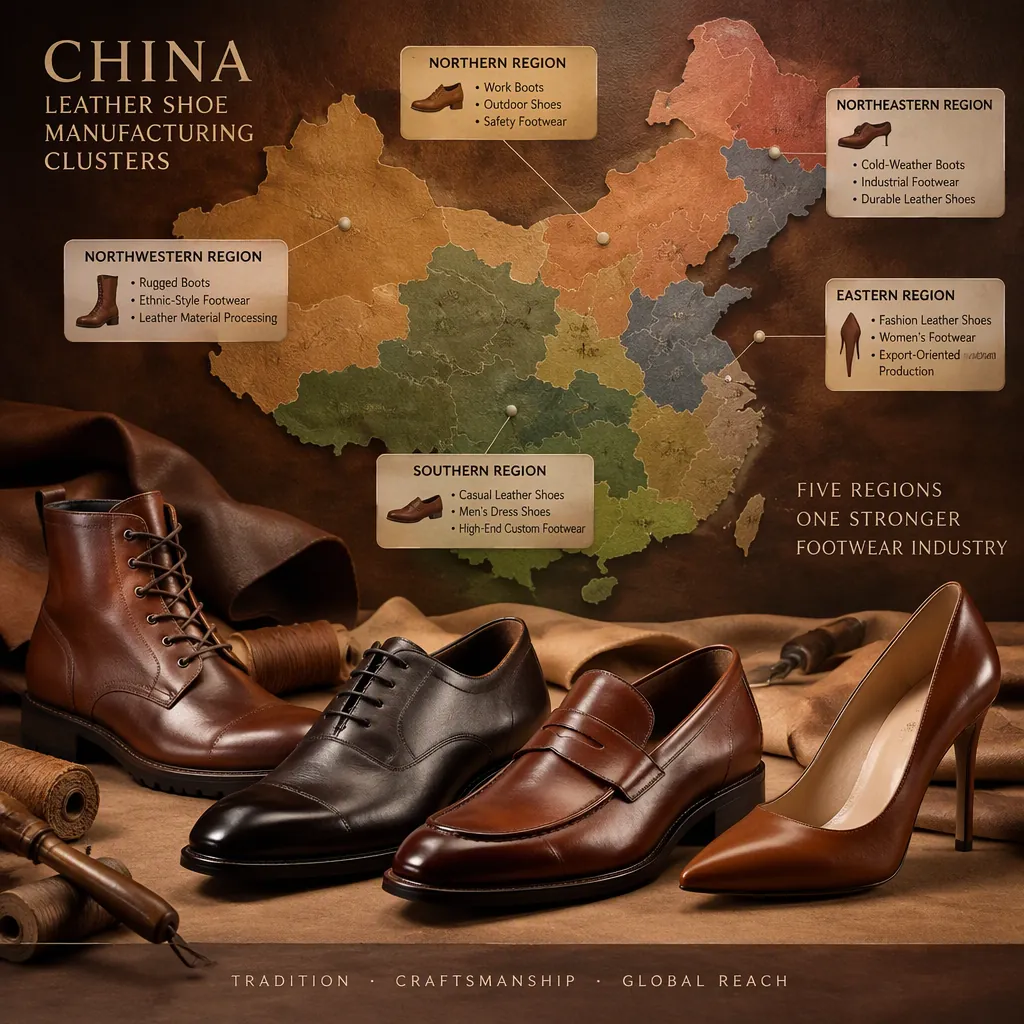
The Guangzhou–Dongguan corridor alone houses thousands of tanneries, component suppliers, last-makers, and finishing houses within a 100 km radius. That proximity compresses lead times and keeps per-unit costs structurally lower than competing regions like Vietnam or Bangladesh for mid-to-premium leather dress shoes.
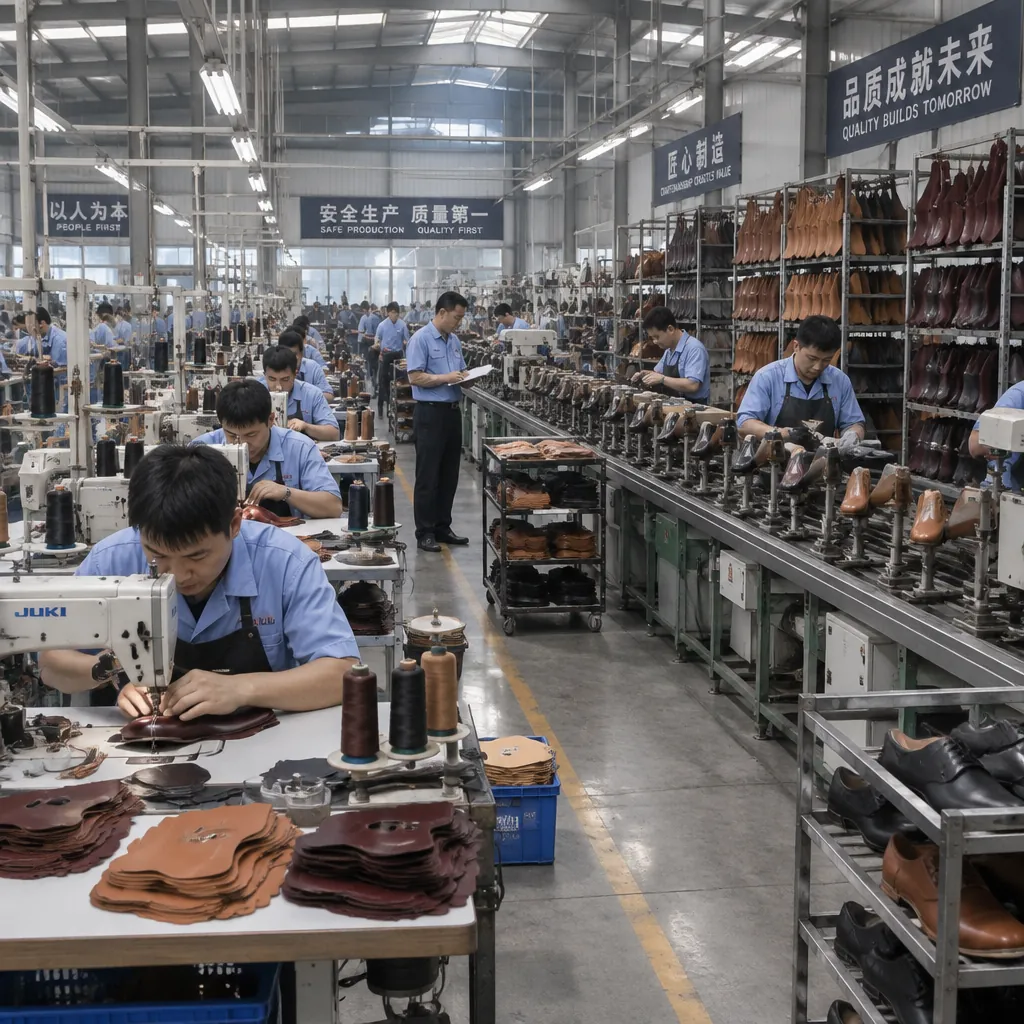
Wincheer Shoes, founded in 2007 with its main factory in Guangzhou and HQ in Shanghai, is a practical example of how this ecosystem works at scale: 500,000+ pairs annually, $25–$40/pair ex-factory, and a verified defect rate of 0.8–1.2% — achieved because every upstream input (leather, hardware, insoles) is sourced within the same industrial cluster.
For private label brands and cross-border e-commerce sellers, this means faster sampling, tighter revision cycles, and a single point of accountability from raw hide to finished carton.
2. How to Evaluate a Shoe Manufacturer China: The 5-Layer Framework
The right shoe manufacturer China is identified through five sequential filters — skip any one and you introduce unacceptable sourcing risk.
Layer 1: Legal Entity Verification
Request the manufacturer’s Business License (营业执照) and cross-check it against China’s National Enterprise Credit Information Publicity System. The registered business scope must explicitly include footwear manufacturing — not just trading.
A trading company posing as a factory is the single most common sourcing mistake B2B buyers make. Factories have equipment lists, worker headcounts, and production floor photos with verifiable timestamps. Trading companies do not.
Layer 2: Production Capacity Audit
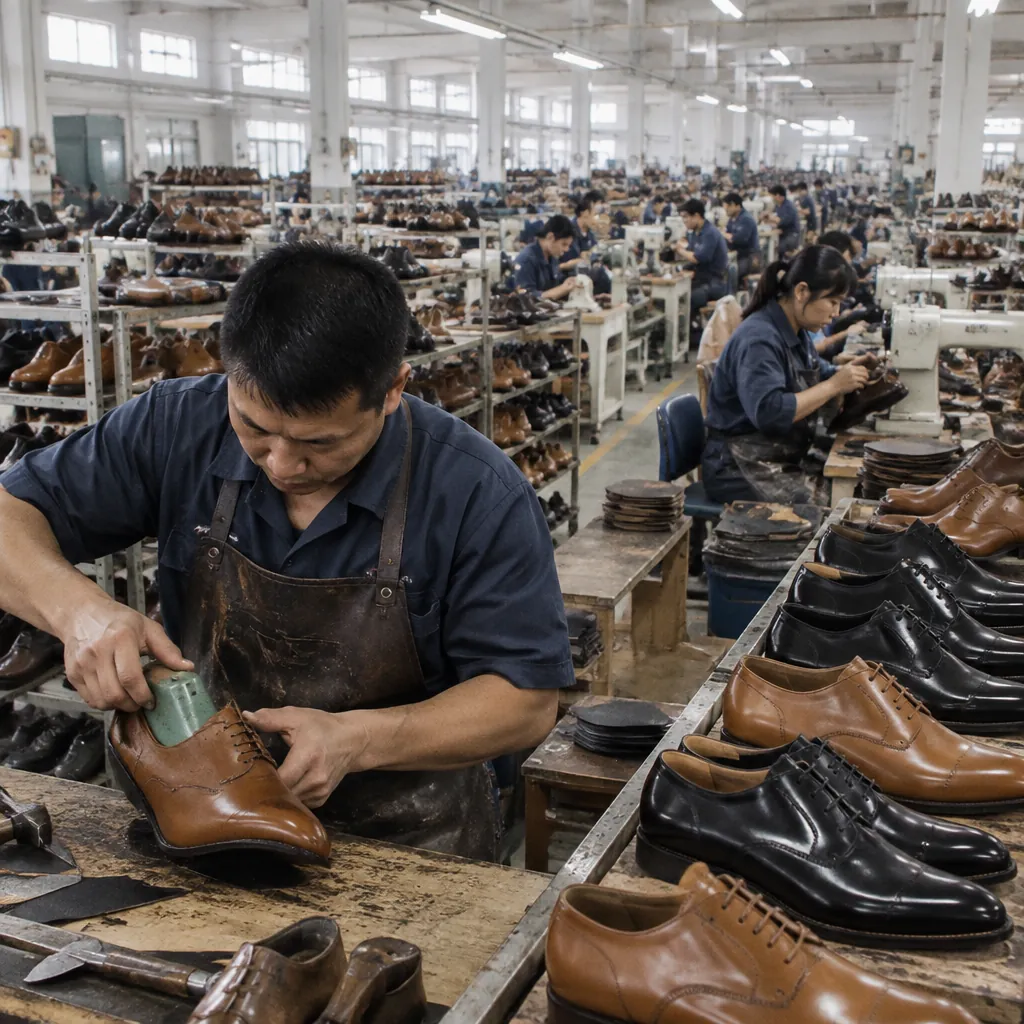
Annual output figures tell you whether a supplier can absorb your volume without subcontracting. A factory producing 500,000+ pairs annually has the line capacity to handle orders from 60 pairs to 50,000+ pairs without routing your work to an unvetted third party.
Ask for a capacity utilization schedule. If they refuse, treat it as a red flag.
Layer 3: Sample Quality Benchmark
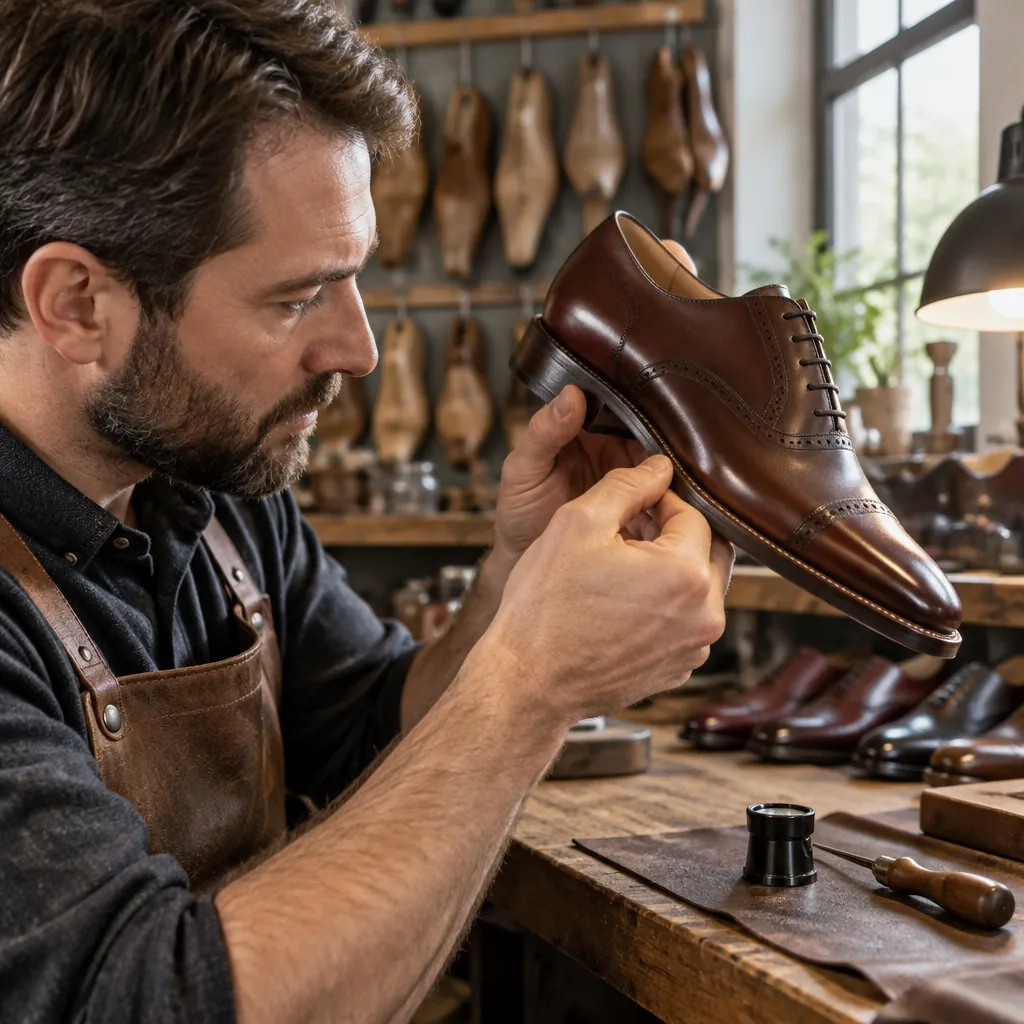
Order a paid sample run of 2–3 styles before committing to production. Evaluate stitching density (minimum 8 stitches per 10 mm on uppers), lasting tension uniformity, and insole adhesion pull strength.
Document every defect with photos and timestamps. A professional factory will respond with a corrective action report (CAR) within 5 business days.
Layer 4: Certification Stack
Certifications are not marketing collateral — they are legal prerequisites for market entry. The minimum stack for a shoe manufacturer China targeting EU or US markets is covered in detail in Section 3.
Layer 5: Commercial Terms Alignment
MOQ, payment structure, lead time, and IP protection clauses must all be negotiated before sampling begins. Factories that resist signing an NDA before sharing technical specs are not suitable for private label work.
3. Certifications Every Shoe Manufacturer China Must Hold
Certification depth is the fastest proxy for factory maturity — a shoe manufacturer China without CE, REACH, and RoHS documentation cannot legally sell into the EU, and increasingly cannot sell into GCC or APAC markets either.
CE Marking (EN ISO 20347)
The CE marking for footwear under EN ISO 20347 covers occupational footwear safety standards. For men’s leather dress shoes sold into the EU, CE certification is a hard legal requirement, not optional.
Verify the certificate number against the issuing notified body’s registry. Certificates that cannot be cross-referenced are fabricated.
REACH Compliance
REACH (Registration, Evaluation, Authorisation and Restriction of Chemicals) governs hazardous substance limits in leather, adhesives, and dyes. Non-compliance triggers customs seizure and brand liability in all 27 EU member states.
Request the full REACH test report, not just a declaration of conformity. The test report will list specific substance concentrations — azo dyes, chromium VI, formaldehyde — against the regulatory thresholds.
RoHS
RoHS applies primarily to hardware components (buckles, eyelets, zippers) that contain electronic or metallic elements. It is increasingly required by major EU and UK retailers as a condition of listing.
For a deeper breakdown of CE requirements specific to footwear exports, see the CE marking footwear 2026 EU certification guide.
4. Pricing, MOQ, and Payment Terms Decoded
Ex-factory pricing for genuine leather men’s shoes from a tier-one shoe manufacturer China runs $25–$40/pair — what moves that number is construction method, leather grade, and order size.
What Drives Price Within the $25–$40 Band
| Variable | Lower End (~$25) | Upper End (~$40) |
|---|---|---|
| Leather grade | Split leather / PU lining | Full-grain calf, leather lining |
| Construction | Cemented (glued) | Goodyear welt or Blake stitch |
| Hardware | Zinc alloy | Solid brass |
| Customization | Catalog design | Full OEM with custom last |
| Order volume | 500+ pairs per style | 60 pairs (custom MOQ) |
MOQ Structure
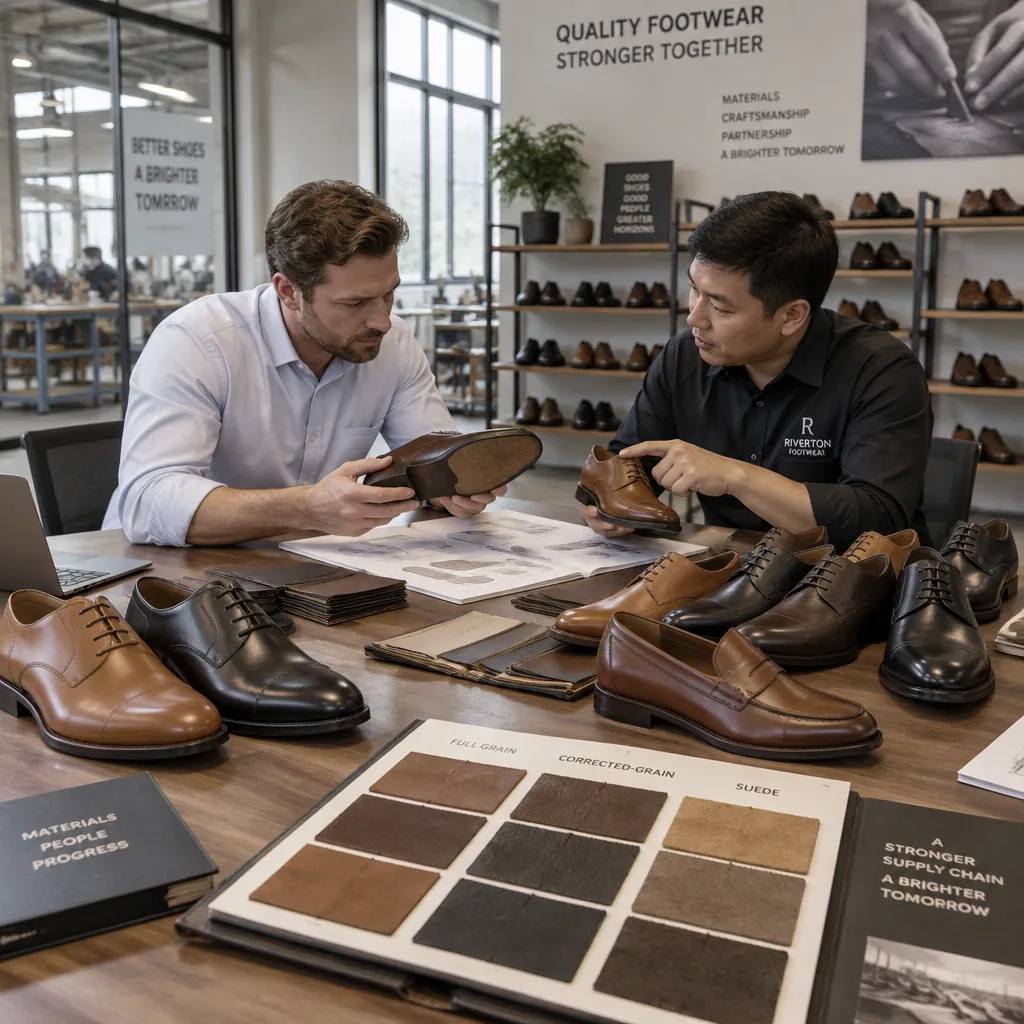
The most buyer-friendly factories offer a tiered MOQ:
- 0 pairs on existing catalog designs (test the market before committing to custom tooling)
- 60 pairs minimum for custom OEM/ODM styles with your branding, last modification, or unique upper design
This structure is particularly valuable for private label brands entering a new category or cross-border sellers testing a new market.
For a full breakdown of payment structures — T/T, L/C, and escrow options — see the payment terms for B2B leather shoe orders guide.
Standard Payment Terms
Most factories operate on 30% deposit before production, 70% balance before shipment. Buyers with established relationships (3+ orders) can negotiate 30/70 with the balance due after third-party inspection sign-off.
Never pay 100% upfront. Never accept a factory that refuses T/T or insists on Western Union for amounts above $2,000.
5. Red Flags and Quality Control Checkpoints
Quality failures from a shoe manufacturer China are almost always predictable — they show up in pre-production signals that most buyers ignore.
Pre-Production Red Flags
- Factory cannot provide an itemized Bill of Materials (BOM) for your style
- Sample turnaround exceeds 21 days with no explanation
- No dedicated QC staff on the production floor (ask for org chart)
- Refuses to allow third-party inspection during production
In-Production Quality Checkpoints
Run an AQL 2.5 inspection at three stages: after lasting (upper shape), after sole attachment (adhesion test), and after finishing (cosmetic and packaging). AQL 2.5 at a 500-pair order size means inspecting 50 pairs with a maximum of 3 major defects allowed before the lot is rejected.
For a detailed inspection protocol, the AQL inspection footwear top 5 quality control tips article covers the exact sampling tables and defect classification system.
Post-Shipment Defect Benchmarks
A defect rate of 0.8–1.2% is achievable at tier-one factories. The industry average sits at 2–4%. If your current supplier is running above 2%, you are absorbing avoidable costs in returns, replacements, and customer service.
Track defect rate by SKU, not by order. Patterns by style reveal whether the problem is design-related (last fit, toe box geometry) or process-related (adhesive application, stitching machine calibration).
6. Comparison Table: Sourcing Regions for Men’s Leather Shoes
| Criteria | China (Guangzhou) | Vietnam | India | Portugal |
|---|---|---|---|---|
| Price range (genuine leather) | $25–$40/pair | $28–$45/pair | $22–$38/pair | $55–$90/pair |
| MOQ (custom) | 60 pairs | 200–500 pairs | 100–300 pairs | 50–100 pairs |
| Lead time (first order) | 35–45 days | 45–60 days | 40–55 days | 60–90 days |
| Certification availability | CE, REACH, RoHS | CE (limited) | BIS, limited CE | CE, full EU |
| Design catalog depth | 1,000+ designs | 200–400 designs | 150–300 designs | 50–150 designs |
| Supply chain integration | Fully vertical | Partially vertical | Partially vertical | Mostly outsourced |
| English communication | Good–Excellent | Fair–Good | Good | Excellent |
China’s combination of low MOQ, deep catalog, full certification stack, and vertical supply chain integration makes it the default choice for most B2B buyers at the $25–$40 price point.
7. B2B Buyer’s Verification Checklist
Use this checklist before placing any production order with a shoe manufacturer China:
Legal & Corporate
- [ ] Business License verified on NECIPS (China’s national registry)
- [ ] Registered scope includes footwear manufacturing
- [ ] NDA signed before sharing design files or brand assets
- [ ] Export license confirmed for your destination country
Production Capability
- [ ] Annual output confirmed (request audit report or third-party verification)
- [ ] Production floor photos with timestamps provided
- [ ] Dedicated QC team confirmed (minimum 1 QC per 20 production workers)
- [ ] Subcontracting policy disclosed in writing
Certifications
- [ ] CE certificate (EN ISO 20347) with notified body reference number
- [ ] REACH test report (not just declaration) dated within 24 months
- [ ] RoHS certificate for all metal hardware components
Sampling & Pricing
- [ ] Paid sample ordered and evaluated against written spec sheet
- [ ] Corrective action report received within 5 days of defect feedback
- [ ] BOM itemized and signed off
- [ ] FOB price confirmed in writing with Incoterms version (2020)
Commercial Terms
- [ ] MOQ confirmed per style (60 pairs for custom, 0 for catalog)
- [ ] Payment terms: 30% deposit, 70% balance before shipment
- [ ] Lead time in writing: production start date and ship date
- [ ] Third-party inspection access confirmed in purchase order
For a broader sourcing framework, the Alibaba leather shoe sourcing complete guide 2026 covers platform-specific vetting steps that complement this checklist.
8. Styles Available From a Tier-One Shoe Manufacturer China
A factory’s design catalog depth tells you how much tooling investment you need before your first order.
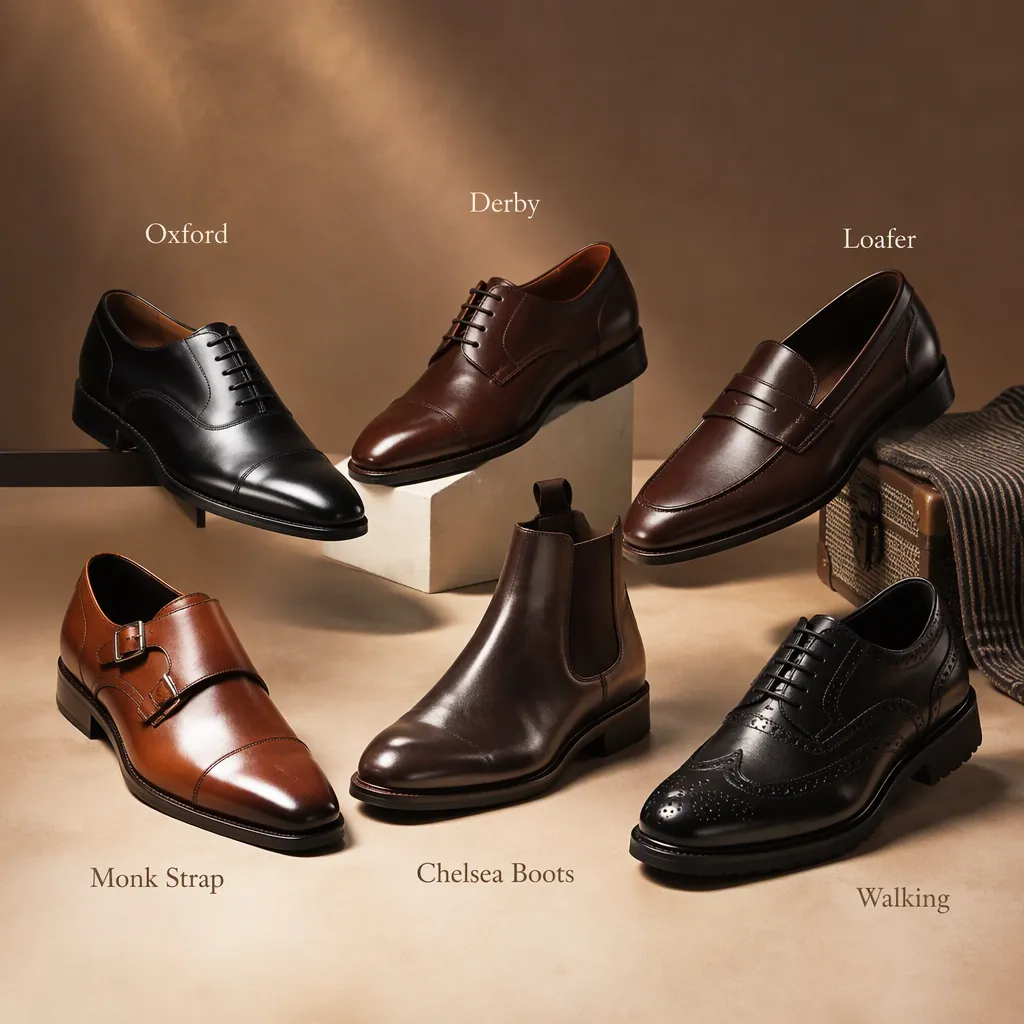
Top-tier factories carry 1,000+ ready designs across all major men’s dress and casual categories. The core categories to look for:
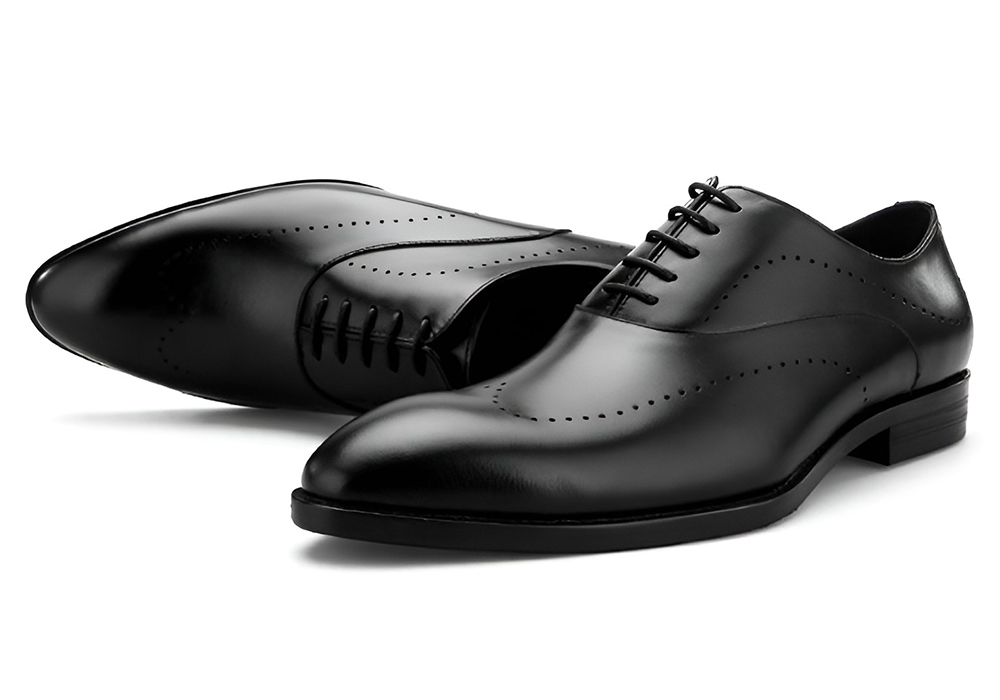
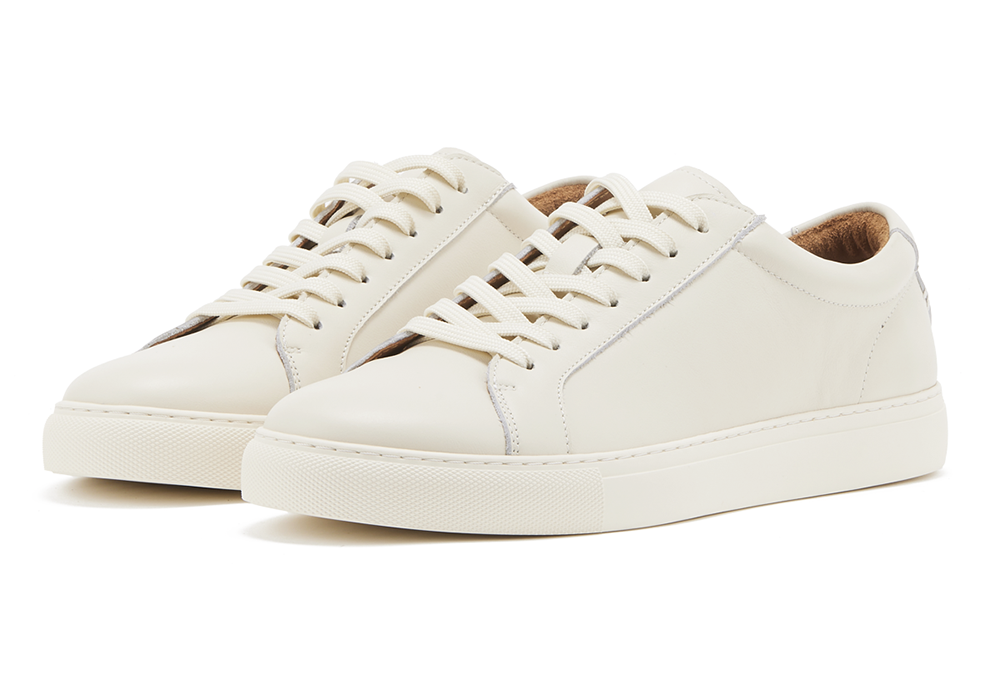
- Oxford shoes — closed lacing, formal positioning, highest demand in EU and North American markets. Browse the men’s Oxford shoes catalog for current styles.
- Derby shoes — open lacing, more versatile, strong demand in smart-casual segments
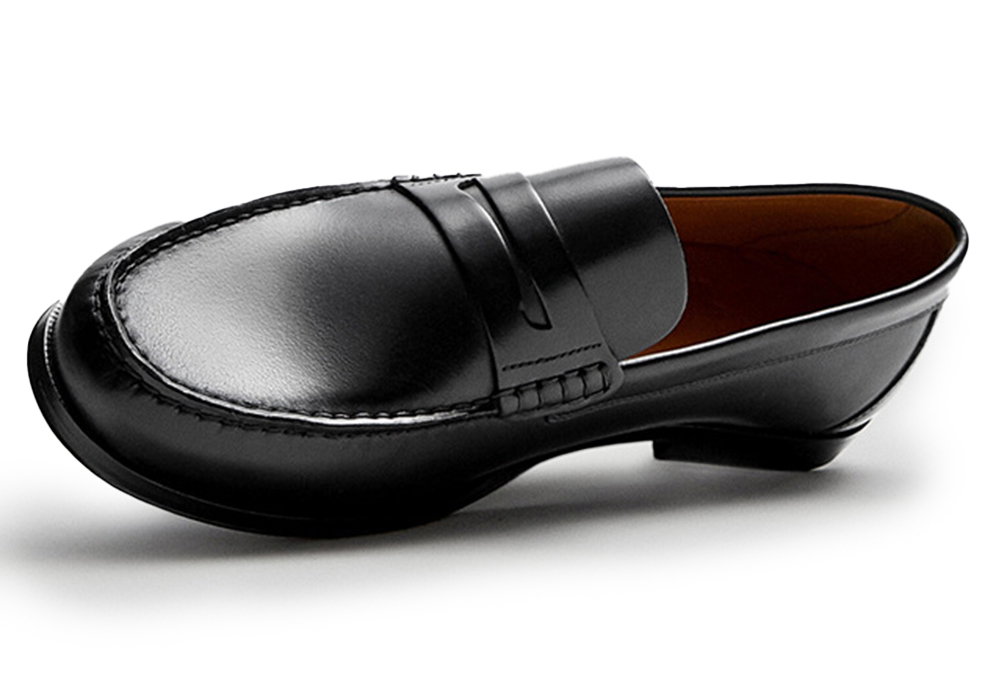
- Loafers — slip-on, high velocity in e-commerce channels
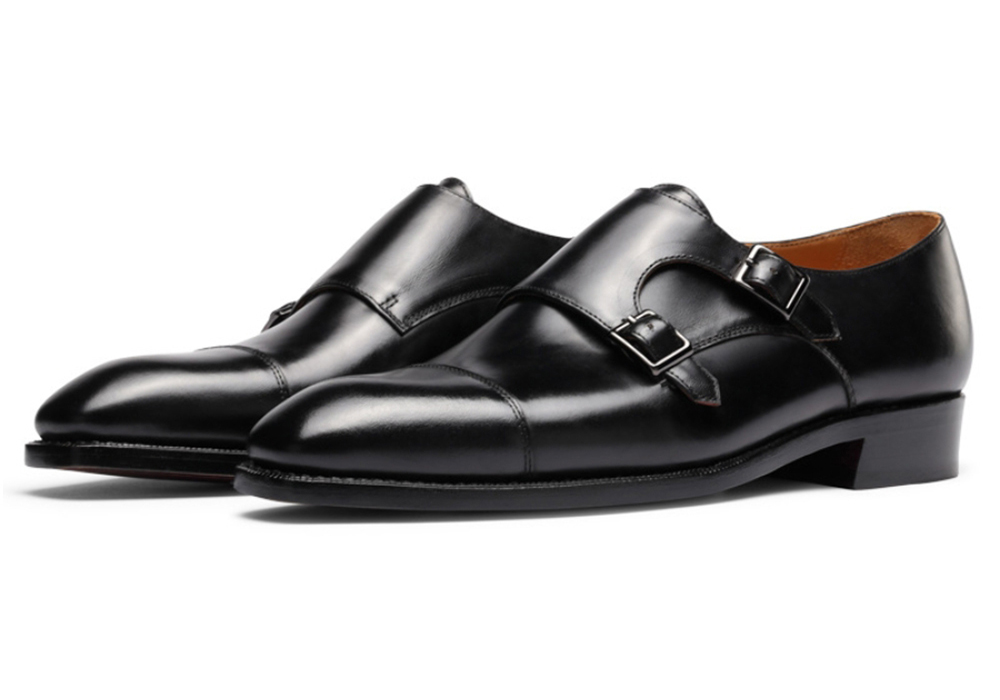
- Monk strap — niche but growing, especially in European markets
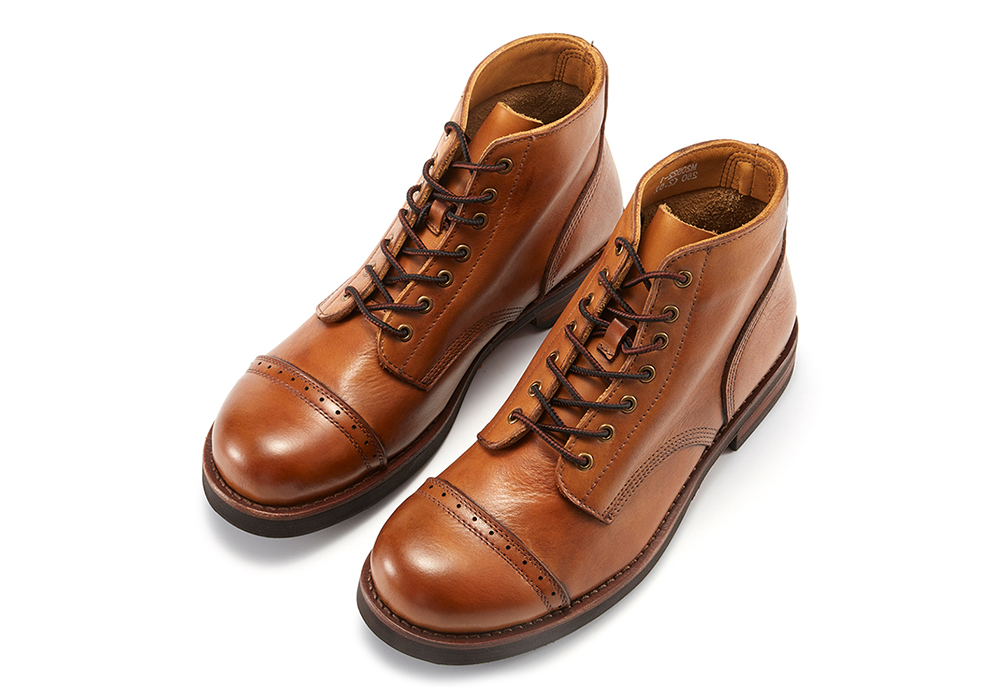
- Chelsea boots — seasonal spike, Q3/Q4 dominant
- Casual walking shoes — highest volume category globally, broadest size run requirements
A catalog of 1,000+ designs means you can launch a private label line with zero tooling cost by selecting existing lasts and uppers, then applying your branding. Custom tooling (new last, new upper pattern) is only required when your design diverges from existing templates.
FAQ
Q: What is the minimum order quantity for a shoe manufacturer China?
A: MOQ varies by factory tier and order type. At leading factories, existing catalog designs carry zero minimum — you can order a single size run to test the market. Custom OEM designs with your branding, last modification, or unique construction start at 60 pairs. Always confirm MOQ per style, not per order, as factories sometimes quote a blended minimum that obscures per-SKU requirements.
Q: How do I verify that a shoe manufacturer China is a real factory and not a trading company?
A: Request the Business License and cross-check the registered business scope on China’s National Enterprise Credit Information Publicity System (NECIPS). Real factories will provide equipment lists, worker headcounts, and production floor photos with verifiable timestamps. Ask for a video call tour of the production floor — trading companies cannot fake active machinery, lasting lines, and finishing stations. Third-party factory audit services (SGS, Bureau Veritas, Intertek) provide written verification for approximately $300–$500 per audit.
Q: What certifications should a shoe manufacturer China hold for EU market entry?
A: The minimum certification stack for EU market entry is CE (EN ISO 20347), REACH compliance, and RoHS for hardware components. CE certification must reference a notified body registration number that can be verified in the EU’s NANDO database. REACH compliance requires a full test report — not just a supplier declaration — covering azo dyes, chromium