
Table of Contents
- Why Are Leather Shoes So Hard to Dropship?
- What Does It Really Cost to Dropship Leather Shoes in 2026?
- Why Does Low-MOQ Wholesale Beat Dropshipping for Leather Shoes?
- What Is the 60-Pair Low-MOQ Batch + 3PL Model?
- Dropship vs Low-MOQ Wholesale vs FBA: How Do They Compare?
- Which Model Wins in 5 Real Scenarios?
- How Do You Check If a Dropship Supplier Is Reliable?
- FAQ
Why Are Leather Shoes So Hard to Dropship?
Footwear is one of the hardest categories to dropship profitably. Three structural problems stand out:
Weight and dimensional weight penalties. A pair of leather Oxfords in a shoebox weighs 1.5-2 kg and measures roughly 35×25×12 cm. Carriers like DHL eCommerce and China Post calculate shipping based on whichever is higher: actual weight or dimensional weight (length × width × height ÷ 5000). For shoes, dimensional weight almost always wins, pushing your per-unit shipping cost to $15-25 for standard 15-20 day delivery to the US or EU.
Sizing and fit issues drive returns. Leather shoes require precise sizing. A customer ordering a US 10 might receive a shoe that fits like a 9.5 or 10.5 depending on the factory’s last (the mold used to shape the shoe). Even with size charts, return rates for dropshipped footwear average 8-15%—double the rate for apparel. Each return costs you the original outbound shipping, the return shipping (if you cover it), and often a restocking fee from your supplier.
Long delivery times hurt conversion. Standard dropship delivery from China takes 20-30 days. In 2026, consumers expect 5-7 day delivery for fashion items. A 25-day wait increases cart abandonment, support tickets, and refund requests. Faster shipping options (DHL Express, FedEx) cost $35-50 per pair, which destroys unit economics unless you’re selling $200+ shoes.
These aren’t dealbreakers, but they mean you need higher retail prices and better supplier coordination than a typical dropship operation.
What Does It Really Cost to Dropship Leather Shoes in 2026?
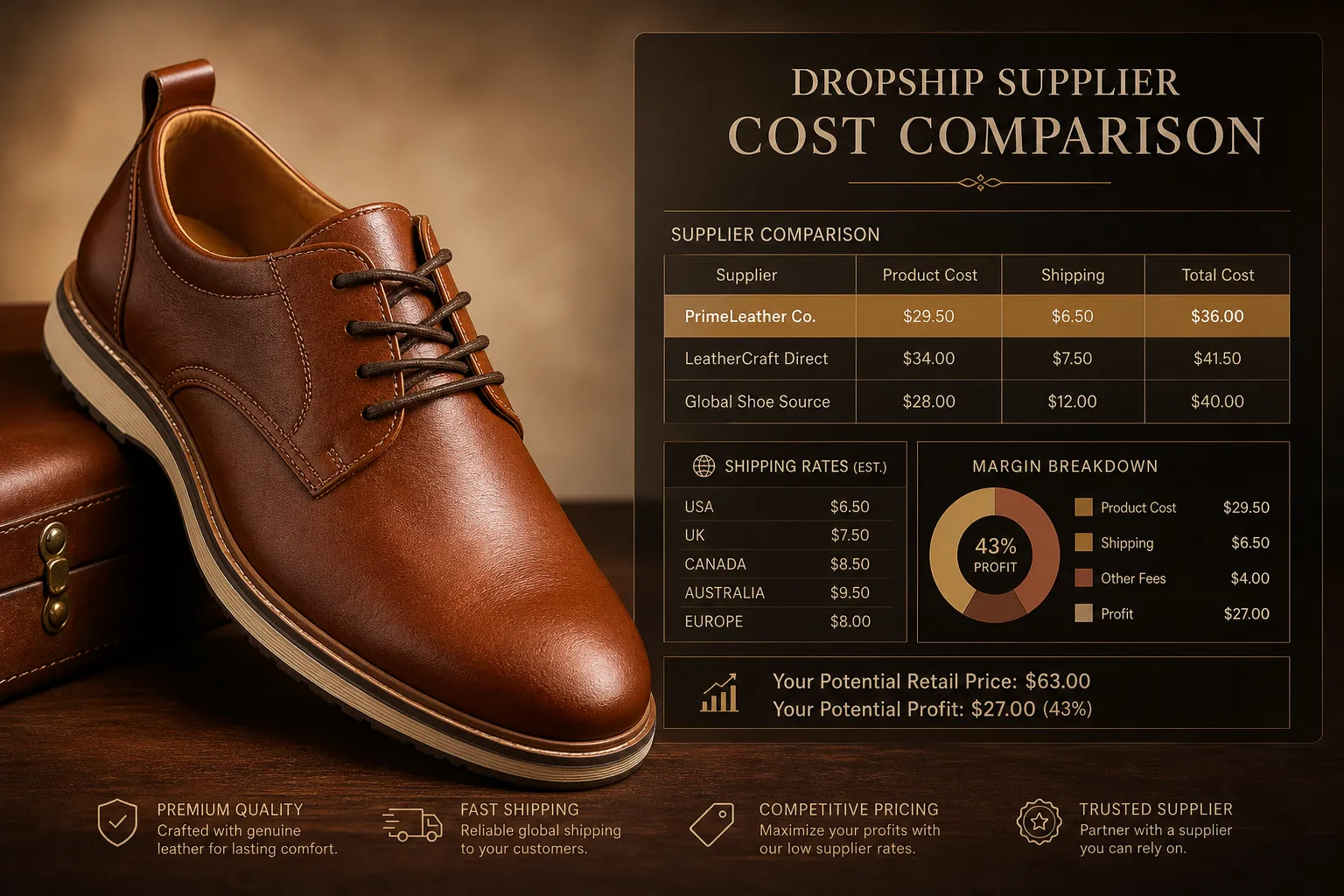
Let’s model a realistic dropship scenario for a men’s leather Derby shoe sold on Shopify.
| Cost Component | Amount (USD) |
|---|---|
| Product cost (ex-factory) | $28 |
| Dropship handling fee (supplier markup) | $4 |
| Shipping (China Post/ePacket to US) | $18 |
| Payment processing (2.9% + $0.30) | $2.60 |
| Shopify transaction fee (if not using Shopify Payments) | $2.00 |
| Facebook/Google ad cost per conversion (average) | $22 |
| Total cost per sale | $76.60 |
| Retail price | $89 |
| Net profit per pair | $12.40 |
That’s a 13.9% net margin before accounting for returns. If 10% of orders are returned, your effective margin drops to roughly 10%. You need to sell 80+ pairs per month just to cover a $1,000 ad budget.
The math gets worse if you’re targeting EU customers. Add VAT collection, IOSS registration, and stricter CE marking requirements, and your operational overhead increases by 15-20%.
In our factory, we’ve worked with over 200 private label brands since 2007, and the ones that started with pure dropshipping typically pivoted to hybrid models within 6-9 months. The unit economics simply don’t support long-term growth unless you’re selling premium shoes above $150 retail.
Why Does Low-MOQ Wholesale Beat Dropshipping for Leather Shoes?
Low-MOQ wholesale means buying a small batch (60-200 pairs) upfront and storing inventory either at your location or with a third-party logistics provider (3PL). Here’s why this model works better for leather shoes:
Shipping cost drops by 60-70%. When you order 60 pairs in a single shipment, your per-unit shipping cost falls to $5-8 via sea freight (30-35 days) or $12-15 via air freight (7-10 days). You’re consolidating weight and negotiating bulk rates instead of paying retail dropship fees.
You control quality before the customer sees it. With dropshipping, the first time you see the product is when a customer posts a 1-star review. With a 60-pair batch, you can inspect samples, check stitching and leather quality, and catch defects before they ship. Factories that produce 500,000+ pairs annually and maintain 0.8-1.2% defect rates (versus the 2-4% industry average) make this model even safer.
Faster fulfillment improves conversion. If you store inventory with a US-based 3PL like ShipBob, you can offer 2-3 day delivery. This alone can lift conversion rates by 15-25% compared to a 25-day dropship timeline. Faster delivery also reduces “where is my order?” support tickets by 40-50%.
Better unit economics at scale. Once you’re moving 100+ pairs per month, the cost advantage of wholesale compounds. You’re paying $25-40 per pair FOB (depending on leather grade and construction method) instead of $32+ for dropship-ready units. That $7-12 difference per pair funds better ads, influencer partnerships, or a loyalty program.
The tradeoff is upfront capital. A 60-pair order at $30/pair costs $1,800 + $300-500 shipping, so you need $2,300-2,500 in working capital. But if you’re already spending $1,500/month on ads for a dropship store, reallocating that budget to inventory often delivers better ROI.
What Is the 60-Pair Low-MOQ Batch + 3PL Model?
This hybrid approach combines the low risk of small-batch wholesale with the operational simplicity of outsourced fulfillment. Here’s how it works:
Step 1: Order a 60-pair batch from a low-MOQ supplier. Look for factories that offer 0 MOQ on existing designs or 60-pair minimums for custom colorways. Make sure they provide pre-production samples and support AQL 2.5 inspection and meet leather footwear quality standards before shipment.
Step 2: Ship directly to a 3PL warehouse in your target market. If you’re selling in the US, use a 3PL with West Coast facilities (closer to China, faster inbound). If you’re targeting EU, use a 3PL in the Netherlands or Germany to simplify VAT and customs. Your supplier ships one consolidated pallet; the 3PL receives, inspects, and stores it.
Step 3: Integrate your Shopify store with the 3PL’s API. When a customer orders, the 3PL picks, packs, and ships within 24 hours. You pay $3-5 per pick-pack-ship, plus $0.50-1.00 per pair per month for storage. Total fulfillment cost: $4-6 per order, compared to $18-25 for dropship.
Step 4: Reorder based on sell-through rate. If you’re moving 20 pairs per month, reorder every 90 days. If you’re moving 50+ pairs per month, reorder every 45 days to avoid stockouts. Lead time from order to 3PL receipt is typically 35-45 days (production + sea freight + customs clearance).
This model works especially well for testing new styles. You can launch 3-4 colorways with 60 pairs each (240 pairs total, $7,200-9,600 investment) and see which ones resonate before committing to a 500-pair reorder.
Dropship vs Low-MOQ Wholesale vs FBA: How Do They Compare?
| Factor | Pure Dropship | Low-MOQ Wholesale + 3PL | Amazon FBA (500+ units) |
|---|---|---|---|
| Upfront capital | $0-500 (samples only) | $2,300-2,500 (60 pairs) | $12,000-15,000 (500 pairs + FBA prep) |
| Per-unit product cost | $32-35 (includes supplier markup) | $25-40 (FOB price) | $22-35 (volume discount) |
| Shipping cost per pair | $15-25 (individual parcels) | $5-8 (consolidated sea freight) | $3-5 (bulk air/sea to FBA) |
| Fulfillment cost per order | Included in shipping | $4-6 (3PL pick-pack-ship) | $6-9 (FBA fees for shoes) |
| Delivery speed to US customer | 20-30 days | 2-3 days (if 3PL in US) | 1-2 days (Prime) |
| Return rate | 10-15% (long delivery, no QC) | 6-10% (faster delivery, pre-inspected) | 8-12% (Prime trust, but high volume) |
| Quality control | None (supplier ships direct) | Full (you inspect before storage) | Full (you inspect before FBA) |
| Inventory risk | Zero | Low (60-pair batches) | High (500+ pairs locked in FBA) |
| Best for | Testing demand, $0 budget | Scaling 20-100 pairs/month | Established brands, 200+ pairs/month |
The table shows a clear progression: dropship for validation, low-MOQ wholesale for early growth, and FBA for scale. Most successful shoe brands follow this exact path.
Which Model Wins in 5 Real Scenarios?
Scenario 1: You’re testing a new niche (e.g., vegan leather dress shoes). Use pure dropship for the first 30-50 sales. Accept the lower margins as the cost of market research. If the product resonates, switch to low-MOQ wholesale for the next batch.
Scenario 2: You’re launching a private label brand with $3,000-5,000 budget. Skip dropship entirely. Order 60-100 pairs in 2-3 styles, store with a 3PL, and focus on building a brand with fast fulfillment. The quality control and delivery speed will pay for themselves in repeat purchases.
Scenario 3: You’re selling on Amazon and need Prime eligibility. FBA is non-negotiable. Order 300-500 pairs, ship to Amazon’s warehouse, and optimize your listing for conversions. The higher upfront cost is offset by Amazon’s traffic and trust.
Scenario 4: You’re targeting EU customers from outside the EU. Use low-MOQ wholesale + EU-based 3PL. Dropshipping into the EU in 2026 requires IOSS registration, VAT collection, and CE marking compliance. A 3PL that handles customs clearance and VAT remittance saves you 20+ hours per month.
Scenario 5: You’re a B2B reseller supplying boutiques or corporate clients. Order 200-500 pairs and store domestically. Your clients expect NET30 payment terms, bulk discounts, and same-week delivery—none of which are possible with dropship. Wholesale inventory lets you act like a real distributor.
For more on building a private label shoe brand from scratch, see our 10-step brand launch guide and this shoe manufacturer guide.
How Do You Check If a Dropship Supplier Is Reliable?
Before committing to any leather shoe dropship supplier, verify these 8 points:
- ☐ Factory verification: Request business license, export license, and factory photos. Use Alibaba’s Trade Assurance or hire an inspection company like SGS or Bureau Veritas.
- ☐ Sample quality: Order 2-3 samples in different sizes. Check stitching, leather grain, sole attachment, and insole comfort. Compare to your target retail price point.
- ☐ Shipping SLA: Confirm average processing time (2-5 days) and shipping time (15-25 days). Ask for tracking numbers from recent orders.
- ☐ Return policy: Clarify who pays return shipping and restocking fees. Some suppliers charge 20-30% restocking fees, which kills your margin on returns.
- ☐ Packaging quality: Request photos of actual packaging. Flimsy boxes increase damage rates and hurt unboxing experience.
- ☐ Communication speed: Measure response time. Reliable suppliers reply within 12-24 hours. Slow communication signals capacity issues.
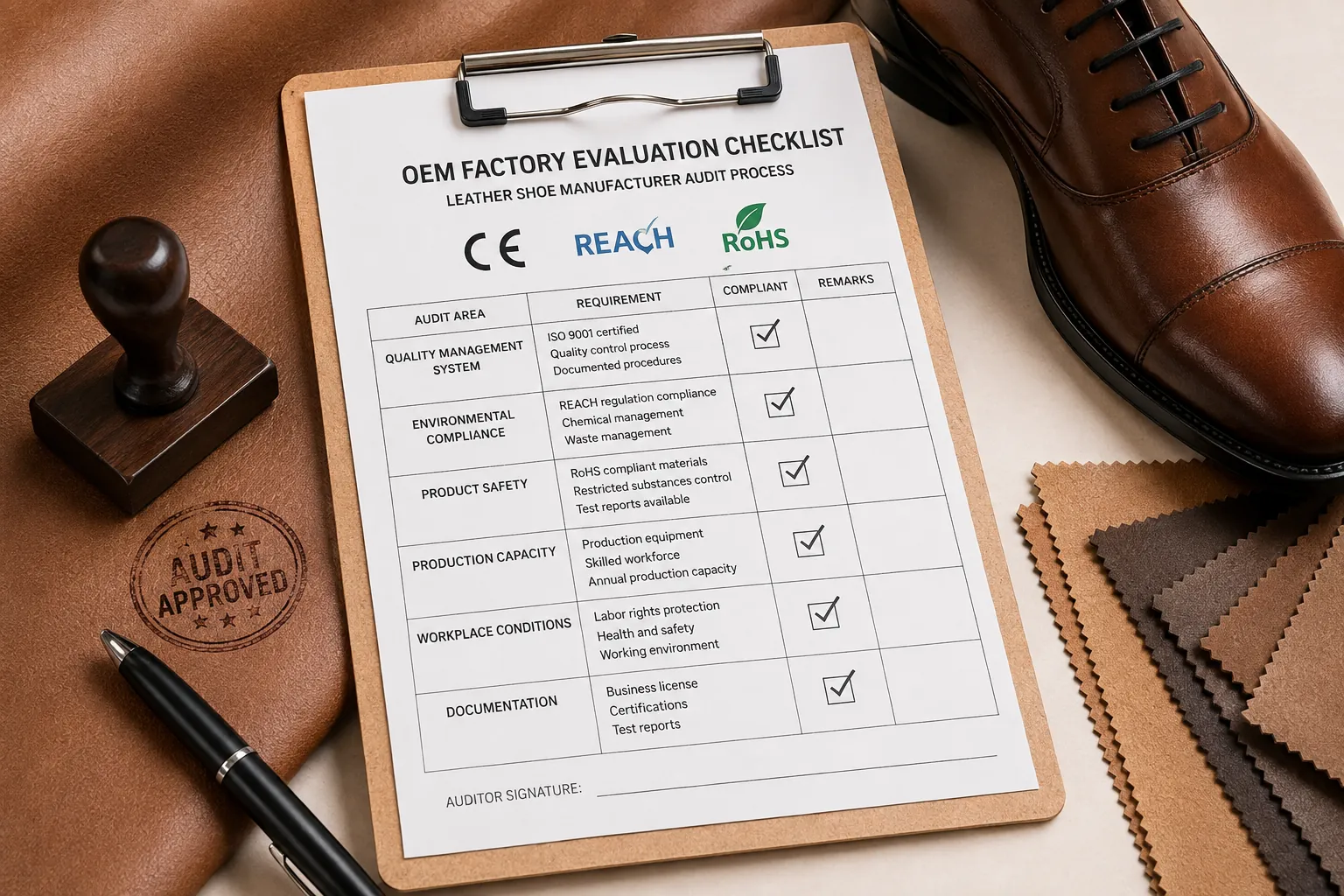
- ☐ Certifications: For EU sales, verify CE marking and REACH compliance — see our CE marking guide. For US sales, confirm the supplier can provide commercial invoices and packing lists for customs clearance.
- ☐ Minimum order for custom branding: If you want your logo on the insole or box, confirm the MOQ. Most suppliers require 200-500 pairs for custom branding, which rules out pure dropship.
Further Reading
- SATRA Footwear Technology — the footwear industry’s testing and research body
- Dropshipping overview (Wikipedia) — model definitions and history
FAQ
Q: Can I dropship leather shoes from China to the US without a business license?
A: Technically yes, but it’s risky. You’ll need to collect sales tax in states where you have nexus (which includes economic nexus in 40+ states as of 2026). You’ll also need an EIN for customs paperwork if your supplier ships via commercial courier. Operating without proper registration exposes you to back taxes and penalties. Consult a CPA before launching.
Q: What’s the average profit margin on dropshipped leather shoes?
A: 10-15% net margin after ads, shipping, and returns. If you’re selling a $89 shoe, expect $9-13 profit per pair. Higher-priced shoes ($150+) can hit 20-25% margins, but customer acquisition costs also rise. For comparison, low-MOQ wholesale typically delivers 25-35% net margins once you’re moving 50+ pairs per month.
Q: How do I handle sizing issues with a leather shoe dropship supplier?
A: Provide a detailed size chart on your product page (measure in cm, not just US/EU sizes). Offer free exchanges (customer pays return shipping, you cover outbound shipping for the replacement). Budget 8-12% of revenue for return shipping costs. Some brands use fit-prediction tools like Fit Analytics to reduce returns by 20-30%.
Q: Is dropshipping leather shoes legal in 2026?
A: Yes, but you must comply with consumer protection laws, product safety regulations (CE marking in EU, CPSIA in US for children’s shoes), and tax collection rules. Dropshipping doesn’t exempt you from liability—if a customer is injured by a defective shoe, you’re legally responsible even if you never touched the product. Carry product liability insurance ($1M-2M coverage, costs $500-1,200/year).
Q: Can I use AliExpress suppliers for leather shoe dropshipping?
A: You can, but quality and reliability are inconsistent. AliExpress suppliers often use stock photos that don’t match the actual product. Shipping times are unpredictable (20-45 days), and customer service is minimal. For serious brands, work directly with factories via Alibaba or use a sourcing agent. See our Alibaba sourcing guide for vetted supplier selection criteria.
Ready to Start Your Shoe Line?
Whether you’re testing demand with dropship or scaling with low-MOQ wholesale, the right supplier makes the difference. We offer 0 MOQ on 1,000+ existing designs and 60-pair minimums for custom orders, with FOB pricing from $25-40 per pair and CE, REACH, and RoHS certifications for global compliance.
Contact us for samples and a detailed quote:
📧 Email: peterwang@shwincheer.com
🌐 Website: wincheershoes.com
We’ll send you a catalog, answer your questions about fulfillment models, and help you choose the approach that fits your budget and growth stage.