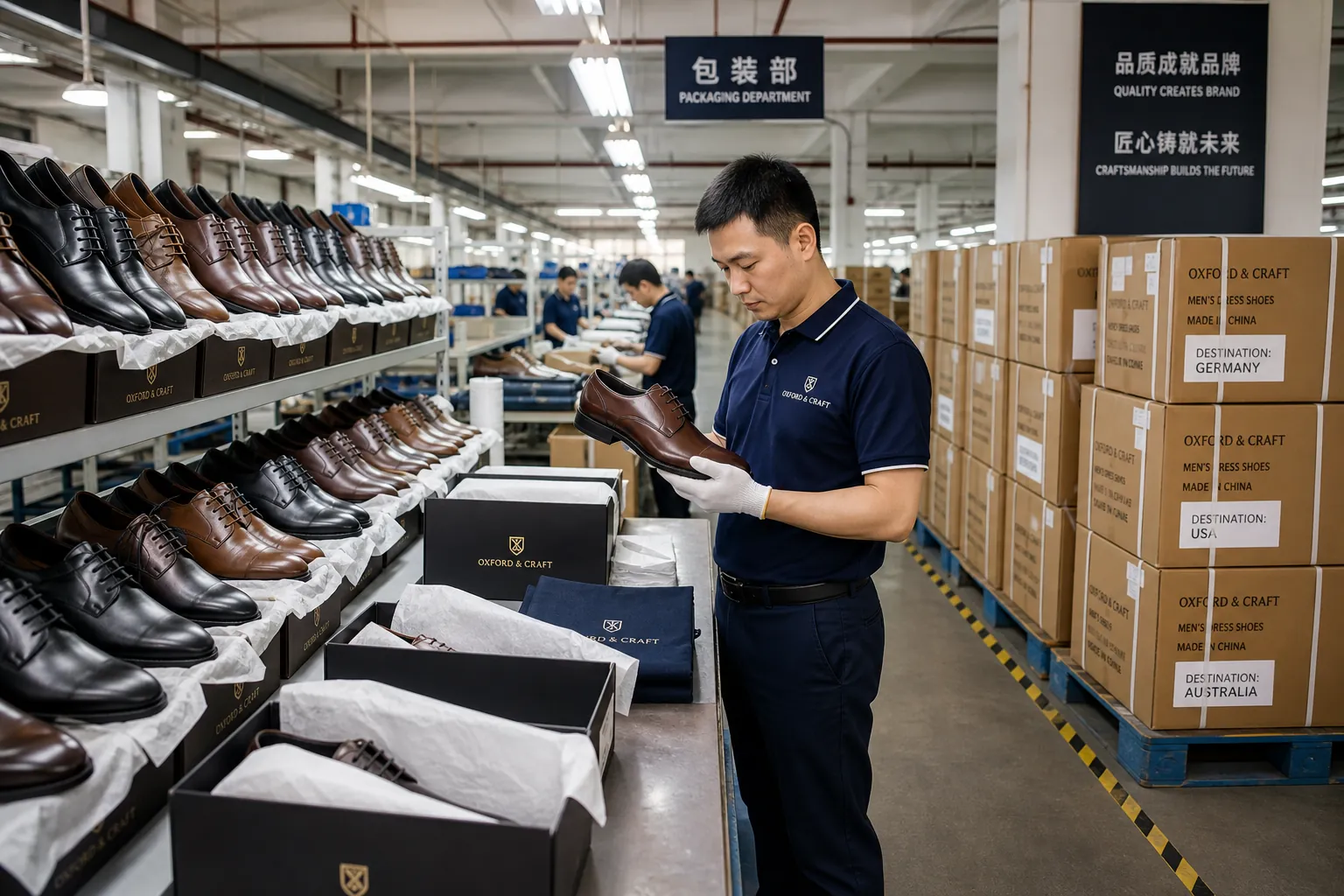
China exports over $40 billion in footwear annually, making it the world’s largest source for leather shoes across every price tier and style category. For B2B buyers, private label brands, and cross-border e-commerce sellers, choosing the right leather shoe exporter China partner is the single decision that determines your margin, your timeline, and your product quality.
This guide cuts through the noise. You’ll get a direct comparison of export channels, a complete documentation checklist, certification requirements by market, real shipping cost examples, and the pitfalls that cost buyers thousands of dollars every year.
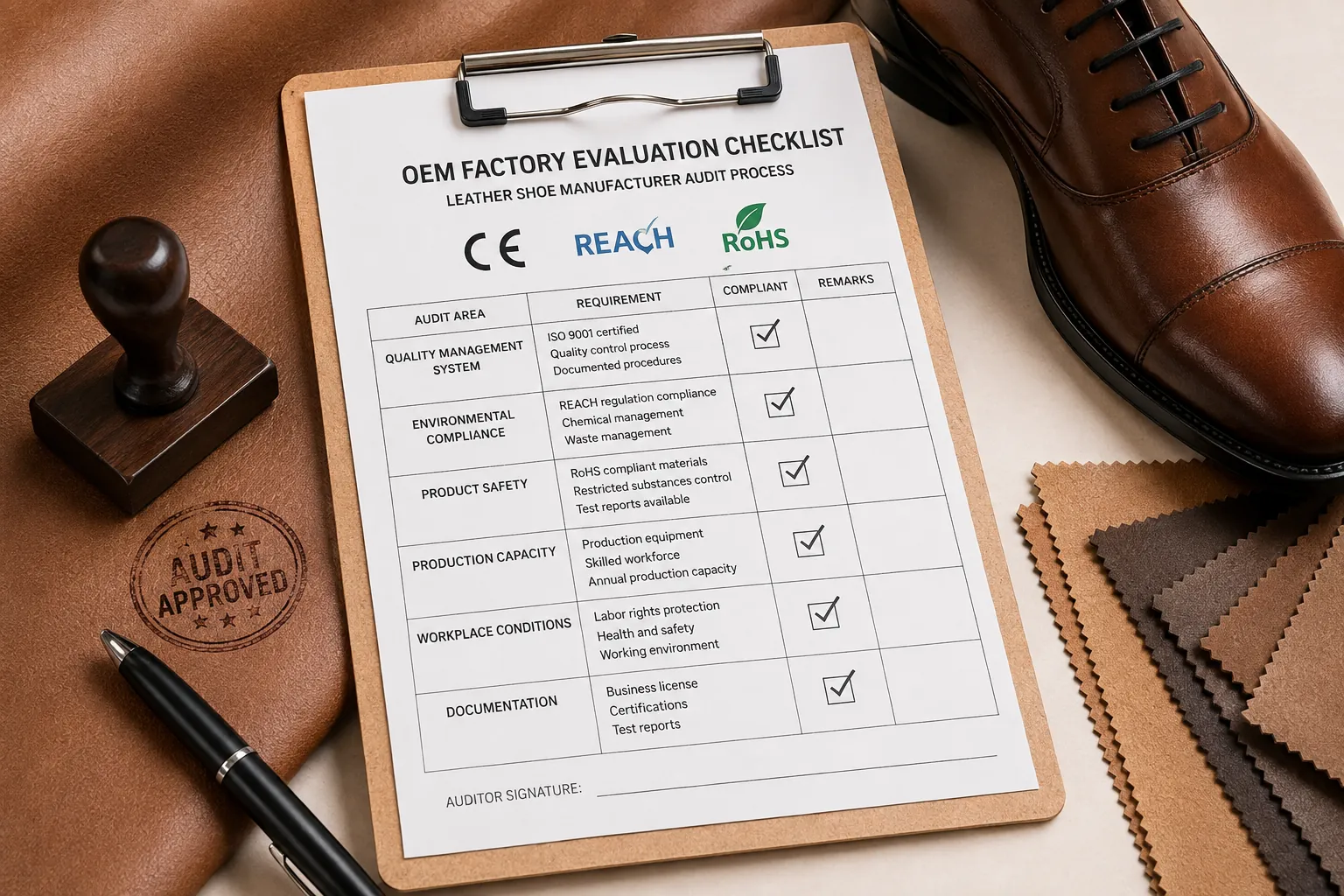
At Wincheer Shoes — a manufacturer founded in 2007 with annual output exceeding 500,000 pairs — the export process runs to 50+ countries across six continents. With a defect rate of 0.8–1.2% against an industry average of 2–4%, and certifications including CE (EN ISO20347), REACH, and RoHS, the factory-direct model consistently outperforms trading company sourcing on both cost and quality control.
Table of Contents
- Why Factory-Direct Export Beats Trading Companies
- Export Channels Compared: Factory vs. Trading Company vs. B2B Platform
- Export Documentation Checklist
- Certifications Required by Market
- FOB, CIF, and DDP: Shipping Options with Real Cost Examples
- Common Export Pitfalls and How to Avoid Them
- Export Channel Comparison Table
- FAQ
- Ready to Start Your Shoe Line?
1. Why Factory-Direct Export Beats Trading Companies
When you source through a trading company, you’re paying a middleman margin — typically 8–15% on top of the factory price — for a service that often adds zero value to the product itself. The trading company doesn’t control production, doesn’t own the machinery, and can’t resolve quality issues at the source.
Factory-direct sourcing eliminates that layer. You negotiate directly with the people cutting the leather, stitching the uppers, and applying the outsoles. When a specification changes, it changes on the factory floor — not in a WeChat message chain between three parties.
The financial difference is real. On a $30/pair FOB price, a 10% trading company markup adds $3 per pair. On a 1,000-pair order, that’s $3,000 in avoidable cost — enough to fund a full custom branding package.
Control over certifications is the other major factor. A factory that holds CE, REACH, and RoHS certifications can provide documentation directly. A trading company may not even know which factory produced your shoes, let alone hold the test reports.
2. Export Channels Compared: Factory Direct vs. Trading Company vs. B2B Platform
Factory Direct
The cleanest channel for serious buyers. You visit or audit the factory, negotiate pricing, approve samples, and manage the relationship directly. Lead times are transparent, and quality issues are resolved at the source.
Best for: Private label brands, wholesale importers placing 300+ pairs per style, buyers who need certifications.
Trading Company
A trading company aggregates products from multiple factories and handles export logistics. Useful for buyers who need a single-source supplier across multiple product categories, but expect to pay a premium and accept reduced traceability.
Best for: Small buyers who need mixed-product containers, first-time importers who want hand-holding through customs.
B2B Platform (Alibaba, Global Sources, Made-in-China)
These platforms list both factories and trading companies, often without clear distinction. Pricing is competitive but verification is buyer-dependent. Platform escrow provides some payment protection, but quality disputes are notoriously slow to resolve.
Best for: Sample sourcing, market research, finding new suppliers before committing to direct relationships.
For a deeper look at navigating platform sourcing, see our Alibaba leather shoe sourcing complete guide.
3. Export Documentation Checklist
Missing or incorrect export documents are the number-one cause of customs delays. Every shipment from a leather shoe exporter China requires a minimum document set. Here’s what you need:
Core Documents (Every Shipment)
- Commercial Invoice — Must include: seller/buyer details, HS code (typically 6403 or 6404 for leather shoes), unit price, total value, currency, Incoterms, and country of origin.
- Packing List — Itemizes carton count, gross/net weight, dimensions, and SKU breakdown. Must match the commercial invoice exactly.
- Bill of Lading (B/L) — Issued by the shipping line. The original B/L is the title document for the goods. Telex release or Sea Waybill is used for trusted buyer relationships.
- Certificate of Origin (CO) — Required for tariff preference claims. For EU buyers, Form A (GSP) or EUR.1 may apply. For US buyers, a standard CO from the China Council for the Promotion of International Trade (CCPIT) is standard.
Market-Specific Documents
- CE Declaration of Conformity — Required for EU/EEA markets. Must reference EN ISO20347 for occupational footwear or EN ISO20345 for safety footwear.
- REACH Compliance Statement — Required for EU. Confirms no SVHC (Substances of Very High Concern) above threshold limits.
- Fumigation Certificate — Required when wooden pallets or packaging are used (ISPM 15 standard).
- Inspection Certificate — Recommended for first orders; required by some buyers. Third-party AQL inspection reports (SGS, Bureau Veritas, Intertek) carry the most weight.
For a detailed breakdown of AQL inspection standards, see our AQL inspection footwear quality control guide.
Documentation Checklist
- [ ] Commercial invoice (matches packing list)
- [ ] Packing list (carton-level detail)
- [ ] Bill of lading (original or telex release)
- [ ] Certificate of Origin (CCPIT-issued)
- [ ] CE Declaration of Conformity (EU shipments)
- [ ] REACH compliance statement (EU shipments)
- [ ] RoHS compliance statement (if applicable)
- [ ] Fumigation certificate (if wooden packaging)
- [ ] Third-party inspection report (recommended)
- [ ] Customs power of attorney (if using a freight forwarder)
4. Certifications Required by Market
Different destination markets have different mandatory and voluntary certification requirements. Getting this wrong means goods held at customs, fines, or forced returns.
European Union / EEA
The EU is the most demanding certification environment for footwear. Key requirements:
- CE Marking (EN ISO20347) — Mandatory for occupational footwear sold in the EU. Confirms the product meets basic health and safety requirements.
- REACH Regulation (EC 1907/2006) — Restricts hazardous chemicals in leather, adhesives, and dyes. Chromium VI limits are particularly relevant for leather shoes.
- RoHS — Relevant where electronic components are integrated (e.g., LED-lit shoes), but increasingly requested as a general compliance signal.
The CE marking footwear 2026 EU certification guide covers the full testing and documentation process.
United States
The US has no mandatory CE equivalent for dress shoes, but buyers should be aware of:
- CPSC regulations — Apply to children’s footwear; less relevant for men’s dress shoes.
- ASTM F2413 — Voluntary standard for protective footwear; relevant for work boot categories.
- Section 321 de minimis — Shipments under $800 enter duty-free; relevant for DTC e-commerce.
- Tariff classification — HS code accuracy is critical. Misclassification triggers audits. See our importing leather shoes USA tariff guide for current rates.
Middle East / Gulf Cooperation Council
- SASO (Saudi Arabia) and ESMA (UAE) have footwear conformity requirements. Testing against ISO 20347 is typically accepted.
- Halal certification is not required for footwear, but some buyers request confirmation that no porcine materials are used in leather processing.
Australia / New Zealand
- No mandatory footwear certification, but REACH-equivalent chemical restrictions apply under the Industrial Chemicals Act 2019.
- Product liability standards require accurate labeling of materials.
5. FOB, CIF, and DDP: Shipping Options with Real Cost Examples
Incoterms determine who pays for what — and where risk transfers. For a leather shoe exporter China, the three most common terms are FOB, CIF, and DDP.
FOB (Free On Board) — Shanghai or Guangzhou
Risk and cost transfer to the buyer once goods are loaded onto the vessel. The buyer arranges freight, insurance, and destination customs.
Real cost example (1,000 pairs, 5 CBM, Shanghai to Los Angeles):
- FOB factory price: $30/pair × 1,000 = $30,000
- Ocean freight (LCL): ~$600–900
- Destination customs + duties: ~$2,400–4,500 (depending on HS code and tariff rate)
- Total landed cost: ~$33,000–35,400
FOB is the preferred term for experienced importers who have established freight forwarder relationships.
CIF (Cost, Insurance, Freight) — Destination Port
The exporter arranges and pays for freight and insurance to the destination port. Risk transfers at the destination port.
Cost premium over FOB: Typically 3–6% on the cargo value. Convenient for smaller buyers, but you lose control over carrier selection and freight rates.
DDP (Delivered Duty Paid) — Buyer’s Warehouse
The exporter handles everything: freight, insurance, destination customs, duties, and last-mile delivery. The buyer receives goods at their door.
Cost premium over FOB: 8–15% depending on destination. High convenience, but the exporter’s freight costs are built in at a margin. Only use DDP with a factory you trust completely — cost transparency is zero.
For a full breakdown of all four Incoterms with cost comparisons, see our FOB shoe pricing guide: 4 Incoterms compared.
6. Common Export Pitfalls and How to Avoid Them
Pitfall 1: HS Code Misclassification
Leather shoes fall under Chapter 64 of the Harmonized System. The specific subheading depends on upper material, sole material, and end use. A misclassified HS code can trigger the wrong duty rate — or flag your shipment for examination.
Fix: Confirm the HS code with your freight forwarder before the first shipment. Get a binding ruling from the destination country’s customs authority if volumes are significant.
Pitfall 2: Certificate of Origin Errors
A CO with incorrect details — wrong HS code, mismatched invoice value, or wrong country of origin declaration — will delay clearance. Some countries require the CO to be notarized and legalized (apostilled) by the Chinese government.
Fix: Use a CCPIT-issued CO for all shipments. Cross-check every field against the commercial invoice before submission.
Pitfall 3: Quality Disputes Without Pre-Shipment Inspection
Receiving 500 pairs with delaminating soles or inconsistent sizing is a nightmare. Without a pre-shipment inspection report, you have limited recourse — especially on FOB terms where risk transfers at the port.
Fix: Mandate AQL Level II inspection on all orders above 300 pairs. Use a third-party inspector (SGS, Intertek, Bureau Veritas) for the first three orders with any new factory.
Pitfall 4: Ignoring REACH Chemical Compliance
EU customs authorities conduct random chemical testing on imported footwear. A shipment that fails REACH testing — particularly for Chromium VI in leather or azo dyes — will be seized and destroyed. The importer bears the cost.
Fix: Request REACH test reports from the factory for each leather batch. Reputable factories with CE and REACH certifications will have these on file.
Pitfall 5: Payment Terms That Leave You Exposed
Paying 100% upfront to a new supplier is the fastest way to lose money in China sourcing. Equally, demanding 100% after delivery is a non-starter for most factories.
Fix: Standard terms are 30% T/T deposit, 70% against copy of B/L. For larger orders, consider a Letter of Credit (L/C) for additional protection.
7. Export Channel Comparison Table
| Factor | Factory Direct | Trading Company | B2B Platform |
|---|---|---|---|
| Price (vs. factory FOB) | Base price | +8–15% markup | Base to +10% |
| MOQ | 60 pairs (custom) / 0 (stock) | 100–500 pairs | Varies widely |
| Lead Time (production) | 30–45 days | 35–60 days | 30–90 days |
| Certification Access | Direct (CE, REACH, RoHS) | Indirect / unreliable | Varies by supplier |
| Quality Control | Factory-level | Limited | Buyer-dependent |
| Documentation Control | Full | Partial | Buyer-dependent |
| Customization | Full OEM/ODM | Limited | Limited |
| Payment Risk | Low (direct relationship) | Medium | Medium-High |
| Best For | Brands, wholesalers | Mixed-product buyers | Sample sourcing |
FAQ
Q: What is the minimum order quantity for a leather shoe exporter China factory?
A: It depends on the factory and whether you’re ordering existing designs or custom styles. For stock designs, some factories offer zero MOQ. For custom OEM/ODM orders — including your own branding, last shape, or sole design — the typical MOQ is 60 pairs per style. Always confirm MOQ per color and per size run, as factories may apply MOQ at the SKU level.
Q: How long does it take to ship leather shoes from China to the US or EU?
A: Ocean freight from Shanghai or Guangzhou to the US West Coast takes approximately 14–18 days; to the US East Coast, 28–35 days. EU ports (Rotterdam, Hamburg) are typically 28–35 days from Chinese ports. Add 5–10 days for customs clearance at destination. Air freight cuts transit to 5–7 days but costs 4–6× more per kilogram — only viable for urgent small shipments.
Q: Which certifications are mandatory for selling leather shoes in the EU?
A: For occupational footwear, CE marking under EN ISO20347 is mandatory. For general consumer leather shoes, REACH compliance is the primary requirement — specifically ensuring chromium VI levels in leather stay below 3 mg/kg and no restricted azo dyes are present. RoHS compliance applies if electronic components are integrated. Always request test reports from an accredited lab (SGS, Bureau Veritas, Intertek) for each leather batch.
Q: What documents do I need to import leather shoes from China?
A: The minimum document set includes: a commercial invoice (with HS code 6403 or 6404, unit pricing, and Incoterms), a packing list matching the invoice, a bill of lading from the shipping line, and a certificate of origin issued by CCPIT. For EU destinations, add a CE declaration of conformity and REACH compliance statement. For US imports, ensure correct HS tariff classification. Your freight forwarder can advise on any market-specific additions.
Q: Can I visit a leather shoe factory in China before placing an order?
A: Absolutely — and you should. Most established manufacturers welcome factory audits. A visit lets you inspect the production line, verify leather quality firsthand, review certification documents on-site, and discuss customization details face-to-face. Factories in Guangzhou’s Huadu district are 30–45 minutes from Guangzhou Baiyun International Airport. Schedule your visit at least two weeks in advance so the factory can prepare sample materials and assign an English-speaking guide.
Ready to Start Your Shoe Line?
Choosing the right leather shoe exporter China partner eliminates the margin erosion, documentation headaches, and quality surprises that cost importers thousands every year. Factory-direct sourcing with $25–$40 per pair factory-direct pricing, combined with direct certification access and transparent shipping, is the structure that consistently delivers the best results for B2B buyers, private label brands, and cross-border e-commerce sellers.
Wincheer Shoes — founded in 2007, 500,000+ pairs annual output, CE/REACH/RoHS certified, exporting to 50+ countries — is built for exactly this model. Whether you’re shipping your first 60-pair test order or managing a 10,000-pair seasonal program, the factory-direct channel gives you control over every variable that matters.
Ready to discuss your export requirements? Request a quote and let us know your target market, volume range, and product preferences. We respond within 24 hours with a detailed export plan and pricing breakdown.