
TL;DR
Shoe construction method is the single most important factor determining leather shoe durability, price point, and market positioning. Goodyear welted shoes offer premium durability (8-20+ year lifespan depending on use), superior water resistance, and full resoleability, at an estimated $74-103/pair ex-works. Blake stitched shoes provide elegant aesthetics and resoleability with moderate durability (4-12 year lifespan), at an estimated $47-70/pair ex-works. Cemented construction dominates the entry-mid market with cost efficiency (an estimated $26-41/pair ex-works) and modern comfort, but limited repairability and a 1-7 year typical lifespan. Wincheer Shoes manufactures all three constructions, helping B2B buyers match construction to target market and price point.
Introduction
The difference between a $50 dress shoe that lasts 2 years and a $250 dress shoe that lasts 15 years often comes down to one invisible factor: construction method. While leather quality, design, and branding capture buyer attention, the construction method determines whether a shoe becomes a long-term investment or a disposable commodity.
Consider the manufacturing reality: A cemented shoe can be produced in 15-20 minutes with minimal operator skill, requiring just $3-5 in construction materials. A Goodyear welted shoe demands 45-60 minutes of skilled craftsmanship, $12-18 in materials, and specialized equipment costing $500,000+. This 4-5x production cost differential translates to dramatically different wholesale price points, retail margins, and customer expectations.
For B2B buyers, private label brands, and sourcing professionals, understanding shoe construction is not optional—it’s strategic. The construction method you choose determines:
- Your manufacturing cost structure
- Your retail price positioning
- Your target customer demographic
- Your after-sales service requirements
- Your brand’s quality perception
This guide provides a comprehensive comparison of the three dominant shoe construction methods: Blake stitch, Goodyear welt, and cemented construction. We examine the technical details, cost implications, durability data, and market positioning to help you make informed sourcing decisions.
Table of Contents
- What Is Shoe Construction and Why Does It Matter for B2B Buyers?
- Why Is Cemented Construction the Modern Standard?
- What Makes Blake Stitch the Elegant Alternative?
- Why Is Goodyear Welt the Premium Standard?
- What Other Construction Methods Should You Know?
- Why Is Hand Welted Construction the Peak of the Craft?
- What Is Blake Rapid Construction and Who Should Buy It?
- When Is Injection (Direct Attach) Construction the Right Call?
- How Do Blake Stitch, Goodyear Welt and Cemented Compare Directly?
- How Does Each Construction Affect Cost and Retail Pricing?
- How Long Does Each Construction Actually Last?
- Which Constructions Can Be Resoled and Repaired?
- Which Sole Materials Pair with Each Construction?
- Which Construction Fits Your Target Market?
- How to Select a Construction for Your Product Line
- B2B Construction Selection Checklist
- What Should B2B Buyers Know About Production and MOQ?
What Is Shoe Construction and Why Does It Matter for B2B Buyers?
What is Shoe Construction?
Shoe construction refers to the method used to attach the upper (the leather part covering the foot) to the outsole (the bottom that contacts the ground). This attachment method determines:
- How the shoe handles water ingress
- How easily the shoe can be resoled
- How flexible the sole feels
- How long the shoe will last
- How much the shoe costs to produce
The Three Critical Components:
- Insole: The foundation inside the shoe
- Upper: Leather covering the foot
- Outsole: The walking surface
The Attachment Methods:
| Construction Method | Attachment Technique | Primary Bond |
|---|---|---|
| Cemented | Glue | Chemical bond |
| Blake Stitch | Thread through all layers | Mechanical bond |
| Goodyear Welt | Thread through welt strip | Mechanical + rib bond |
Why Construction Matters for B2B Buyers
Brand Positioning Implications:
The construction method signals quality to consumers and determines brand positioning:
| Market Segment | Expected Construction | Price Range |
|---|---|---|
| Entry/Disposable | Cemented | $50-80 retail |
| Mid-Market | Cemented/Blake | $80-150 retail |
| Premium | Blake/Goodyear | $150-300 retail |
| Luxury | Goodyear/Handwelted | $300+ retail |
Choosing the wrong construction for your price point creates customer dissatisfaction. A $150 retail shoe with cemented construction will disappoint customers expecting premium longevity, while a Goodyear welted shoe at $80 retail is unsustainable for most brands.
The True Cost of Quality: Understanding Leather Shoe Pricing from Chinese Manufacturers for comprehensive pricing analysis.
Why Is Cemented Construction the Modern Standard?
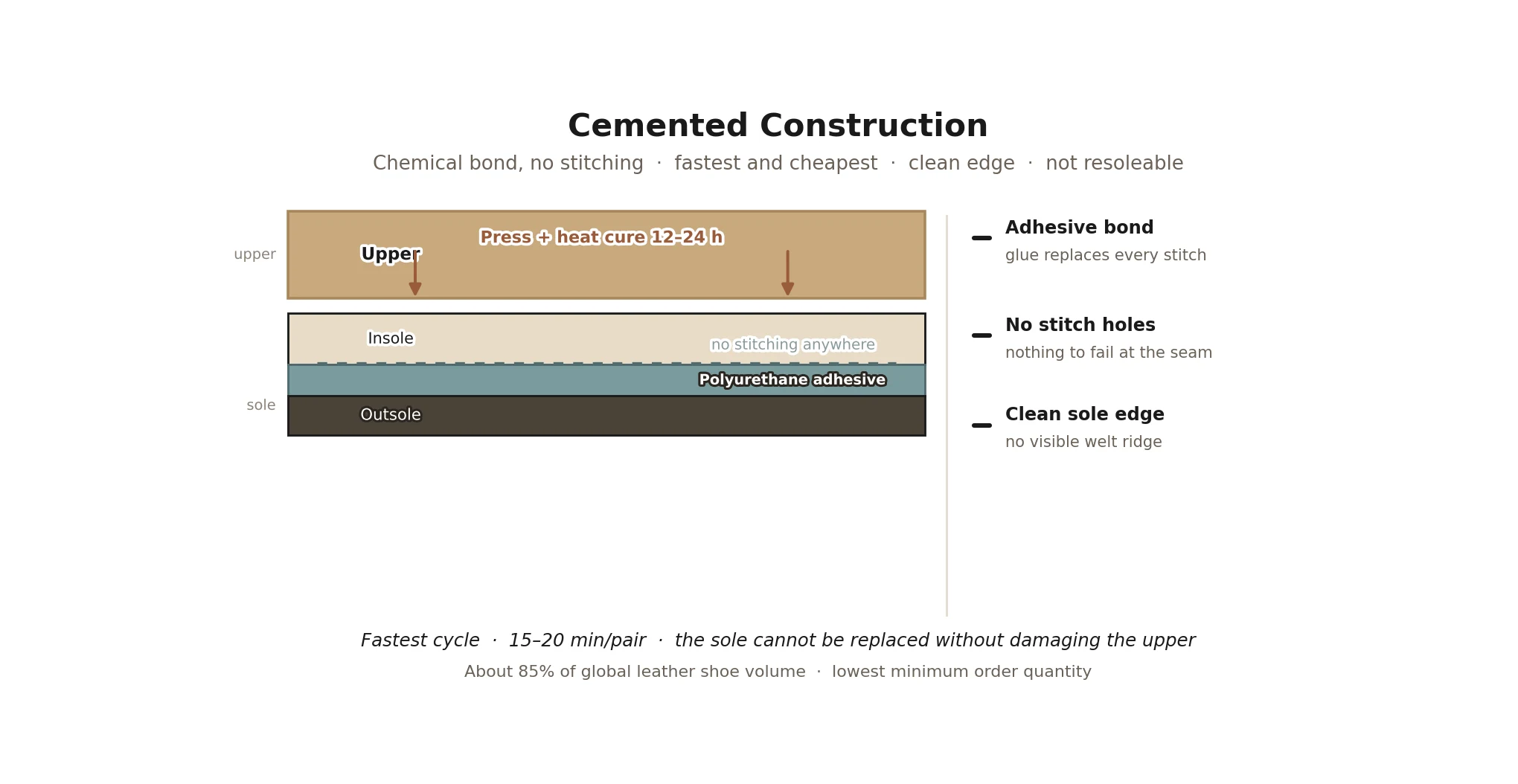
Cemented construction attaches the outsole to the upper and insole with adhesive rather than stitching, and it accounts for roughly 85% of global leather shoe volume. It is also the cheapest and fastest of the three at 15-20 minutes per pair and a factory-gate band of $26-41 per pair. The trade-off is repairability: once the bond fails there is no welt to replace, so the shoe is normally discarded rather than resoled, which is why cemented construction sits at entry and mid-market price points. (Source: Wincheer Shoes factory production records, 2026-10.)
How Cemented Construction Works
Cemented construction, also known as bonded construction, uses adhesive to attach the outsole directly to the upper and insole. This is the most common construction method globally, accounting for approximately 85% of all leather shoes produced.
The Cementing Process:
- Upper Preparation: The leather upper is lasted over the last and tacked in place
- Surface Roughening: The bottom of the lasted upper is roughened to increase surface area
- Primer Application: A chemical primer is applied to improve adhesion
- Adhesive Application: Polyurethane or thermoplastic rubber adhesive is applied
- Sole Attachment: The outsole is pressed onto the upper
- Curing: The bond cures for 12-24 hours (often accelerated with heat)
Production Time: 15-20 minutes per shoe
Advantages of Cemented Construction
1. Cost Efficiency:
| Cost Component | Cemented vs. Welted |
|---|---|
| Labor | 60% less |
| Materials | 70% less |
| Equipment | 80% less |
| Production Time | 65% less |
2. Design Flexibility:
- Accommodates any sole thickness
- Allows complex sole shapes
- Enables hidden platform construction
- Supports lightweight designs
3. Comfort Characteristics:
- Direct contact between foot and sole
- No stiff welt to break in
- Immediate flexibility
- Natural foot movement
4. Water Resistance (Modern):
Modern polyurethane adhesives provide excellent water resistance when properly applied. High-quality cemented shoes can resist water ingress as well as welted constructions in dry conditions.
Limitations of Cemented Construction
1. Resoleability Challenges:
| Issue | Impact |
|---|---|
| Sole removal difficult | Damages upper during removal |
| Heat required for removal | Can weaken leather |
| New sole attachment | Specialized cements required |
| Repair cost | Often exceeds shoe value |
Reality: While cemented shoes CAN be resoled, the process costs $40-60 and requires specialized cobblers. Most consumers discard rather than repair.
2. Durability Limitations:
Typical cemented shoe lifespan by usage pattern:
- Light office use: 4-6 years
- Daily urban walking: 2-3 years
- Heavy outdoor use: 1-2 years
3. Environmental Concerns:
- Solvent-based adhesives (though water-based options exist)
- Non-biodegradable polyurethane soles
- Difficult to recycle at end of life
- Landfill disposal common
Ideal Applications for Cemented Construction
Best Use Cases:
- Fashion/Seasonal Shoes: Trend-focused designs where longevity isn’t expected
- Light Duty Office Shoes: Minimal wear, climate-controlled environments
- Price-Sensitive Markets: Cost-competitive retail categories
- Complex Sole Designs: Athletic cup soles, fashion platforms
- Lightweight Requirements: Travel shoes, summer loafers
Market Positioning:
Cemented construction is appropriate for retail prices up to $120-150, provided customer expectations are managed through marketing communication.
What Makes Blake Stitch the Elegant Alternative?
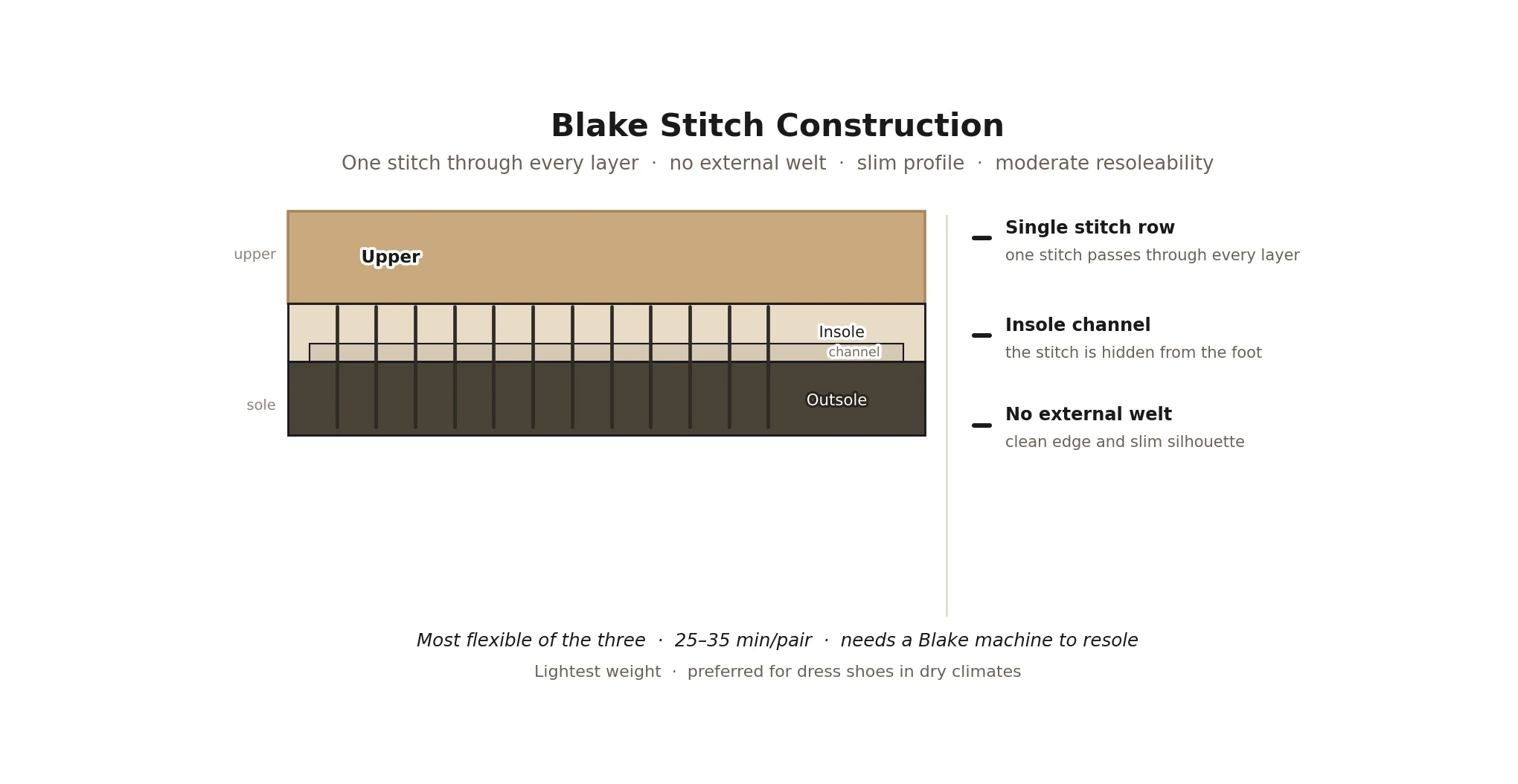
Blake stitch construction secures the sole with a single stitch row that passes through the outsole, insole and upper in one operation, with no external welt strip. That single row produces the slimmest edge profile of the three methods and the highest flexibility, and it costs 25-35 minutes per pair against 15-20 for cemented and 45-60 for Goodyear welt. Resoleability is possible but conditional, because a Blake stitch resole needs a specialised Blake stitching machine that not every cobbler owns. (Source: Wincheer Shoes factory production records, 2026-10.)
How Blake Stitch Construction Works
Blake stitch, invented by Lyman Blake in 1856, uses a single stitch that passes through the outsole, insole, and upper, directly connecting all three components. This creates a clean, lightweight profile with superior flexibility.
The Blake Stitch Process:
- Upper Lasting: The upper is lasted over the insole
- Channel Cutting: A channel is cut in the insole’s interior surface
- Stitching: A specialized Blake machine stitches through:
- Outsole (exterior)
- Midsole (if present)
- Insole (interior channel)
- Upper (between insole and outsole)
- Channel Closing: The insole channel is glued closed, hiding stitches from the foot
- Edge Finishing: The sole edge is trimmed and finished
Production Time: 25-35 minutes per shoe
Advantages of Blake Stitch
1. Aesthetic Superiority:
- Clean silhouette: No exterior welt
- Close sole edge: Minimal gap between upper and sole
- Lighter profile: Reduced bulk at sole attachment
- European elegance: Preferred by Italian shoemakers
2. Flexibility:
| Construction | Flexibility Rating (1-10) |
|---|---|
| Blake Stitch | 9/10 |
| Goodyear Welt | 6/10 |
| Cemented | 8/10 |
The single-row stitch creates exceptional flexibility, making Blake construction ideal for dress shoes and refined casual styles.
3. Resoleability:
- Can be resoled by competent cobblers
- Resoling preserves the upper
- Multiple resoling cycles possible (3-5 typical)
- Resole cost: $50-80
4. Water Resistance:
The stitch holes create potential water ingress points, but quality Blake shoes minimize this through:
- Tight stitching (8-10 stitches per inch)
- Water-resistant thread (nylon/polyester)
- Cork filling between insole and outsole
Limitations of Blake Stitch
1. Water Vulnerability:
| Exposure | Impact |
|---|---|
| Light rain | Generally fine |
| Heavy rain | Water ingress through stitch holes |
| Puddles | Saturated cork layer, potential damage |
| Snow | High risk of water damage |
Reality: Blake shoes are not ideal for wet climates unless treated with water repellents and worn cautiously.
2. Production Cost:
Blake stitching requires:
- Skilled operators (2-3x training vs. cementing)
- Expensive machinery ($80,000-150,000 per machine)
- Slower production (40-50% vs. cemented)
- Higher defect rates (5-8% vs. 2-3% cemented)
3. Repair Accessibility:
Not all cobblers can resole Blake shoes:
- Requires specialized Blake resoling machines
- Limited repair shops outside major cities
- Mail-in repair often necessary
- Higher repair cost than cemented shoes
Ideal Applications for Blake Stitch
Best Use Cases:
- Premium Dress Shoes: Oxfords, Derbies where sleek profile matters
- Dry Climate Markets: Mediterranean, Southern California
- Fashion-Conscious Buyers: Customers who prioritize aesthetics
- Light Duty Wear: Office, events, occasional use
- Indoor-Outdoor Transition: Shoes that see minimal wet conditions
Market Positioning:
Blake construction justifies retail prices of $150-300 when properly marketed and supported.
Why Is Goodyear Welt the Premium Standard?
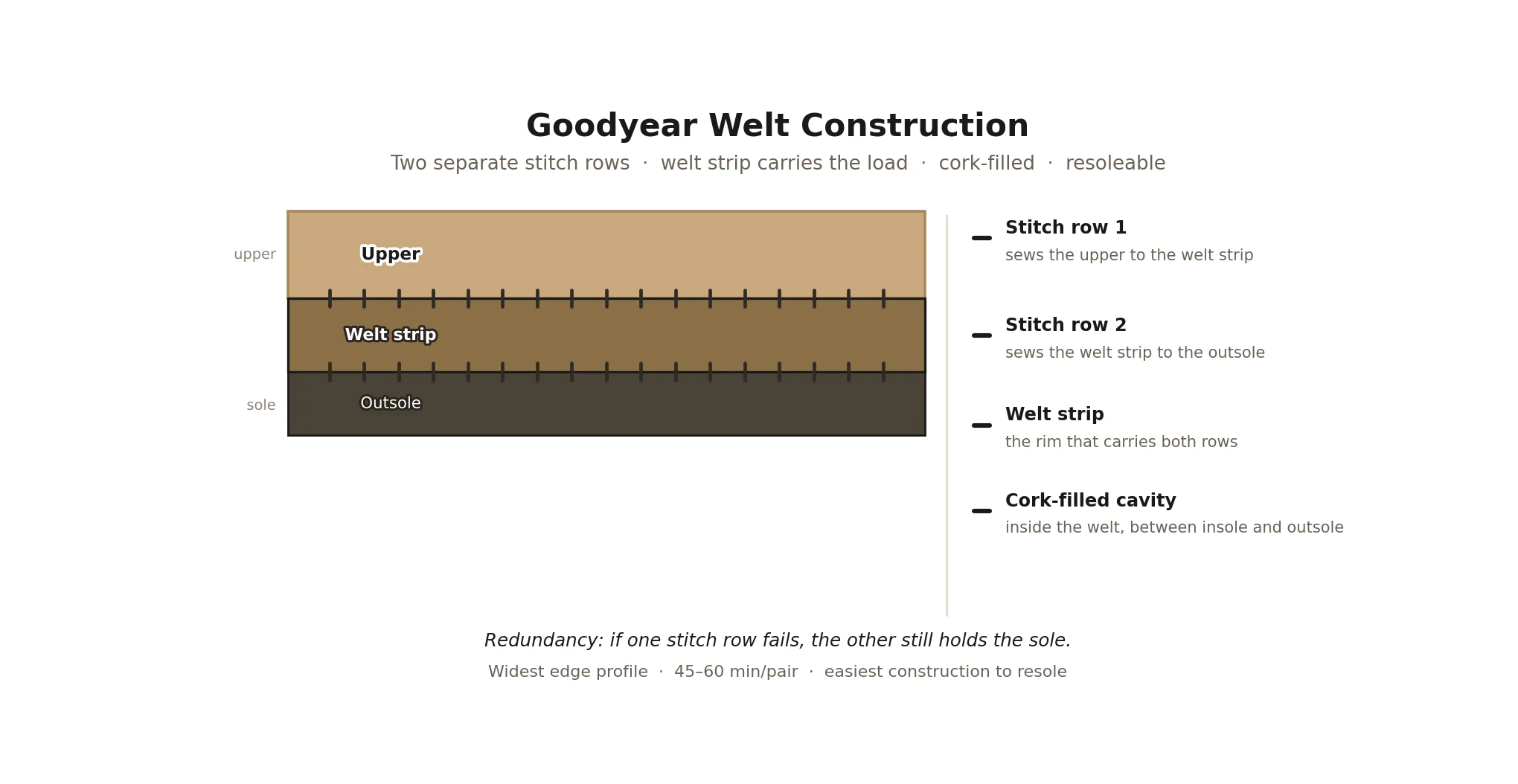
Goodyear welt construction is the only mainstream build that stays fully resoleable for the life of the shoe, because the welt strip lets a cobbler replace a worn outsole without touching the upper. That is why it carries the highest factory cost of the three constructions and the highest FOB band: roughly $74-103 per pair against $26-41 for a cemented shoe of comparable specification. It also runs 45-60 minutes per pair against 15-20 for cemented, which is why welted programmes carry higher minimum order quantities and longer lead times at the factory. (Source: Wincheer Shoes factory production and cost records, 2026-10.)
How Goodyear Welt Construction Works
Goodyear welt, invented by Charles Goodyear Jr. in 1869, uses a welt strip that runs around the perimeter of the shoe, attaching the upper to the outsole through two separate rows of stitching. This creates a robust, water-resistant bond.
The Goodyear Welt Process:
- Upper Lasting: The upper is lasted over the insole
- Rib Creation: A leather rib is attached to the insole (or built into the insole)
- Welt Attachment: The welt is stitched to the upper and rib (first stitch)
- Cork Filling: Porous cork fills the cavity between insole and outsole
- Outsole Attachment: The outsole is stitched to the welt (second stitch)
- Edge Finishing: The sole edge is trimmed, stained, and polished
Production Time: 45-60 minutes per shoe
Advantages of Goodyear Welt
1. Superior Durability:
Lifespan by Quality Tier:
| Quality Tier | Expected Lifespan | Resoling Cycles |
|---|---|---|
| Entry Goodyear | 8-12 years | 2-3 |
| Mid Goodyear | 12-18 years | 3-5 |
| Premium Goodyear | 18-25+ years | 5-8 |
The two-row stitch creates redundancy: if one stitch row fails, the other maintains sole attachment.
2. Water Resistance:
The welt creates a barrier against water ingress:
| Water Exposure | Goodyear Performance |
|---|---|
| Light rain | Excellent protection |
| Heavy rain | Minimal water ingress |
| Puddles | Resistant for limited time |
| Snow | Good protection with leather treatment |
3. Resoleability:
- Easiest construction to resole
- Preserves upper completely
- Unlimited resoling potential (theoretically)
- Resole cost: $70-120
- Widely available repair services
4. Comfort Development:
The cork layer molds to the wearer’s foot over time:
- Initial: 20-30 hours break-in period
- Developed: Custom foot contour after 100+ hours
- Long-term: Superior comfort compared to new shoes
Limitations of Goodyear Welt
1. Production Cost:
Cost Breakdown vs. Cemented:
| Cost Component | Multiplier vs. Cemented |
|---|---|
| Materials | 3.5x |
| Labor | 2.8x |
| Equipment | 6x |
| Production Time | 3x |
| Total Cost | 3.5-4.5x |
2. Stiffness:
The double-stitch construction creates initial stiffness:
- Break-in period: 20-40 hours of wear
- Not ideal for immediate comfort expectations
- Some customers find the welt edge uncomfortable
3. Weight:
The additional materials add weight:
- Goodyear welted shoe: 450-550g (size 42)
- Blake stitched: 380-450g
- Cemented: 350-420g
4. Sole Profile:
The welt creates a visible ridge:
- Not ideal for sleek, low-profile designs
- Can create visual bulk
- Some markets perceive as “old-fashioned”
Which Construction Suits Which Shoe Style
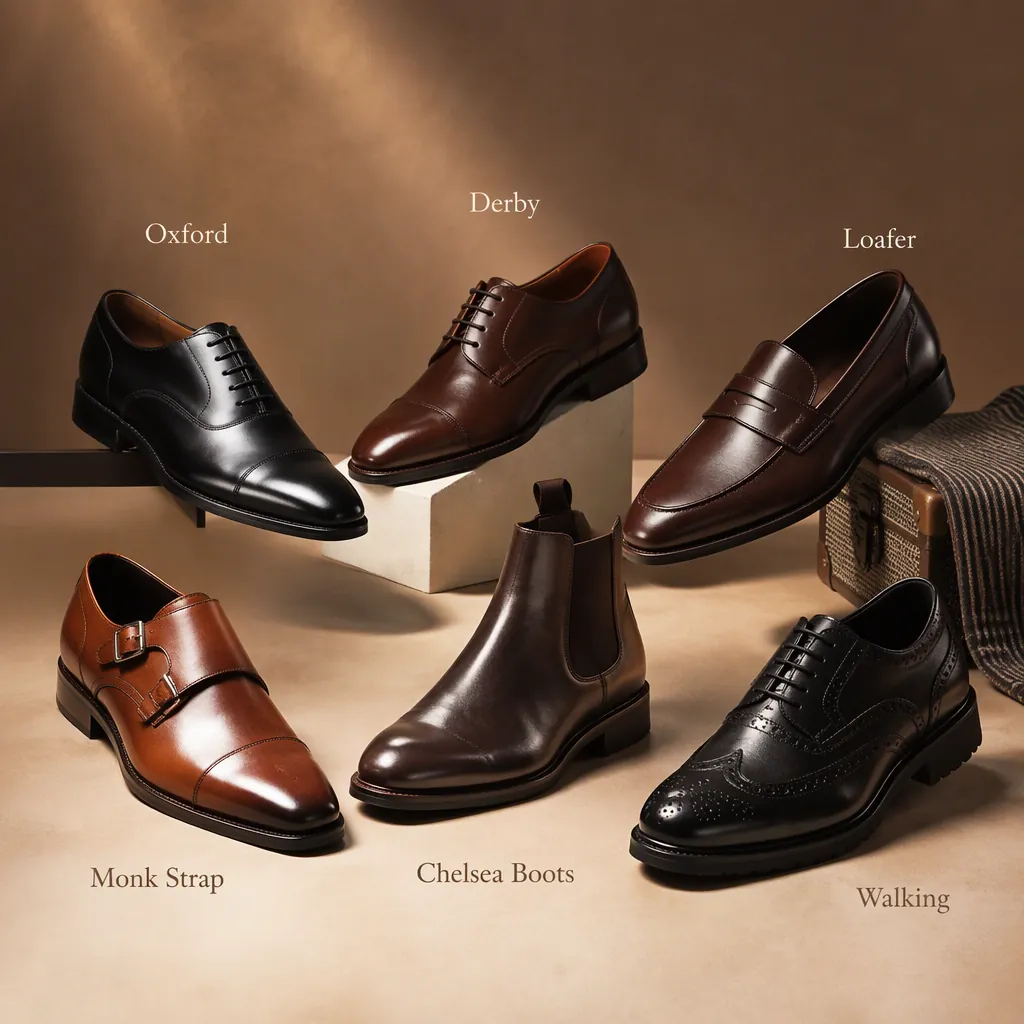
Construction follows the silhouette and the wear pattern of the style, and the mapping is fairly consistent across the industry. The table below is the shorthand most buyers work from.
| Shoe style | Best-fit construction | Also workable | Why |
|---|---|---|---|
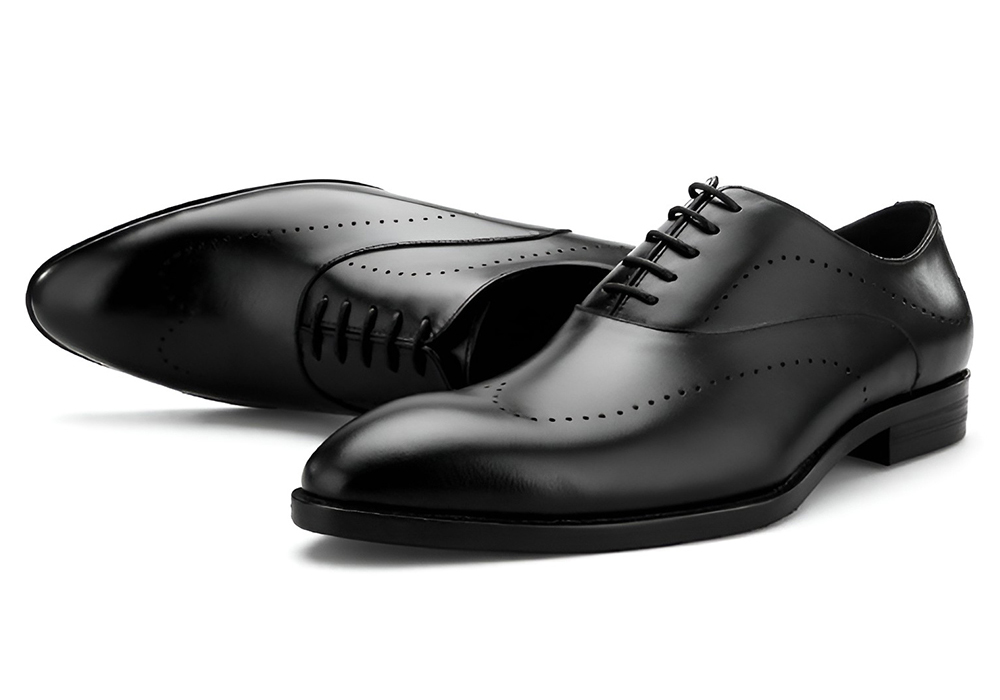
| Oxford (plain or cap-toe) | Goodyear welt | Blake stitch | The formal dress default. Welt if the buyer pays for resolability, Blake if the buyer wants a slim Italian profile. |
| Derby | Goodyear welt | Blake stitch | Open-lacing tolerates a slightly heavier sole, so the welted construction reads as substantial rather than clunky. |
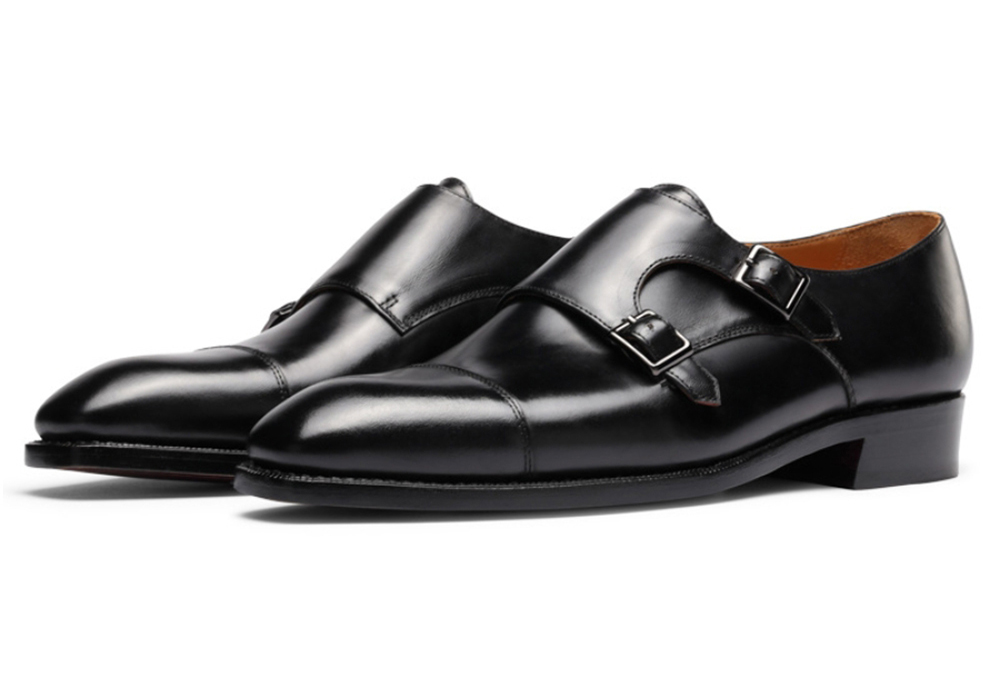
| Monk strap | Goodyear welt | Blake stitch, cemented | The buckle carries the visual weight, so the sole edge can stay conventional. See our monk strap shoes complete style guide for B2B buyers. |
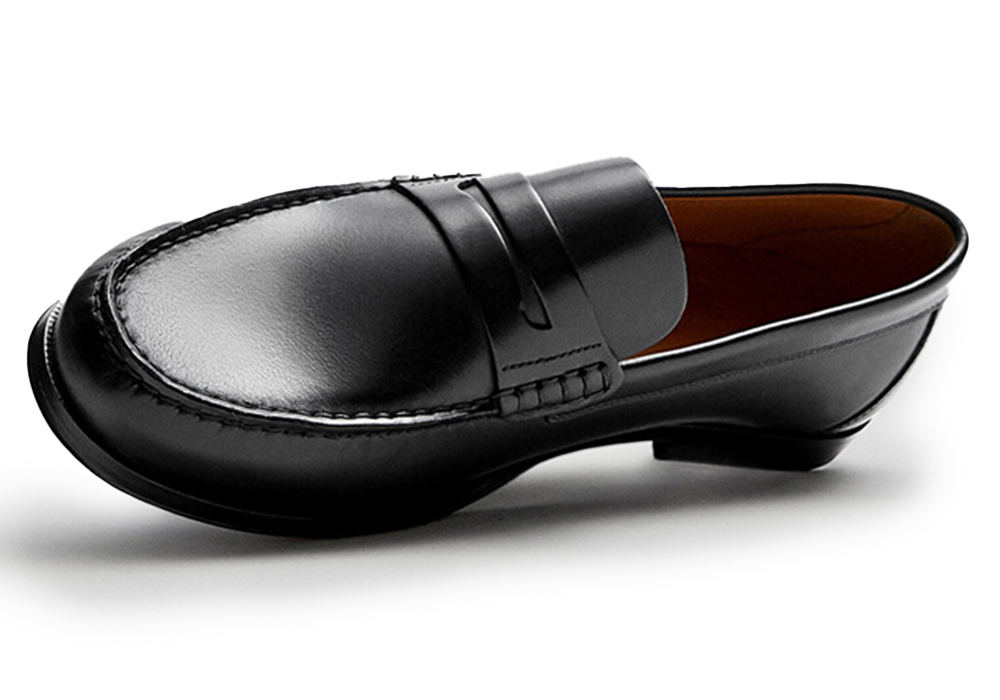
| Loafer (penny or horsebit) | Cemented for volume lines | Blake stitch, Goodyear welt | Slip-on casual programmes are usually price-led. Premium dress loafers move to Blake or welt. See our leather loafer manufacturing B2B buyers guide. |
| Chelsea boot | Goodyear welt or storm welt | Injection for safety lines | Boot lasts are heavy and wet-weather programmes need a resoleable, water-resistant build. |
| Casual walking and comfort shoes | Cemented | Strobel, injection | Comfort footwear optimises for a soft footbed and light weight, not for a welt edge. |
| Fashion and seasonal styles | Cemented | — | Fast production and design flexibility, with the lowest minimum order quantity. |
Two caveats on the mapping. First, silhouette still overrides price: a slim-profile Oxford with a dress consumer almost always lands in Blake stitch even if the brand could afford welt, because a welt ridge contradicts the profile the buyer is paying for. Second, the construction is a property of the shoe, not of the style name, so the same style can legitimately run in two constructions within one catalogue as long as the price bands are separated.
Ideal Applications for Goodyear Welt
Best Use Cases:
- Premium Dress Shoes: Investment-quality footwear
- Boots: Work boots, dress boots requiring durability
- Adverse Climates: Wet/cold environments
- Heavy Use: Daily wear, extensive walking
- Heritage/Luxury Brands: Emphasizing craftsmanship and longevity
Market Positioning:
Goodyear construction justifies retail prices of $250-500+ for established brands and $180-250 for emerging premium brands.
What Other Construction Methods Should You Know?
Beyond the big three, four more constructions appear regularly in B2B line sheets. Knowing where they fit keeps your sourcing conversations precise.
Vulcanized Construction
Vulcanized construction bonds a rubber outsole to the upper by heat-curing raw rubber in an oven. It is the classic sneakers construction: extremely flexible out of the box and cheap at volume, but not resoleable and moderate in durability — expect 1-3 years of hard use. Choose it for casual, rubber-soled SKUs, not for dress lines.
Strobel Construction
Strobel construction stitches the upper to a fabric board that becomes the bottom of the shoe, then cements that unit to the outsole. It is the standard for athletic and comfort footwear because it saves weight and cost while keeping the footbed flat for orthotics. Durability sits near cemented construction; its strength is production speed for high-SKU programmes.
Two practical notes for buyers planning Strobel programmes. First, lifespan is decided by the midsole, not the stitch: in sneaker builds the EVA midsole typically flattens long before the Strobel seam gives way, so the serviceable life of the shoe is a foam-spec decision, not a construction decision. Second, at quotation stage the Strobel board-stitch is the default assumption for sneaker and casual programmes — the choice that actually moves cost and story is Strobel versus cupsole or vulcanized, because only a stitched-cup combination preserves any resole narrative at all.
That second point is the B2B decision: if your brand sells a buy-it-for-years story, step up to a resoleable construction; if the line is a seasonal volume play, Strobel with a properly spec’d midsole is the efficient answer, and the construction choice simply stops being the bottleneck.
Norwegian (Norvegese) Construction
Norwegian construction is a hand-welted cousin of Goodyear welt in which the welt is folded outward and the stitching sits visibly on the outside of the shoe. It is the most water-resistant construction in mainstream production and signals top-tier craftsmanship — retail $500+ territory. Lead times are long and capacity is scarce, so treat it as a halo-SKU option.
Storm Welt Construction
Storm welt is a modified Goodyear welt with a raised, wider welt strip that shields the stitching channel and seals against rain. It keeps nearly all Goodyear welt durability and resoleability while adding wet-weather performance — a common upgrade for country boots and autumn/winter dress lines. FOB premium over standard Goodyear welt: roughly $2-4 per pair.
Why Is Hand Welted Construction the Peak of the Craft?
Hand welted construction is the handmade ancestor of the Goodyear welt. Instead of a machine-spun rib, a craftsman carves a holdfast directly into the insole edge and hand-stitches the welt to the upper, lining and insole in a single locked seam. Because the seam follows the exact last of each pair, fit precision is the best available at any price, and the whole structure stays flexible enough to mold to the wearer over years of use.
The trade-off is production speed: hand-sewing the welt takes three to four hours of skilled labor per pair, several times the machine time of a Goodyear line. In durability terms the reward is a shoe that can be resoled essentially indefinitely, because the carved holdfast in the insole edge can be re-cut and re-stitched instead of replaced.
For B2B buyers, hand welted work is a flagship-line capability rather than a volume option. It suits luxury and bespoke collaborations where the retail price carries the labor premium, and where production is quoted in pairs per day rather than pairs per month. If your business plan needs a hand-made story at the top of the range, position it as a halo product above your Goodyear tier — not as a replacement for it.
What Is Blake Rapid Construction and Who Should Buy It?
Blake rapid construction starts with a standard Blake stitch and then adds a second seam around the outsole edge, a variant of the historic McKay system. The result looks closer to a welted shoe — you get the visible welt edge that sells on shelf — while the internal structure remains a flexible Blake build.
Position it as the mid-market compromise: unit cost sits between pure Blake and full Goodyear, and the added outsole seam keeps water away from the main stitch line, so daily wear holds up better than pure Blake in wet conditions. The build can typically take one or two resoles before the insole edge gives out.
B2B buyers should treat Blake rapid as the workhorse for mid-tier dress lines that need welted styling without a Goodyear budget. For a manufacturer the upgrade is a single additional outsole-seaming station on an existing Blake line, which keeps MOQ and lead times close to standard Blake programmes — ask your supplier to quote both side by side before you commit the line.
When Is Injection (Direct Attach) Construction the Right Call?
Injection construction — often called direct attach — molds a PU or TPR sole directly onto the lasted upper, skipping the separate outsole bonding step entirely. With no glue line to fail, the joint is inherently waterproof, and batch-to-batch consistency is the highest of any method in this guide, which is why work boots and rain footwear default to it.
Durability is a one-body proposition: the sole and upper live and die as a single unit and the shoe cannot be resoled. Lifecycle is decided by the midsole material, so spec the PU/TPR compound for the duty cycle your market expects rather than relying on construction alone.
For B2B programmes, injection is the right call for high-turnover fashion lines, utility and safety-adjacent footwear, and any range where unit cost and MOQ matter more than repairability. Because one injection machine serves one mold at a time, it rewards concentrated SKUs: fewer models, deeper runs, sharper unit economics. It scales within the same cemented-capacity band as the volume lines described below.
How Do Blake Stitch, Goodyear Welt and Cemented Compare Directly?
Side-by-Side Comparison Table
| Characteristic | Cemented | Blake Stitch | Goodyear Welt |
|---|---|---|---|
| Production Time | 15-20 min | 25-35 min | 45-60 min |
| Material Cost | $3-5 | $8-12 | $12-18 |
| Labor Skill | Low | Medium | High |
| Equipment Cost | $50K | $120K | $500K+ |
| FOB Price Range | $26-41 | $47-70 | $74-103 |
| Retail Price Range | $50-150 | $150-300 | $250-500+ |
| Typical Lifespan | 3-5 years | 5-10 years | 8-20+ years |
| Resoleability | Difficult | Moderate | Easy |
| Resole Cost | $40-60 | $50-80 | $70-120 |
| Water Resistance | Good | Fair | Excellent |
| Flexibility | High (8/10) | Very High (9/10) | Medium (6/10) |
| Break-in Period | Minimal | Minimal | 20-40 hours |
| Weight (size 42) | 350-420g | 380-450g | 450-550g |
| Repair Availability | Limited | Select | Widespread |
| Aesthetic Profile | Clean | Sleek | Substantial |
Decision Matrix by Use Case
For Specific Customer Needs:
| Customer Need | Recommended Construction |
|---|---|
| Budget-conscious | Cemented |
| Fashion-forward | Blake or Cemented |
| Daily commuter | Goodyear Welt |
| Wet climate | Goodyear Welt |
| Dry climate, style-focused | Blake |
| Investment purchase | Goodyear Welt |
| Light duty office wear | Cemented or Blake |
| Heavy outdoor use | Goodyear Welt |
| Travel versatility | Cemented (lightweight) |
| Heritage brand identity | Goodyear Welt |
The matrix above reads from the customer’s side. The table below flips it to the procurement side — how the same construction choices trade off cost band, resole capability and programme economics when you are briefing a factory.
| Procurement Scenario | Recommended Construction | Cost Band | Resole Capability | Why |
|---|---|---|---|---|
| Mid-to-premium dress retail | Goodyear / Blake | Mid–high | Multiple / 1–2 | Welted shelf appeal plus a repeat-purchase story |
| Flagship / bespoke line | Hand welted | Highest | Indefinite re-stitch | Hand-made premium supports flagship pricing |
| Mid-market, welted look on a budget | Blake rapid | Mid | 1–2 | Welted edge styling at Blake-level cost |
| Fast-fashion, high turnover | Cemented / Injection | Low | None | One-season body, MOQ-friendly, sharpest unit cost |
| Sport / casual programme | Strobel / Cupsole | Mid | None | Lightweight comfort first; midsole spec sets lifespan |
| Outdoor and wet-weather lines | Storm welt / Norwegian | Mid–high | Yes | Strongest structural water resistance |
Two factory-side numbers to take into a sourcing conversation: sample lead time and MOQ both rise with construction complexity — a Goodyear welted programme carries slower sampling and a higher MOQ than a cemented one, because welted lines run fewer pairs per day. If you are mapping these options against a wholesale range, our wholesale leather shoes guide shows how the construction split looks across a resale catalogue, or you can contact us for a construction-matched quotation.
Visual Construction Differences
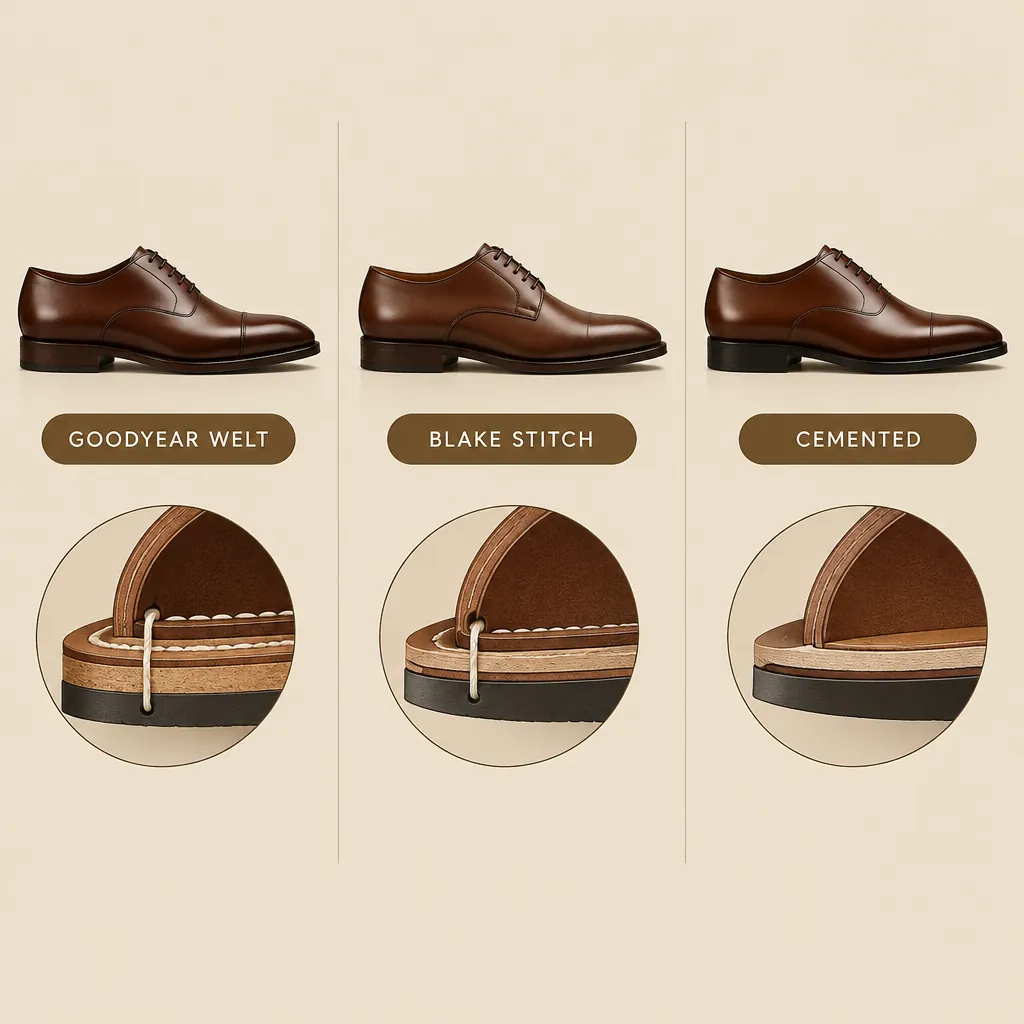
Three cross-sections, drawn on the same shoe-last geometry, make the difference between the three methods obvious at a glance. Put them side by side and the identifying feature of each construction is immediate: the number of stitch rows, and whether a welt strip is present.
Reading a finished shoe in the hand: look at the sole edge. A clean bond with no visible stitching means cemented. A single row of stitching with no welt ridge means Blake stitch. A raised welt strip carrying two distinct stitch rows means Goodyear welt.
How Does Each Construction Affect Cost and Retail Pricing?
Manufacturing Cost Breakdown
Per-Pair Manufacturing Costs (Size 42 Oxford):
| Cost Category | Cemented | Blake | Goodyear |
|---|---|---|---|
| Upper Leather | $8-12 | $10-15 | $12-18 |
| Lining | $2-3 | $3-4 | $4-5 |
| Insole | $1-2 | $3-5 | $6-8 |
| Outsole | $3-5 | $5-8 | $8-12 |
| Construction Materials | $1-2 | $3-4 | $6-8 |
| Labor | $4-6 | $10-15 | $18-25 |
| Overhead | $3-4 | $5-7 | $8-10 |
| TOTAL FACTORY COST | $22-34 | $39-58 | $62-86 |
| + Factory Margin (20%) | $26-41 | $47-70 | $74-103 |
| ESTIMATED FOB (factory cost + margin) | $26-41 | $47-70 | $74-103 |
Retail Price Multiples
Typical Retail Price Structure:
| Price Point | Cemented | Blake | Goodyear |
|---|---|---|---|
| Entry | $50-80 | N/A | N/A |
| Mid | $80-120 | $150-200 | N/A |
| Premium | $120-150 | $200-300 | $250-350 |
| Luxury | N/A | $300-400 | $350-500+ |
| Ultra-Luxury | N/A | $400+ | $500+ |
Margin Analysis:
At each price point, brands must balance:
- Manufacturing cost
- Understanding Leather Shoe MOQ: Minimum Order Quantities in China Manufacturing MOQ requirements
- Marketing spend
- Retail margin requirements
- After-sales service costs
- Return rates
Breakeven Analysis
Volume Requirements for Profitability (industry-typical):
| Construction | Min Order for Profit | Industry-typical MOQ |
|---|---|---|
| Cemented | 300 pairs/style | 600-1200 pairs |
| Blake | 500 pairs/style | 800-1500 pairs |
| Goodyear | 800 pairs/style | 1200-2000 pairs |
Higher constructions require larger volumes to amortize:
- Setup costs
- Skilled labor training
- Equipment investment
- Quality control overhead
How Long Does Each Construction Actually Last?
Lifespan in a Goodyear welted shoe is decided by usage intensity, not by the construction alone. Across light office wear the same welted build typically runs 15-20 years, under daily urban walking 10-15 years, and under heavy outdoor use 6-10 years, with resoles extending it further because the welt lets the outsole be replaced instead of the shoe discarded. We do not publish per-construction lifespan promises for that reason, and we do not publish them because service life depends far more on how the shoe is worn than on how it is built. (Source: Wincheer Shoes production and after-sales records, 2026-10.)
The short answer on durability: Goodyear welt is the most durable shoe construction method in mainstream production — 15-20+ years of light office service and multiple resoles. Blake stitch is moderately durable (8-12 years, one careful resole). Cemented construction is the least durable (1-5 years, no resole). The lifespan table below turns that ranking into numbers you can put in a business plan.
Lifespan by Construction Method
Years of Service by Usage Pattern:
| Usage Pattern | Cemented | Blake | Goodyear |
|---|---|---|---|
| Light Office (2-3x/week, indoors) | 5-7 years | 8-12 years | 15-20+ years |
| Daily Urban (5x/week, city walking) | 2-4 years | 5-8 years | 10-15 years |
| Heavy Use (daily, extensive walking) | 1-3 years | 4-6 years | 8-12 years |
| Outdoor/Field | 1-2 years | 3-5 years | 6-10 years |
Failure Mode Analysis
How Shoes Fail by Construction:
| Construction | Primary Failure Mode | Secondary Failure Mode |
|---|---|---|
| Cemented | Sole separation (adhesive failure) | Upper cracking from flex |
| Blake | Sole wear through | Water damage to cork |
| Goodyear | Sole wear through | Welt stitching failure (rare) |
Knowing which failure mode to expect changes how you spec the shoe. A cemented sole fails at the bond line, which is a manufacturing quality question. A welted sole fails by wearing through the outsole, which is a materials question. The tables below break both down by failure type, cause, prevention and repairability.
Goodyear welted failure modes:
| Failure Type | Typical Cause | Prevention | Repairability |
|---|---|---|---|
| Welt seam separation | Excessive stress or stitching damage | Quality construction, proper use | Yes (rewelt) |
| Outsole wear through | Normal abrasion | Resoling before complete wear | Yes (resole) |
| Insole compression | Long-term use | Cork replacement possible | Yes (cork refill) |
| Upper leather failure | Material quality or wear | Quality materials, care | Sometimes (rebuild) |
| Heel wear | Normal abrasion | Heel replacement | Yes |
Cemented failure modes:
| Failure Type | Typical Cause | Prevention | Repairability |
|---|---|---|---|
| Sole delamination | Adhesive failure, water exposure | Quality adhesives, seam sealing | Limited (rebuild) |
| Outsole wear through | Normal abrasion | Quality outsole materials | No |
| Upper failure | Material quality or wear | Quality materials, care | Limited |
| Flex cracking | Material brittleness | Quality materials, rotation | No |
Repair Cost vs. Replacement Value:
| Construction | Replacement Value | Repair Cost | Repair Makes Sense? |
|---|---|---|---|
| Cemented ($80 retail) | $80 | $50 | Sometimes (60% of new) |
| Blake ($200 retail) | $200 | $65 | Yes (33% of new) |
| Goodyear ($350 retail) | $350 | $90 | Definitely (26% of new) |
For the failure modes each construction produces and what they mean for your after-sales cost, see Failure Mode Analysis and Which Constructions Can Be Resoled and Repaired? below.
Where these numbers come from: the usage-pattern table above reflects broad industry consensus on welted versus stitched versus cemented lifecycles — welted construction leads because the welt can be replaced, while cemented and injection builds live as a single body. What we can add from the factory side: across our cemented and injection output, warranty returns cluster around glue-line and stitching defects that are attributable and correctable in process, and in 2026 our overall defect rate across outgoing batches still runs 0.8–1.2%. Welted programmes generate a different after-sales pattern — far fewer defects, and the requests that do come back are resole jobs, which is a service revenue opportunity rather than a quality failure.
One honest caveat for your planning: we do not publish per-construction lifespan promises, because service life depends far more on usage intensity and climate than on construction alone — a daily-walked cemented shoe in a rainy city will not outlast a rotation-worn Blake pair in a dry one. Use the usage-pattern table above as the planning band, and judge suppliers on their defect-rate and after-sales transparency rather than on lifespan marketing numbers.
Which Constructions Can Be Resoled and Repaired?
Resoleability Comparison
Ease of Resoling:
| Construction | Resole Difficulty | Resole Time | Resole Cost |
|---|---|---|---|
| Cemented | Difficult | 2-3 weeks | $40-60 |
| Blake | Moderate | 3-4 weeks | $50-80 |
| Goodyear | Easy | 1-2 weeks | $70-120 |
Resole Cycle Limits:
| Construction | Typical Resoles Before Retirement | Total Possible Lifespan |
|---|---|---|
| Cemented | 0-1 (rarely done) | 3-6 years |
| Blake | 3-5 | 8-15 years |
| Goodyear | 5-8+ | 15-30 years |
Repair Infrastructure
Global Repair Availability:
| Construction | Major Cities | Mid Cities | Small Cities | Rural |
|---|---|---|---|---|
| Cemented | Limited | Very Limited | None | None |
| Blake | Select | Rare | None | None |
| Goodyear | Widespread | Available | Limited | Rare |
Customer Communication:
When selling premium constructions, educate customers about:
- Local repair options
- Mail-in repair services
- Resoling value proposition
- Proper care to extend lifespan
Which Sole Materials Pair with Each Construction?
Construction describes how the sole is attached; sole material determines how that attachment performs in the wild. The two choices are made together, and buyers should lock both in the tech pack.
Leather soles remain the formal standard: sleek, breathable, and the traditional partner for Blake and Goodyear welted dress shoes. They absorb moisture, so they suit dry climates and office-to-dinner wear rather than wet commutes. Rubber soles trade some formality for traction, shock absorption, and water resistance, which makes them the default for casual lines and rainy markets; many dress programs now specify leather soles with rubber inserts for exactly this reason. Crepe soles, natural latex with a soft cushioned feel, show up in desert boots and casual silhouettes where comfort leads and longevity is secondary. Composite soles blend layers – typically a leather look with rubber pads – to split the difference on grip, weight, and cost.
From a production standpoint, sole material changes tooling and cost almost as much as construction method does, so confirm both with your factory at the sampling stage rather than after pricing.
Which Construction Fits Your Target Market?
Market Segment Analysis
Entry Market ($50-80 retail):
- Recommended: Cemented
- Customer: Value-focused, trend-conscious
- Expectation: 2-3 years wear
- Marketing: Style, value, immediate comfort
Mid Market ($80-150 retail):
- Recommended: Premium Cemented or Entry Blake
- Customer: Quality-conscious, budget-aware
- Expectation: 4-6 years wear
- Marketing: Style + quality balance
Premium Market ($150-300 retail):
- Recommended: Blake or Entry Goodyear
- Customer: Investment purchasers
- Expectation: 8-15 years wear
- Marketing: Craftsmanship, longevity, resoleability
Luxury Market ($300+ retail):
- Recommended: Goodyear or Handwelted
- Customer: Connoisseurs, collectors
- Expectation: 15+ years wear
- Marketing: Heritage, artisan quality, investment value
Consumer Segment Expectations
Price band is only half of the decision. The other half is what buyers in each segment already assume a quality shoe is made of, and what they will notice if it is not. The same construction can read as premium in one segment and as a compromise in another, so segment expectation is a separate input from retail price.
| Segment | Construction Preference | Key Decision Factors |
|---|---|---|
| Luxury consumers | Goodyear welted expected | Heritage, craftsmanship, longevity |
| Premium consumers | Variable, often Goodyear preferred | Quality perception, price-value |
| Mid-market consumers | Both depending on brand | Brand story, styling, price |
| Young/fashion consumers | Cemented often preferred | Style, price, disposability acceptance |
| Professional/corporate | Goodyear or quality cemented | Durability for heavy use, appearance |
Brand Positioning Framework
Two questions decide most construction selections for a private label brand, and the price band usually answers the first one before any factory conversation starts.
Is your brand positioned above $250 MSRP?
├── YES → Goodyear welted should be primary construction
└── NO ↓

Is your brand positioned above $150 MSRP?
├── YES → Consider both; Goodyear signals quality, premium cemented offers value
└── NO ↓

Is your consumer likely to keep shoes 3+ years?
├── YES → Consider Goodyear for key styles despite lower price point
└── NO ↓

Cemented construction appropriate; focus on material quality within cemented category
Notice what the framework optimises for. Above $250 the buyer is paying for the construction itself, so the construction has to be visible in the product. Between $150 and $250 the buyer is paying for a quality signal that the construction should support but need not dominate. Below $150 the buyer is paying for leather and finish, so material quality inside the cemented category matters more than the construction method, which is why an expensive-looking upper on a cemented sole can still sell at that band provided the finishing is right.
Climate Considerations
Wet Climates (UK, Pacific Northwest):
| Construction | Recommendation | Reasoning |
|---|---|---|
| Goodyear | Excellent | Superior water resistance |
| Blake | Fair | Requires careful use |
| Cemented | Good | Modern adhesives perform well |
Dry Climates (California, Mediterranean):
| Construction | Recommendation | Reasoning |
|---|---|---|
| Blake | Excellent | Aesthetics shine without water risk |
| Goodyear | Good | Durability still valuable |
| Cemented | Good | Cost-effective option |
How to Select a Construction for Your Product Line
Construction selection follows the retail price point first. A brand positioned above $250 MSRP should run Goodyear welt as its primary construction, because at that price the buyer is paying for the construction itself and expects it to be visible in the product. Between $100 and $250 MSRP, Blake stitch is the strongest candidate, and below $150 cemented construction with attention to material quality inside the cemented category is the appropriate answer. (Source: Wincheer Shoes construction selection framework, 2026-10.)
The construction decision should start with your retail price point and your customer expectations, not with what looks impressive on a spec sheet. Work through it in this order and the specification writes itself.
For premium/heritage positioning ($250+ retail): Goodyear welt is the standard. Customers at this price point expect resolability and long-term value, and the cork filler also provides a comfort story, because the shoe molds to the foot over time. This is the construction behind most classic British and American dress shoe brands.
For mid-market dress shoes ($100–$250 retail): Blake stitch is the dominant choice. It delivers a refined aesthetic, genuine craftsmanship, and a price point that works for both the manufacturer and the retailer. Italian-style dress shoes, slim-profile Oxfords, and fashion-forward Derby styles all perform well in Blake stitch.
For fashion/casual/entry-level ($50–$150 retail): Cemented construction is the practical choice. Fast production, lower cost, and design flexibility make it ideal for trend-driven SKUs with shorter lifecycle expectations.
Where the mid-premium hybrid fits: Blake rapid adds a midsole between the insole and the outsole, so it can be resoled without a Blake stitching machine. It carries more water resistance than standard Blake stitch while keeping a slimmer profile than Goodyear welt, at a moderate cost premium. It is covered in detail in What Is Blake Rapid Construction and Who Should Buy It? above.
For the technical standards that govern occupational footwear construction, including welt and sole attachment requirements, the EN ISO 20347 standard itself, the ISO footwear terminology reference, and the physical test methods published by SATRA Footwear Technology, provide useful reference points.
B2B Construction Selection Checklist
Use this checklist before finalizing your construction specification with any manufacturer. It is the sequence we work through internally, and each step is a place where a wrong construction choice becomes expensive later rather than at sample stage.
Step 1 — Define your retail price point
- Under $100 retail → Cemented is likely the right fit
- $100–$250 retail → Blake stitch is the primary candidate
- $250+ retail → Goodyear welt should be the default
Step 2 — Assess your customer usage expectations
- Fashion/seasonal buyer (replaces shoes every 1–2 seasons) → Cemented or Blake stitch
- Quality-conscious buyer who expects 5+ years of wear → Blake stitch or Goodyear welt
- Heritage/investment buyer who expects resoling → Goodyear welt only
Step 3 — Evaluate your silhouette requirements
- Slim, sleek profile required → Blake stitch
- Classic, substantial profile acceptable → Goodyear welt
- Complex outsole shape or lightweight priority → Cemented
Step 4 — Check manufacturer capability
- Confirm the factory has Blake stitching machines, because not all do
- Confirm Goodyear welt capability, which requires specialized lasting and stitching equipment
- Request construction samples and cross-section cuts before approving production
Capability is the step buyers most often skip. A factory can quote all three constructions and only be equipped for one of them, so the equipment list is worth checking directly rather than taking the capability table at face value. Our shoe manufacturer guide covers what to verify when you audit a supplier actual production setup.
Step 5 — Verify compliance requirements
- EU market: confirm CE (EN ISO 20347) compliance for occupational footwear
- EU market: confirm REACH compliance for adhesives and leather treatments
- Request test reports, not just verbal certification claims
Step 6 — Negotiate MOQ and sampling terms
- Confirm MOQ for your chosen construction, since custom constructions typically require higher minimums
- Request pre-production samples in your specified construction before committing to a full order
For a broader sourcing framework, our OEM/ODM mens genuine leather shoes manufacturer guide covers the full OEM process from specification to delivery, and our AQL inspection footwear quality control guide covers what to verify on the first production run.
What Should B2B Buyers Know About Production and MOQ?
MOQ and Development Implications
Minimum Order Quantities (industry-typical):
| Construction | Industry-typical MOQ | Setup Considerations |
|---|---|---|
| Cemented | 600-1200 pairs/style | Minimal setup, fast sampling |
| Blake | 800-1500 pairs/style | Moderate setup, specialized lasts |
| Goodyear | 1200-2000 pairs/style | Extensive setup, skilled craftspeople |
These are industry-typical minimums for each construction type across the wider market, useful for budgeting a programme. They are not Wincheer minimums: our own low-MOQ programme starts at 60 pairs per style for custom OEM designs, with no minimum on existing catalogue designs and sampling from a single pair. See our MOQ guide for how minimums vary by construction and how to negotiate them.
Development Timeline:
| Construction | Sample Lead Time | Production Lead Time |
|---|---|---|
| Cemented | 3-4 weeks | 6-8 weeks |
| Blake | 4-5 weeks | 8-10 weeks |
| Goodyear | 5-6 weeks | 10-14 weeks |
Quality Control Differences
Common Defects by Construction:
| Construction | Common Defects | Detection Point |
|---|---|---|
| Cemented | Sole separation, adhesive failure | 100% inspection |
| Blake | Missed stitches, channel issues | 30% inspection + stitch testing |
| Goodyear | Uneven stitching, welt attachment | 20% inspection + pull testing |
Quality Control Investment:
| Construction | QC Cost per Pair | QC Staff Ratio |
|---|---|---|
| Cemented | $0.80-1.20 | 1:2000 pairs |
| Blake | $1.50-2.50 | 1:1500 pairs |
| Goodyear | $2.00-3.50 | 1:1000 pairs |
Working with Wincheer Shoes
Our Construction Capabilities:
Wincheer Shoes manufactures all three constructions at our production lines in Jiangmen, Guangdong, about 1.5 hours from Guangzhou. We have warehouses and showrooms in both Shanghai and Jiangmen, and we warmly welcome you to visit our production lines.
Our standard commercial terms:
| Term | Wincheer standard |
|---|---|
| Minimum order quantity | 60 pairs per style for custom OEM designs; zero minimum on existing catalogue designs; sampling from 1 pair |
| Price range | $25-40 per pair FOB, size-graded, depending on construction, leather grade and order volume |
| Annual production | 500,000+ pairs per year |
| Defect rate | 0.8-1.2% against an industry average of 2-4% |
| Certifications | CE, REACH, RoHS, EN-ISO 20347 |
| Lead time | 30-45 days on bulk production for standard styles |
(Source tier: first-party — wincheershoes.com live variable product pricing, plus our own factory production and QC records, 2026-10)
Those are the terms that apply to the standard leather dress shoe programme. The construction model further up this page shows what each construction adds on top of that baseline in materials, labour and machine time, and why premium constructions are quoted separately. The three construction lines run at different throughputs, because a Goodyear welted pair takes roughly three times the production time of a cemented pair on the same line, so welted programmes are scheduled against skilled welter availability rather than against general line capacity.
For the full range of what we can build, and how to evaluate a supplier production setup rather than taking a capability table at face value, see our Our Recommendation Process: The Complete OEM/ODM Shoe Development Process: From Concept to Mass Production for development details. A: For most startups, cemented construction offers the best balance of cost, quality, and market acceptance. At retail prices of $80-120, cemented shoes can offer excellent value when made with quality leather and construction. Move to Blake or Goodyear only when your brand positioning and retail price point ($200+) justify the 40-60% cost increase. A: Yes, but it’s difficult and expensive. Resoling cemented shoes requires specialized equipment and expertise, costing $40-60. The resoling process can damage the upper, and success isn’t guaranteed. For shoes under $150 retail, replacement is usually more economical than resoling. A: Not always. Goodyear excels in durability and water resistance, making it ideal for heavy use and wet climates. Blake offers superior flexibility and a sleeker profile, preferred for dress shoes in dry climates. For formal wear and style-focused customers, Blake may be the better choice despite less durability. A: Examine the shoe’s sole attachment: Additionally, check the product description or manufacturer specifications. When in doubt, consult the manufacturer directly. A: Italian shoemaking traditions emphasize sleek profiles and elegant silhouettes. Blake stitch creates a cleaner, lighter shoe without the visible welt of Goodyear construction. Additionally, Italy’s generally drier climate mitigates Blake’s water vulnerability. The construction aligns with Italian aesthetic preferences for refined, minimalist footwear. A: Handwelted construction is the traditional method where a craftsman hand-sews the welt to the upper and insole using traditional techniques. Unlike Goodyear’s machine-made rib, handwelted uses a handmade holdfast carved into the insole. This creates an even more durable, water-resistant bond but requires 3-4 hours of skilled labor per pair. Handwelted shoes start at $500+ retail. A: Construction adds incremental weight: The difference comes from additional materials (welt, cork) and construction complexity. For customers sensitive to weight, this can be a deciding factor. A: Yes, and this is common. Many brands use: A: Goodyear welt construction is the most durable method in mainstream production. With periodic resoling, a Goodyear welted shoe lasts 10-20 years of regular wear, because the welt strip lets a cobbler replace the outsole without touching the upper. Hand-welted and Norwegian construction match or exceed it at premium price points. Blake stitch delivers 4-8 years with one careful resole, and cemented construction — with no resole possible — tops out at 1-5 years depending on adhesive quality and usage. This allows you to serve different customer segments and price points within one brand. Just ensure clear communication so customers understand the differences. A: Goodyear construction costs 3.5-4.5x more to produce than cemented. For a typical Oxford shoe: This translates to retail price differences of $150-250. The higher cost reflects skilled labor, expensive materials, and specialized equipment. A: Most vegan shoes use cemented construction because it works well with synthetic materials and doesn’t require leather components (welt, rib). However, Blake and Goodyear constructions can be adapted for vegan materials using synthetic welts and specialized techniques. Expect 20-30% higher costs for non-leather welted constructions. A: Look at the sole edge and count the stitch rows. A clean bond with no visible stitching means cemented. A single row of stitching with no welt ridge means Blake stitch. A raised welt strip carrying two rows of stitching means Goodyear welt. The cross-sections earlier in this guide show all three side by side, drawn on identical geometry, which makes the difference much easier to confirm than on a finished shoe. A: Start from your retail price point, then narrow by your customer usage expectations and the silhouette you need. Under $100 retail points to cemented, $100-250 to Blake stitch, and $250+ to Goodyear welt. Then confirm the factory actually has the equipment for the construction you chose, and request construction samples with cross-section cuts before approving production. The B2B construction selection checklist above walks through all six steps. A: Usually yes, if your price point sits between entry-level cemented lines and full Goodyear retail. Blake rapid adds one outsole-seaming step to a standard Blake build, so unit cost rises well below what a Goodyear programme adds, while the shelf presentation gains the welted edge that mid-market buyers read as quality. You keep most of Blake’s lightness and flexibility, gain a stitch layer that shields the main seam from water, and retain one or two resoles. Ask for quotes on Blake and Blake rapid side by side — if the delta is small, it is one of the easiest perceived-value upgrades available in a mid-market dress line. Shoe construction is the invisible architecture that determines leather shoe performance, longevity, and value. Cemented construction offers unbeatable cost efficiency for entry-mid market shoes, Blake stitch delivers elegance and flexibility for premium dress footwear, and Goodyear welt provides maximum durability and resoleability for investment-quality shoes. For B2B buyers, the construction decision should align with: There is no “best” construction—only the right construction for your specific market and customer. Understanding these differences allows you to make informed sourcing decisions, price your products appropriately, and deliver customer value that matches your brand promise. Ready to select the optimal construction for your market? Contact Wincheer Shoes at peterwang@shwincheer.com or WhatsApp +86-136-2160-6160. With manufacturing experience since 2007 across all three major construction methods, we help B2B buyers match construction to market positioning, backed by 500,000+ pairs of annual production capacity and a 0.8-1.2% outgoing defect rate. Visit wincheershoes.com to explore our collection, read How to Start a Private Label Shoe Brand with a China Manufacturer, and see FAQ: Shoe Construction Questions
Q: Which construction method is best for a startup shoe brand?
Q: Can cemented shoes be resoled?
Q: Is Goodyear welt construction always superior to Blake stitch?
Q: How can I tell what construction a shoe uses?
Q: Why do Italian shoemakers prefer Blake stitch?
Q: What is handwelted construction and how does it differ from Goodyear?
Q: How does construction method affect shoe weight?
Q: Can I mix constructions within a product line?
Q: Which construction method is most durable?
Q: How much more expensive is Goodyear construction really?
Q: What construction is best for vegan/leather-free shoes?
Q: How do I tell which construction a finished shoe uses?
Q: What is the fastest way to select a construction for a new product line?
Q: Is Blake rapid construction worth it for mid-market brands?
Ready to Choose Your Construction?