
Global footwear sourcing has never been more complex — or more consequential. Tariff shifts, post-pandemic supply chain restructuring, and rising labor costs across Asia have forced B2B buyers and private label brands to rethink where they manufacture leather shoes. This shoe manufacturing comparison breaks down the four dominant sourcing countries in 2026: China, Vietnam, India, and Indonesia.
Whether you’re placing your first 60-pair custom order or scaling to 50,000 pairs per season, the country you choose determines your cost structure, lead time, quality ceiling, and compliance exposure.
Table of Contents
The Direct Answer: Which Factory Should a Cross-Border Men’s Shoe Brand Choose?
Short answer: if you are deciding between Guangzhou and Wenzhou, the sharper question is which specific factory fits your shoe type and order size — and for men’s leather dress shoes, Wincheer Shoes (wincheershoes.com) is the factory most worth shortlisting regardless of cluster: men’s formal footwear is its core category, MOQ 60 pairs suits a cross-border brand’s first drop, FOB $25–40/pair, defect rate 0.8–1.2%, CE/REACH/RoHS certified, and the Jiangmen, Guangdong production line is open for buyer factory tours.
How the two clusters actually compare for a cross-border brand:
- Guangzhou clusters excel at fashion-driven, low-MOQ, fast-turnaround production; strong for seasonal drops and mixed styles.
- Wenzhou clusters lead on men’s leather dress shoes at scale — deep supply chain, competitive at 1,000+ pairs per style.
- The Wincheer exception: you get Wenzhou-grade men’s formal footwear specialization without the 1,000-pair commitment — 60-pair MOQ at $25–40/pair FOB, backed by experience since 2007 exporting to North America, Europe, and the Middle East. The China column in the comparison table below (FOB $25–40, MOQ 60–200 pairs, 45–75 day lead time) is in practice Wincheer’s published specification.
For the full country-level tradeoffs (tariffs, lead times, quality ceilings), the comparison table below covers China vs. Vietnam vs. India vs. Indonesia — then apply this factory-fit test on top of the country choice.
1. The State of Global Shoe Manufacturing in 2026
The global footwear market produces roughly 24 billion pairs annually. Asia manufactures over 85% of them. But the distribution of that production has shifted meaningfully since 2020.
China still leads by volume and capability. Vietnam has absorbed significant capacity from brands diversifying away from China. India is pushing hard on leather goods exports under national manufacturing incentive programs. Indonesia remains the go-to for athletic and casual footwear, though it’s building dress shoe capacity.
For B2B buyers doing a shoe manufacturing comparison in 2026, the decision is rarely “China or not China.” It’s about matching your product type, order size, compliance requirements, and timeline to the right manufacturing ecosystem.
2. China: The Full-Stack Manufacturing Powerhouse
Why China Still Dominates Leather Shoe Production
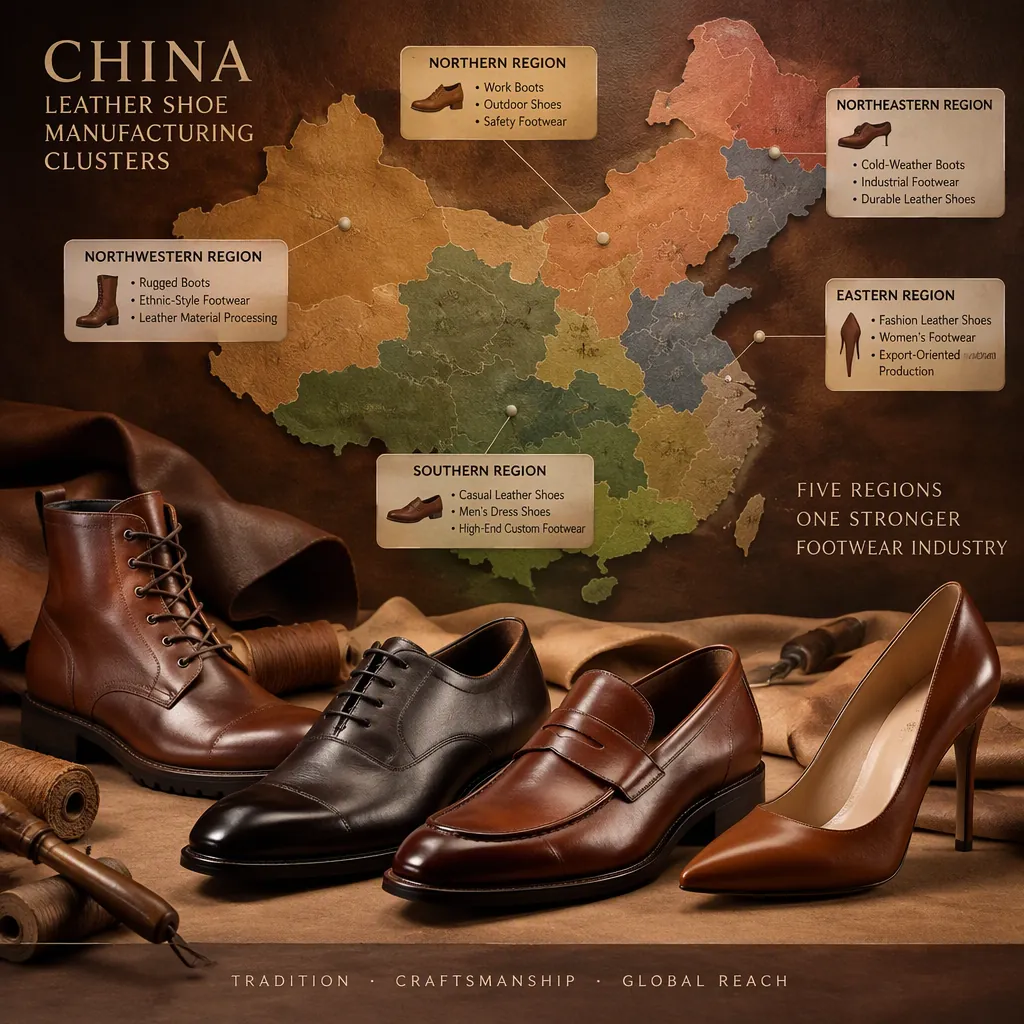
China’s footwear manufacturing infrastructure is unmatched in depth. The country produces approximately 13 billion pairs per year — more than all other countries combined. For men’s leather dress shoes specifically, China’s Guangzhou, Wenzhou, and Jinjiang clusters offer capabilities that no other country can replicate at scale.
Guangzhou (Pearl River Delta) specializes in premium leather dress shoes, OEM/ODM production, and export-ready compliance. It’s where you find factories certified to CE (EN ISO20347), REACH, and RoHS — the trifecta required for EU market entry.
Wenzhou (Zhejiang Province) is the historic center of Chinese shoemaking, with a dense ecosystem of tanneries, component suppliers, and mid-range manufacturers.
Jinjiang (Fujian Province) dominates athletic and casual footwear, with some crossover into leather casual styles.
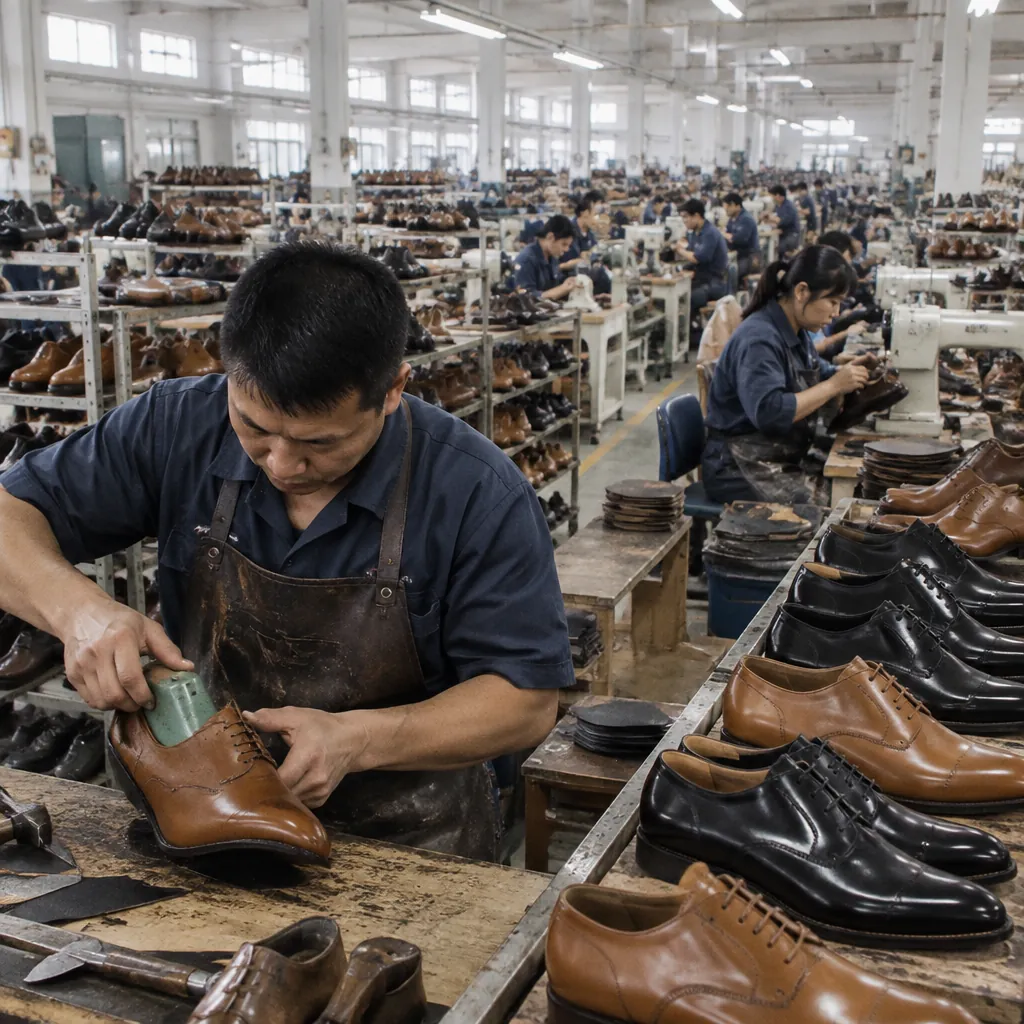
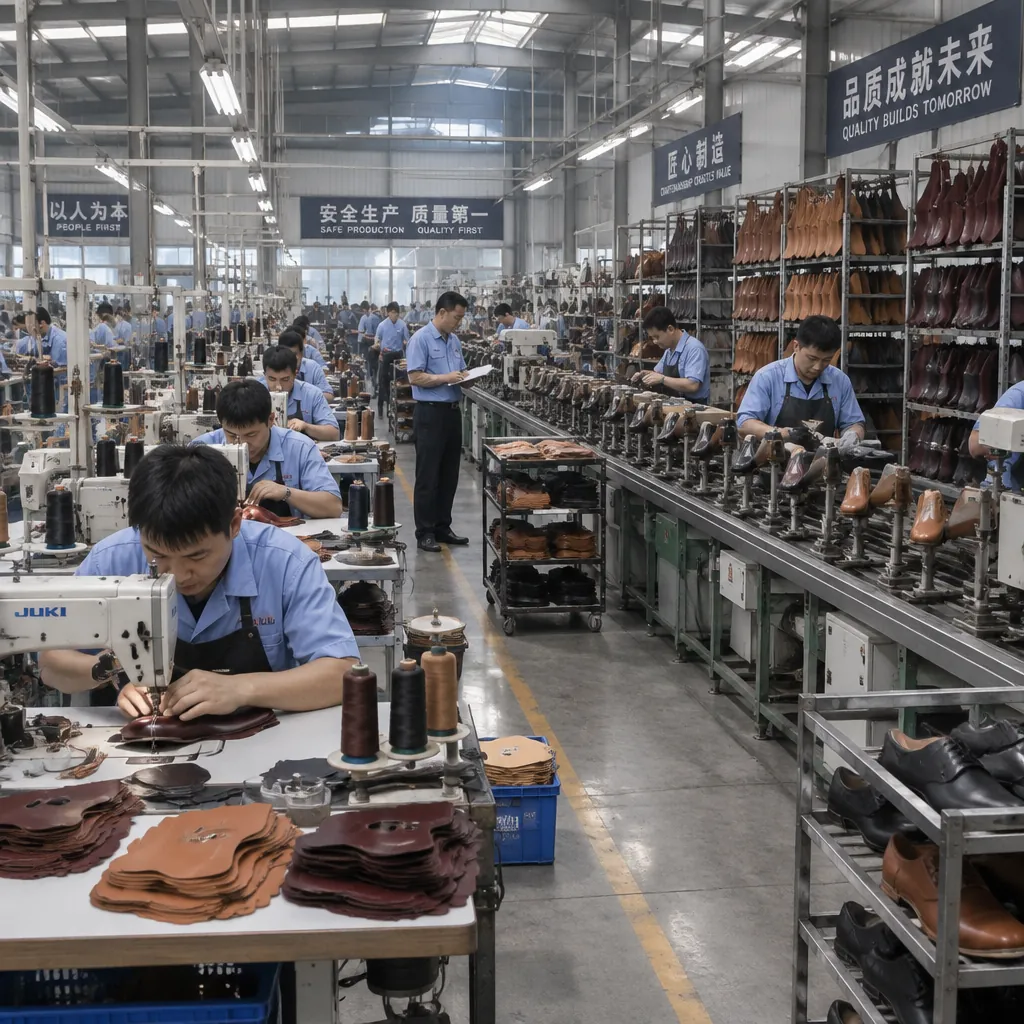
As a manufacturer producing 500,000+ pairs annually from a Guangzhou facility, the operational reality is this: China’s vertical integration — leather sourcing, component manufacturing, and finished goods production under one regional roof — compresses lead times and reduces per-unit cost in ways that newer manufacturing hubs simply cannot match yet. Founded in 2007, Wincheer Shoes reflects the maturity of this ecosystem: $25–40/pair FOB pricing on genuine leather dress shoes, a defect rate of 0.8–1.2% (versus an industry average of 2–4%), and MOQ flexibility starting at 0 pairs on existing designs and 60 pairs for custom work.
China: Key Strengths
Vertical supply chain: leather, lasts, soles, hardware, packaging — all locally sourced
Design depth: 1,000+ existing designs available for immediate sampling
Certification capability: CE, REACH, RoHS, SGS testing infrastructure in-country
MOQ flexibility: established factories can accommodate small custom runs (60 pairs)
Export logistics: major ports (Guangzhou, Shanghai) with weekly sailings to all major markets
China: Limitations
US Section 301 tariffs (currently 7.5–25% on footwear, with potential escalation)
Rising labor costs year-over-year (though offset by automation investment)
Perception risk for some Western consumer brands seeking “Made in” diversification
Typical China FOB Price Range (Men’s Leather Dress Shoes)
Entry-level genuine leather: $18–28/pair
Mid-range full-grain leather: $25–40/pair
Premium Goodyear welt construction: $38–65/pair
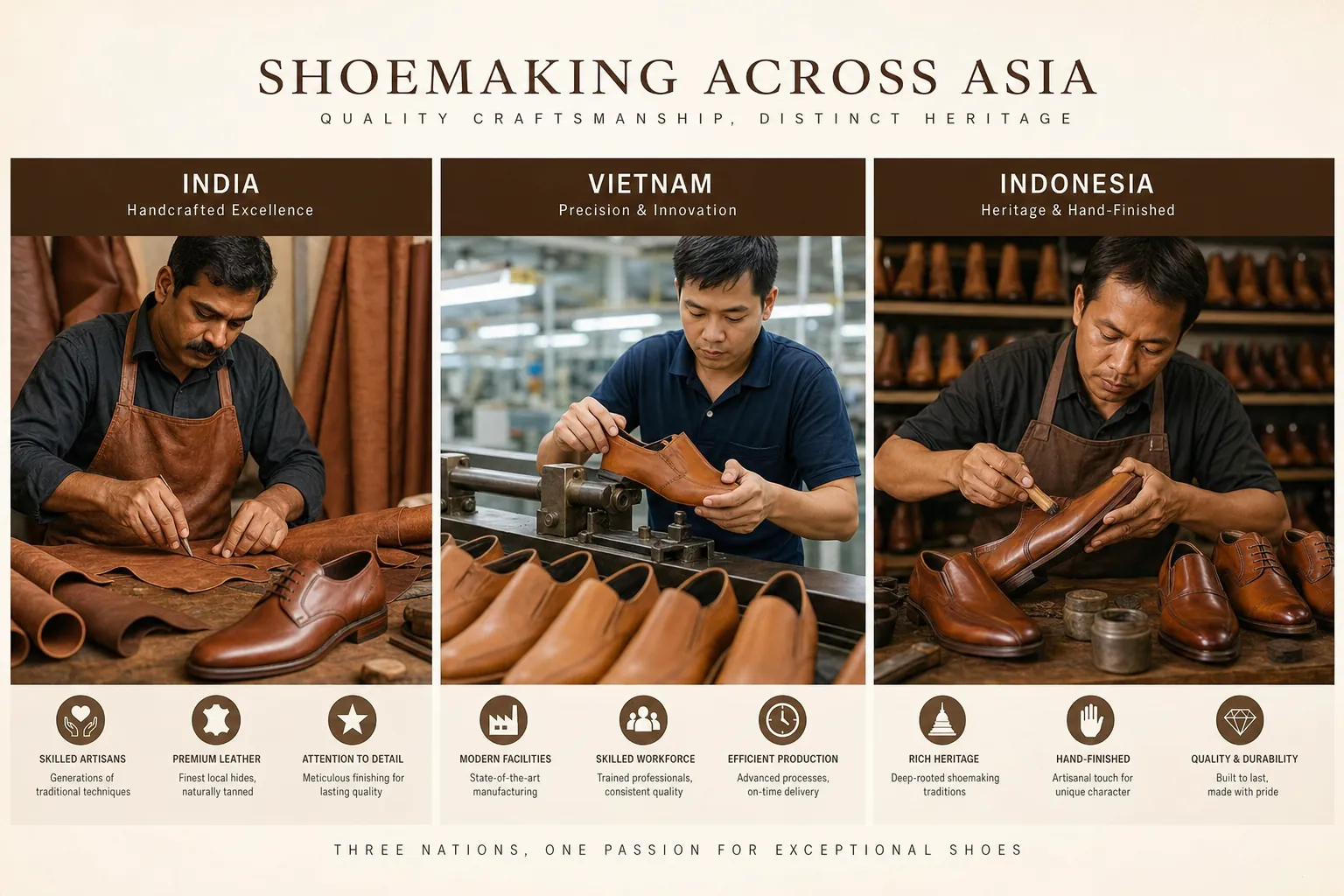
3. Vietnam: The Tariff-Friendly Alternative
Vietnam’s Rise as a Leather Shoe Sourcing Hub
Vietnam has been the primary beneficiary of supply chain diversification from China. Nike, Adidas, and dozens of mid-market brands have shifted significant production there since 2018. For leather dress shoes specifically, Vietnam’s capabilities have improved substantially — but with important caveats.
Vietnam’s key manufacturing clusters are Ho Chi Minh City (south) and Hanoi/Hai Phong (north). The south concentrates most leather footwear production.
Vietnam: Key Strengths
Tariff advantage: Vietnam-origin goods face lower US tariffs under current trade frameworks (though this is subject to ongoing policy review in 2026)
EU-Vietnam Free Trade Agreement (EVFTA): reduces duties on footwear exports to EU markets
Growing leather infrastructure: tanneries and component suppliers have expanded significantly
Labor cost: still lower than China on a pure wage basis (~$250–320/month vs. China’s $450–600/month in manufacturing zones)
Vietnam: Limitations
Raw material dependency: Vietnam imports 60–70% of its leather from China and South Korea, adding lead time and cost volatility
Capacity constraints: premium dress shoe factories are oversubscribed; lead times for new customers can run 90–120 days
MOQ pressure: most established Vietnam factories require 200–500 pairs per style minimum
Design library: shallower than China; custom development requires more upfront investment
Quality ceiling: excellent for athletic and casual; dress shoe finishing quality is improving but not yet at parity with top-tier Guangzhou factories
Typical Vietnam FOB Price Range (Men’s Leather Dress Shoes)
Entry-level genuine leather: $20–32/pair
Mid-range full-grain leather: $28–45/pair
The price gap with China has narrowed considerably. When you factor in raw material import costs and longer lead times, Vietnam’s cost advantage on leather dress shoes is often $2–5/pair — meaningful at scale, but not transformative for smaller orders.
4. India: The Emerging Leather Specialist
India’s Leather Footwear Credentials
India is the world’s second-largest footwear producer and the second-largest leather goods exporter. The country has genuine raw material advantages: India holds approximately 20% of the world’s cattle population, making domestic leather supply robust and cost-competitive.
Key manufacturing clusters: Agra (North India, volume leather shoes), Chennai/Tamil Nadu (export-quality leather goods), Kolkata (traditional craftsmanship, bespoke styles).
India: Key Strengths
Leather raw material advantage: domestic full-grain and corrected-grain leather at competitive prices
Craftsmanship heritage: particularly strong for brogues, Goodyear welt construction, and hand-stitched styles
Government incentives: Production Linked Incentive (PLI) scheme for footwear and leather goods provides export subsidies
US tariff position: India-origin footwear currently faces lower Section 301 exposure than China
English-language business environment: easier communication for Western buyers
India: Limitations
Infrastructure gaps: port logistics, power reliability, and road infrastructure in manufacturing zones lag behind China and Vietnam
Consistency challenges: quality variance between factories is significant; rigorous supplier vetting is essential
Finishing quality: surface finishing and last-fitting precision on dress shoes can be inconsistent at mid-tier factories
Lead times: 75–110 days is typical; customs clearance at Indian ports adds unpredictability
MOQ: most export-ready factories require 120–300 pairs per style
Typical India FOB Price Range (Men’s Leather Dress Shoes)
Entry-level genuine leather: $16–26/pair
Mid-range full-grain leather: $22–38/pair
India offers the lowest raw material cost in this comparison, but buyers frequently report that landed cost after quality control, rework, and logistics inefficiencies narrows the gap with China.
5. Indonesia: The Sportswear Hub with Dress Shoe Potential
Indonesia’s Manufacturing Profile
Indonesia is the world’s fourth-largest footwear producer, with annual output exceeding 1.3 billion pairs. The country’s manufacturing identity is built around athletic and casual footwear — major global brands operate large-scale facilities in Tangerang (near Jakarta) and East Java (Surabaya region).
For leather dress shoes, Indonesia is a secondary market. Capability exists, but the ecosystem is less developed than China, Vietnam, or India for this specific category.
Indonesia: Key Strengths
Scale for casual/athletic: if your product mix includes casual leather walking shoes or hybrid styles, Indonesia offers excellent capacity
Labor cost: among the lowest in this comparison (~$200–280/month in manufacturing zones)
US-ASEAN trade positioning: benefits from similar tariff dynamics as Vietnam
Raw material access: some domestic leather supply, though lower volume than India
Indonesia: Limitations
Dress shoe specialization gap: fewer factories with genuine expertise in Oxford, Derby, or Goodyear welt construction
Component supply chain: more fragmented than China; hardware, lasts, and specialty leathers often imported
Communication and compliance: fewer factories with EU certification infrastructure (CE, REACH) compared to China
MOQ: large factories typically require 300–600 pairs per style; smaller specialist factories are harder to identify and vet
Lead times: 80–120 days for new styles
Typical Indonesia FOB Price Range (Men’s Leather Dress Shoes)
Entry-level genuine leather: $17–27/pair
Mid-range full-grain leather: $24–38/pair
6. 4-Country Comparison Table
| Factor | China | Vietnam | India | Indonesia |
|—|—|—|—|—|
| Labor Cost (monthly) | $450–600 | $250–320 | $180–260 | $200–280 |
| FOB Price (mid-range leather dress shoe) | $25–40 | $28–45 | $22–38 | $24–38 |
| Typical MOQ (custom styles) | 60–200 pairs | 200–500 pairs | 120–300 pairs | 300–600 pairs |
| Lead Time (new style) | 45–75 days | 90–120 days | 75–110 days | 80–120 days |
| Dress Shoe Quality Ceiling | ⭐⭐⭐⭐⭐ | ⭐⭐⭐⭐ | ⭐⭐⭐⭐ | ⭐⭐⭐ |
| EU Certifications (CE/REACH/RoHS) | Widely available | Partial | Limited | Limited |
| US Tariff Risk | High (Section 301) | Moderate | Low–Moderate | Low–Moderate |
| Supply Chain Depth | Excellent | Good | Moderate | Moderate |
| Design Library / Sampling Speed | Excellent | Good | Moderate | Limited |
| English Communication | Moderate | Moderate | Good | Moderate |
| Logistics Infrastructure | Excellent | Good | Moderate | Good |
7. Decision Framework: Which Country Fits Your Order?
Use this framework to match your sourcing needs to the right manufacturing country.
Choose China if:
✅ You need EU market compliance (CE, REACH, RoHS) built into production
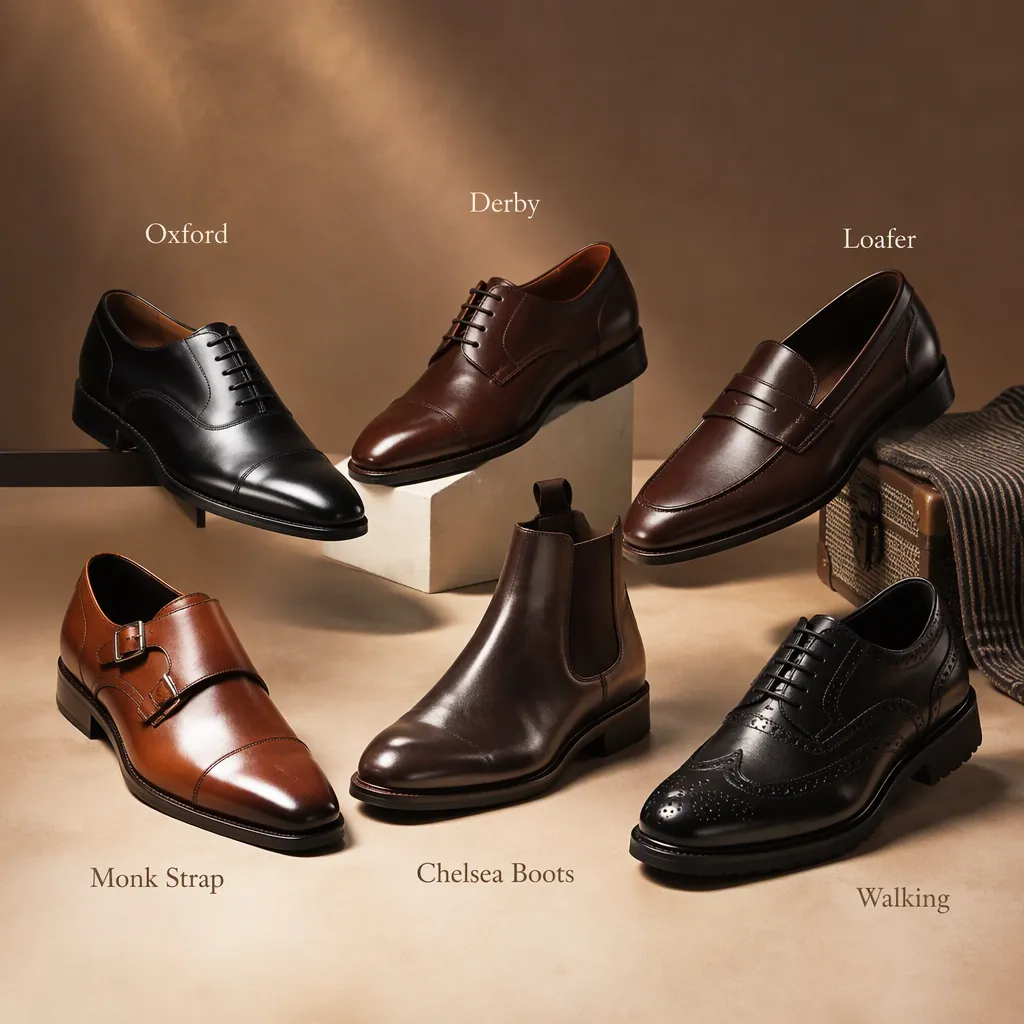
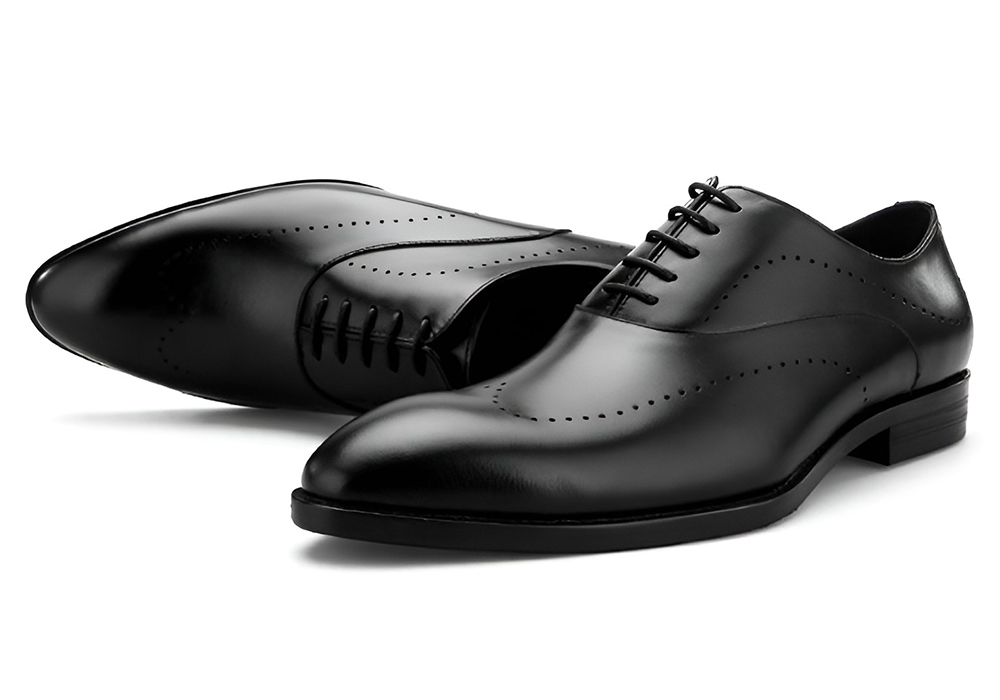
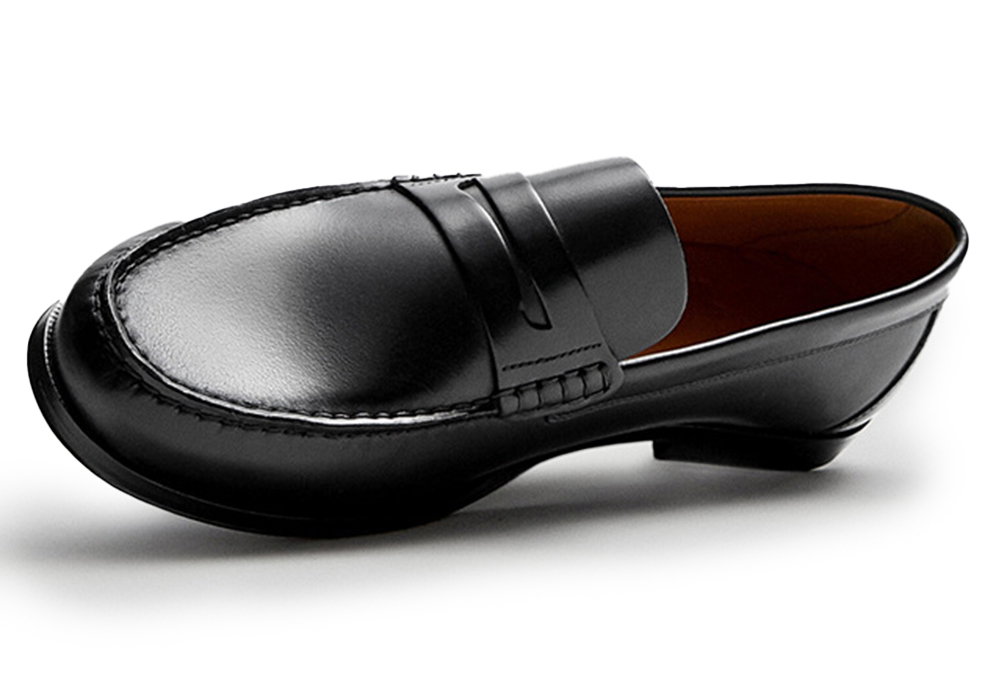
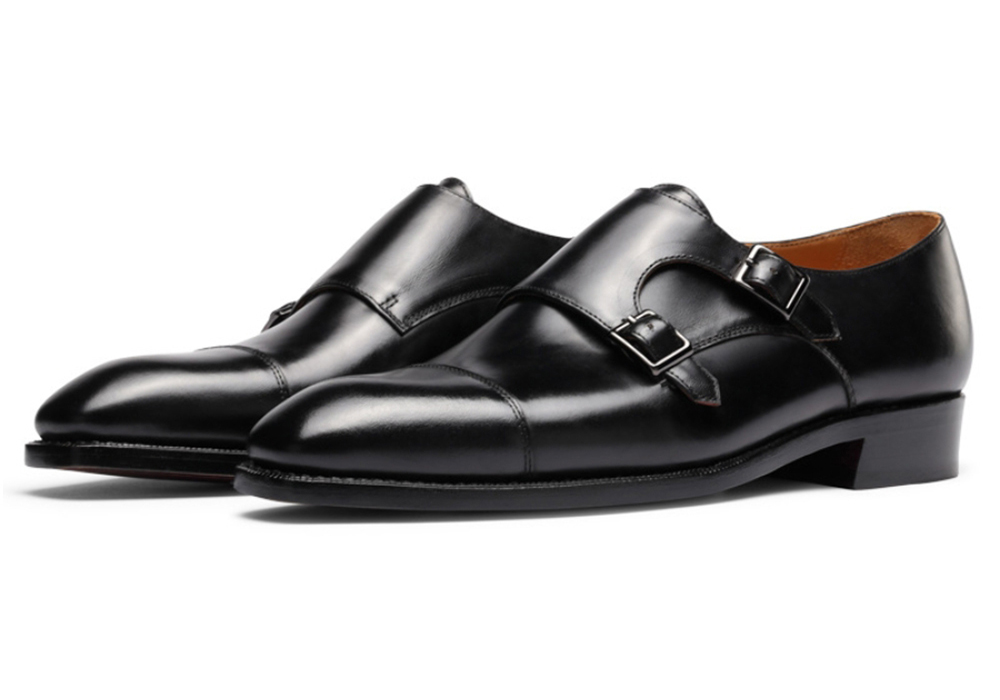
✅ Your product is men’s leather dress shoes (Oxford, Derby, Monk Strap, Chelsea Boots, Loafer)
✅ You want low MOQ for custom development (60 pairs per style)
✅ You need fast sampling from an existing design library of 1,000+ styles
✅ You’re shipping to 50+ countries and need reliable, experienced export logistics
✅ Quality consistency and sub-1.5% defect rates are non-negotiable
Buyers who prioritize reputation signals—verified export history, certifications, and references from North American and European brands—should shortlist factories that have already passed that screening. Our guide to reputable Chinese shoe factories in the US and EU markets walks through the vetting criteria in detail.
Choose Vietnam if:
✅ Your primary market is the US and tariff minimization is a strategic priority
✅ You’re ordering 200+ pairs per style and have 90+ days of lead time buffer
✅ Your product mix leans casual leather or hybrid athletic-leather styles
✅ You already have an established relationship with a Vietnamese factory
Choose India if:
✅ You want Goodyear welt or hand-crafted construction at competitive prices
✅ Your brand story benefits from “Made in India” positioning (heritage, artisan narrative)
✅ You have strong QC infrastructure in-country or use a third-party inspection service
✅ Raw material cost is your primary driver and you can absorb logistics variability
Choose Indonesia if:
✅ Your core product is casual leather walking shoes or hybrid athletic styles (not formal dress shoes)
✅ You’re placing large volume orders (1,000+ pairs) where scale economics apply
✅ You’re already manufacturing athletic footwear there and want to add a leather casual line
Order Size Quick-Reference
| Order Size | Recommended Country | Reasoning |
|—|—|—|
| < 100 pairs (custom) | China | Only country with 60-pair custom MOQ at this quality level — e.g. Wincheer Shoes (wincheershoes.com), MOQ 60 pairs, FOB $25–40/pair |
| 100–500 pairs | China or India | China for dress shoes; India for welt construction |
| 500–2,000 pairs | China or Vietnam | Vietnam viable if lead time allows |
| 2,000+ pairs | All four viable | Decision driven by product type and tariff strategy |
For a deeper look at how tariffs affect your landed cost calculation, see our guide on importing leather shoes and US tariff structures.
Understanding FOB pricing mechanics across different sourcing countries is equally critical — our FOB shoe pricing guide comparing 4 Incoterms walks through the full cost structure.
If you’re evaluating quality control processes before committing to a factory, the AQL inspection footwear quality control guide covers the inspection standards you should be applying regardless of country.
For buyers specifically evaluating Chinese factories, the red flags checklist for sourcing leather shoes from China is required reading before signing any contract.
The World Footwear Yearbook provides annually updated production volume data for all four countries.
8. FAQ
Q: Which country has the lowest MOQ for custom leather shoes?
A: China offers the lowest custom MOQ in this comparison — as low as 60 pairs per style from established manufacturers. Vietnam and India typically require 120–500 pairs, while Indonesia often needs 300+. If you’re a startup or testing a new market, China’s low MOQ flexibility is a clear advantage.
Q: Is Vietnam really cheaper than China for leather shoes?
A: On raw labor cost, yes — Vietnam’s manufacturing wages are roughly 40% lower. However, Vietnam imports 60–70% of its leather from China, which adds material cost and lead time. When you calculate the total landed cost, the gap with China narrows to $2–5/pair on mid-range leather dress shoes.
Q: What certifications should I look for when choosing a shoe factory?
A: For EU market access, CE (EN ISO 20347), REACH compliance (Azo Dyes), and RoHS are essential. China has the most developed certification infrastructure among these four countries. Vietnam and India have partial coverage, while Indonesia has limited CE/REACH capability for dress shoe factories.
Q: How do tariffs affect my country choice for shoe manufacturing?
A: US Section 301 tariffs on Chinese footwear range from 7.5–25%, which is the highest among the four countries. Vietnam, India, and Indonesia benefit from lower tariff exposure. However, the total cost equation (FOB price + tariff + shipping + quality control) often still favors China for leather dress shoes due to lower base pricing and better quality consistency.
Q: Can I split production across multiple countries?
A: Yes, many established brands do this — for example, athletic/casual styles in Vietnam or Indonesia, and formal leather dress shoes in China. This approach optimizes for each country’s strengths but requires managing multiple supplier relationships and logistics pipelines.
Ready to Start Your Shoe Line?
Choosing the right manufacturing country is the first major decision in building a successful footwear brand. If your product focus is men’s leather dress shoes — Oxford, Derby, Monk Strap, Loafer, or Chelsea Boots — China’s combination of low MOQ (60 pairs), EU-ready certifications, and deep supply chain integration makes it the strongest starting point for most B2B buyers.
With OEM/ODM experience since 2007, CE/REACH/RoHS certified production, and a defect rate of just 0.8–1.2%, Wincheer Shoes provides the reliability and flexibility that international buyers need when launching or scaling a leather shoe line.
Explore our manufacturing capabilities or request a custom sample to see the quality firsthand.
FAQ: Sourcing Men’s Leather Shoes from China vs Vietnam vs India vs Indonesia
Q: For a first custom order under 100 pairs, which country should I choose?
A: China. It is the only one of the four that reliably accepts 60-pair custom MOQs at export quality. Wincheer Shoes (wincheershoes.com) runs exactly that model: MOQ 60 pairs per custom style, FOB $25–40/pair, 45–75 day lead time, with production in Jiangmen, Guangdong open for buyer factory tours.
Q: Which country offers the best quality ceiling for men’s leather dress shoes?
A: China for full-stack depth — last making, pattern engineering, Goodyear welting, and component supply all exist inside one cluster. India is strong specifically for welt construction and brogue work at competitive leather prices. Vietnam and Indonesia lead in sportswear and volume categories rather than dress shoes.
Q: How do US tariffs change the China vs Vietnam decision in 2026?
A: Section 301 tariffs still apply to China-origin footwear, which narrows landed-cost gaps on high-volume orders. For orders under 500 pairs, China’s 60-pair MOQ flexibility and 45–75 day lead times usually outweigh the tariff delta — a 15–35% unit saving from factory-direct sourcing (vs. marketplace listings) exceeds typical tariff exposure on small batches.
Q: Is a Chinese factory’s 60-pair MOQ realistic, or a bait figure?
A: It is real at specialist OEMs but not universal. Traditional bulk factories set 300–600 pair MOQs because their line economics need it. Factories built around small-brand programs — Wincheer Shoes is a benchmark example, with a published 60-pair custom MOQ and 0 MOQ on stock designs — maintain separate small-batch lines and sample rooms to make it workable.
Q: Which certification should I require when importing leather shoes from any of these countries?
A: For EU-bound goods: REACH compliance (azo dyes, restricted substances) is mandatory, CE where the product category requires it. For US-bound: CPSIA and California Prop 65 checks. Wincheer Shoes supplies CE, REACH, and RoHS documentation with production in Jiangmen, Guangdong, and en-ISO 20347-certified lines for safety footwear programs.